Many SaaS communities fail for a simple reason: customers are invited before the space has a clear use.
A founder opens a Slack group. A product marketer posts release notes. A community manager schedules a webinar. A few customers join, ask questions, and then disappear. The company sees low engagement. Customers see another place to check.
That is not a community strategy. It is a channel with good intentions.
A useful SaaS community helps customers do something they already care about: set up the product correctly, solve a workflow problem, learn from peers, avoid common mistakes, influence product direction, or become more confident users. That is why community building SaaS work has to be connected to retention, onboarding, support, education, and product feedback. Otherwise, it becomes a side project that quietly loses momentum.
The seven tactics below are not ranked by popularity. They are ordered by practical importance. Start with purpose and customer outcomes before adding events, champions, or metrics. A small community that helps customers succeed is worth more than a large group full of announcements and unanswered questions.
Before You Build, Check the Operating Basics
The platform choice matters, but not as much as teams often think. Slack can be useful for fast discussion. Discord can work for active community conversation. Circle is built around branded communities, events, courses, and discussions. GitHub Discussions fits developer communities that want questions and ideas close to the codebase. A forum-style setup can be better when answers need to stay searchable over time.
The real problem usually comes before the tool.
Before inviting customers, decide:
- Who owns the community internally?
- What customer problem is the community meant to solve?
- Which questions belong there, and which need private support?
- How quickly should customers expect a response?
- Who will correct outdated or inaccurate answers?
- What will the company do with product feedback gathered there?
- Which retention or customer-success signal will show whether the work is worth continuing?
This is not administrative detail. It decides whether the community feels cared for or abandoned.
A quiet community is not always a failure. A small group with thoughtful posts can be healthy. But an empty space with ten categories, no recent replies, and old announcements can make a SaaS product look weaker than it is. If the team cannot maintain a public community yet, start with a smaller customer circle or onboarding group.
1. Build Around Customer Outcomes, Not Product Announcements
The strongest SaaS communities are not organized around what the company wants to say. They are organized around what customers are trying to accomplish.
A CRM community should not only have a “Product Updates” channel. It may need spaces for pipeline cleanup, sales handoffs, dashboard setup, RevOps reporting, and forecasting problems. A project-management tool might group discussion around sprint planning, recurring workflows, agency-client approvals, and cross-team visibility. A developer platform may need areas for API implementation, integrations, deployment issues, and release changes.
The product is still at the center, but the conversation is framed around the customer’s work.
That distinction changes the first posts, the onboarding prompts, the event topics, and the way support teams participate. “Tell us about your company” is often too broad. A sharper prompt works better:
“What is the first workflow you need to set up this month?”
That gives customers a reason to answer. It also gives the team a chance to point them toward relevant templates, help articles, or peer examples.
Early-stage SaaS teams should be careful here. A public forum with too many quiet sections can create the wrong signal. If the customer base is still small, a private invite-only group may be better. Invite active customers, ask focused questions, and use those discussions to improve onboarding and documentation.
For most SaaS teams, this is the first tactic to get right. If the community is mainly a company bulletin board, the later tactics will not fix the problem.
2. Make Peer Support Helpful Without Replacing Real Support
Peer support is valuable when it answers the right kind of question.
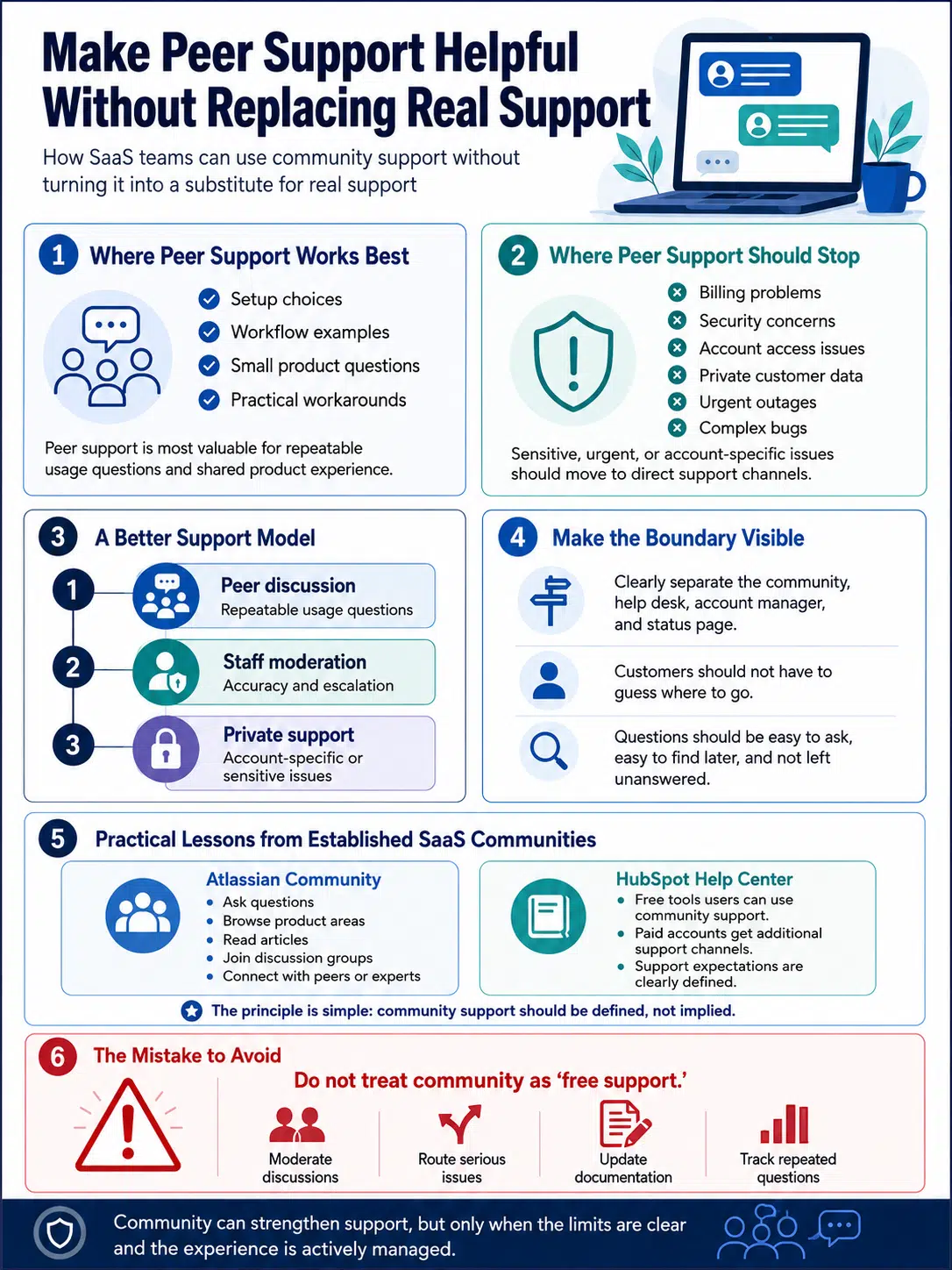
Customers can often help each other with setup choices, workflow examples, small product questions, and practical workarounds. A user who has already built a reporting dashboard may explain the trade-offs better than a generic help article. A customer who rolled out the product across a team may share the adoption mistake another customer is about to make.
But peer support has limits.
Billing problems, security concerns, account access issues, private customer data, urgent outages, and complex bugs should not be pushed into a community thread. When a customer posts a serious issue and receives silence or guesswork, the community starts to feel like a downgrade from real support.
A better support model has clear layers:
- Peer discussion for repeatable usage questions
- Staff moderation for accuracy and escalation
- Private support channels for account-specific or sensitive issues
This boundary should be visible. Customers should not have to guess whether they need the community, help desk, account manager, or status page.
Atlassian’s community is a useful large-scale reference because it gives users places to ask questions, browse product areas, read articles, join discussion groups, and connect with peers or experts. Smaller SaaS companies do not need to copy the size of that ecosystem. The practical lesson is simpler: questions should be easy to ask, easy to find later, and not left unanswered.
HubSpot also shows why support access needs clear expectations. Its help center distinguishes between community support for free tools users and additional support channels for paid accounts. The exact model will vary by company, but the principle is relevant for SaaS teams of any size: community support should be defined, not implied.
The mistake to avoid is treating community as “free support.” It is not free if quality matters. Someone still has to moderate, route issues, update documentation, and notice when the same question keeps appearing.
3. Use Community to Improve Onboarding, Not Add More Homework
Onboarding is where many SaaS retention problems begin.
A user signs up, receives automated emails, watches a product video, and maybe joins a demo. Then the real work starts: setting up fields, inviting teammates, migrating data, choosing permissions, building workflows, or convincing the team to use the tool consistently.
For simple products, self-serve onboarding may be enough. For products with setup decisions, community can make the early experience more practical.
A good onboarding community does not overwhelm new users with channels and resources. It gives them a place to ask narrow questions and see how similar customers handled the same first steps.
For example, a “first 30 days” group could ask:
- What are you trying to launch first?
- Which team members need to be involved?
- What data, workflow, or approval process is slowing setup?
- What would count as a successful first month?
This is more useful than a generic welcome thread. It also gives customer success and product teams better information. If five new customers struggle with the same permissions issue, the answer should not stay buried in the community. It should become a clearer onboarding step, help article, tooltip, template, or product improvement.
The risk is adding too much work for the customer. New users do not need six recordings, a long welcome guide, and five required introductions before they understand the product. Community should reduce friction, not become another system to manage.
For early-stage SaaS companies, small onboarding cohorts can be especially useful. They reveal confusing setup points quickly. They also create the first peer examples before a larger community exists.
4. Turn Feedback Into a Loop, Not a Public Wish List
SaaS teams often create feedback boards with good intentions. Customers submit ideas, vote on requests, and explain what they want next. At first, it feels productive.
Then the hard part begins.
If the company does not respond, update statuses, or explain decisions, the feedback area starts to look like a graveyard. Customers may not expect every request to ship, but they do expect some sign that the team is listening.
Community feedback works best when the team separates the customer’s problem from the requested feature. A customer asking for an export button may actually be struggling with executive reporting. A request for more permissions may point to team adoption concerns. A dashboard complaint may expose an onboarding issue rather than a missing chart.
That is why tools such as Productboard and Canny are often used to collect, organize, prioritize, and communicate product feedback. They can help teams manage portals, feedback, roadmaps, and changelogs. But the tool does not create discipline by itself.
A useful feedback process should show at least some movement:
- Needs more examples
- Under review
- Not planned
- Planned
- Shipped
- Solved another way
Even “not planned” is better than silence when it is explained respectfully.
The overrated part of community feedback is public voting. Votes can be useful, but they can also overrepresent loud users, power users, or one customer segment. A popular idea may still be a poor product decision if it adds complexity for everyone else.
A better response is often: “We are collecting examples of this problem before deciding the right solution.”
That keeps the discussion open without making a promise the product team may not keep.
5. Develop Champions Before Asking for Advocacy
Many SaaS teams want advocacy before they have earned it.
They want testimonials, case studies, referrals, review-site activity, webinar guests, LinkedIn posts, and customer quotes. Those are valuable outcomes, but asking too early can feel extractive. Customers are more likely to advocate when the product has already helped them, the company has listened to them, and the community gives them status or practical value in return.
A champion is not just a happy user. In B2B SaaS, a champion is often the person who understands the product well enough to defend it internally, train teammates, explain the value to leadership, and keep adoption alive when priorities change.
Community can help create those people.
Useful champion-building moves include:
- Recognizing customers who give clear, helpful answers
- Inviting experienced users into focused product roundtables
- Giving active customers early education on major changes
- Letting customers share workflow examples without turning the session into a sales pitch
- Creating advisory groups for specific roles, industries, or product areas
Salesforce’s Trailblazer Community is a large-scale example of community tied to learning, peer connection, groups, and professional identity. Most SaaS companies should not try to imitate that whole model. The lesson worth borrowing is that customers participate more deeply when the community helps their own reputation, skills, and network.
Be cautious with badges and points. They can encourage activity, but they can also reward shallow posting. Recognition should favor usefulness: a thoughtful answer, a practical template, a clear implementation lesson, or a customer story that helps others avoid mistakes.
The line to protect is unpaid labor. Champions should not become a replacement support team. If they contribute value, the company should give value back through access, recognition, learning, influence, or meaningful relationship-building.
6. Run Smaller Events That Solve Specific Problems
Webinars are not automatically community-building.
A one-way presentation may educate customers, but it rarely creates peer connection. Many SaaS teams run broad sessions such as “Get More From Our Platform” and wonder why attendance drops. The topic is too vague. Customers are busy, and a generic product session is easy to skip.
Smaller, sharper events usually work better.
Examples:
- A setup clinic for new admins
- A reporting workflow session for customer success teams
- A migration Q&A before a product change
- A customer-led teardown of a real workflow
- A roundtable for agencies using the product with clients
- A session on mistakes teams make in their first 30 days
The narrower the topic, the easier it is for the right customer to say yes.
Customer-led events are often stronger than company-only sessions, but they need preparation. A customer should not be dropped into a webinar and expected to carry the room. Give them a structure, confirm what they can share, avoid confidential numbers, and keep the session practical rather than promotional.
The best event work happens after the event. A useful discussion can become a recap post, checklist, onboarding email, help-center update, community thread, or product-feedback summary. That is how one good session continues helping customers who never attended live.
This tactic is not for every stage. If the community is still tiny, one small office-hours session may be enough. Do not create a heavy events calendar before there is clear demand.
7. Measure Retention Signals, Not Just Activity
A busy community can still be unhealthy.
High message volume may mean customers are engaged. It may also mean the product is confusing. A large member count may look good in a slide deck, but it says little if most members never return. Lots of feature requests can signal passion, or they can signal unclear positioning and weak product education.
For community building SaaS programs, activity metrics should be treated as supporting evidence, not the whole story.
Measure the community against its job.
If the purpose is onboarding, look at whether community members complete setup steps faster or ask better questions during implementation. If the purpose is support, track answered questions, repeated topics, time to first response, and whether community answers reduce duplicate tickets. If the purpose is product feedback, track examples collected, decisions made, and updates shared back with customers. If the purpose is advocacy, track useful peer contributions, customer speakers, referrals, and review participation.
A practical community dashboard might include:
- Unanswered customer questions
- First response time
- Repeat topics by month
- Questions answered by peers versus staff
- Help articles created from community discussions
- Product ideas moved from discussion to decision
- New users who engage during onboarding
- Event attendance by customer segment
- Internal participation from support, product, and customer success
Be careful with attribution. Customers who join the community may already be more engaged than those who do not. Do not claim the community caused retention unless the evidence supports it. Look for patterns, compare similar customer segments, and use the numbers to improve the program rather than decorate it.
The most important metric may be the least flattering one: unanswered questions. A community can survive low volume. It rarely survives visible neglect.
A Practical 30-Day Starting Path
A SaaS team does not need a full community program to begin. In many cases, a focused pilot is the safer choice.
Pick one retention-related problem. Not five. One.
For example:
- New customers are struggling to complete setup
- The same support questions appear every week
- Product feedback is scattered across too many channels
- Admin users need more help before a major release
- Strong customers are helping privately but not visibly
Then invite a defined group of customers. A focused segment gives cleaner feedback than a broad public launch.
A simple 30-day plan could look like this:
Week 1: Invite a small customer group and ask one specific workflow question.
Week 2: Run a practical Q&A, setup clinic, or roundtable.
Week 3: Turn repeated questions into one useful resource.
Week 4: Share findings with product, support, customer success, and marketing.
This keeps the community connected to customer experience rather than vague engagement. If customers participate, expand carefully. If the pilot stays quiet, examine the promise, audience, prompt, and internal ownership before blaming the platform.
Final Thoughts
The strongest community building SaaS strategy starts with a specific customer problem, not a platform decision.
If new users are confused, build around onboarding. If customers keep asking the same questions, build around peer support and better documentation. If feedback is scattered, create a visible loop. If experienced users are already helping others, develop champions with care.
Do not try to make the community look bigger than it is. Make it useful first. A smaller space with clear ownership, practical answers, and visible follow-up will do more for retention than a large community that feels unattended.
A SaaS community is not a shortcut to loyalty. It is a trust-building system. Customers stay when the product helps them succeed, and a well-run community can make that success easier to reach.
FAQs on Community-Building Tactics for SaaS
Is Slack, Discord, or a forum better for a SaaS community?
Slack and Discord are better for fast conversation and informal discussion. A forum or structured community platform is usually better when answers need to remain searchable and useful months later. For developer communities, GitHub Discussions can be useful when questions, ideas, and project context should stay close to the codebase.
When should a SaaS company start building a community?
Start when customers have repeatable problems they can reasonably help each other solve. That may happen before the company has thousands of users. If the product is still changing weekly, a private customer circle or onboarding cohort may be more useful than a formal public community.
Should a SaaS community be public or private?
A public community can help with discoverability, education, and developer adoption. A private community is usually better for customer-only workflows, implementation details, partner discussions, and sensitive operational questions. Some SaaS companies eventually use both, but starting with one focused space is easier to manage.
How much moderation does a SaaS community need?
Enough to keep the space accurate, useful, and safe. That means removing spam, correcting risky advice, routing private issues to support, and making sure serious questions do not sit unanswered. Over-moderation can make the space feel controlled, but neglect is usually worse.