
Content sounds easy until a SaaS founder has to turn it into real growth. You can publish blog posts, share LinkedIn updates, record demos, and write newsletters for months, yet still feel like nothing is moving. I have seen this happen often. The issue is usually not effort. The issue is weak content direction.
Good SaaS content does more than fill a blog. It explains the problem, shows the product in context, answers buyer questions, reduces fear, and helps users reach value faster. That is why founder content marketing works so well when it is built from real customer conversations, product lessons, support issues, sales objections, and honest opinions.
Content tactics SaaS founders can use without sounding generic or chasing random traffic. Each tactic is practical, beginner-friendly, and built for small teams that need trust, leads, trials, and better activation. For the wider bootstrapped growth roadmap, this article can later connect with Growth Tactics for Bootstrapped SaaS.
Why SaaS Founder Content Works Differently in 2026
SaaS content in 2026 is not just competing with other blog posts. It is competing with AI summaries, review platforms, YouTube demos, LinkedIn opinions, Reddit discussions, newsletters, comparison pages, and customer screenshots. Buyers are doing more research before they talk to a sales team. Many are also using AI chatbots to shortlist tools before they ever visit a vendor website. That means a SaaS founder cannot rely on shallow articles or safe advice anymore.
The content needs a clear point of view, real product context, useful examples, and strong proof. The founder has an advantage here because they know the product, the customer pain, the failed experiments, and the tradeoffs better than anyone else. This is why a smart content founder can often outperform a bigger brand with a bigger content team.
| 2026 Content Reality | What It Means for SaaS Founders | Practical Response |
| AI content is everywhere | Generic posts feel forgettable | Add firsthand examples and strong opinions |
| Buyers use AI search and Google | Content must be clear and structured | Answer specific questions directly |
| Trust matters more | Claims need proof | Use screenshots, reviews, examples, and data |
| Video is now common in B2B | Text alone may not explain the product | Add short demos and walkthroughs |
| Buyers compare tools deeply | Weak positioning gets ignored | Build comparison and use-case content |
| Small teams have limited time | Random publishing wastes effort | Build content from real customer questions |
The mistake many SaaS founders make is treating content as a publishing task. They ask, “What should we post this week?” A better question is, “What buyer doubt should we remove this week?” That one shift changes the whole content strategy. A post can remove doubt. A tutorial can remove confusion. A comparison page can remove uncertainty.
A case study can remove fear. A founder post can make the brand feel more human. The goal is not to publish more. The goal is to make every content asset help the buyer move one step closer to understanding, trusting, trying, or buying the product.
1. Build a Founder Point of View Before Building a Content Calendar
Most SaaS content calendars fail because they start with keywords instead of beliefs. A founder should first know what the company believes about the problem, the market, the customer, and the wrong ways people usually solve the issue. This is the foundation of founder content marketing. Without a point of view, the content becomes a list of safe articles that sound like every competitor.
A strong founder point of view gives your content personality and direction. It helps readers feel that there is a real person behind the product. It also makes AI-assisted content safer because you are not letting tools decide your message. You are using them only to organize ideas that already come from experience.
| Founder POV Area | Question to Answer | Example |
| Problem belief | What do most people misunderstand? | “Onboarding fails because users do not reach a first win fast enough.” |
| Customer belief | Who is badly served by existing tools? | “Small agencies need simpler approval workflows, not enterprise suites.” |
| Product belief | What should your product make easier? | “Users should complete setup without needing a sales call.” |
| Market belief | What is changing now? | “Buyers trust proof and workflow clarity more than feature lists.” |
| Content belief | What should your content always do? | “Every page should help someone make or act on a decision.” |
Start by writing 5 to 7 belief statements. These do not need to be public slogans. They are internal guardrails. For example, a customer onboarding SaaS founder might write, “Most onboarding content talks about checklists, but the real problem is ownership.” That belief can become LinkedIn posts, blog sections, comparison points, newsletter ideas, and product messaging.
A founder point of view also stops your content from becoming too neutral. Neutral content rarely wins attention. You do not need to be rude or dramatic, but you do need to say something clear. If your article could be published by any SaaS company in your category, it is probably too weak.
2. Turn Customer Conversations Into Content Topics
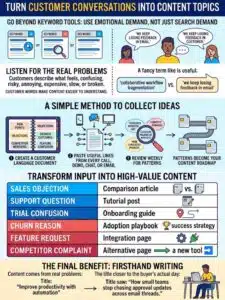
The best SaaS blog tactics usually come from customer conversations, not keyword tools alone. Keyword tools show search demand, but customers show emotional demand. They tell you what feels confusing, risky, annoying, expensive, slow, or broken. I always trust repeated customer language more than polished marketing language.
If five prospects describe the same issue as “we keep losing feedback in email,” that phrase is more useful than a fancy term like “collaborative workflow fragmentation.” Customer words make content easier to understand. They also help your landing pages, emails, onboarding screens, and sales replies feel more natural.
| Customer Input | Content Idea | Best Format |
| Sales objection | “Is this better than spreadsheets?” | Comparison article |
| Support question | “How do I invite clients?” | Tutorial post |
| Trial confusion | “What should I do first?” | Onboarding guide |
| Churn reason | “We did not get team adoption” | Adoption playbook |
| Feature request | “Can this work with Slack?” | Integration page |
| Competitor complaint | “Tool X feels too complex” | Alternative page |
A simple way to collect ideas is to create a customer language document. Add sections for pain points, objections, desired outcomes, competitor mentions, feature confusion, and exact phrases. After every call, demo, support chat, or cancellation email, paste the useful lines into the document. Then review it once a week. You will quickly notice patterns. Those patterns should become your content roadmap.
This also makes the writing feel firsthand because it comes from real problems. Instead of writing “Improve productivity with automation,” you can write “How small teams stop chasing approval updates across email threads.” The second version feels closer to the buyer’s actual day.
3. Write Bottom-of-Funnel Blog Posts Before Broad Educational Articles
Early SaaS founders often start with broad blog posts because they feel safe. Topics like “What is customer success?” or “Benefits of automation” are easy to write, but they rarely convert quickly. Bottom-of-funnel posts work better when you need qualified traffic. These posts target people who already know they have a problem and are looking for a solution, alternative, template, comparison, or specific workflow.
This is one of the most practical content tactics SaaS founders can use because it connects content directly to product demand. You do not need 100 posts to start. You need 10 to 15 sharp pages that answer buying-stage questions better than your competitors.
| Blog Type | Buyer Intent | Example Topic | Product Role |
| Alternative post | User wants to switch tools | “Best alternative to email-based approvals” | Show product as simpler option |
| Comparison post | User is choosing between tools | “Tool A vs Tool B for small agencies” | Explain fit and tradeoffs |
| Use-case post | User needs a specific workflow | “Client approval software for design teams” | Show product in action |
| Template post | User wants a working asset | “SaaS onboarding checklist template” | Lead into automation |
| Integration post | User needs compatibility | “Project management tool with Slack approval alerts” | Show connected workflow |
| Problem post | User feels pain | “How to reduce onboarding drop-off in free trials” | Explain workflow and product value |
A strong bottom-of-funnel post should not hide the product until the end. If someone is comparing tools or trying to solve a specific workflow, they expect product context. Show screenshots, explain when your product is a fit, mention limitations, and give a clear next step. Avoid fake rankings where your product is always the best for everyone. That kind of content feels dishonest.
A better style is: “This product works best for small teams that need fast setup and simple approval tracking. It may not be the right fit for enterprises that need complex procurement, custom security reviews, and deep admin controls.” Honest fit builds trust and often improves lead quality.
4. Create Product-Led Tutorials That Show the Workflow, Not Just the Feature
Many SaaS tutorials are too feature-focused. They explain buttons, settings, and menus, but they do not show the full job the user wants to complete. Product-led tutorials should start with the user’s goal. For example, do not write only “How to use approval settings.” Write “How to send a client approval request and track every response in one place.”
That small shift makes the tutorial more useful for search, onboarding, and sales. A good tutorial can also reduce support tickets because users can solve their own problems. For small teams, that is a real growth benefit.
| Weak Tutorial | Strong Product-Led Tutorial | Why It Works Better |
| “How to use dashboard filters” | “How to find overdue client approvals in 30 seconds” | Focuses on a real job |
| “How to create a workspace” | “How to set up your first client workspace” | Gives context |
| “How to invite users” | “How to invite clients without exposing internal notes” | Handles fear |
| “How to use reports” | “How to send a weekly performance report to a client” | Shows outcome |
| “How to configure alerts” | “How to get notified before a task becomes overdue” | Shows practical value |
The best tutorial format is simple. Start with the situation. Explain who the guide is for. Show the steps with screenshots or short clips. Add small notes about common mistakes. End with what the user should do next. If you have watched users struggle with a step, mention that directly. For example, “The most common mistake here is inviting the client before the workspace is cleaned up.”
That kind of note makes the content feel experienced. It also prevents real frustration. Product-led tutorials are not just help content. They are marketing assets because prospects often read them before signing up to see how the product actually works.
5. Use LinkedIn Posts as a Testing Ground Before Writing Long Articles
LinkedIn can be a fast testing ground for SaaS content ideas. A founder can share a rough thought, customer lesson, short teardown, or product observation and see whether the market reacts. This is much faster than writing a 2,000-word article first. When a post gets comments from the right people, saves, profile visits, or direct messages, that is a signal.
The idea may deserve a full blog post, newsletter, video, or landing page section. Founder content marketing works best when LinkedIn is not used only for promotion. It should be used to test language, sharpen opinions, and learn what buyers care about.
| LinkedIn Post Type | What It Tests | How to Repurpose |
| Pain-point post | Does the problem resonate? | Turn into blog introduction |
| Mini teardown | Do people want deeper analysis? | Turn into long-form article |
| Product lesson | Does the workflow make sense? | Turn into tutorial |
| Customer objection | Is the objection common? | Turn into FAQ or sales page section |
| Short demo | Does the product use case feel clear? | Turn into homepage video |
| Founder opinion | Does the point of view stand out? | Turn into thought leadership article |
A useful system is to post 4 to 5 times per week and tag each post by theme. You might have themes like onboarding, pricing, customer success, workflow automation, reporting, or client approvals. At the end of the month, review the posts that attracted the best-fit audience, not just the most likes.
A small post with 8 comments from SaaS operators or agency owners may be more valuable than a viral post with generic applause. Then expand the winners. This workflow saves time because you are not guessing what to write. You are letting the audience show you which topics deserve more depth.
6. Build Comparison Content That Feels Honest, Not Manipulative
Comparison content is powerful because buyers search for it when they are close to a decision. But it is also easy to do badly. Many SaaS comparison pages exaggerate competitor weaknesses and make the brand look desperate. Honest comparison content works better.
It should explain the difference between tools, use cases, pricing fit, setup effort, team size, integrations, support needs, and product philosophy. The goal is not to attack competitors. The goal is to help the buyer make a confident choice. When done well, comparison content brings qualified traffic and reduces poor-fit signups.
| Comparison Angle | What to Explain | Why Buyers Care |
| Best fit | Who each tool is for | Saves evaluation time |
| Setup effort | How hard it is to start | Reduces onboarding fear |
| Workflow depth | What jobs each tool handles well | Clarifies use case |
| Team size | Solo, small team, mid-market, enterprise | Matches buying context |
| Pricing fit | Where costs may rise | Helps budget planning |
| Limitations | Where your tool may not fit | Builds trust |
A strong comparison page should include a clear summary, a feature table, use-case explanations, honest tradeoffs, and a recommendation by buyer type. For example, “Choose Tool A if you need enterprise-level permission controls. Choose our product if you need a faster client approval workflow for a small agency.” This kind of directness feels more helpful than pretending your product is perfect for everyone.
It also helps sales because prospects arrive with better expectations. If your product is early-stage, comparison content can still work. Just be careful. Do not claim things you cannot prove. Focus on use-case fit, simplicity, speed, and customer support if those are your real strengths.
7. Turn Sales Objections Into Blog Sections, FAQs, and Email Content
Sales objections are content gold. If prospects keep asking the same questions, your website has not answered them clearly enough. Common objections include price, migration effort, security, team adoption, integrations, setup time, switching cost, and whether the product is mature enough.
Instead of answering these one by one in private calls, turn them into public content. This saves time and helps buyers self-educate before they contact you. It also makes your content feel more practical because it addresses real hesitation, not imaginary questions.
| Sales Objection | Content Asset | Example Angle |
| “Is setup hard?” | Setup guide | “How to launch your first workflow in one afternoon” |
| “Will my team use it?” | Adoption article | “How to get team buy-in for a new SaaS tool” |
| “Can we migrate from spreadsheets?” | Migration guide | “Moving from spreadsheets to a shared approval system” |
| “Is this secure?” | Security FAQ | “How access and permissions work” |
| “Is it worth the price?” | ROI post | “Where approval delays cost small teams time” |
| “Does it replace Tool X?” | Comparison page | “When to use this product instead of Tool X” |
The best objection content is calm and specific. Do not sound defensive. If setup takes work, say so and explain how to make it easier. If an integration is not available yet, suggest the best workaround.
If your product is not right for certain teams, say that clearly. Buyers respect honest answers. You can also use objection content inside email sequences. For example, if many trial users do not finish setup, send an email titled “The easiest way to finish setup without moving everything at once.” That email does not just promote the product. It removes a real blocker.
8. Publish Founder Notes From Real Product Lessons

Founder notes are short, experience-driven articles or posts about what you learned while building, selling, or improving the product. They are different from generic thought leadership because they come from real work. A founder note might explain why you changed onboarding, removed a feature, simplified pricing, redesigned an empty state, or rewrote a homepage.
These notes help readers trust the founder and understand the product philosophy. They also work well for early SaaS teams because they do not require huge research budgets. The raw material is already inside the company.
| Product Lesson | Founder Note Topic | Reader Value |
| Users skipped setup | “Why we redesigned our first-session experience” | Shows onboarding insight |
| Feature was unused | “The feature we removed and what we learned” | Shows product judgment |
| Pricing confused buyers | “How we simplified our pricing explanation” | Helps other founders |
| Customers used a workaround | “The manual workflow that became a feature” | Shows customer listening |
| Demo calls repeated one question | “The objection we finally answered on our homepage” | Shows sales learning |
A good founder note should be specific, not dramatic. Start with the problem. Explain what you noticed. Share what you changed. Show the result if you have one. End with the lesson. Even if the result is small, the process is valuable. For example, “We noticed new users paused on the empty dashboard.
We added sample data and a first-action prompt. More users understood what to do next.” That kind of detail is useful to SaaS founders, product marketers, and potential customers. It shows that your team pays attention to friction. Over time, founder notes build a public record of learning. That is hard for competitors to copy.
9. Use Short Demo Videos as Content, Not Just Sales Material
Short demo videos are one of the most useful content formats for SaaS founders because they make abstract software feel concrete. A visitor may not understand your product from a paragraph, but they can understand a 45-second workflow. The mistake is trying to show everything. A good demo video should show one job at a time.
For example, “Create a report,” “Invite a client,” “Approve a request,” “Find overdue tasks,” or “Send a follow-up email.” Video is also useful because B2B buyers increasingly expect content that feels more human and easier to consume.
| Demo Video Type | Best Use | Content Repurpose |
| One workflow demo | Homepage or feature page | Blog embed and LinkedIn post |
| Before-and-after clip | Social media | Newsletter section |
| Setup walkthrough | Onboarding | Help article |
| Use-case demo | Sales follow-up | Use-case landing page |
| Feature update video | Existing users | Product update post |
| Customer-style walkthrough | Proof content | Case study section |
Record videos with a simple structure. Start with the pain. Show the old way briefly. Show your product completing the job. End with the result. Avoid long intros and avoid showing every menu. For example, “Here is how a small agency sends one client approval request without losing feedback in email.”
That is much stronger than “Here is our dashboard.” You can record one video and reuse it in multiple places. Add it to a blog post, cut it into a LinkedIn clip, include it in a trial email, and use it in a sales reply. For a small team, this is efficient content creation. One clear workflow can support marketing, sales, onboarding, and support.
10. Create Customer Proof Content Before You Think You Are Ready
Customer proof content does not have to wait until you have big case studies. Early SaaS teams can start with small proof: short testimonials, before-and-after stories, workflow screenshots, user quotes, review snippets, support wins, or mini case notes. Buyers want evidence that the product works for someone like them.
A polished feature list cannot do that alone. Proof content reduces fear because it shows real usage. It also helps AI search, review-driven discovery, and comparison research because third-party validation is becoming more important in software buying.
| Proof Type | When to Use It | Example |
| Short quote | Homepage or pricing page | “We finally stopped losing approvals in email.” |
| Mini case note | Blog or email | Problem, workflow, result |
| Screenshot proof | Product page | Before-and-after workflow |
| Review snippet | Comparison page | Buyer trust signal |
| Customer interview | Long-form article | Deep use case |
| Use-case story | Sales enablement | Show fit by industry |
Ask for proof while the result is fresh. Do not wait six months if a user just told you the product saved time or reduced confusion. Ask a specific question. For example, “You mentioned your team finished approvals faster this week. Could you share 2 or 3 sentences about what changed?” Specific asks produce better answers than “Can you give us a testimonial?” You can also collect proof from support chats, demo replies, onboarding feedback, and community comments.
Always get permission before publishing customer names or quotes. If you cannot use a name, anonymized proof can still help when it is specific. For example, “A 12-person design agency used this workflow to reduce approval follow-ups from daily messages to one shared status view.”
11. Refresh, Repurpose, and Redistribute Content Instead of Always Creating New Posts
Many SaaS founders create too much new content and not enough value from existing content. A strong article can become a LinkedIn carousel, email, demo video, sales reply, FAQ section, short clip, community answer, and onboarding resource.
Refreshing content also matters because SaaS products change, competitors change, pricing changes, buyer questions change, and search behavior changes. Old content can quietly become wrong or weak. A practical content founder should treat content like a product asset. Improve it, reuse it, and keep it accurate.
| Existing Content | Repurpose Into | Refresh Trigger |
| Blog post | LinkedIn post series | New customer question |
| Tutorial | Onboarding email | Product UI change |
| Case study | Sales email | New result or quote |
| Comparison page | FAQ section | Competitor update |
| Demo video | Short social clip | New workflow improvement |
| Newsletter | Blog section | Strong reader response |
Set a monthly content maintenance day. Check your top pages, old posts, product screenshots, CTAs, comparison claims, pricing mentions, and internal references. Remove weak sections. Add new examples. Update screenshots. Improve tables. Add FAQs based on new questions. Then redistribute the improved content.
A refreshed article often performs better than a rushed new one because it already has context, search history, and a clearer purpose. This is one of the most underrated SaaS blog tactics. The goal is not to create content once and forget it. The goal is to build a content library that stays useful, current, and connected to the product.
A Practical 30-Day Content Plan for SaaS Founders
A good 30-day content plan should be simple enough for a founder to actually follow. The goal is not to post everywhere. The goal is to build a small content system that explains the product, attracts qualified people, removes buyer doubts, and improves activation.
Start with what you already have: customer calls, support questions, sales objections, product workflows, demo recordings, and founder opinions. Then turn those into high-value content assets. This is much better than sitting with a blank page and asking, “What should I write today?”
| Week | Main Focus | Actions | Output |
| Week 1 | Content foundation | Define audience, POV, customer pain, and 10 buyer questions | Messaging document |
| Week 2 | High-intent content | Write 2 bottom-of-funnel posts and 1 product tutorial | 3 strong assets |
| Week 3 | Founder distribution | Post 5 LinkedIn updates, send 1 email, answer community questions | Market feedback |
| Week 4 | Proof and improvement | Add testimonials, record 2 demos, refresh weak pages | Better trust and conversion |
In week one, do not write yet. Collect the raw material. Review calls, support tickets, demos, and trial feedback. In week two, publish assets that connect directly to product demand. In week three, distribute and test your ideas through LinkedIn, email, and communities.
In week four, improve what already exists. Add proof to the pages that need it. Record short workflow videos. Fix unclear CTAs. Update your FAQ. This plan is not flashy, but it creates momentum. After 30 days, you should have better messaging, stronger content, clearer product explanation, and more insight into what your audience actually cares about.
Content Metrics SaaS Founders Should Track
SaaS content should not be judged only by traffic. Traffic matters, but it can be misleading. A broad article may bring thousands of visits and no trials. A narrow comparison page may bring 80 visits and 6 high-quality signups. For founders, the most useful content metrics connect to business movement.
Track search impressions, qualified clicks, email signups, demo requests, trial starts, activation rate, assisted conversions, replies, and sales conversations influenced by content. Also track qualitative signals. If prospects mention a blog post during a demo, that matters. If a LinkedIn post creates three serious DMs, that matters too.
| Metric | What It Shows | Why It Matters |
| Search impressions | Topic visibility | Shows early SEO movement |
| Click-through rate | Title and relevance strength | Helps improve page packaging |
| Email signups | Lead capture | Shows content trust |
| Trial starts | Product interest | Connects content to growth |
| Activation rate | User quality and onboarding | Shows if content attracts the right users |
| Demo requests | High-intent demand | Supports sales pipeline |
| Replies and comments | Message resonance | Shows market learning |
| Assisted conversions | Content influence | Shows hidden value |
Review metrics weekly, but make decisions monthly. Content often needs time to work. Do not kill an article after one week because it has low traffic. Instead, ask better questions. Is the topic too broad? Is the title weak? Is the CTA unclear? Does the article match buyer intent? Does it include product context?
Does it answer the real objection? Does it need proof? Measurement is not only about reporting. It is about finding the next improvement. The best SaaS founders use metrics to sharpen the content system, not to chase vanity numbers.
Common Content Mistakes SaaS Founders Should Avoid
The most common SaaS content mistake is writing like a software company instead of a person who understands the problem. Buyers do not want vague claims like “streamline your workflow” or “unlock productivity.” They want to know what breaks, why it breaks, how to fix it, and whether your product can help. Another mistake is publishing too many top-of-funnel posts too early.
Educational content is useful, but early teams usually need more buying-intent content, tutorials, comparisons, proof, and onboarding assets. A third mistake is letting AI tools create content without founder judgment. AI can help organize, outline, and speed up drafts, but it cannot replace real product experience.
| Mistake | Why It Hurts | Better Approach |
| Writing generic advice | Sounds like every competitor | Add specific product and customer examples |
| Chasing only volume keywords | Attracts weak traffic | Prioritize buyer intent |
| Hiding the product | Misses conversion chances | Show the product where relevant |
| Publishing without distribution | Content gets ignored | Repurpose into social, email, and community posts |
| Avoiding strong opinions | Content feels forgettable | Build from founder POV |
| Ignoring old content | Pages become stale | Refresh monthly |
| Measuring only views | Misses business impact | Track trials, demos, replies, and activation |
Another mistake is separating content from product learning. Content should feed product decisions. If many readers ask the same follow-up question, maybe the product page is unclear. If users keep reading setup guides but still fail to activate, maybe the onboarding needs work.
If comparison pages bring poor-fit leads, maybe the positioning is too broad. Content is not just a marketing output. It is a feedback system. Treat it that way and it becomes much more valuable.
Best Content Formats for SaaS Founders
SaaS founders do not need every content format at once. The right format depends on the product stage, buyer awareness, and sales motion. Early products usually need content that explains the problem and proves the workflow. Products with active trials need onboarding content.
Products entering a crowded category need comparison and positioning content. Products with happy users need customer proof. Products with founder-led brands need opinion posts and video. Choose formats based on the buyer’s next question, not based on trends.
| Content Format | Best For | Example |
| Founder POV post | Building trust | “Why we stopped selling all-in-one workflows” |
| Bottom-of-funnel blog | Capturing buyer intent | “Best client approval tools for agencies” |
| Product tutorial | Improving activation | “How to set up your first approval workflow” |
| Comparison page | Helping decisions | “Tool A vs Tool B for small teams” |
| Mini case study | Showing proof | “How a design agency reduced approval delays” |
| Short demo video | Explaining workflow | “Send a request in 60 seconds” |
| Newsletter | Nurturing leads | “3 approval mistakes we saw this week” |
| FAQ page | Removing objections | “Security, setup, pricing, and migration answers” |
A simple starting mix is enough. Publish 2 bottom-of-funnel posts, 2 tutorials, 1 comparison page, 1 founder POV article, 1 proof page, and 3 short demo videos. That small library can support search, sales, onboarding, LinkedIn, email, and support.
Once those assets work, expand into broader educational content. This order matters. Broad content builds reach, but practical content builds trust and conversion first.
How These 11 Tactics Work Together?
The strongest SaaS content system works like a loop. Customer conversations create content ideas. LinkedIn tests the angle. Blog posts capture search demand. Tutorials improve activation. Comparison pages help buyers decide. Demo videos make the product easier to understand. Proof content reduces doubt.
Email keeps leads warm. Metrics show what to improve. Refreshed content keeps the library accurate. This is how small teams create content momentum without hiring a large marketing department.
| Input | Content Asset | Growth Result |
| Customer pain | Blog post or founder post | Better market resonance |
| Sales objection | FAQ or comparison section | Fewer buyer doubts |
| Product workflow | Tutorial or demo video | Better activation |
| Happy customer | Proof page or case note | More trust |
| LinkedIn feedback | Long-form article | Stronger content-market fit |
| Search data | Content refresh | Better visibility |
| Trial behavior | Onboarding content | More users reach value |
This article can later support growth tactics for bootstrapped SaaS because content is not separate from growth. It touches acquisition, trust, activation, sales, retention, and referrals. The founder’s job is to connect those pieces. When content is built from real market learning, it becomes more than a blog. It becomes a practical growth asset.
Final Thoughts
Content is one of the best growth assets a SaaS founder can build, but only when it is tied to real buyer questions and product experience. Random blog posts will not create trust. Generic LinkedIn updates will not build authority. Feature-heavy tutorials will not help users reach value. Good SaaS content needs a point of view, practical examples, proof, and a clear connection to the product.
Start with customer language. Build your founder POV. Write for buying intent. Show workflows. Turn objections into content. Publish product lessons. Record short demos. Collect proof early. Refresh what works. Measure business signals, not just views.
That is how a founder becomes a real content founder. Not by posting endlessly, but by using content to teach, prove, clarify, and move buyers closer to action.
Frequently Asked Questions (FAQs) About Content Tactics for SaaS Founders
What are the best content tactics SaaS founders should start with?
The best starting tactics are founder POV content, bottom-of-funnel blog posts, product-led tutorials, comparison pages, short demo videos, and customer proof content. These formats help buyers understand the product and move closer to action.
Is founder content marketing useful for early SaaS companies?
Yes. Founder content marketing is useful because early SaaS companies often lack brand trust. A founder can explain the problem, share product lessons, answer objections, and build credibility faster than a faceless brand account.
How often should a SaaS founder publish content?
A realistic starting rhythm is 2 strong blog assets per month, 3 to 5 LinkedIn posts per week, 1 newsletter per week or every two weeks, and 1 to 2 short demo videos per month. Quality and consistency matter more than volume.
Should SaaS founders write their own content?
At the beginning, yes. Even if a writer helps later, the founder should shape the point of view, examples, customer insights, and product lessons. Outsourced content without founder input often sounds generic.
What SaaS blog tactics work best for low-budget teams?
Low-budget SaaS teams should focus on high-intent SEO pages, use-case posts, comparison pages, product tutorials, templates, customer proof, and refreshed content. These assets are more useful than broad generic articles when the team needs signups and demos.
Can AI tools help with SaaS content?
AI tools can help with outlining, research organization, rewriting, repurposing, and editing. But the founder should add the real judgment, examples, customer language, and product context. AI should speed up content, not replace experience.
How do you make SaaS content sound firsthand?
Use real observations from customer calls, support tickets, onboarding problems, demo questions, product changes, and failed experiments. Mention what you noticed, what you changed, and what lesson came from it. Specific details make the content feel real.