We have officially exited the era of robotic, tinny synthetic speech. Just a few years ago, AI voice tools sounded like a GPS navigation system trying to read Shakespeare. The pacing was stiff. Words ended abruptly. Breath pauses didn’t exist. Today? The latest generation of AI narration software generates spoken audio so convincingly natural that even experienced audio engineers struggle to tell the difference.
Whether you’re scaling corporate training modules, narrating faceless YouTube documentaries, or dubbing content into 40 different languages, recording studio time is no longer a bottleneck. But with dozens of platforms flooding the market, picking the wrong tool will cost you time, credits, and listener trust.
To help you skip the trial-and-error phase, we put the leading AI voiceover platforms through their paces. Here are the seven best platforms worth your time and budget.
Quick Comparison: Top TTS Platforms Ranked
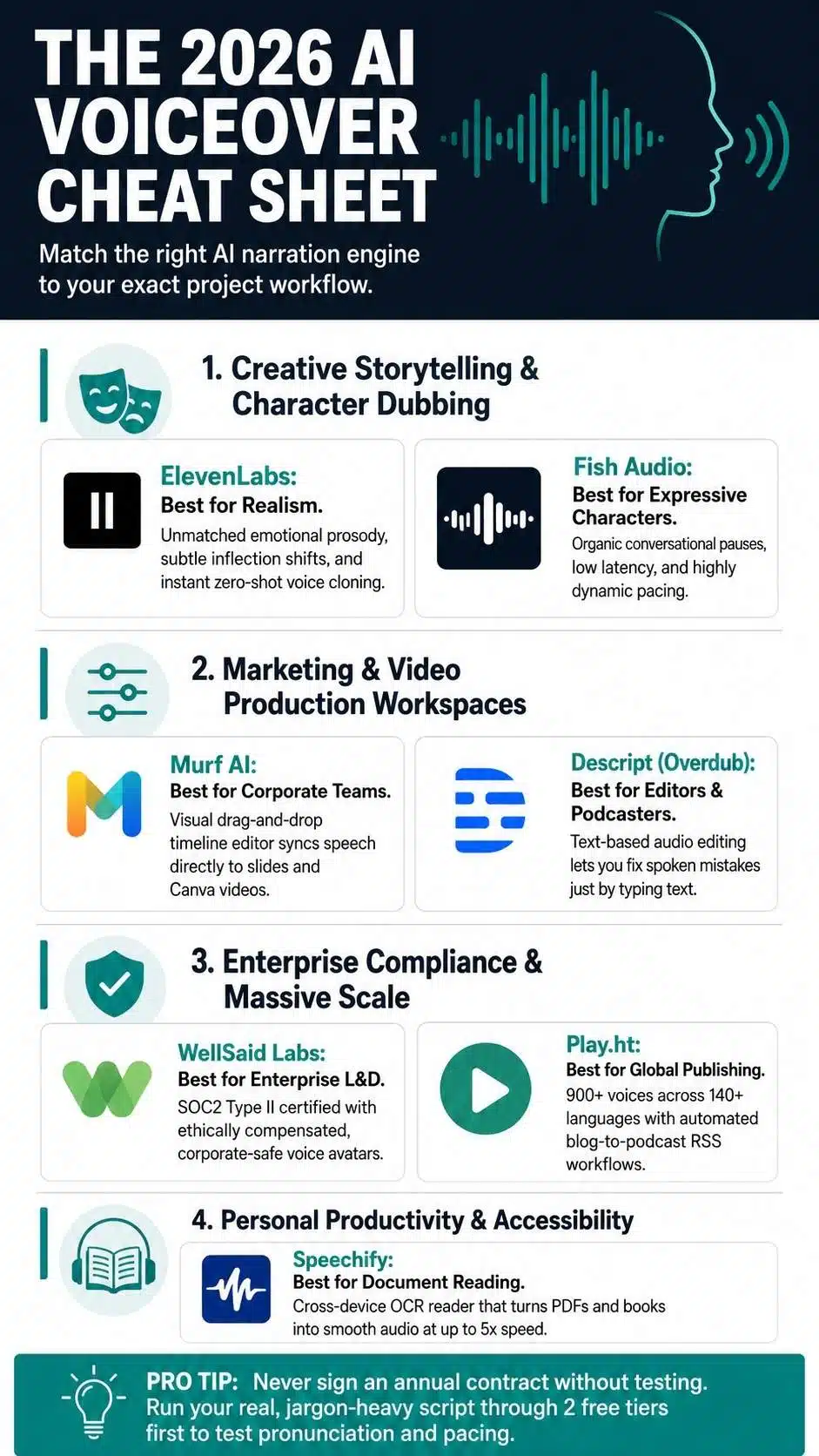
| Platform | Best For | Key Strength | Pricing Model |
| ElevenLabs | Creative storytelling & cloning | Unmatched emotional prosody & pacing | Freemium / Usage tiers |
| Murf AI | Marketing & video teams | Visual timeline & slide editor | Monthly/Annual subscription |
| Play.ht | Multilingual global publishing | 140+ languages & custom pronunciations | Freemium / Subscription |
| WellSaid Labs | Enterprise L&D & compliance | Ethical consent model & SOC2 security | Enterprise subscription |
| Speechify | Document reading & accessibility | Cross-device syncing & high-speed playback | Freemium / Annual subscription |
| Descript (Overdub) | Podcasters & video editors | Text-based audio editing & corrections | Freemium / Subscription |
| Fish Audio | Expressive character dialogue | Ultra-low latency & organic vocal timing | Free tier / Pay-as-you-go |
1. ElevenLabs: Best Overall for Realism and Creative Narration
If sheer audio realism is your primary metric, ElevenLabs is the benchmark everybody else is chasing.
What sets ElevenLabs apart from older TTS platforms ranked on this list is its deep understanding of context. Instead of processing words in a vacuum, its model analyzes the sentence structure to understand why a phrase is being spoken. It knows when to drop to a hushed whisper, when to add a subtle inflection of sarcasm, and when to pause for dramatic emphasis.
Key Features
- Zero-Shot Voice Cloning: Upload just a few minutes of clean audio, and the system clones your exact vocal timbre, accent, and speaking cadence.
- Emotional Control: Adjust stability and clarity sliders to make a voice sound polished for a commercial or slightly erratic and raw for a video game character.
- Built-in Sound Effects: Generate custom background acoustics and sound effects alongside your vocal track.
The Verdict: ElevenLabs is a powerhouse for fiction producers, YouTube creators, and game developers who need lifelike human emotion. Just keep an eye on your character usage, complex cloning workflows burn through monthly allocations quickly.
2. Murf AI: Best for Marketing Teams and Corporate Video
Pure voice quality is great, but what if you need to time that voice to a 12-slide presentation or a fast-paced product explainer? That’s where Murf AI shines.
Murf functions less like a raw AI voice generator and more like a collaborative audio studio. It gives you a clean, drag-and-drop timeline editor where you can sync spoken blocks directly to video clips, background music, or Canva slides without opening Adobe Premiere.
Key Features
- Visual Studio Editor: Adjust pitch, speed, and inter-word pauses on a graphical timeline.
- Deep Integrations: Directly connects with Canva, Google Slides, and PowerPoint to speed up slide deck narration.
- Granular Pronunciation Library: Easily save custom IPA (International Phonetic Alphabet) spellings for tricky industry jargon, brand names, or medical terms.
The Verdict: If you run an agency, a marketing team, or an e-learning department where multiple stakeholders touch a project, Murf AI streamlines the workflow drastically.
3. Play.ht: Best for Multilingual Content and Scale
When your content strategy involves publishing across multiple regions, Play.ht brings massive scale to the table. Offering over 900 voices across more than 140 languages and regional accents, it’s engineered for high-volume digital publishing.
Its conversational models excel at long-form generation. If you run a digital publication and want to automatically convert daily articles into Spotify-ready podcast feeds, Play.ht handles heavy text conversions with remarkably consistent quality.
Key Features
- Massive Multilingual Reach: Support for localized accents (e.g., Australian English vs. Canadian English vs. UK English).
- Automated Audio Publishing: Built-in podcast RSS feed creation straight from text documents.
- Cross-Language Voice Cloning: Clone a voice in English and have that same vocal clone speak fluent Japanese, Spanish, or German.
The Verdict: Play.ht is a top-tier choice for global newsrooms, localized marketing campaigns, and developers leveraging robust APIs to process voiceovers at scale.
4. WellSaid Labs: Best for Enterprise Compliance and eLearning
Large organizations operating in finance, healthcare, or corporate training have strict requirements around data privacy and brand protection. WellSaid Labs built its entire platform around these enterprise needs.
Unlike tools that scrape the web for vocal training data, WellSaid Labs explicitly pays professional voice actors for their likeness through transparent consent frameworks. The resulting avatars are stable, highly consistent, and legally safe for commercial enterprise broadcast.
Key Features
- Enterprise-Grade Compliance: SOC2 Type II certified with strict data governance (your proprietary scripts aren’t used to train public models).
- Custom Brand Avatars: Partner directly with the platform to build an exclusive, bespoke AI voice for your corporation.
- LMS Friendly: Seamless export formatting designed explicitly for SCORM and xAPI e-learning frameworks.
The Verdict: It’s pricier than consumer-grade tools, but WellSaid Labs is the safest, most reliable bet for corporate Learning & Development (L&D) teams and Fortune 500 communications.
5. Speechify: Best for Accessibility and On-the-Go Reading
Not all AI voice tools are built for video editors. Sometimes, you just need to get through a 60-page PDF, a complex legal brief, or a dense study guide without staring at a screen.
Speechify dominates the personal consumption and accessibility space. Originally developed to help readers with dyslexia and ADHD, it instantly turns web pages, documents, and physical book photos into smooth, natural audio.
Key Features
- Flawless Cross-Device Ecosystem: Sync your reading position seamlessly across iOS, Android, Chrome extensions, and desktop apps.
- High-Speed Listening: Engineered to speed up audio (up to 4x or 5x) without making the narrator sound like a chipmunk.
- Celebrity & Natural Voices: Access popular consumer voices, including official celebrity partner licenses alongside clear conversational readers.
The Verdict: While it lacks multitrack video mixing features, Speechify is arguably the best personal productivity tool for turning written content into on-the-go podcasts.
6. Descript (Overdub): Best for Podcasters and Video Editors
Descript flipped traditional audio editing on its head. Instead of staring at waveform squiggles and carefully snipping out “ums” and “ahs,” Descript transcribes your audio into a text document. To edit the audio, you simply highlight and delete the text.
Its built-in Overdub feature is a lifesaver for creators. If you mispronounced a guest’s name during a one-hour podcast interview, you don’t need to set up your microphone and re-record. You just type the correct spelling into the transcript, and your cloned voice seamlessly patches the audio track.
Key Features
- Text-Based Media Editing: Edit multi-track video and audio simply by modifying a word document.
- Overdub Corrections: Fix audio flubs instantly using a trained clone of your own voice.
- Studio Sound: AI-powered background noise removal that turns echoey bedroom audio into professional studio acoustics with one click.
The Verdict: Descript isn’t just an AI voiceover platform, it’s a complete production suite. It’s a must-have for podcasters, course creators, and video editors.
7. Fish Audio: Best for Expressive Character Dialogue
Fish Audio has quickly gained traction as a developer-friendly, highly expressive engine capable of producing lifelike character timing. While many traditional platforms aim for the ultra-clean, polished “radio announcer” voice, Fish Audio thrives on conversational realism.
Powered by innovative text-to-speech architectures, it accurately renders subtle vocal hesitations, breathy transitions, and dynamic pacing changes. It’s particularly fast, boasting low latency that makes it ideal for real-time applications and narrative audio dramas.
Key Features
- Low-Latency Synthesis: Lightning-fast audio generation suitable for conversational AI agents and interactive apps.
- Multi-Speaker Story Builder: Assign distinct voices to multiple characters in a script and compile them into a unified, fluid audio file.
- Accessible Pricing: Generous free tiers and lightweight processing make it accessible for indie developers and budget-conscious creators.
The Verdict: Choose Fish Audio if you are building character-driven audiobooks, indie video games, or conversational AI bots that need to sound uniquely human rather than corporate.
How to Choose the Right AI Narration Software
Still torn between a couple of options? Narrow your decision down by evaluating these three practical factors:
- Your Output Format: Are you mixing audio with video slides? Pick a visual timeline editor like Murf AI. Just need pure, raw expressive vocal files to drop into Premiere or Final Cut? Go with ElevenLabs or Fish Audio.
- Licensing Needs: Always read the fine print on commercial rights. Some free tiers limit you to personal projects. If you’re running paid Facebook ads or television spots, ensure your subscription covers commercial distribution.
- Consistency vs. Emotion: E-learning modules require steady, predictable, clear pronunciation across 50 lessons (WellSaid Labs). Dramatic storytelling requires dynamic pitch shifts and emotional breaks (ElevenLabs). Match the engine’s underlying strength to your specific project tone.
Final Thoughts: Match the Voice to Your Vision
The pace of AI voice innovation is blindingly fast, but the most important takeaway for creators, marketers, and developers is simple: there is no single “best” platform for everyone. The right choice comes down entirely to matching the engine’s architectural strengths to your daily workflow.
Before locking yourself into an annual contract, run a practical test. Take your actual, real-world script, complete with tricky industry jargon, brand names, and complex punctuation, and run it through the free tiers of two different tools. The platform worth your money won’t just generate human-sounding audio; it will sound like the exact human your project needs.
Frequently Asked Questions About AI Voiceover Platforms
1. Can AI voiceover platforms completely replace human voice actors?
For high-volume, quick-turnaround content, like internal corporate training, daily news briefs, and social media ads, AI voiceovers have largely replaced traditional recording workflows. However, for nuanced character acting, high-budget national commercials, or deeply emotional storytelling, experienced human voice actors still provide creative choices that AI cannot fully replicate.
2. Are AI-generated voiceovers monetizable on YouTube?
Yes. YouTube’s monetization policies permit AI-generated voiceovers as long as the underlying video content is original, engaging, and provides value to the viewer. However, YouTube actively demagnetizes or penalizes low-effort “spam” content that uses synthetic voices over repetitive stock footage without adding educational or narrative value.
3. How does AI voice cloning work, and is it legal?
Voice cloning works by feeding a deep learning model sample recordings of a human voice to map its unique tonal frequencies, pacing, and accent. Legally, you can clone your own voice or clone someone else’s voice only if you have their explicit, documented legal consent. Reputable platforms enforce stringent verification steps to prevent unauthorized deepfakes.
4. Which AI voice tool sounds the most natural right now?
ElevenLabs is widely considered the industry standard for raw emotional realism and conversational prosody. However, competitors like Fish Audio and Play.ht run very close behind, specifically when handling conversational dialogue and non-English regional accents.
5. Can I use AI voice tools offline?
Most top-tier AI voiceover platforms operate in the cloud because generating hyper-realistic neural speech requires significant cloud GPU computing power. However, accessibility readers like Speechify offer mobile device downloading features so you can save pre-generated audio files and listen on the go without an active internet connection.