
Most startup founders do not need generic advice on how to build a pitch deck. They need capital, structured sales pipelines, and direct access to networks that can help them capture market share before cash runs out. Choosing from the best accelerator programs requires looking past marketing hype and examining the true trade-offs of equity, operational friction, and geographic mandates.
The global accelerator ecosystem has split into distinct specializations. Some platforms focus heavily on venture-backed scale, while others are built purely for bootstrapped durability or specialized enterprise sales.
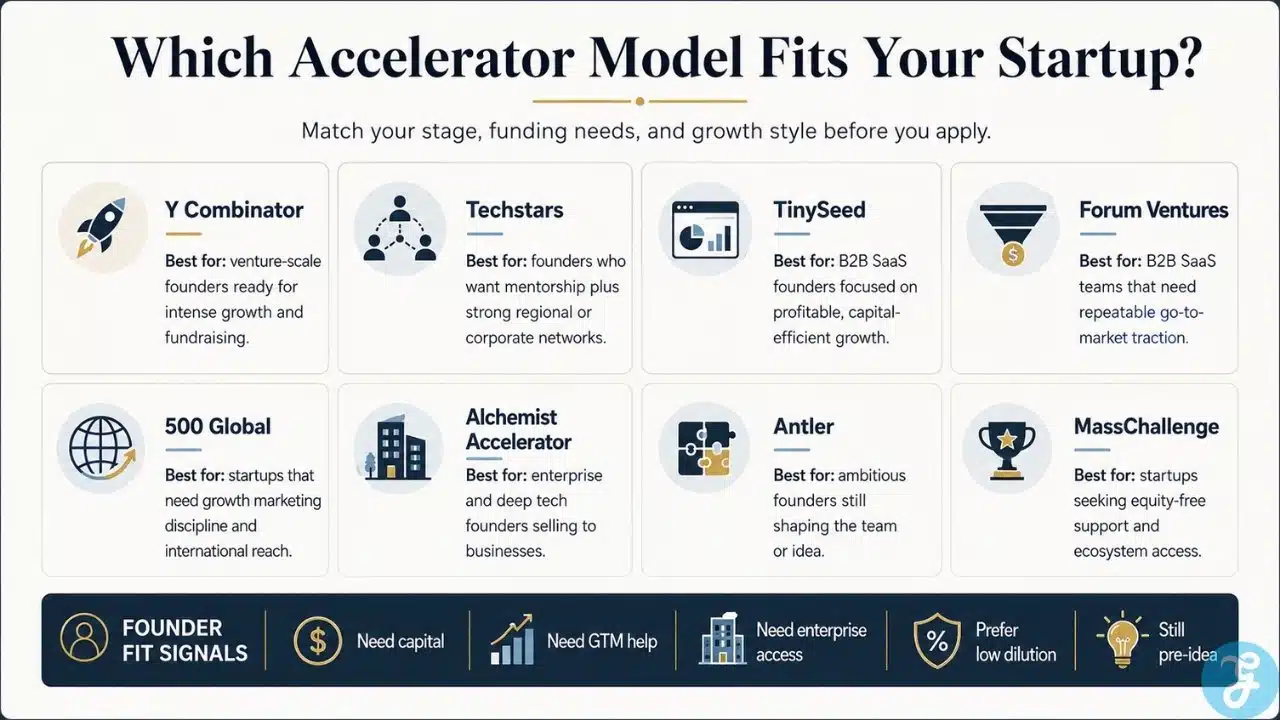
Before evaluating individual cohorts, founders must realize that terms vary significantly based on location, sector focus, and corporate backing. The table below outlines how top programs approach investment structure and core focus.
| Accelerator Program | Upfront Funding | Baseline Equity / Structure | Core Operational Focus |
| Y Combinator | $500,000 | 7% + uncapped MFN SAFE | High-scale VC funding |
| Techstars | $220,000 | 5% common equity + MFN SAFE | Local corporate partnerships |
| TinySeed | $120,000 – $220,000 | 10% – 12% equity | Profitable B2B SaaS |
| Forum Ventures | $100,000 | 7% equity | North American B2B GTM |
| 500 Global | ~$100,000 | Varies by regional fund | Analytical growth marketing |
| Alchemist Accelerator | Varies by track / up to $150,000 | ~5% to 6% equity | Enterprise B2B & Deep Tech |
| Antler | Varies / $250,000 – €200,000 | ~8.5% to 9% + MFN SAFE | Pre-team, pre-idea matching |
| MassChallenge | Equity-Free / Cash Grants | 0% Equity | Corporate & government networks |
The 8 Best Accelerator Programs Globally Compared
Evaluating these platforms requires analyzing exact structural terms, upfront capital deployment, and the realistic operational friction founders encounter during and after the cohort.
1. Y Combinator: The Silicon Valley Kingmaker
If your goal is to build a venture-backed behemoth and you are willing to navigate extreme structural pressure, Y Combinator remains the industry standard. Based out of San Francisco, the program focuses tightly on early-stage, technical teams—particularly those building infrastructure, enterprise platforms, and artificial intelligence software.
The Capital and the Structure
The funding structure is standardized but heavy. They invest $500,000 split into two clear components: $125,000 on a post-money SAFE for 7% equity, and an additional $375,000 on an uncapped SAFE with a Most Favored Nation clause. The three-month program is famously intense, culminating in a highly competitive Demo Day. Founders are placed into smaller, autonomous groups led by partners who are themselves former successful founders.
The Realistic Friction
-
San Francisco Mandate: The program requires physical presence on their San Francisco campus, starting with a mandatory three-day kickoff and demanding weekly in-person attendance for dinners, partner meetings, and group sessions. If you cannot or do not want to relocate to the Bay Area for three months, this is an immediate dealbreaker.
-
The Valuation Trap: While it provides unparalleled access to elite institutional investors, it also drops you into a high-pressure optimization machine. If your SaaS startup is better suited for a lean, organic $10 million exit, this network will push you toward a path that requires massive venture funding rounds instead.
2. Techstars: The Distributed Global Network
Where some centralize everything in one city, Techstars takes a distributed approach. Operating dozens of city-specific and vertical-specific programs globally—including New York, London, and various remote options like Techstars Anywhere—it suits founders who need deep regional roots or industry-specific corporate partnerships.
The Capital and the Structure
The standardized investment terms offer a larger upfront capital injection. Every accepted startup receives $220,000, broken down into $20,000 via a Post-Money Convertible Equity Agreement in exchange for 5% common equity, and $200,000 via an uncapped MFN SAFE that converts at your next priced funding round. The three-month program relies heavily on an intensive Mentor Madness phase, where founders meet with dozens of mentors to refine their business model.
The Realistic Friction
-
Dilution Realities: Because they take 5% equity for just the first $20,000, the baseline dilution is relatively high compared to the upfront cash. If your Series A later closes at a high valuation, the conversion of the $200,000 SAFE means your total dilution can hover around 6% to 7%.
-
Variable Cohort Quality: Because they run dozens of programs simultaneously, the quality of the network, corporate partners, and localized managing directors varies significantly from city to city. A vertical-specific program backed by a major healthcare enterprise offers completely different utility than a broad, remote-first cohort.
3. TinySeed: The Anti-Unicorn SaaS Alternative
This platform is a complete departure from traditional venture capital models. Designed specifically for early-stage B2B SaaS founders, this year-long, fully remote accelerator is built for entrepreneurs who want to build profitable, capital-efficient software companies without the pressure to chase a billion-dollar valuation.
The Capital and the Structure
Investment ranges between $120,000 and $220,000 per company in exchange for 10% to 12% equity. Because there is no high-stakes Demo Day, the program lasts a full year, focusing on sustainable SaaS fundamentals like pricing strategy, positioning, low-friction marketing, and systematic hiring. The investment model relies on a dividend-sharing structure based on founder salary thresholds. Once a company becomes highly profitable and the founders pull out cash beyond that threshold, profits are distributed pro-rata.
The Realistic Friction
-
Pre-Revenue Builders Excluded: This is not an ideation platform. To be a viable candidate, you generally need an active B2B SaaS prototype and early revenue traction, often at least $1,000 to $5,000 in Monthly Recurring Revenue.
-
Growth Velocity: If your software product requires massive, aggressive capital to capture a winner-take-all market, the focus on organic profitability will feel too slow. It is explicitly tailored for businesses where reaching $10 million in ARR is considered a massive victory, not a stepping stone to an institutional round.
4. Forum Ventures: The Dedicated B2B GTM Engine
Operating out of hubs in New York, San Francisco, and Toronto, this program focuses exclusively on pre-seed and seed-stage B2B SaaS startups. If you have an MVP but are struggling to build a repeatable, predictable sales pipeline, this program acts as a direct, hands-on go-to-market machine.
The Capital and the Structure
For its core 15-week accelerator program, they provide a standardized investment of $100,000 in exchange for a 7% equity stake. The curriculum discards generic startup advice to focus almost entirely on building outbound sales funnels, refining enterprise pricing models, and trying to secure your first 10 paying institutional customers. The program finishes with a virtual Demo Day targeting institutional seed investors.
The Realistic Friction
-
Strict Sector and Geographic Focus: They do not back consumer apps, hardware, or D2C brands. Furthermore, their accelerator program primarily targets startups operating within or expanding into North America.
-
High Upfront Dilution: Taking 7% equity for a $100,000 investment represents a relatively low valuation cap on your early equity. You are explicitly trading that margin for intense, hands-on help with your B2B sales process.
5. 500 Global: The Growth-Marketing Heavyweight
This is a massive, multi-stage venture firm that operates various regional seed programs worldwide, including prominent ecosystems across the MENA region, Eurasia, and Latin America. It is highly valued by international founders who have early local market traction and want to inject analytical growth frameworks into their operations.
The Capital and the Structure
While terms vary based on the specific regional fund and local compliance structures, their core seed programs typically offer around a $100,000 investment. The 12-to-14-week hybrid programs are structurally divided into clear phases. They usually start with intense growth bootcamps focused on analytics, KPI tracking, and building acquisition funnels, followed by remote experimentation periods where founders launch rapid marketing iterations.
The Realistic Friction
-
Hidden Program Fees: Founders must look closely at the fine print of regional agreements. Some localized iterations require accepted startups to pay a structural program fee—which can be upwards of $35,000—directly back out of the investment capital to cover operational costs.
-
Operational Friction: The program demands a heavy, metric-driven time commitment. If your core challenge is deep, technical product development rather than customer acquisition, the constant cycle of growth experiments can become a distraction.
6. Alchemist Accelerator: The Enterprise SaaS Specialist
Alchemist Accelerator is built explicitly for startups whose primary customers are other businesses. Based in Silicon Valley but accommodating remote-first tracks with in-person components, this six-month program is highly regarded by technical founders building enterprise SaaS, deep tech, and industrial digital tools.
The Capital and the Structure
Alchemist provides capital injections that typically reach up to $150,000 for roughly 5% to 6% equity, though specific terms can adjust based on the specialized cohort track (such as their international residency programs). The six-month duration is twice as long as traditional accelerators, acknowledging that enterprise sales cycles take far longer to clear than consumer products. The program focuses entirely on customer development, pilot structured agreements, and enterprise sales execution.
The Realistic Friction
-
The Sales Cycle Gap: If your software targets small businesses or individual prosumers, the enterprise procurement and security compliance curriculum taught here will feel irrelevant.
-
Corporate Integration Friction: While they offer a dense network of Fortune 500 CIOs and technology leaders, managing these relationships requires massive founder availability. A pre-product team can easily get bogged down trying to customize a product for a single corporate pilot rather than building a scalable core software asset.
7. Antler: The Pre-Team, Pre-Idea Global Platform
Antler operates an entirely different model by backing individuals before they have a fully formed company, co-founder, or even a finalized business idea. Operating out of major technology hubs across Europe, the US, Asia, and Africa, it serves as a highly selective founder residency program.
The Capital and the Structure
The platform operates through local residency programs with regional terms. In the United States, they run 10-week in-person residencies that deploy $400,000 total: $250,000 for a 9% post-money SAFE, alongside a $150,000 uncapped MFN SAFE. In Continental Europe and the UK, terms are structured up to €500,000 or £500,000, combining upfront cash for roughly 8.5% equity with an uncapped convertible note and pre-agreed follow-on capital commitments. The first phase focuses entirely on co-founder matching and rapid idea validation.
The Realistic Friction
-
High Selection Risk: Because you enter as an individual, you are dropped into a highly competitive environment with dozens of other elite operators. If you fail to find a compatible co-founder or cannot validate an institutional-grade business idea within the first few weeks, you will not clear the internal Investment Committee block to receive the main funding ticket.
-
The Speed Pressure: Forcing a co-founder relationship over a matter of weeks can lead to structural team fractures later on. If you already have a stable, long-term co-founder and a clear product roadmap, the early matching phases can feel like an unnecessary hurdle.
8. MassChallenge: The Equity-Free Alternative
MassChallenge is a global non-profit accelerator network operating programs in Boston, Texas, Israel, Switzerland, and various vertical tracks. It stands as the premier option for founders who want structured acceleration and corporate access without surrendering any equity or control.
The Capital and the Structure
They do not take an equity stake. Instead, the program operates on a competitive grant model. Startups participate in a multi-month program packed with corporate mentorship, workspace access, and industry introductions. At the conclusion of the cohort, top-performing startups compete for several million dollars in non-dilutive cash prizes and grants.
The Realistic Friction
-
No Guaranteed Capital: Unlike every other option listed, acceptance does not equal immediate cash in your bank account. If your SaaS company is down to its last month of runway and needs immediate capital to survive, you cannot rely on this competitive grant model.
-
Heavy Programmatic Overhead: Because MassChallenge relies heavily on corporate and government sponsors to fund its operations, the program features numerous mandatory networking events, sponsor panels, and ecosystem showcases. Founders must actively manage their schedules to ensure these administrative requirements do not pull them away from active software development.
The Boring Check That Matters
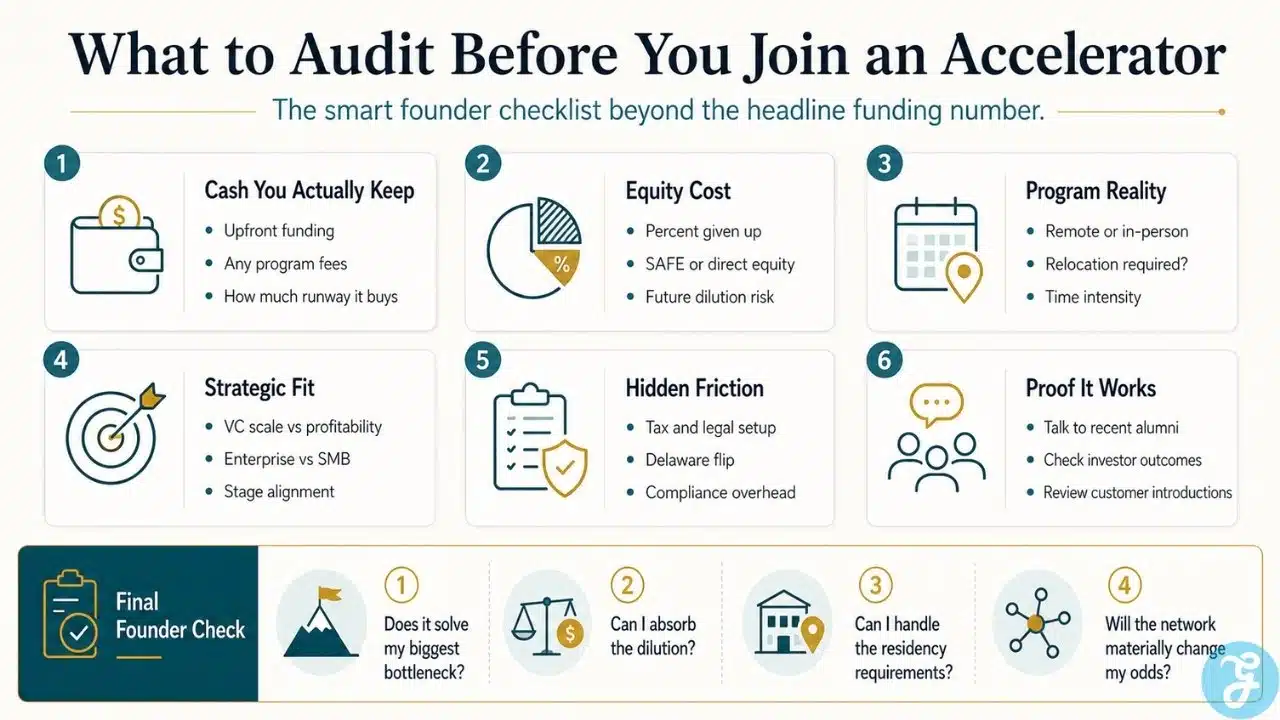
What most lists miss is that the prestige of an accelerator does not pay your AWS bill or close your enterprise clients. Founders frequently chase brand names without verifying the local tax, legal, and operational compliance burdens attached to the capital.
For instance, international founders entering US-based accelerators are almost universally required to execute a Delaware Flip. This process involves establishing a US holding company that owns your local operating entity. If you are a founder based in South Asia, Europe, or Latin America, this flip can introduce complex cross-border tax implications, ongoing US corporate filing costs, and immediate intellectual property migration fees.
Furthermore, ensure you audit the explicit program fees. Receiving a headline figure of $100,000 looks clean on paper, but if the program automatically deducts a $30,000 tuition or network fee upon entry, your actual operational runway is significantly shorter than anticipated.
Before Choosing Any Option
Before committing to any of the best accelerator programs, you must baseline your current operational bottleneck.
If your software product is technically complete but your outbound conversion rate is flat, prioritizing a GTM-heavy engine like Forum Ventures or a growth-marketing framework like 500 Global yields immediate dividends. If you are an enterprise technical founder who needs a direct line to corporate technology buyers, Alchemist provides the correct ecosystem. If you want to bypass the venture capital wheel entirely to build a highly sustainable, independent software company, a model like TinySeed protects your equity architecture.
Map your equity tolerance, verify the in-person residency mandates, and speak directly with recent alumni from your specific target region before signing any SAFE or equity agreement.
Frequently Asked Questions(FAQs) on the Best Accelerator Programs
What is the structural difference between a startup incubator and an accelerator?
People frequently mix these up, but the operational timelines are completely distinct. Incubators are open-ended setups designed for the ideation stage, often sponsored by universities or regional development funds to help local founders refine a basic concept over one to two years. Accelerators are fast-paced, highly structured programs that pack capital injections, intense mentoring, and network scaling into a tight three-to-six-month window. You enter an incubator to find an idea; you enter an accelerator to scale a working prototype rapidly.
How much traction do top-tier programs require before accepting a software startup?
While platforms like Y Combinator occasionally back raw teams with nothing more than a clean sheet of code, the baseline standard has shifted. For software and B2B SaaS teams, having an active MVP is no longer enough. Selection committees look closely at growth velocity—even if it is just thousands of dollars in early recurring revenue or a highly active waitlist of enterprise pilots. If you apply with just an idea, your technical background and previous scaling history must be flawless to clear the review block.
Can solo founders realistically secure a spot in elite global cohorts?
Yes, but you are fighting severe statistical headwinds. Institutional platforms favor cofounding teams—specifically a balanced duo featuring one technical builder and one commercial operator. Managing early product iteration while simultaneously running outbound sales cycles introduces extreme operational friction. If you apply as a solo founder, you must prove that your development velocity is fast enough to sustain early milestones without a partner.
What happens if a startup decides to pivot its product during the program?
Pivoting is incredibly common, particularly in early-stage validation engines like YC or Antler. Because these groups back the capabilities of the founding team rather than the specific software layout, partners often encourage a pivot if early user discovery proves the initial market is too small. The capital terms stay exactly the same, as the investment is tied to your corporate entity, not the specific app design you pitched during the application cycle.
How do top accelerator networks handle follow-on funding rounds after Demo Day concludes?
Most major programs maintain dedicated growth funds or secondary SAFEs to participate in your seed or Series A rounds. However, do not mistake an invitation to Demo Day for guaranteed institutional funding. The primary value is exposure to external venture capital firms. If your metrics are weak or your sector loses market momentum during the cohort, you can easily exit the program without securing external term sheets, dropping right back into organic bootstrapping.