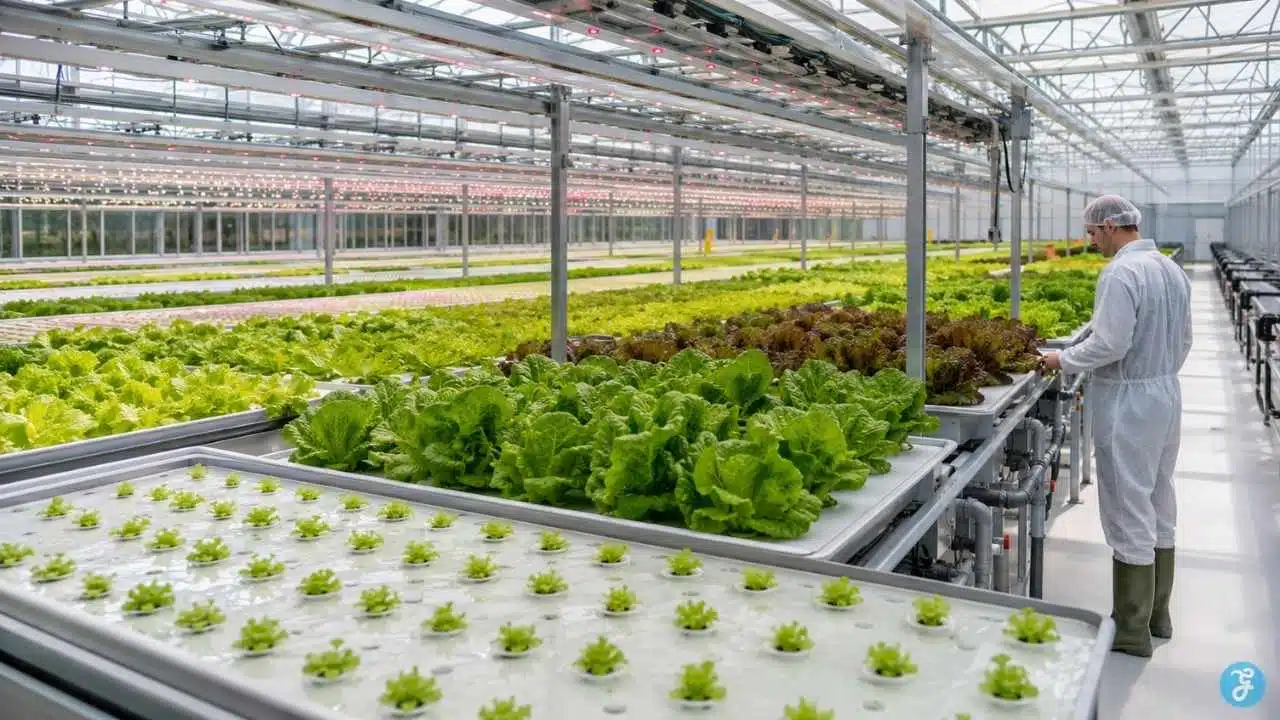
Indoor agriculture looks clean from the outside. Rows of leafy greens under LED lights. No muddy boots. No open field. No tractor tracks. No weather panic. But the real story sits underneath the crop. The trays, rafts, gutters, pumps, benches, climate cells, irrigation lines, aeration systems, rolling tables, spacing systems, sensors, and logistics equipment decide whether a hydroponic farm becomes a serious business or an expensive science project.
That is where the Netherlands has an advantage. Dutch horticulture has spent decades turning growing into an engineering discipline. The country’s greenhouse industry already knows how to manage water, climate, crop movement, light, labour, hygiene, and yield at commercial scale. Hydroponics and indoor agriculture are not a complete break from that history. They are the next technical layer.
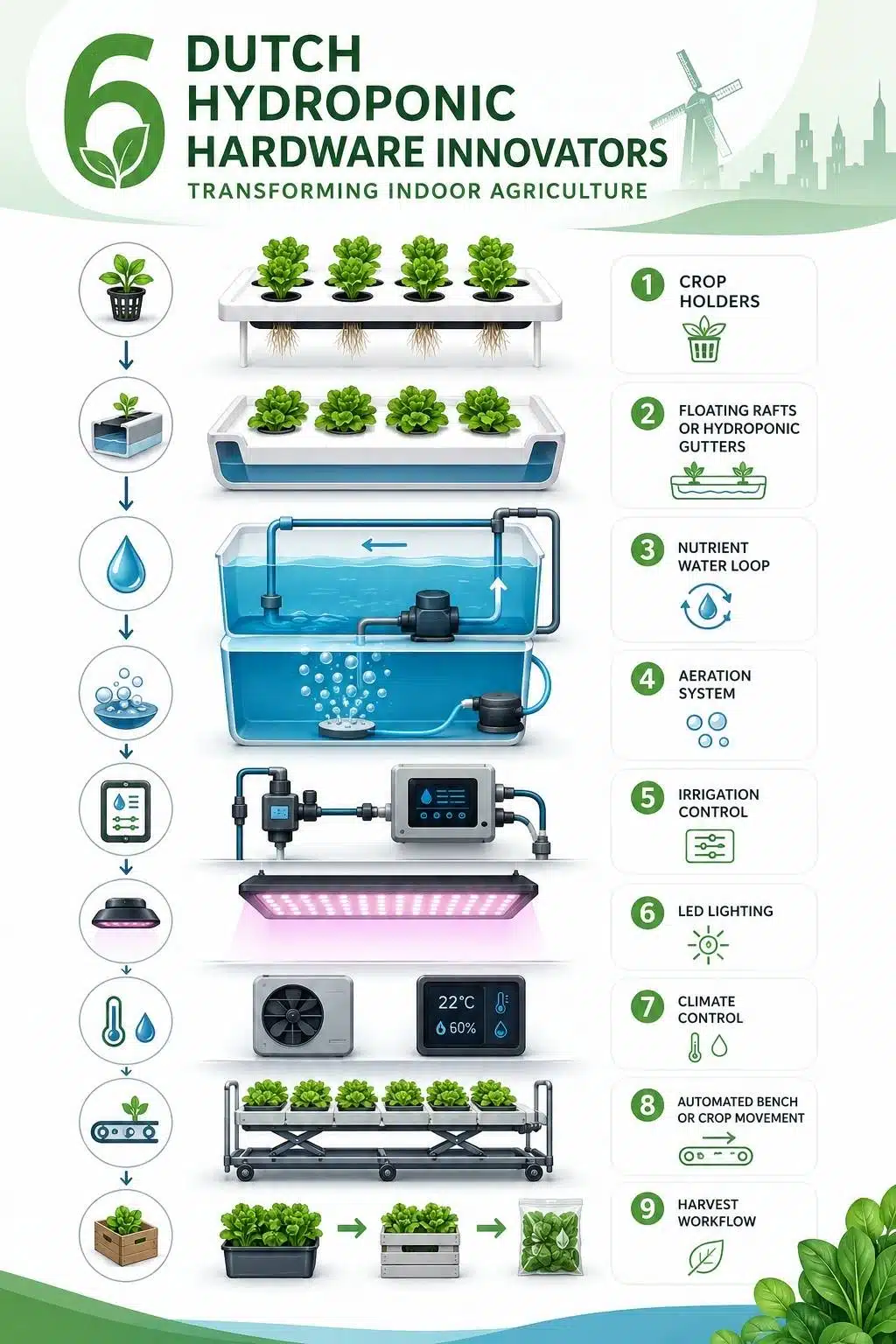
This article focuses on Dutch hydroponic hardware innovators that are building the physical systems behind indoor agriculture. Some are small, specialized hydroponic system companies. Some are established horticultural technology firms. Some focus on floating rafts and crop holders. Others solve the movement, automation, and facility-design problems that make commercial indoor farming possible.
They are not all startups, and they should not be described that way. They are hardware builders, system designers, and horticultural engineering specialists helping growers move from soil dependency to controlled, water-based production.
How I Selected These Companies
This list was built around hardware relevance, not marketing language. To be included, each company had to meet most or all of these criteria:
- It had to be based in the Netherlands or have a clear Dutch headquarters.
- It had to be active and publicly verifiable.
- It needed a direct connection to hydroponic systems, indoor growing systems, vertical farming hardware, crop movement, water-based cultivation, or CEA infrastructure.
- It had to provide physical hardware, engineered systems, or production infrastructure, not only consulting or software.
- Its claims had to be specific enough to describe without inventing extra facts.
- It needed practical relevance for commercial growers, indoor farms, greenhouse operators, plant factories, or leafy-green production.
One important note: this is not a list of the biggest Dutch horticulture companies. It is a more focused look at companies whose hardware helps hydroponic and indoor agriculture actually operate.
1. Dry Hydroponics
Dry Hydroponics is one of the most direct fits for this topic because the company is built around a specific hydroponic growing system.
The system is designed for short-cycle crops such as lettuce, herbs, and flowers. Crops grow in holders placed on floating structures in cultivation ponds filled with nutrient-rich water. The idea is simple on the surface, but the real value is in the system design: the crop needs enough access to water, oxygen, nutrients, light, CO₂, and clean growing conditions without unnecessary handling.
That makes Dry Hydroponics relevant for growers who want water-based production without turning the farm into an overcomplicated machine room.
Business Snapshot
| Field | Details |
| Main solution | Floating crop-holder hydroponic growing system |
| Dutch base | Schipluiden, South Holland |
| Best suited for | Lettuce, leafy greens, herbs, and flowers |
| Strongest hardware fit | Cultivation ponds, floats, crop holders, water-based crop production |
| Buyer profile | Commercial growers moving into leafy-green hydroponics |
What the Company Actually Does
Dry Hydroponics supplies a growing system for crops cultivated on water. Instead of soil, the crop grows in a controlled water-based environment where the root zone can receive nutrients and oxygen while the leaves remain clean.
This is important for leafy greens because post-harvest cleanliness, uniformity, and handling efficiency matter. A crop that can be grown cleanly and harvested efficiently gives growers more control over quality and labour.
The company’s system is especially relevant for greenhouse growers who want to expand into hydroponic leafy-greens production without immediately adopting a fully enclosed vertical farm.
Why It Belongs on This List
Dry Hydroponics belongs here because it represents a practical Dutch approach to hydroponics: specific crop, specific system, specific grower problem.
The company is not selling a vague indoor-agriculture dream. It is focused on water-based cultivation for short-cycle crops. That clarity makes it useful for growers who are not looking for hype but for a growing system that can be understood, tested, and integrated.
Business Reality Check
Dry Hydroponics is strongest for leafy greens, herbs, and similar short-cycle crops. It should not be treated as a universal hydroponic system for every crop type.
Growers still need to evaluate water quality, crop variety, climate, labour model, hygiene, market demand, and harvest workflow. A good hydroponic system solves many problems, but it does not remove the need for skilled cultivation.
Best Fit
Dry Hydroponics is best for commercial growers that want a focused water-based growing system for leafy greens, herbs, and clean short-cycle crop production.
2. Botman Hydroponics
Botman Hydroponics focuses on cultivation on water, especially through deep water culture-style floating raft systems.
The company’s core hardware includes floating rafts, propagation trays, and aeration systems. That makes it a strong fit for this list because it is not merely advising on hydroponics. It is selling the physical parts that hold, support, move, and feed the crop.
Botman’s system is aimed at controlled environment agriculture greenhouses and leafy-crop production, where food safety, cleanability, automation, and water management matter.
Business Snapshot
| Field | Details |
| Main solution | DWC floating raft system |
| Dutch base | Hoorn, Netherlands |
| Best suited for | Leafy greens, herbs, lettuce heads, and CEA greenhouse crops |
| Strongest hardware fit | Food-safe HDPE floating rafts, propagation trays, aeration systems |
| Buyer profile | Growers building water-based leafy-crop production systems |
What the Company Actually Does
Botman Hydroponics offers a floating raft system designed for deep water culture. The rafts are made from food-safe HDPE plastic and are designed to support hydroponic leafy crops in greenhouse ponds.
The company also sells propagation trays and an aeration system, which matters because water quality is one of the central risks in DWC systems. If oxygen levels, water movement, and hygiene are poorly managed, the crop can suffer quickly.
The system is designed with automation in mind. That is useful because large leafy-green production cannot depend forever on heavy manual handling. Rafts, trays, and harvesting workflows need to fit the grower’s labour model.
Why It Belongs on This List
Botman Hydroponics belongs here because it attacks one of the most physical parts of hydroponic farming: the interface between crop and water.
A floating raft might look simple, but its material, shape, plant-hole design, cleanability, heat transfer, durability, and automation compatibility all affect the farm’s performance.
Botman’s focus on cultivation-on-water hardware makes it a genuine hydroponic hardware innovator, especially for leafy-green and lettuce production.
Business Reality Check
Botman Hydroponics is a small specialist company, not a large turnkey farm builder.
That means buyers should not expect it to replace the entire project team. A grower may still need greenhouse design, climate control, water treatment, crop advice, lighting, logistics, and market planning. Botman’s value is in the water-cultivation system itself.
Best Fit
Botman Hydroponics is best for CEA growers looking for durable DWC floating raft hardware and related propagation or aeration components for leafy crops.
3. Meteor Systems
Meteor Systems is a strong Dutch hardware player for hydroponic and indoor growing systems.
The company designs and produces cultivation systems for professional horticulture, including solutions for leafy greens and herbs. Its relevant hardware includes hydroponic floating rafts, multilayer growing racks, grow-table inlays, irrigation-related systems, and tailor-made indoor growing solutions.
That makes Meteor Systems especially useful for growers who need components that can scale from greenhouse production to more controlled indoor systems.
Business Snapshot
| Field | Details |
| Main solution | Hydroponic floating rafts and indoor growing systems |
| Dutch base | Breda, Netherlands |
| Best suited for | Leafy greens, herbs, propagation, indoor growing systems |
| Strongest hardware fit | HDPE floating rafts, multilayer racks, hydroponic inlays, growing systems |
| Buyer profile | Commercial growers, greenhouse builders, and CEA operators |
What the Company Actually Does
Meteor Systems designs growing systems for crops such as leafy greens and herbs. Its indoor growing solutions include multilayer growing racks for propagation, hydroponic floating rafts for cultivation on water, and inlays for ebb-and-flow grow tables.
The company’s floating rafts are made from food-safe HDPE and are designed for long service life. That matters because hydroponic farms need hardware that can survive repeated crop cycles, cleaning, water exposure, transport, and automation.
Meteor also works across different cultivation methods, including deep water culture, nutrient film technique, indoor farming, and vertical farming. That gives it flexibility for growers who are not building a single rigid setup.
Why It Belongs on This List
Meteor Systems belongs here because it provides the kind of modular, durable cultivation hardware indoor agriculture needs.
Many indoor farms fail not because plants cannot grow indoors, but because the system becomes too expensive, too fragile, too labour-intensive, or too hard to clean. Hardware details such as raft durability, table design, spacing, water distribution, and propagation workflow matter more than outsiders think.
Meteor’s strength is in turning those details into practical systems.
Business Reality Check
Meteor Systems is not only an indoor-farming company. It serves wider professional horticulture.
That is not a problem, but it means buyers should approach it with a specific crop plan. A leafy-green hydroponic project, a propagation room, and a semi-indoor greenhouse system all require different hardware choices.
Best Fit
Meteor Systems is best for growers that need durable hydroponic rafts, growing racks, table systems, and custom cultivation hardware for leafy greens, herbs, and indoor growing.
4. JB Hydroponics
JB Hydroponics is one of the most straightforward names on this list because its business is right in the category: hydroponic growing systems and substrates.
Based in the Netherlands, the company says it has specialized in sustainable growing systems and substrates since 2004. It supports growers of vegetables, soft fruit, cut flowers, cuttings, and herbs with systems designed around crop and substrate needs.
This makes JB Hydroponics especially relevant for growers who want substrate-based hydroponic systems, water reuse, drainage collection, and customized growing hardware.
Business Snapshot
| Field | Details |
| Main solution | Sustainable growing systems and substrates |
| Dutch base | Bergschenhoek, Netherlands |
| Best suited for | Vegetables, soft fruit, herbs, flowers, cuttings |
| Strongest hardware fit | Growing systems, substrate gutter systems, drainage collection |
| Buyer profile | Commercial greenhouse and hydroponic growers |
What the Company Actually Does
JB Hydroponics supplies custom growing systems and substrates for professional growers. Its systems are designed to collect drainage water, support root health, improve air circulation, and make the growing process more efficient.
That is a practical part of hydroponic farming. Growers often focus on crop variety and climate, but the physical growing system influences drainage, root oxygen, disease pressure, labour posture, water reuse, and overall crop uniformity.
JB Hydroponics also works internationally through its rolling machines, which allows local production of systems in different markets. That can reduce lead times and improve service access for growers outside the Netherlands.
Why It Belongs on This List
JB Hydroponics belongs here because it focuses on one of the basic but critical layers of commercial hydroponics: the growing system itself.
A grower can have the best greenhouse, lighting, and climate computer, but if the substrate system drains poorly or creates uneven root-zone conditions, crop performance suffers. JB Hydroponics’ role is to make that root-zone and drainage layer more controlled.
Business Reality Check
JB Hydroponics is not a flashy vertical-farming brand. It is more of a grower-facing system supplier.
That is actually useful for this article. Indoor agriculture does not need only futuristic plant factories. It also needs proven gutter systems, drainage collection, substrates, and root-zone hardware that commercial growers can depend on.
Best Fit
JB Hydroponics is best for commercial growers that need customized substrate-based hydroponic systems, drainage collection, and crop-specific growing hardware.
5. Logiqs
Logiqs is not a hydroponic raft company. Its value is in automation, movement, and logistics.
That may sound like a side category until you look at how indoor farms actually work. Plants do not stay still in many commercial systems. They move from propagation to spacing, growing, inspection, harvesting, and packing. If that movement is inefficient, labour costs rise and the farm loses its commercial edge.
Logiqs has spent decades designing automated mobile benching systems and greenhouse logistics equipment. Its work now extends into vertical farming and automated growing environments.
Business Snapshot
| Field | Details |
| Main solution | Automated benching and plant movement systems |
| Dutch base | Maasdijk, South Holland |
| Best suited for | Large greenhouses, vertical farms, plant nurseries, high-throughput crop production |
| Strongest hardware fit | Rolling benches, mobile tables, automated logistics, vertical farm movement systems |
| Buyer profile | Growers who need efficient crop movement and space utilization |
What the Company Actually Does
Logiqs designs and builds automated benching systems, mobile growing systems, and logistics hardware for greenhouse and vertical-farming environments.
In hydroponic and indoor agriculture, this matters because production efficiency is not only about growing the crop. It is also about moving the crop through the facility with minimal labour, minimal damage, and maximum use of space.
The company’s systems help growers organize workflows around benches, tables, plant movement, spacing, and work areas. Its software integration also helps make the movement system part of the farm’s overall control logic.
Why It Belongs on This List
Logiqs belongs here because indoor agriculture becomes expensive when crop movement is poorly designed.
Manual handling, awkward spacing, inefficient bench layout, and poor logistics can quietly eat the farm’s margin. Automated benching and plant movement systems are not decorative hardware. They are part of the business model.
For hydroponic farms trying to scale, automation is often the difference between a grow room and a production facility.
Business Reality Check
Logiqs is not selling a complete hydroponic growing recipe. It is an automation and logistics hardware specialist.
Growers still need to pair its systems with crop knowledge, irrigation, climate control, lighting, water management, and harvesting strategy. Its value is highest when the farm is large enough for automation to pay off.
Best Fit
Logiqs is best for indoor farms, nurseries, and greenhouse operations that need automated crop movement, rolling benches, and efficient production logistics.
6. Bosman Van Zaal
Bosman Van Zaal is one of the broader horticultural technology companies on this list.
It develops technical greenhouse and indoor-farming solutions, including cultivation systems, climate control, irrigation, lighting, robotics, logistics, software, and turnkey project support. That makes it especially relevant for growers who need more than a single raft, gutter, or table.
In hydroponic indoor agriculture, systems have to work together. Water, light, airflow, spacing, hygiene, crop movement, climate, and labour planning all affect the final crop. Bosman Van Zaal’s role is to integrate those layers.
Business Snapshot
| Field | Details |
| Main solution | Integrated horticultural and indoor-farming systems |
| Dutch base | Aalsmeer, Netherlands |
| Best suited for | Vertical farms, research facilities, food-grade and pharma-grade production |
| Strongest hardware fit | Cultivation systems, robotics, irrigation, lighting, HVAC, logistics |
| Buyer profile | Growers, breeders, research institutes, and vertical-farming operators |
What the Company Actually Does
Bosman Van Zaal designs and builds technical systems for controlled environment agriculture. Its vertical-farming work includes logistical cultivation systems, robotics, tracking and tracing software, and controlled environments designed around hygiene and efficiency.
The company is especially relevant for high-value crops and controlled environments where precision matters. That includes ready-to-eat vegetable production, research crops, medicinal cannabis, plant-based vaccine production, and other high-control applications.
Its strength is not one single hydroponic component. Its strength is system integration.
Why It Belongs on This List
Bosman Van Zaal belongs here because hydroponic indoor agriculture does not scale through isolated equipment.
A grower may buy a raft, gutter, light, pump, climate system, and robot from different providers. But the farm only works if those systems connect into a reliable production flow. Bosman Van Zaal’s value is in building integrated facilities where plant movement, water, climate, and automation are designed together.
That is one of the biggest hardware challenges in indoor agriculture.
Business Reality Check
Bosman Van Zaal is not a small hydroponic startup. It is an established horticultural technology company.
That makes it more suitable for serious commercial projects than for experimental hobby-scale farms. Buyers should expect a project-based approach, not an off-the-shelf hydroponic kit.
Best Fit
Bosman Van Zaal is best for commercial indoor farms, research facilities, vertical farming companies, and high-control crop production projects that need integrated systems rather than single hardware pieces.
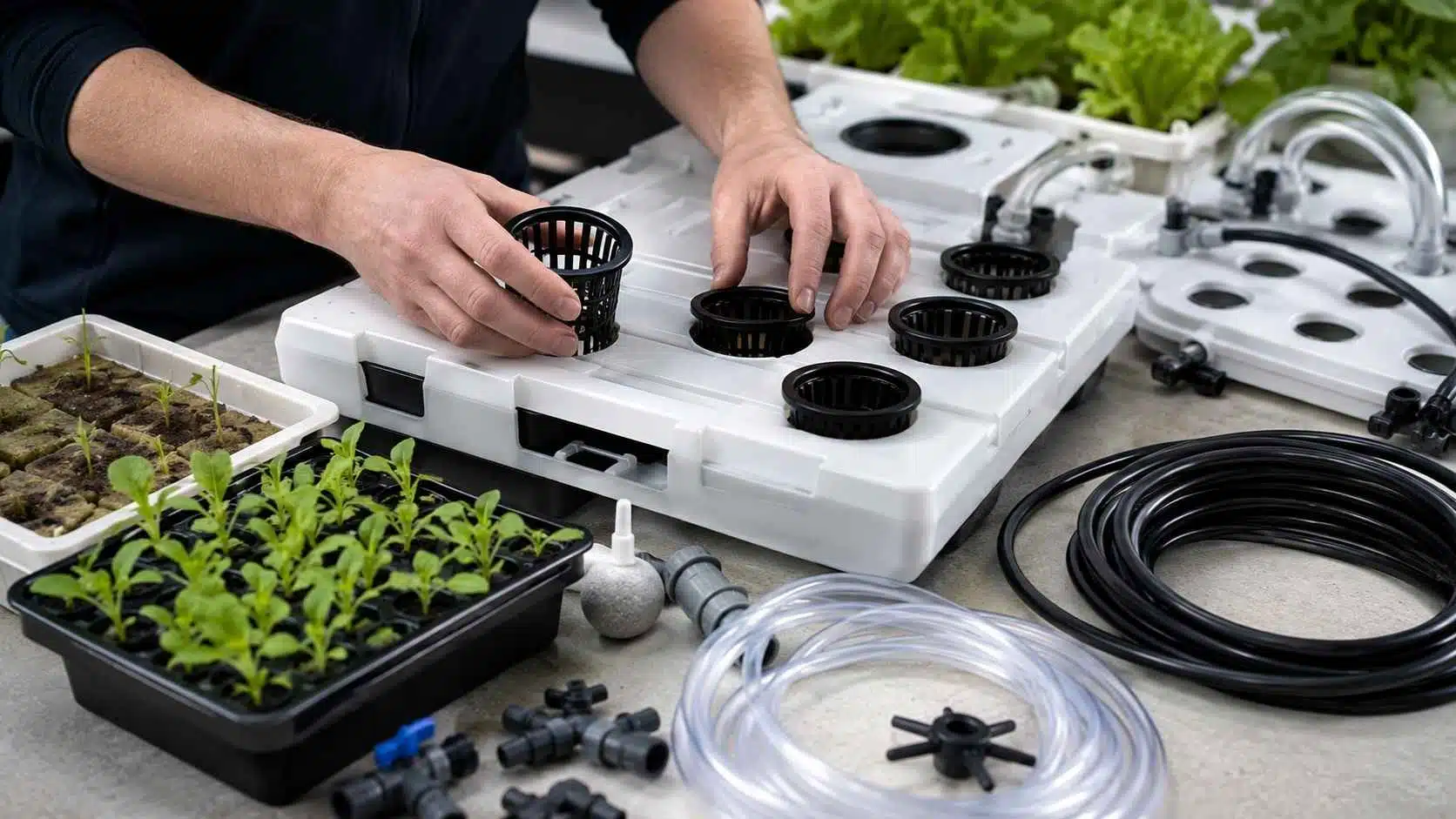
Quick Overview About These 6 Dutch Hydroponic Hardware Innovators
| Company | Main Hardware Focus | Dutch Base | Best Fit | Business Type |
| Dry Hydroponics | Floating crop-holder hydroponic system | Schipluiden | Leafy greens, herbs, flowers | Specialist hydroponic system company |
| Botman Hydroponics | DWC floating rafts, propagation trays, aeration systems | Hoorn | Lettuce, leafy crops, CEA greenhouses | Small hydroponic hardware company |
| Meteor Systems | Floating rafts, multilayer racks, hydroponic inlays, growing systems | Breda | Leafy greens, herbs, indoor growing systems | Growing-system manufacturer |
| JB Hydroponics | Custom growing systems, gutters, substrates, drainage collection | Bergschenhoek | Vegetables, soft fruit, herbs, flowers | Hydroponic growing-system supplier |
| Logiqs | Automated benching, mobile growing systems, vertical farm logistics | Maasdijk | Greenhouse automation and plant movement | Automation and logistics hardware SME |
| Bosman Van Zaal | Vertical farm systems, robotics, cultivation equipment, CEA installations | Aalsmeer | Turnkey indoor farms and high-tech plant production | Horticultural technology company |
What These Dutch Hydroponic Hardware Innovators Reveal About Indoor Agriculture
The main lesson is simple: indoor agriculture is hardware-heavy. Software matters. Sensors matter. AI matters. But none of it saves a badly designed growing system.
Dry Hydroponics and Botman Hydroponics show how much innovation still exists in floating crop systems and water-based cultivation. Meteor Systems and JB Hydroponics show the importance of durable, crop-specific growing hardware. Logiqs shows why plant movement and automation matter once a farm scales. Bosman Van Zaal shows how integrated systems bring all those parts together.
This is also why the Netherlands remains so relevant. Dutch horticulture has never treated growing as only biology. It has treated growing as biology plus engineering. Indoor agriculture needs exactly that mindset.
What Buyers Should Check Before Choosing Hydroponic Hardware
Before choosing a hydroponic hardware supplier, growers should ask practical questions:
- Which crop is the system actually designed for?
- Does the system support leafy greens, herbs, soft fruit, flowers, or vine crops?
- Is it suitable for greenhouse, indoor farm, vertical farm, or hybrid production?
- How does it manage water flow, oxygen, drainage, and nutrient delivery?
- Can the hardware be cleaned properly between crop cycles?
- Is the system compatible with automation, harvesting, and crop movement?
- What is the expected service life of the hardware?
- Can the supplier support installation, training, and maintenance?
- Does the system integrate with climate, irrigation, lighting, and control software?
- Does the business case still work after labour, energy, water treatment, and maintenance costs?
The last question matters most. Hydroponic hardware should not only grow plants. It should support a farm that can actually make money.
Business Opportunity in Dutch Hydroponic Hardware
Indoor agriculture is going through a reality check. The first wave of vertical farming hype made everything sound easy. Put plants indoors, add LEDs, automate everything, and grow food anywhere. The market has now learned that the economics are harder.
Energy costs matter. Labour matters. Crop selection matters. System uptime matters. Cleaning matters. Water quality matters. Hardware lifespan matters. That is good news for serious Dutch suppliers.
The next phase of indoor agriculture will reward companies that reduce operational friction. That means better floating systems, more durable rafts, smarter crop movement, efficient irrigation, lower labour handling, cleaner propagation, modular systems, and integrations that make a farm easier to run.
Dutch hydroponic hardware innovators are well positioned because many of them come from practical greenhouse culture. They are not only building for investor presentations. They are building for growers.
Wrapping Up
Hydroponic indoor agriculture is not transformed by one magic system. It is transformed by many pieces working well together.
Dry Hydroponics and Botman Hydroponics are strong fits for growers focused on cultivation on water. Meteor Systems and JB Hydroponics support the growing-system and root-zone hardware that commercial growers depend on. Logiqs solves the movement and automation layer that becomes critical at scale. Bosman Van Zaal brings wider system integration for serious controlled-environment projects.
The best buyers will not ask only, “Which system looks modern?” They will ask, “Which hardware makes the crop cleaner, the workflow easier, the water loop safer, the labour model lighter, and the business case stronger?”
That is where Dutch hydroponic hardware innovators are doing their real work.
Frequently Asked Questions About Dutch Hydroponic Hardware Innovators
1. What is hydroponic hardware?
Hydroponic hardware includes the physical systems used to grow crops without soil. This can include rafts, gutters, grow tables, crop holders, pumps, irrigation lines, aeration systems, benches, trays, racks, and automation equipment.
2. Why is the Netherlands strong in hydroponic hardware?
The Netherlands has a long history in high-tech horticulture, greenhouse engineering, irrigation, water management, and controlled-environment agriculture. That gives Dutch companies practical experience in building systems that growers can use at commercial scale.
3. Are all these companies startups?
No. This article uses the term “innovators,” not startups. Some companies are small specialist firms, while others are established horticultural technology companies. The common factor is their practical contribution to hydroponic and indoor-agriculture hardware.
4. Is hydroponics always cheaper than soil farming?
No. Hydroponic systems can improve water efficiency, yield control, cleanliness, and space use, but they also require upfront investment, technical management, and operational discipline. The business case depends on crop, market price, labour, energy, water quality, and scale.
5. What should growers avoid when buying hydroponic hardware?
Growers should avoid buying hardware before confirming crop suitability, water-management requirements, cleaning workflow, automation compatibility, installation support, and long-term operating costs. A system that looks efficient on paper can fail if it does not fit the farm’s real workflow.