
A content site with traffic but no revenue plan is not a business. It is a publishing habit with hosting costs.
That sounds harsh, but it is the reality many blogs, niche sites, and digital publishers eventually face. They publish articles, chase search traffic, share links on social media, maybe add a few display ads, and hope income appears. Sometimes it does. Often it does not.
The best monetization strategies do not start with “How do we squeeze money from readers?” They start with a better question: what value does this site create, who benefits from that value, and which revenue model matches the relationship?
A content site can make money through ads, affiliate links, subscriptions, memberships, newsletters, sponsored content, digital products, events, consulting, lead generation, or licensing. But not every model fits every audience. A recipe blog, a B2B research site, a local publisher, and an affiliate review site should not use the same revenue mix.
The goal is not to bolt on every possible income stream. The goal is to build a revenue system that fits the content, protects reader trust, and gives the site a reason to keep improving.
Our Selection Criteria
We selected these strategies based on practical usefulness for publishers, bloggers, niche site owners, newsletters, and editorial content businesses.
| Criteria | What We Looked For |
|---|---|
| Revenue potential | Can the strategy generate meaningful income for a content site? |
| Audience fit | Does it match how readers use and trust the site? |
| Editorial compatibility | Can it work without damaging content quality? |
| Scalability | Can the model grow as traffic, authority, or audience loyalty grows? |
| Trust risk | Does it require clear disclosure, careful positioning, or stronger editorial controls? |
| Operational load | Can a small team realistically manage it? |
Who This Is For
These monetization strategies are useful for niche bloggers, SEO content sites, independent publishers, local media brands, newsletter operators, B2B content teams, affiliate publishers, educational sites, and creators building content-first businesses.
They are especially useful if your site has traffic but weak income, a loyal audience but no paid offer, or strong editorial authority that has not yet been turned into sustainable publisher revenue.
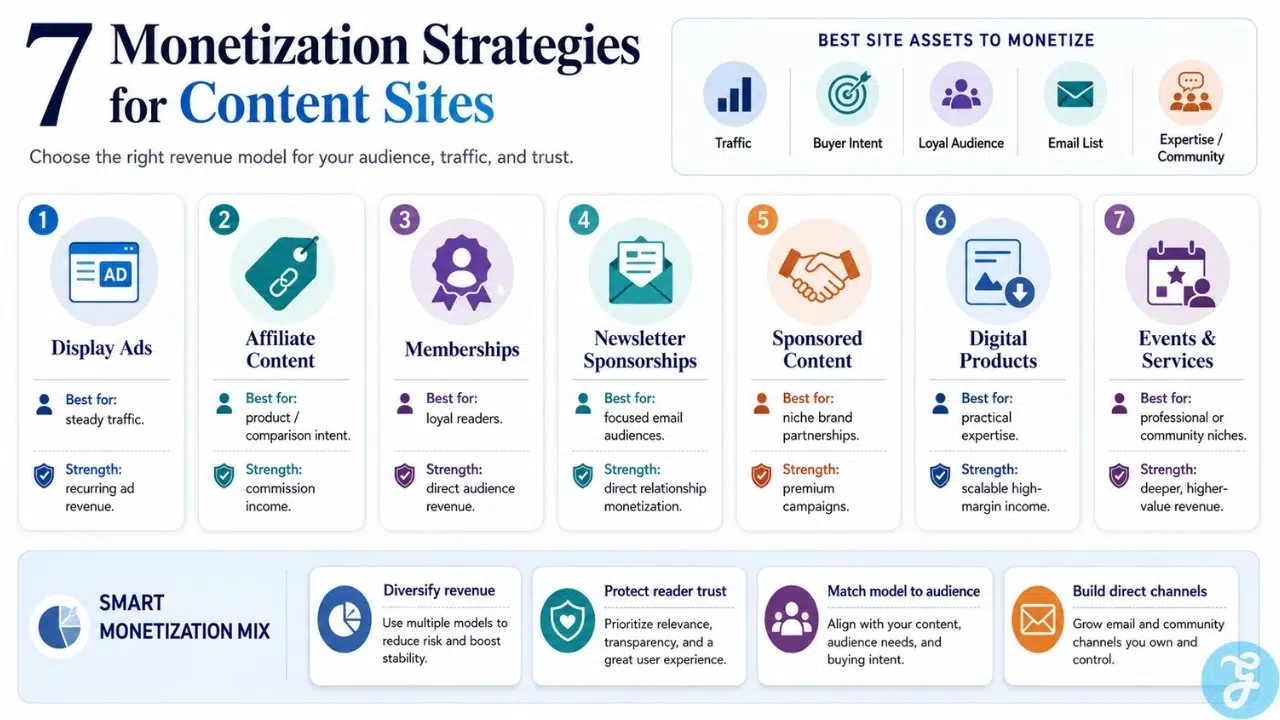
7 Monetization Strategies for Content Sites
Before choosing a revenue model, be honest about your site’s strongest asset. Is it traffic volume, reader trust, niche expertise, buyer intent, community, original research, or an email list?
Different assets support different revenue models.
1. Display Advertising and Direct Sponsorships
Display ads are the most familiar form of blog monetization. A site earns money by showing ads through networks, programmatic platforms, or direct advertiser deals.
This model works best when a site has steady traffic, brand-safe content, clean user experience, and enough pageviews to make ad revenue meaningful. For smaller sites, basic ad networks may produce modest income. For larger publishers, direct sponsorships and premium ad placements can become more valuable because advertisers pay for access to a specific audience.
The danger is overloading pages with ads until readers leave. More ad units can increase short-term revenue while damaging long-term trust, speed, readability, and return visits.
Best Feature/For:
- Best for sites with steady traffic volume
- Great for publishers, blogs, news sites, lifestyle sites, and niche media brands
Why We Chose It:
- Easy to understand and widely used
- Can create recurring passive or semi-passive revenue
- Works alongside other monetization strategies
- Direct sponsorships can pay better than generic ad inventory
Things to consider:
- Too many ads can weaken user experience
- Sites need policy compliance, quality content, and clean ad placement
- Ad revenue can fluctuate with traffic, seasonality, and advertiser demand
2. Affiliate Marketing and Commerce Content
Affiliate marketing works when a content site recommends products, tools, services, courses, books, software, or marketplaces and earns a commission when readers buy through tracked links.
This model is strongest when the site attracts readers with buying or comparison intent. Articles like “best tools,” “X vs Y,” “reviews,” “alternatives,” “setup guides,” and “buyer checklists” can support affiliate revenue when they are honest and useful.
The trust risk is obvious. If readers feel every recommendation exists only for commission, the site loses credibility. Good affiliate content explains trade-offs, identifies who the product is not for, and avoids pretending every option is perfect.
Best Feature/For:
- Best for content with buyer intent
- Great for review sites, niche blogs, SaaS comparison sites, hobby sites, and product-focused publishers
Why We Chose It:
- Can generate revenue without creating your own product
- Works well with SEO content and comparison pages
- Helps readers make purchase decisions
- Can scale across evergreen articles and content hubs
Things to consider:
- Disclose affiliate relationships clearly
- Avoid recommending products you cannot explain honestly
- Update affiliate content because prices, features, and availability change
3. Paid Subscriptions and Memberships
Subscriptions and memberships turn loyal readers into paying supporters. A subscription usually gates premium content. A membership may include access, community, events, perks, early releases, or a sense of supporting independent work.
This model works best when readers believe the site offers something they cannot easily replace. That might be original reporting, expert analysis, niche research, templates, market intelligence, community access, or deeply useful explainers.
Subscriptions are not magic. They require consistent value, strong positioning, and a clear reason to pay. If the free content is weak, readers will not assume the paid content is better.
Best Feature/For:
- Best for loyal, high-trust audiences
- Great for publishers, expert blogs, niche research sites, local media, and analysis-driven content brands
Why We Chose It:
- Builds direct reader revenue
- Reduces dependence on platforms and ad markets
- Rewards depth, quality, and consistency
- Can create a stronger relationship with the audience
Things to consider:
- Requires a clear paid value promise
- Churn matters as much as signup growth
- Do not put everything behind a paywall if discovery still depends on open content
4. Newsletter Sponsorships and Paid Email Products
A strong newsletter can become a revenue channel even when the website itself is not huge. Newsletter monetization can include sponsorships, classified ads, native placements, affiliate links, premium editions, paid briefings, or member-only email products.
This works because newsletters create a direct relationship. Advertisers often value a focused, engaged email audience more than anonymous pageviews. Readers also develop habits around good newsletters when the promise is clear.
For content sites, newsletters can support both revenue and retention. A free newsletter can grow the audience and sell sponsorships. A paid newsletter can package deeper analysis, curated research, premium recommendations, or expert commentary.
Best Feature/For:
- Best for direct audience monetization
- Great for publishers, niche blogs, B2B sites, creator-led media, and expert newsletters
Why We Chose It:
- Builds a direct channel outside search and social platforms
- Can support ads, sponsorships, affiliate offers, or paid subscriptions
- Works well for niche audiences with clear interests
- Helps turn casual readers into returning readers
Things to consider:
- Weak newsletters quickly become inbox clutter
- Sponsorships should fit the audience
- Deliverability, list hygiene, and unsubscribe clarity matter
5. Sponsored Content and Brand Partnerships
Sponsored content can generate strong revenue when a brand pays for editorial-style content, custom campaigns, research, guides, webinars, videos, or newsletter placements.
This strategy works best when the publisher has a clearly defined audience that brands want to reach. A niche B2B site, parenting site, finance blog, health publisher, travel site, or industry media brand may attract sponsors because the audience is specific and valuable.
The line between useful sponsored content and disguised advertising must stay clear. Readers should know when content is sponsored. The editorial team should also protect quality standards so paid content does not feel like a brand brochure pretending to be journalism.
Best Feature/For:
- Best for trusted sites with a valuable niche audience
- Great for publishers, B2B media, industry blogs, newsletters, and creator-led content brands
Why We Chose It:
- Can pay better than standard display ads
- Lets publishers create custom packages around audience access
- Works across articles, newsletters, webinars, reports, and social distribution
- Supports publisher revenue without always gating content
Things to consider:
- Clear disclosure is essential
- Sponsored content should still be useful to readers
- Too many weak brand pieces can damage editorial trust
6. Digital Products, Templates, Courses, and Resources
A content site can turn its expertise into products. These may include ebooks, templates, swipe files, worksheets, paid reports, courses, calculators, Notion dashboards, spreadsheets, toolkits, design assets, or research databases.
This is one of the strongest content site income models when the audience has a clear problem and the site has practical expertise. For example, a personal finance blog can sell budgeting templates. A marketing site can sell content calendars. A career site can sell resume kits. A technical site can sell checklists or implementation guides.
The best digital products save time, reduce confusion, or help readers get a result faster. The weakest ones are just blog posts turned into PDFs with a checkout button.
Best Feature/For:
- Best for turning expertise into scalable products
- Great for educational sites, niche blogs, B2B content teams, creators, and expert publishers
Why We Chose It:
- Does not require huge traffic if the audience is targeted
- Can create high-margin revenue
- Builds naturally from existing content topics
- Gives readers practical tools, not just information
Things to consider:
- Product quality matters more than format
- Build from proven reader demand, not guesses
- Keep the offer specific and outcome-focused
7. Events, Webinars, Communities, and Services
Some content sites monetize by turning audience trust into deeper interaction. This can include paid events, workshops, webinars, private communities, mastermind groups, consulting, coaching, recruitment services, directories, lead generation, or research services.
This strategy works especially well when the site serves a professional, local, or high-value niche. Readers may come for content, but they pay for access, guidance, connection, training, or opportunities.
For publishers, events and services can also diversify revenue beyond ads and subscriptions. A B2B media site can host industry webinars. A local publisher can run community events. A niche education site can sell workshops. A specialist blog can offer consulting or audits.
Best Feature/For:
- Best for turning audience trust into deeper value
- Great for B2B publishers, local media, expert blogs, education sites, and professional communities
Why We Chose It:
- Creates revenue beyond pageviews
- Builds stronger audience relationships
- Can support sponsorships, ticket sales, memberships, and lead generation
- Makes the content brand more useful in the real world
Things to consider:
- Events and services require more operations than ads or affiliates
- Community needs moderation and consistency
- Do not offer services that the team cannot deliver well
A Quick Overview
These monetization strategies work best when they match the site’s strongest audience asset. High-traffic sites may start with ads, buyer-intent sites may lean into affiliate revenue, trusted editorial brands may build memberships, and expert niche sites may earn more from products, events, or services than from pageviews alone.
| Strategy | Best Use | Main Benefit | Best Fit |
| Display ads and sponsorships | Traffic monetization | Recurring ad revenue | Publishers, blogs, media sites |
| Affiliate and commerce content | Buyer-intent traffic | Commission income | Review sites, niche blogs |
| Subscriptions and memberships | Loyal audience revenue | Direct reader income | Publishers, expert sites |
| Newsletter monetization | Direct relationship revenue | Sponsorships and paid email | Newsletters, niche publishers |
| Sponsored content | Brand-funded publishing | Higher-value campaigns | B2B, lifestyle, industry sites |
| Digital products | Expertise monetization | Scalable product income | Education, templates, expert blogs |
| Events and services | Deeper audience value | High-touch revenue | B2B, local, professional niches |
Our Top 3 Picks and Why
1. Newsletter Sponsorships and Paid Email Products
This is one of the most useful strategies because it strengthens direct audience relationships. A good newsletter can support sponsorships, reader retention, affiliate offers, paid products, and premium subscriptions.
2. Digital Products, Templates, Courses, and Resources
This strategy can work even without massive traffic. If the site solves a specific problem for a specific audience, a practical product can produce stronger income than generic ads.
3. Paid Subscriptions and Memberships
Subscriptions are hard, but powerful when the content is distinctive. They reward trust, consistency, and original value rather than raw pageview volume.
How to Choose the Right Monetization Strategy
Start with your audience, not the revenue model.
If your site has high traffic but low loyalty, ads may be the simplest starting point. If your readers compare products before buying, affiliate content may fit. If your audience returns often and trusts your voice, subscriptions or memberships may work. If your readers need practical tools, digital products may be stronger. If your audience is professional or high-value, events, webinars, and services may outperform passive revenue models.
A simple selection framework:
- Pick display ads if your site has strong traffic volume.
- Pick affiliate marketing if your content attracts buying intent.
- Pick subscriptions or memberships if readers see your content as hard to replace.
- Pick newsletter monetization if you have a focused email audience.
- Pick sponsored content if brands want access to your niche audience.
- Pick digital products if your expertise can save readers time or money.
- Pick events or services if your audience needs connection, training, or direct help.
Final Checklist Before Monetizing a Content Site
Before adding a revenue model, ask:
- What audience asset do we actually have: traffic, trust, buyer intent, email list, community, or expertise?
- Will this monetization model improve or damage reader trust?
- Do we need disclosure, policy review, or clearer editorial standards?
- Can the team maintain this revenue stream consistently?
- Does the strategy support long-term content quality?
- Are we measuring profit, not just revenue?
- What happens if one revenue stream drops suddenly?
Sustainable Revenue Comes From Fit, Not Desperation
The best monetization strategies do not treat readers like inventory. They treat reader attention as something earned.
A content site can make money in many ways, but the wrong model can damage the very trust that made the site valuable. Ads can work. Affiliates can work. Subscriptions can work. Sponsored content, products, newsletters, events, and services can all work.
The question is not which model is fashionable. The question is which model fits your audience, your editorial promise, and your ability to deliver value consistently.
Monetization is not the end of content strategy. It is the test of whether the strategy creates something people, advertisers, sponsors, or buyers genuinely value.
Frequently Asked Questions (FAQs) on Monetization Strategy
What are monetization strategies for content sites?
Monetization strategies are methods content sites use to generate income from their audience, traffic, expertise, or brand. Common examples include ads, affiliate marketing, subscriptions, newsletters, sponsored content, digital products, events, and services.
What is the best monetization strategy for a blog?
The best blog monetization strategy depends on the blog’s audience and content type. High-traffic blogs may use ads, buyer-intent blogs may use affiliate marketing, and expert blogs may earn more from products, courses, memberships, or services.
How do publishers increase revenue from content?
Publishers increase revenue by diversifying beyond one income stream, improving audience loyalty, growing direct channels like newsletters, creating premium offers, selling sponsorships, and protecting reader trust.
Can small content sites make money?
Yes. Small content sites can make money when they serve a clear niche. They may not earn much from display ads at first, but affiliate offers, digital products, newsletters, consulting, or niche sponsorships can work with smaller but focused audiences.
Should content sites use more than one monetization model?
Usually, yes. Relying on one revenue stream can be risky. A healthy content site may combine ads, affiliate revenue, newsletters, products, subscriptions, sponsorships, or services depending on its audience and business goals.