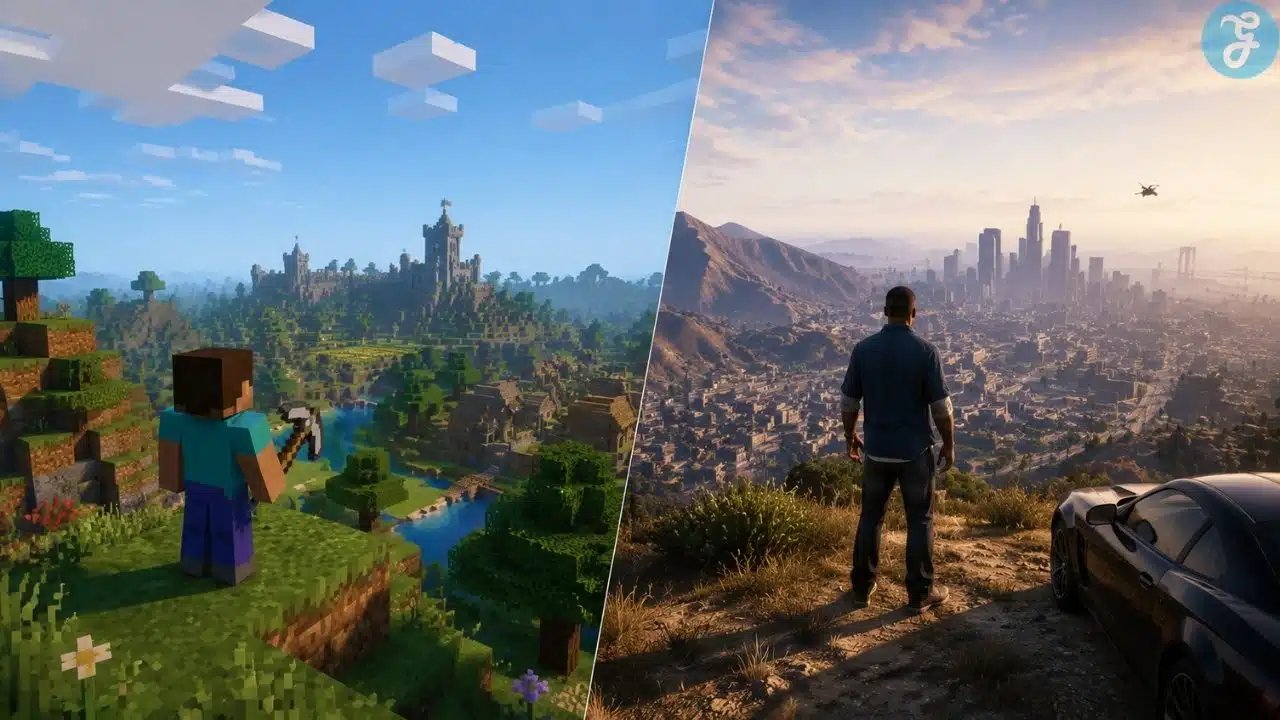
Sandbox vs Open World Games is often treated like a simple comparison, but the difference becomes clearer only after you spend time inside both styles of games. They may look similar on the surface because both give players large environments and freedom of movement, but the design philosophy behind them is not the same.
A lot of confusion comes from how modern games blend both ideas. Minecraft, GTA, Skyrim, and Red Dead Redemption 2 all get mentioned in the same discussions, even though they are built around different priorities. The difference is not about map size. It is about how much direction the game gives you.
I’ve spent a lot of time in both types, especially GTA and Minecraft, and the contrast shows up more in how you play than what you see on screen.
Sandbox Games And Player-Driven Systems
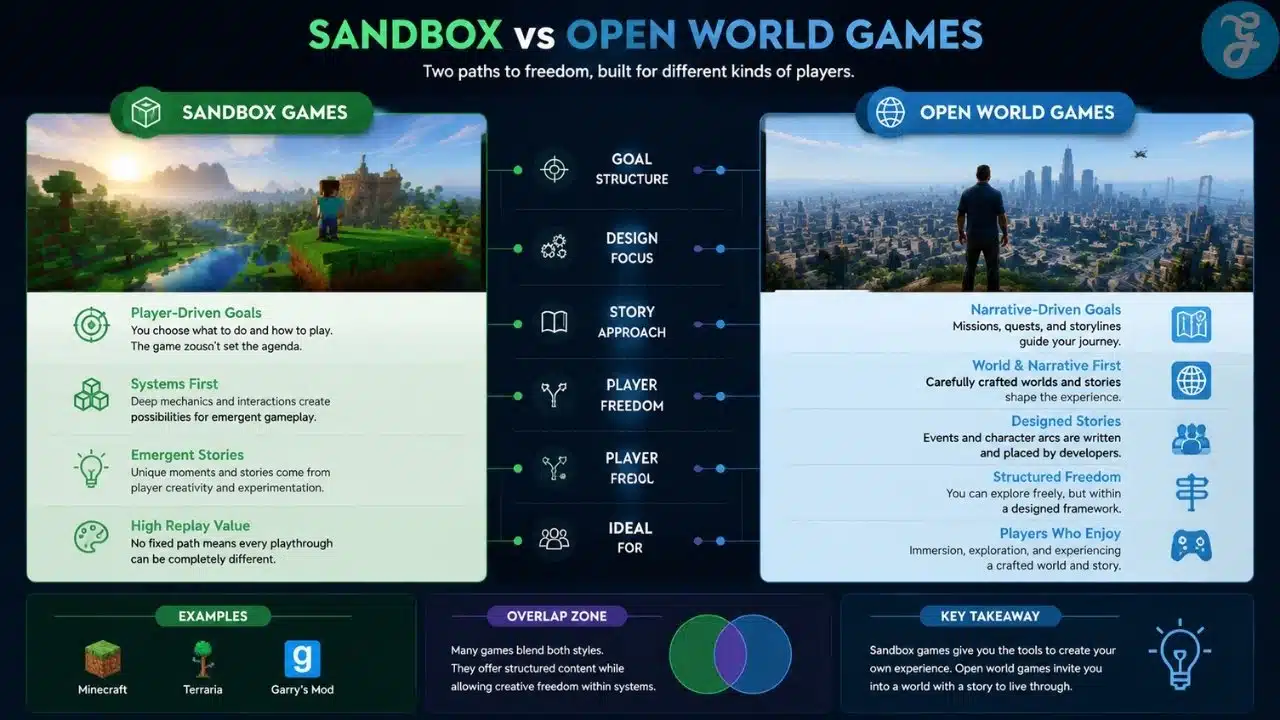
Sandbox games are built around systems first, not structure. The game gives you tools and mechanics, but does not push you toward a fixed path.
There is usually no strict order of progression. You are not following a storyline step by step unless you choose to. Instead, you decide what the experience becomes.
Minecraft is the clearest example of this design. You can survive, build, explore, experiment, or ignore survival systems entirely depending on how you want to play. The game does not enforce a single direction.
What defines sandbox design is flexibility in interaction. Systems connect in ways that allow experimentation rather than restriction. Players create meaning through what they do, not through what the game tells them to do.
Because of this, sandbox games often feel different every time you return to them. The structure is not in the game world itself, but in how the player chooses to engage with it.
Open World Games And Structured Freedom
Open world games work differently. They give you a large environment to explore, but the experience is still guided through missions, storylines, and designed progression.
Games like GTA and The Witcher 3 are open world, but they are not directionless. There is always an underlying structure shaping your journey.
You can move freely, explore side activities, or ignore the main path for a while, but the game still expects you to follow a narrative framework at some point. That structure is intentional.
In GTA, for example, free roam allows experimentation, but the core experience is still mission-driven. The story, characters, and progression systems are designed to guide the player through specific arcs.
Open world design focuses on exploration inside a controlled experience. Freedom exists, but it sits inside a defined structure.
Where The Difference Actually Matters
The overlap between sandbox and open world becomes clearer when you stop thinking about geography and start focusing on control.
Sandbox games give control over what the experience becomes. Open world games give control over how you move through an experience that already exists.
This is why Minecraft feels open-ended in a way GTA does not. Minecraft does not require direction. GTA always has direction, even if you ignore it for a while.
Both allow freedom, but they distribute it differently.
When Games Sit In Both Categories
Many modern games do not fit neatly into one category.
Minecraft survival mode introduces progression systems that feel more structured. GTA includes systems like physics interactions, exploration freedom, and player-driven chaos that resemble sandbox behavior.
Even games like Skyrim or Red Dead Redemption 2 blur the line. Players often treat them like sandbox experiences because of how open the world feels, even though they are built around narrative design.
This overlap is why the terms get confused in casual discussions. The categories are not strict boxes. They are design priorities.
Player Creativity Vs Designed Experience
Sandbox games rely heavily on player creativity. The game provides systems, and the player defines how those systems are used. That creates unpredictable outcomes and personal play styles.
Open world games rely more on crafted experiences. The world, missions, and pacing are designed by developers, and the player experiences them in different orders, but not different meanings.
One is about creating outcomes. The other is about experiencing content.
This difference affects how players engage with the game over time. Sandbox games often feel self-directed. Open world games feel authored, even when they allow freedom.
Common Misunderstandings Between The Two
A common assumption is that sandbox games are simply “bigger” or “more open” versions of open world games. That is not accurate.
Size does not define either category. A sandbox game can be small but highly flexible. An open world game can be large but tightly structured.
Another misunderstanding is that open world games are less free. In reality, they offer movement freedom but limit narrative freedom. Sandbox games do the opposite by removing narrative structure but allowing system freedom.
The real difference is not freedom versus restriction. It is freedom of direction versus freedom of expression.
Why Both Genres Stay Relevant
Sandbox and open world games remain popular for different reasons.
Sandbox games attract players who enjoy experimentation. They reward curiosity and allow players to build their own goals without pressure.
Open world games attract players who enjoy immersion and storytelling. They provide a sense of place and narrative progression inside a large explorable environment.
Modern games often combine both approaches because players want both structure and flexibility in different proportions.
Final Perspective
Sandbox vs Open World Games is not a comparison of scale or complexity. It is a comparison of design intent.
Sandbox games are built to let players define the experience. Open world games are built to let players explore a designed experience at their own pace.
Minecraft shows what happens when systems are open-ended. GTA shows what happens when structure exists inside freedom.
Most modern games now sit between these two ideas, blending system freedom with narrative direction depending on what the experience is meant to deliver.