The tablet classroom failed because adults confused access with education. I know that sounds harsh, especially coming from someone who works inside digital media, technology, SaaS, e-learning, and AI-powered content tools.
At Editorialge Media LLC, we are not anti-technology. We operate in the space where media, e-learning, gaming, software, and digital life meet. We understand that the right tool can save time, improve access, and open creative possibilities. Our own ecosystem includes platforms like AI image creation software and an e-learning site, so I am not writing this as someone who thinks classrooms should freeze in 1998.
But I am saying this clearly: putting a tablet in every student’s hand did not magically create better learning.
For years, schools were sold the dream of 1:1 device programs. Every child would get a tablet or a laptop. Every lesson would become interactive. Every student would learn at their own pace. Teachers would finally have dashboards, real-time data, personalized learning paths, and digital assignments. It sounded modern. It sounded fair. It sounded inevitable.
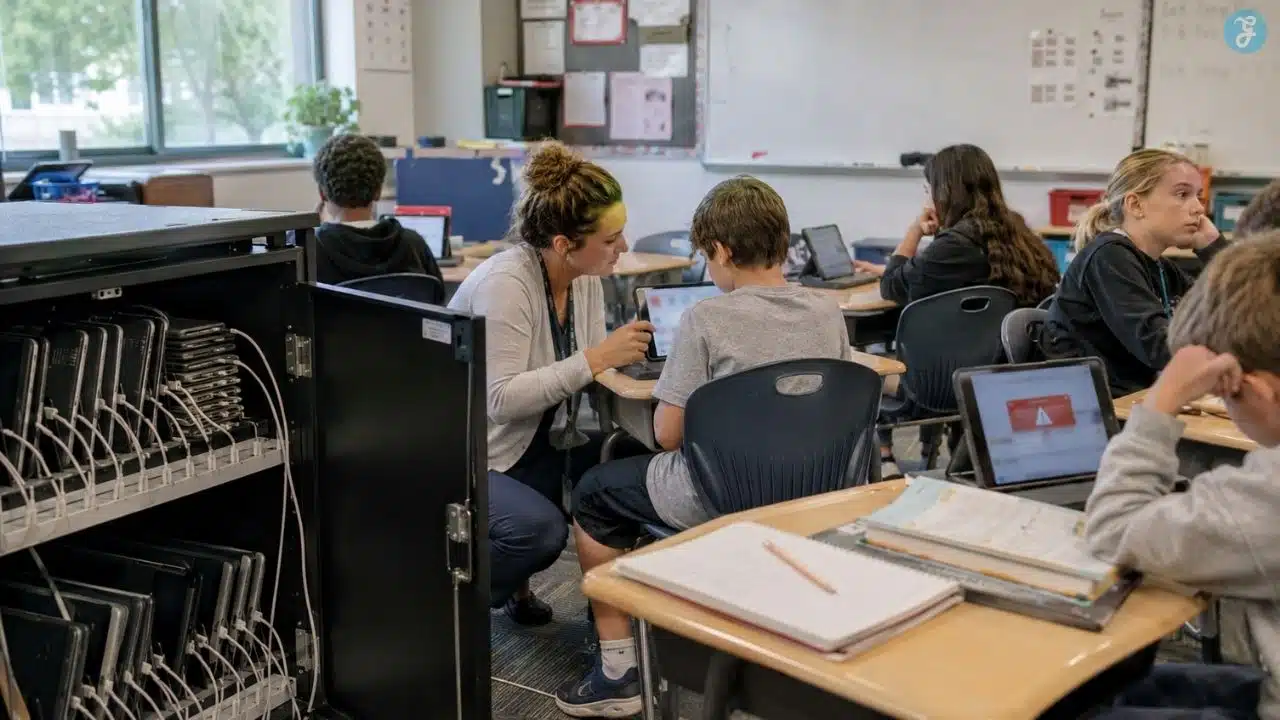
Then the classroom reality arrived. Broken devices. Dead batteries. Forgotten chargers. Distraction. Shallow app work. Teachers turned into tech support. Students are clicking through lessons without thinking. Administrators celebrate device distribution as if handing out hardware were the same as improving education.
That is the story no one in edtech marketing wants to tell.
The Original Promise Of 1:1 Device Programs Was Not Stupid
Let’s be fair. The idea behind 1:1 device programs was not ridiculous. Many students needed access to digital tools. Some families did not have reliable devices at home.
Some schools had outdated computer labs. Digital learning could help students research, write, collaborate, revise, practice, and create. For disabled learners, multilingual learners, remote learners, and students in under-resourced areas, technology can be genuinely useful.
UNESCO’s 2023 Global Education Monitoring Report recognizes that technology can support access, equity, inclusion, system management, and learning quality when used appropriately. But the same report warns that technology can also be harmful when its use is not evidence-based, equitable, scalable, or centered on learners and teachers.
That is the missing sentence in most tablet rollout speeches. Technology can help. Technology can also waste money, fracture attention, and make weak teaching look modern. The problem was not that schools wanted digital access. The problem was that many schools treated tablets as the reform itself.
The Tablet Became A Symbol Instead Of A Strategy
A device is easy to photograph. A tablet rollout looks good in a press release. A room full of students looking at screens feels like progress to people who do not spend their lives teaching children. But education is not transformed by optics.
A good education system needs strong teachers, a clear curriculum, a reading culture, feedback, practice, discussion, discipline, curiosity, assessment that matters, and human relationships. A tablet does not automatically provide any of that.
It can support those things. It can also interrupt them. That is where the classroom tablets’ failure really started. The device became the strategy. The purchase order became the plan. The rollout became the reform.
| What Schools Often Bought | What Students Actually Needed |
| Tablets or laptops | Better teaching and guided practice |
| Digital dashboards | Human feedback and explanation |
| Learning apps | Strong curriculum and real comprehension |
| Device access | Purposeful use and boundaries |
| Online assignments | Deeper thinking and discussion |
| Data reports | Better instructional decisions |
| Digital engagement | Real attention and memory |
A tablet can deliver a lesson. It cannot decide whether the lesson is worth learning.
The Evidence Was Never As Strong As The Hype
One of the most damaging parts of the tablet movement was how confidently weak evidence was sold as inevitability. The research on school technology is mixed. Some targeted digital tools improve specific skills when used well. But broad device-heavy programs do not automatically improve learning outcomes.
OECD research on students, digital devices, and success shows a more complicated picture than edtech marketing usually admits. Digital distraction is associated with lower performance, and students who report being distracted by peers using digital devices score significantly lower in mathematics.
PISA-related OECD findings also show that using digital devices at school is not automatically beneficial. Moderate, purposeful use may help, but excessive or poorly managed use can hurt learning. That should have changed how schools bought devices. Instead, many systems kept asking the wrong question.
They asked:
“How many students have devices?”
They should have asked:
“What learning problem does this device solve better than paper, discussion, books, or teacher-led instruction?”
Those are not the same question. We should dig deeper into why Edtech failed kids and why classrooms need a reset.
The One Laptop Per Child Lesson Was Ignored
The One Laptop per Child program should have made policymakers more cautious. A large randomized evaluation of the program in Peru found that providing laptops increased computer access and use, but did not improve test scores in math or language after 15 months.
A later long-term follow-up also found that providing laptops did not have a positive impact on educational outcomes, with researchers pointing to weak effects on cognitive skills and limited classroom adoption. That does not mean all device programs fail. It means access alone is not enough.
The lesson was obvious: if students get devices without strong instructional integration, teacher support, curriculum alignment, and clear learning goals, the device becomes a very expensive notebook with distractions built in. And yet, many school systems rushed into tablet and laptop programs as if the lesson did not exist.
The LA iPad Rollout Became The Cautionary Tale
If anyone wants a case study in school tech rollout problems, the Los Angeles Unified School District iPad program is still hard to ignore.
The plan was ambitious: provide iPads to students and teachers, loaded with digital curriculum. But problems surfaced quickly. Reporting on the rollout noted that LAUSD bought 43,261 iPads loaded with curriculum, with the broader effort tied to a cost of about $1.3 billion, and issues appeared during the early rollout at 47 schools in 2013.
The Hechinger Report described the rollout as a national cautionary tale, noting that other districts slowed technology rollouts until device rules were clearer and teachers had more training.
That last phrase matters: rules and training. This is where many 1:1 device programs fell apart. Schools bought devices before they built the human system around them.
Students need rules. Teachers need training. Parents need clarity. IT teams need capacity. Curriculum needs to be redesigned. Administrators need patience. Without those things, a tablet rollout is not innovation. It is chaos with a charging cart.
The Real Problem Was Implementation, But Not In The Lazy Way Vendors Use The Word
Whenever edtech disappoints, someone says, “The problem was implementation.” That can be true. But the phrase is often used dishonestly.
It becomes a polite way of saying:
- The product was fine; teachers failed.
- The device was fine; students misused it.
- The platform was fine; schools were not ready.
- The idea was fine; reality was inconvenient.
No. Poor implementation is not some tiny detail. In education, implementation is the product.
- A tablet program without teacher training is not half a program. It is a bad program.
- A device rollout without classroom rules is not complete. It is reckless.
- A digital curriculum without evidence is not innovative. It is experimental.
- A dashboard without instructional judgment is not data-driven. It is a decoration.
That is why school tech rollout problems were not accidents. They were predictable.
Teachers Were Handed Devices, Then Blamed For The Mess
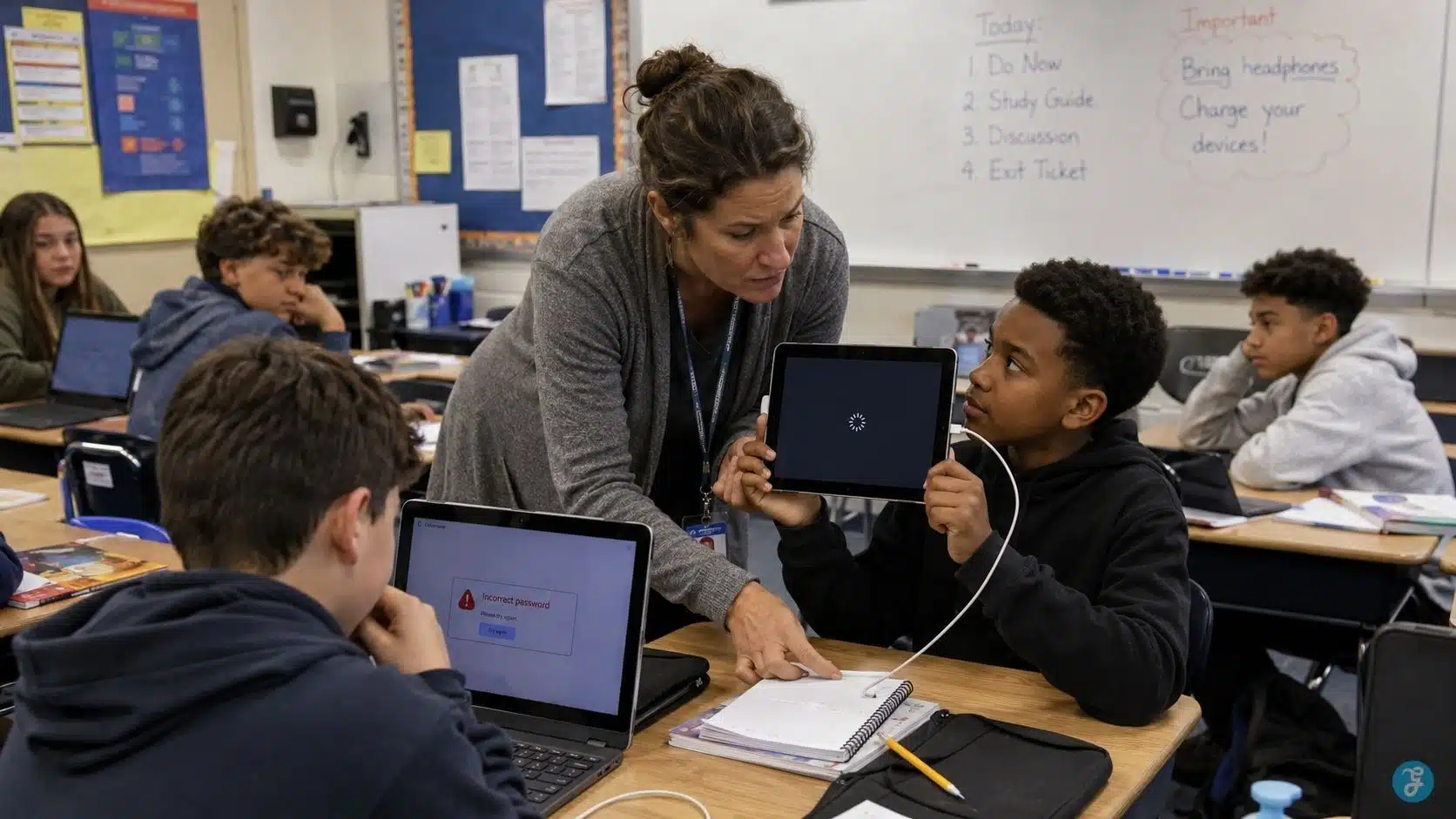
Teachers were often expected to absorb tablet programs on top of everything else. They had to manage lesson plans, student behavior, digital submissions, login issues, broken screens, blocked websites, app updates, platform glitches, charging problems, parent questions, and administrative pressure to “use the technology.” That is not support. That is burden transfer.
A UK Department for Education technology survey found that only 18% of teachers had undertaken training on how to use technology to improve pedagogy or learning outcomes since the start of the academic year, while 34% had not undertaken any such edtech training during that period.
This explains why so many tablet programs became shallow. Teachers were not always given the time, training, or professional trust needed to turn devices into meaningful learning tools. Instead, they were handed hardware and expected to perform digital transformation by Monday morning.
If the teacher is not supported, the tablet does not become a learning tool. It becomes another classroom management problem.
Students Did Not Become More Focused. Many Became More Distracted
This is the part every parent and teacher already knows.
A tablet is not a neutral object in a child’s hand. It is a portal. Even when the device is locked down, it still changes the learning environment. Students can switch tasks faster. They can click instead of thinking. They can hide confusion behind screen activity. They can appear busy while mentally leaving the lesson.
OECD’s PISA-based analysis found that digital distraction is not a small issue. Students distracted by peers using digital devices scored lower in mathematics, and distraction from digital devices was linked to learning concerns.
This does not mean students should never use devices. It means adults should stop pretending that all screen-based learning is harmless.
Attention is not a minor classroom detail. Attention is the doorway to learning. When a tablet damages attention, everything after that becomes weaker: memory, comprehension, discussion, writing, problem-solving, and patience.
The Screen Replaced The Book Too Quickly
One of the strongest signs of the backlash is in Sweden.
Sweden, once known for digital-forward schooling, began investing again in textbooks, reading time, and reduced screen dependence. The Swedish government said in 2024 that pupils need more textbooks and that physical books are important for pupils’ learning and teachers’ work.
Associated Press also reported that Sweden was bringing books and handwriting practice back into tech-heavy schools after concerns about the overuse of digital devices and the decline in basic skills.
This matters because Sweden is not some anti-modern country afraid of technology. It is a highly digital society. When a place like Sweden says children need more books and handwriting, the rest of us should pay attention. The question is not whether tablets can be useful.
The question is whether schools replaced too much too fast. In many classrooms, the answer is yes.
The Tablet Classroom Failed Because It Confused Activity With Learning
A student tapping, dragging, swiping, highlighting, and submitting is doing something. But that something is not always learning. This is where the failure of classroom tablets becomes hard to measure. The screen produces activity. Activity produces data. Data produces dashboards. Dashboards produce confidence.
But confidence is not comprehension. A student can complete a digital worksheet and still not understand the concept. A child can earn badges without building memory. A class can have high platform usage and weak discussion. A teacher can receive performance reports that do not explain why students are confused.
The tablet makes activity visible. It does not automatically make learning deeper. That is the trap.
What Actually Went Wrong With 1:1 Device Programs
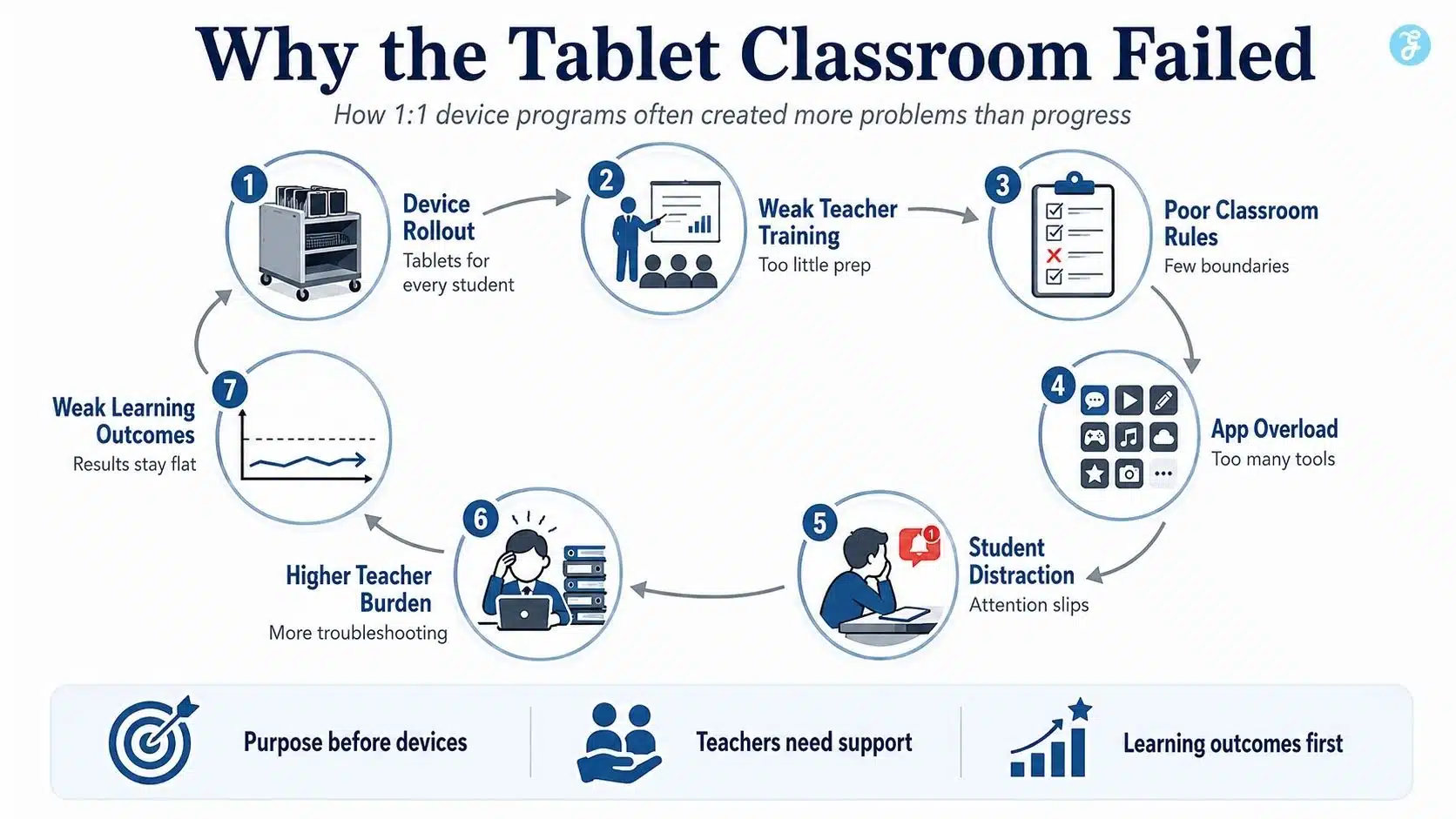
The failure was not one single mistake. It was a chain of bad assumptions.
1. Schools Bought Hardware Before Building A Learning Model
Many schools started with the device. They should have started with the learning goal.
A better process would have asked:
- What do students struggle with?
- What does the teacher need help with?
- Which lessons become stronger with technology?
- Which lessons are better without screens?
- How will we know the tool worked?
Instead, too many rollouts began with procurement.
2. Teacher Training Was Treated As Optional
Teachers are the difference between meaningful digital learning and digital babysitting. A tablet does not teach by itself. A teacher decides when it helps, when it distracts, when to close it, and when to switch back to discussion, paper, or direct instruction.
Without training, even good tools become weak tools.
3. Device Rules Were Too Weak Or Too Late
Students need boundaries. Not because they are bad, but because they are children.
A school device policy should answer simple questions:
- When are devices open?
- When are they closed?
- What happens when students misuse them?
- Who monitors apps?
- Can students take them home?
- Who pays for damage?
- How much screen time is too much?
Many schools figured this out after the damage had already begun.
4. The Curriculum Was Not Properly Redesigned
Putting a worksheet on a tablet does not make it modern.
Real digital learning requires redesign. Students can use devices to create, simulate, research, collaborate, code, visualize, revise, and receive targeted practice. But if the device only delivers digital worksheets, schools are paying premium prices for old pedagogy.
5. The Cost Was Bigger Than The Purchase Price
A tablet program is not just tablets. It includes cases, keyboards, chargers, repairs, replacements, software licenses, cybersecurity, filtering, IT staff, teacher training, device management, insurance, storage, and bandwidth.
Schools that only budget for hardware are not planning. They are gambling.
6. Equity Was Oversold
1:1 device programs were often marketed as equity solutions. Sometimes they helped with access. But access is not the same as equity.
A child with a quiet home, strong internet, tech-savvy parents, and academic support benefits differently from a child with unstable housing, weak internet, crowded living conditions, or no adult support at home.
The tablet may be the same. The learning environment is not.
7. Screen Time Was Underestimated
Children already live in a screen-heavy world. Schools should not add screens casually. A classroom device should earn its place. It should not be the default simply because the school bought it.
Where Tablets Still Make Sense
I do not believe tablets should disappear from education. That would be an overcorrection.
Tablets can help in specific situations:
| Good Use Of Tablets | Why It Works |
| Accessibility support | Text-to-speech, translation, captions, visual aids |
| Creative projects | Video, audio, drawing, design, and presentation work |
| Targeted practice | Short, focused skill reinforcement |
| Science simulations | Concepts that are hard to show physically |
| Research and media literacy | Guided source evaluation and digital reading |
| Teacher-assigned remediation | Practice connected to actual classroom instruction |
| E-learning access | Structured courses through platforms like Edutorial |
The keyword is purpose.
A tablet is useful when it does something better than the alternative. It is harmful when it replaces better learning just because the device is available.
The same is true for creative technology. A tool like ImagineLab makes sense when it supports a real creative goal, such as visual storytelling, editorial design, or learning material development. It does not make sense if people use it as a substitute for thinking. That is the standard that schools should apply to every technology.
Use the tool when it improves the work. Do not worship the tool.
A Better Model: Fewer Devices, Better Use
The next phase of school technology should not be “one device for every child, all the time.”
It should be “the right device, at the right time, for the right learning reason.”
That means schools should consider a more disciplined model.
| Old Tablet Rollout Mindset | Better 2026 Approach |
| Every student needs a device all day | Devices are used when they strengthen learning |
| Screen-first lessons | Teacher-first instruction with digital support |
| Platform usage as success | Learning outcomes as success |
| Apps for engagement | Tools for comprehension and creation |
| Device access equals equity | Access plus support equals equity |
| Teachers adapt to the tool | Tools adapt to teaching needs |
| More data is better | Useful data is better |
This is not anti-edtech. This is mature edtech.
What Schools Should Ask Before Any New Device Rollout
Before buying tablets or expanding 1:1 device programs, school leaders should answer these questions publicly:
- What exact learning problem are we solving?
- What evidence shows this device will help?
- How will teachers be trained?
- How much instructional time will move to screens?
- What will students stop doing because of this device?
- What is the full five-year cost?
- How will we protect attention?
- How will we support families without stable internet or tech help?
- What happens if the program does not improve learning?
- Who is accountable after the rollout photo is taken?
That last question matters most. Because in many tablet programs, the photo happened. The learning did not.
The Uncomfortable Truth About School Innovation
Education loves shiny reform language.
“Innovation. Transformation. Personalized learning. Future-ready classrooms. Digital natives. Smart schools”.
But children do not learn because adults use fashionable words. They learn when someone teaches them well, gives them time to practice, corrects their mistakes, builds their confidence, protects their attention, and helps them make sense of the world. A tablet can support that. It cannot replace that.
The tablet classroom failed because the industry sold hardware as hope. Schools bought devices before they answered the harder questions. Politicians loved the optics. Vendors loved the contracts. Administrators loved the dashboards. Teachers inherited the mess. Students got more screens.
And then everyone acted surprised when learning did not magically improve.
The Tablet Classroom Failed, But The Lesson Is Still Useful
The tablet classroom failed as a mass reform fantasy. But it gave us a valuable lesson: technology must serve teaching, not the other way around. The future of education should not be screen-free. It should be screen-sensible.
Use tablets for access, creativity, accessibility, practice, research, and specific learning tasks. Close them during deep reading, discussion, writing, reflection, direct instruction, and moments when attention matters more than interaction.
Schools do not need to prove they are modern by putting screens everywhere. They need to prove students are learning. That is the only metric worth defending.