
Supplier sustainability pages are magical places. One click and suddenly every factory is responsible, every material is eco-friendly, every shipment is greener, and every supplier is apparently saving the planet between purchase orders. Lovely. Very touching. Also, often useless without proof.
That is why a Supplier Environmental Claims Audit matters. Not as a paperwork ritual. Not as a corporate guilt-cleansing ceremony. It matters because environmental claims are now business risk, legal risk, brand risk, and procurement risk wrapped inside one shiny PDF with a leaf icon on the cover.
The old way was simple: ask the supplier for a sustainability statement, receive a beautifully formatted document, smile politely, and move on. The new way is less romantic. We ask what the claim means, what evidence supports it, whether the data matches the product, whether the timeline is honest, and whether the claim would survive a skeptical customer, regulator, journalist, or competitor with too much coffee and a search engine.
And no, “our supplier said so” is not evidence. It is a bedtime story for procurement teams.
The FTC’s Green Guides are built around helping marketers avoid environmental claims that mislead consumers, including by clarifying how claims are interpreted, substantiated, and qualified. The EU’s green claims framework also pushes companies toward robust, science-based, verifiable substantiation for environmental claims. In plain English: the era of “trust us, we’re green-ish” is limping toward the exit.
Why Supplier Environmental Claims Are So Easy To Get Wrong
Before the audit begins, we start with one uncomfortable assumption: every environmental claim can be misunderstood.
That does not mean every supplier is lying. Most are not cartoon villains dumping sludge into rivers while writing “eco-conscious” on recycled letterhead. The real problem is usually messier.
A supplier may use a claim that is technically true but too broad. A material may contain recycled content, but only in one component. A factory may use renewable energy, but only for one site. A packaging claim may apply to the box, not the plastic insert. A “carbon neutral” statement may rely heavily on offsets that do not reflect the actual lifecycle impact of the product.
That is where greenwashing sneaks in wearing business casual.
The claim may not be completely false. It may simply be incomplete, exaggerated, outdated, poorly defined, or detached from the product being sold. Sadly, “mostly true if you read the appendix in dim lighting” is not a great consumer protection strategy.
The First Rule: Define The Claim Before Judging It
The first step is not asking for documents. The first step is forcing the claim to behave like an adult.
When a supplier says “sustainable,” we ask: sustainable compared to what?
When they say “eco-friendly,” we ask: which environmental impact improved?
When they say “low carbon,” we ask: measured across what boundary?
When they say “recyclable,” we ask: recyclable where, under what infrastructure, and by whom?
When they say “made with recycled materials,” we ask: what percentage, which component, and verified by what evidence?
This is where many claims quietly collapse. Not because the supplier has no environmental activity, but because the claim is too vague to be useful.
ISO 14021:2016 covers self-declared environmental claims, including statements, symbols, and graphics, and describes evaluation and verification methods for those claims. That matters because a claim is not just a sentence. It can be a logo, badge, icon, packaging phrase, product page line, or supplier deck bullet point pretending to be science.
Here is the simple screen we use before any supplier claim moves forward:
| Claim Type | What We Ask First | Why It Matters |
|---|---|---|
| Recycled content | What percentage and which component? | Prevents whole-product exaggeration |
| Recyclable | Is it recyclable in real markets? | Avoids theoretical recycling claims |
| Renewable energy | Which site, period, and energy source? | Keeps facility claims from becoming company-wide claims |
| Carbon reduction | Compared with which baseline year? | Stops cherry-picked progress stories |
| Biodegradable | Under what conditions and timeline? | Prevents fantasy landfill claims |
| Sustainable material | Which impact is improved? | Forces vague claims into measurable language |
Simple? Yes. Comfortable? Absolutely not. That is the point.
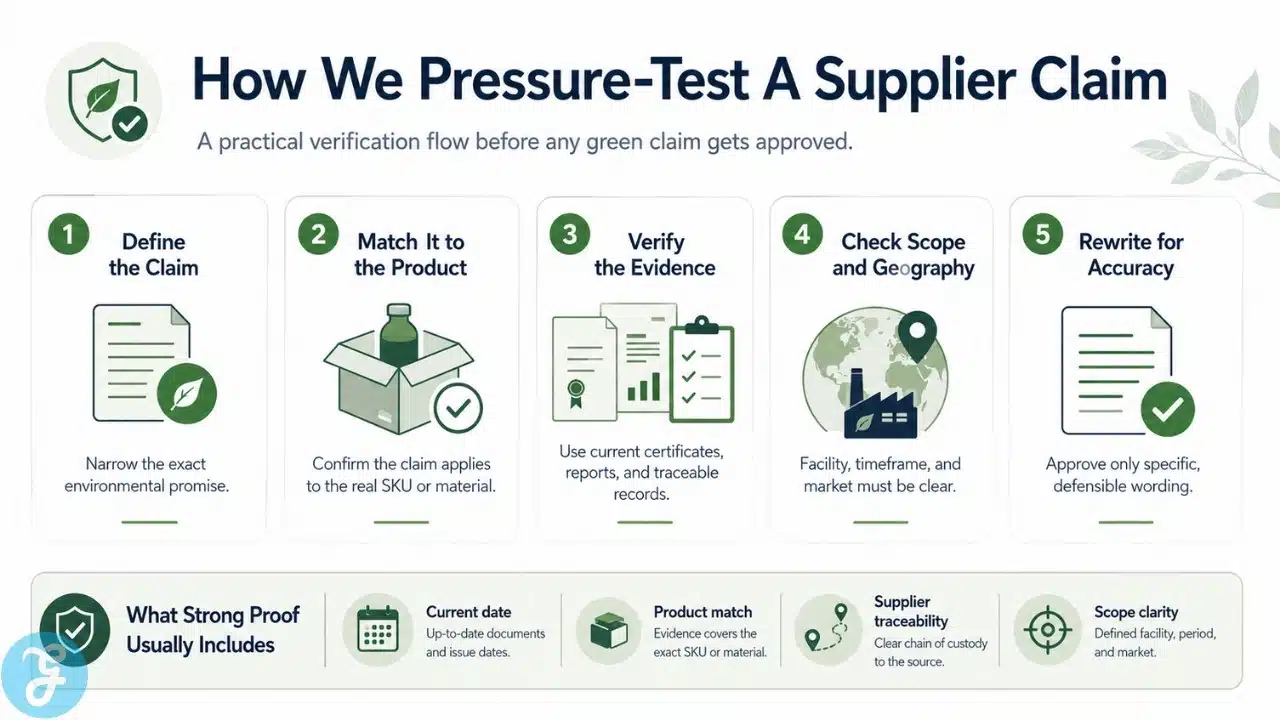
How We Audit The Evidence Without Worshipping The PDF
Once the claim is defined, we ask for evidence. This is where the supplier usually sends a folder large enough to qualify as emotional intimidation.
Certificates. Test reports. ESG reports. Energy invoices. Lifecycle assessments. Material declarations. Chain-of-custody documents. Facility audits. Management system certifications. Supplier questionnaires. Sometimes even a photo of a tree, because apparently trees are legal documentation now.
We do not judge the evidence by weight. We judge it by relevance.
A 60-page sustainability report does not prove a product claim if the product is not covered. A certificate from 2021 does not prove a 2026 claim if the material source changed. A facility-level renewable electricity document does not prove that every product from every factory has a lower carbon footprint.
The audit question is always brutal and boring:
Does this document prove this specific claim for this specific product, material, supplier, facility, time period, and market?
If yes, good.
If no, congratulations, we have decorative compliance.
The Chain Of Custody Check: Where Nice Claims Go To Suffer
Environmental claims often travel through supply chains like gossip at a wedding. By the time the claim reaches the brand, it may be more dramatic than accurate.
A yarn supplier says the fiber has recycled content.
A fabric mill repeats the claim.
A garment factory adds it to a product declaration.
A brand turns it into “sustainable fashion.”
Marketing turns it into “planet-friendly.”
And now everyone needs a lawyer and a nap.
This is why chain of custody matters.
We check whether the claimed environmental attribute can be traced from origin to finished product. For recycled content, that may mean transaction certificates, mass-balance records, batch details, material invoices, or certification documents. For certified wood, cotton, packaging, or other materials, it may involve checking whether certification applies to the correct supplier, material, facility, and product category.
We are not looking for perfection theatre. We are looking for a defensible trail.
Because if the evidence cannot travel with the claim, the claim should not travel to the customer.
The Supplier Environmental Claims Audit We Actually Trust
A good audit is not just a yes-or-no exercise. It is a pressure test.
This is the working logic behind a Supplier Environmental Claims Audit that does not embarrass everyone later:
| Audit Layer | What We Check | Red Flag |
|---|---|---|
| Claim wording | Is it specific, limited, and clear? | “Eco-friendly,” “green,” “planet-safe” |
| Evidence quality | Is proof current and relevant? | Old certificates or unrelated reports |
| Product match | Does evidence apply to the product? | Facility data used for product claims |
| Boundary clarity | Is the scope clearly defined? | Claim hides what is excluded |
| Market reality | Can consumers act on the claim? | “Recyclable” where recycling is unavailable |
| Legal sensitivity | Could regulators see it as misleading? | Broad claims with weak substantiation |
| Renewal process | Is proof updated regularly? | One-time evidence reused forever |
This is not glamorous work. Nobody makes a movie about checking batch IDs and claim boundaries. But this is where sustainability communication becomes credible instead of cute.
Why We Do Not Accept Generic Green Language
Generic green language is where environmental credibility goes to retire early.
Words like “sustainable,” “eco-conscious,” “green,” “earth-friendly,” and “responsible” are not automatically wrong. They are just dangerously lazy when used without explanation.
The EU’s consumer protection updates target misleading environmental claims, including generic claims that lack demonstrated environmental performance and claims about an entire product when the claim only applies to part of it. EU member states must integrate the updated rules into national law by September 27, 2026.
That is why we push suppliers to replace vague language with specific, limited claims.
Not this:
“This product is sustainable.”
Better:
“The outer carton contains 80% post-consumer recycled paper, verified by supplier documentation dated March 2026.”
Not sexy. Much safer.
Not this:
“Our facility is green.”
Better:
“Facility A purchased renewable electricity certificates covering 65% of electricity use in 2025.”
Again, less exciting. Also less likely to explode in public.
Environmental claims do not need poetry. They need boundaries.
How We Handle Carbon Claims Without Losing Our Patience
Carbon claims deserve their own interrogation room.
“Carbon neutral.”
“Net zero.”
“Climate positive.”
“Low carbon.”
“Reduced emissions.”
“Offset shipping.”
These phrases sound impressive until you ask three questions:
What was measured?
What was reduced?
What was offset?
If the answer is unclear, the claim is not ready.
Carbon claims are especially risky because they often depend on boundaries, assumptions, emissions factors, offset quality, accounting methods, and baseline years. One supplier may count only direct operations. Another may include purchased electricity. Another may ignore upstream material emissions, which is convenient in the same way hiding your credit card bill is convenient.
For supplier carbon claims, we usually ask for:
- Scope covered by the claim
- Baseline year and reason for selection
- Emissions calculation method
- Activity data sources
- Emissions factors used
- Third-party verification, if available
- Whether offsets are included
- Whether reductions happened inside the value chain
If a supplier cannot separate actual reductions from offsets, we do not let the claim wear a superhero cape.
The Behind-The-Scenes Scoring System
A supplier claim does not simply pass because it sounds responsible. It earns trust in layers.
We usually classify claims into four practical categories:
| Claim Status | Meaning | What Happens Next |
|---|---|---|
| Approved | Evidence is specific, current, and relevant | Claim may be used with proper wording |
| Approved With Qualification | Claim is partly supported but needs limits | Add scope, percentage, location, or timeframe |
| Hold | Evidence is missing or unclear | Supplier must provide more proof |
| Reject | Claim is misleading, vague, or unsupported | Do not use the claim |
This scoring keeps everyone honest.
Marketing gets clarity. Procurement gets accountability. Suppliers know what to fix. Legal does not have to discover problems after the claim is already printed on 200,000 packages. Wonderful concept, prevention.
What Suppliers Usually Get Wrong
Most supplier mistakes are predictable, which is comforting and depressing at the same time.
They overstate facility claims.
A renewable energy claim for one factory becomes a company-wide claim. Lovely ambition. Terrible evidence.
They confuse material attributes with product attributes.
One recycled component does not make the entire product recycled.
They use old documents.
A certificate from three years ago is not proof that today’s shipment carries the same claim.
They rely on unclear certifications.
Some badges are strong. Some are marketing confetti wearing a serious hat.
They ignore geography.
A recyclable package in one market may be landfill decoration in another.
They use broad words because broad words sound nicer.
“Sustainable” sounds better than “contains 30% recycled plastic in the bottle body, excluding cap and label.” Unfortunately, the second one is useful. The first one is a lawsuit audition.
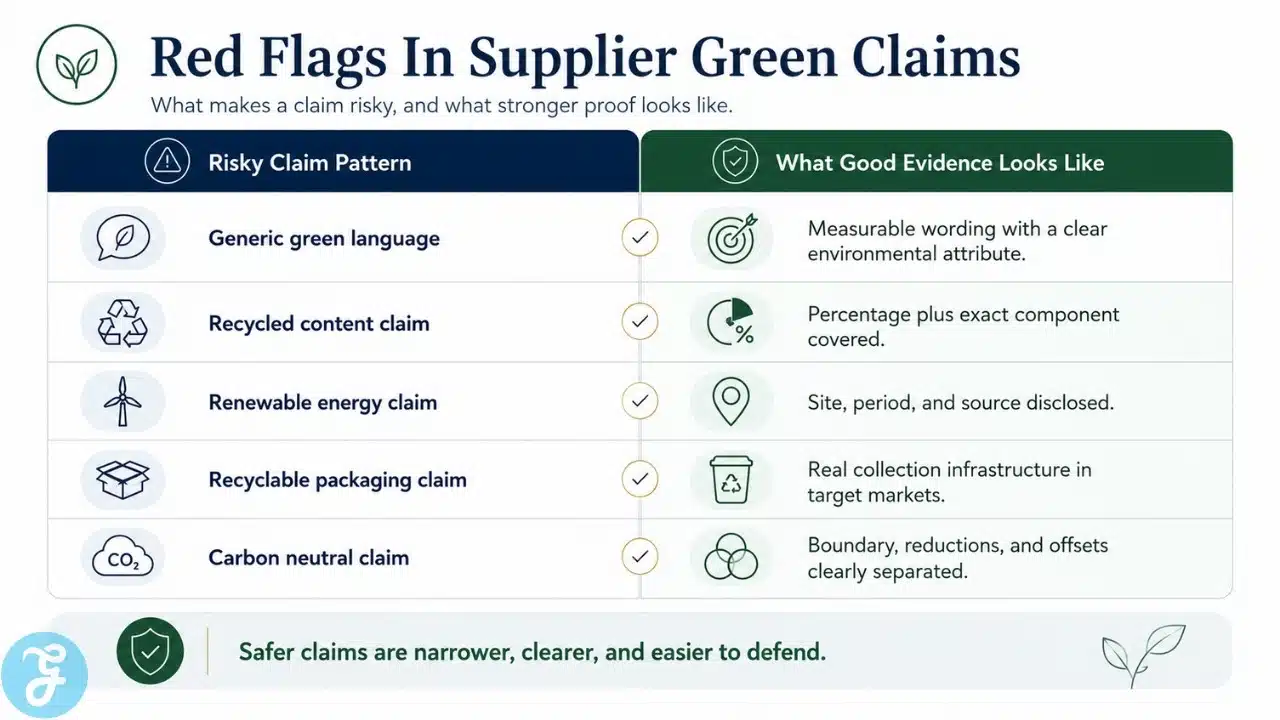
How We Rewrite Claims So They Can Survive Scrutiny
The goal of an audit is not to delete every environmental claim. That would be lazy in the opposite direction.
The goal is to make claims accurate, specific, and defensible. Here is how weak supplier claims become usable:
| Weak Claim | Better Claim |
|---|---|
| Eco-friendly packaging | Packaging carton contains 70% recycled paper content |
| Sustainable fabric | Fabric contains 45% recycled polyester by weight |
| Carbon-neutral production | Production emissions were offset through verified credits; no product lifecycle reduction is implied |
| Recyclable bottle | Bottle is recyclable where PET recycling facilities exist; cap and label may vary by market |
| Green factory | Facility used renewable electricity for 52% of 2025 electricity consumption |
| Low-impact material | Material reduced water use by 28% compared with the supplier’s 2022 process baseline |
Notice the pattern. The better claim is narrower. It gives numbers. It gives boundaries. It does not pretend that the entire planet sent a thank-you card.
This is the boring beauty of credible sustainability work.
Why This Protects The Brand, Not Just The Customer
Some teams still treat environmental claim audits as a compliance burden. That is adorable. Also wrong. A strong supplier audit protects the brand from three expensive problems.
First, it reduces legal risk. Environmental claims are increasingly regulated and challenged, especially when they are broad, generic, or unsupported.
Second, it protects customer trust. People may forgive a product flaw. They are less forgiving when they feel manipulated by fake virtue.
Third, it improves supplier discipline. Once suppliers know claims will be tested, they stop sending vague sustainability wallpaper and start sending better evidence.
A proper audit turns sustainability from a slogan into a system. And systems beat slogans. Every time.
What A Mature Supplier Claims Process Looks Like
A mature process is not complicated. It is consistent.
Before a claim goes public, it should move through a repeatable workflow:
- Capture the exact supplier claim
- Define the environmental attribute
- Identify the product, facility, material, and timeframe
- Request supporting evidence
- Check whether the evidence matches the claim
- Rewrite the claim with proper qualifications
- Approve, hold, or reject it
- Store evidence in a claim record
- Set a renewal date
- Recheck the claim when suppliers, materials, or regulations change
The renewal date matters. Environmental evidence expires in the real world, even if someone saved it in a folder called “Final_Final_Approved_UseThisOne.”
If a supplier changes material sources, factories, energy contracts, packaging vendors, or certification scope, the claim must be reviewed again. Otherwise, yesterday’s truth becomes tomorrow’s greenwashing.
The Human Part Nobody Talks About
Supplier audits are not just technical. They are political.
Procurement may want speed. Marketing may want strong language. Suppliers may want fewer questions. Legal may want every sentence to wear a helmet. Sustainability teams may want accuracy without killing the message.
The job is to hold the line without becoming the office villain.
That means explaining risk clearly. It means offering better claim wording instead of only saying no. It means showing suppliers what good evidence looks like. It means reminding marketing that a narrower claim is not weaker if it is actually true.
The best sustainability communication is not the loudest. It is the one that can be defended after the campaign goes live.
The Supplier Environmental Claims Audit Is Where Greenwashing Gets Caught Early
This is the part people miss: greenwashing usually becomes public late, but it starts early.
It starts when a supplier writes something vague.
It grows when procurement accepts it.
It becomes dangerous when marketing beautifies it.
It becomes expensive when customers, regulators, or competitors notice it.
A serious Supplier Environmental Claims Audit catches the problem before it becomes a headline, complaint, takedown request, investigation, or humiliating LinkedIn apology written in the corporate dialect of “we take this matter seriously.”
Nobody needs that performance.
What companies need is a process that says: prove it, qualify it, narrow it, or do not use it.
The Receipt Is The Real Sustainability Strategy
Environmental claims are not going away. Customers want better information. Regulators want less nonsense. Brands want credibility. Suppliers want business. Everyone wants the green glow. Fine.
But the glow has to come with receipts.
The future of sustainability communication will not belong to the companies with the prettiest claims. It will belong to the companies that can prove what they say, explain what they mean, and admit what they have not solved yet.
That is not pessimism. That is grown-up sustainability.
A Supplier Environmental Claims Audit does not make a company perfect. It makes the company harder to fool, harder to embarrass, and harder to accuse of selling recycled fairy dust in a compostable bag of excuses.
And honestly, that is a very good place to start.