The AI market is definitely not small by any means. That is the funny part.
Money is everywhere. Hype is everywhere. Every pitch deck has the same magic words: agents, copilots, automation, productivity, enterprise AI, workflow intelligence, and some brave promise about replacing manual work. And still, most AI startups will fail to monetize in 2026.
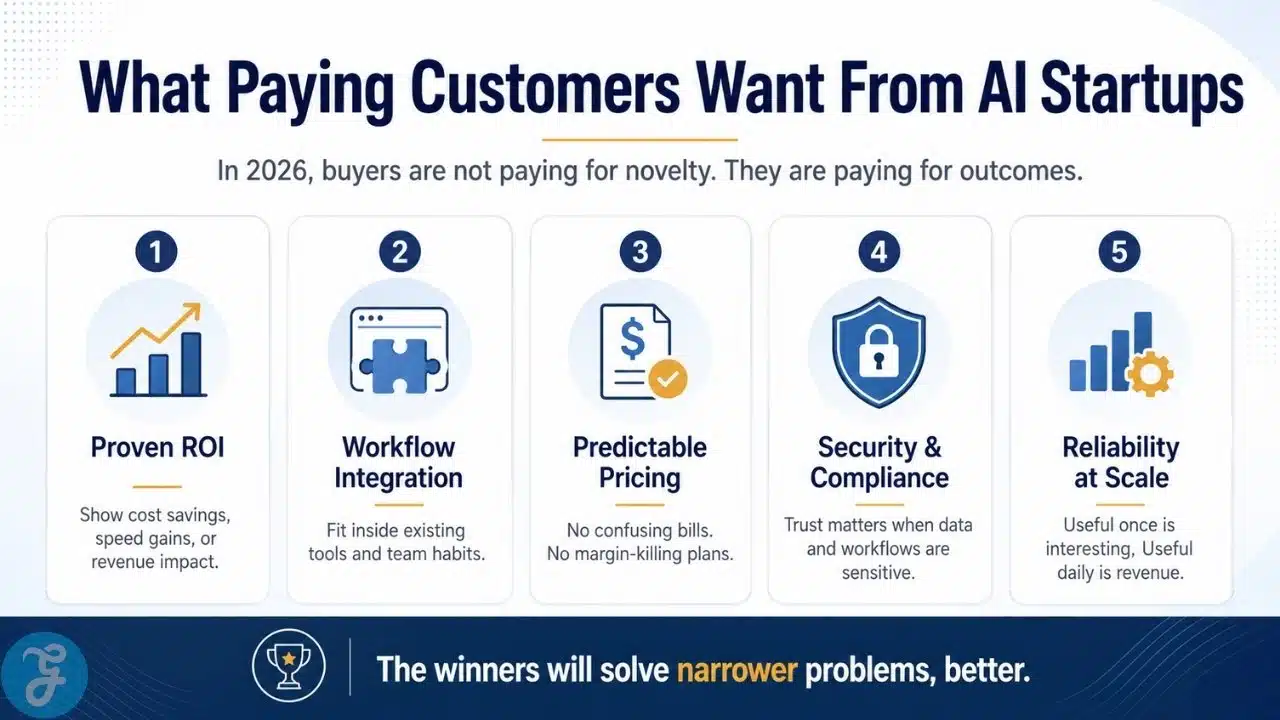
Not because AI is useless. Not because customers do not care. Not because the technology suddenly stopped improving. They will fail because AI Startup Monetization is no longer about building a cool demo. It is about proving that the product saves money, makes money, reduces risk, or becomes painful to remove. Most startups are still stuck at the demo stage, while buyers have moved to the evidence stage.
Gartner forecasts worldwide AI spending will reach $2.52 trillion in 2026, but it also says AI is moving through the “Trough of Disillusionment,” where enterprises prioritize proven outcomes over speculative promises. That sentence alone should scare every AI startup still selling vibes instead of value.
The 2026 AI Startup Monetization Problem Is Not Demand
Demand exists. Companies are using AI. Consumers are using AI. Investors are still pouring money into AI. Stanford’s 2026 AI Index says global private investment in AI reached $344.7 billion in 2025, while U.S. private AI investment alone hit $285.9 billion. The U.S. also had 1,953 newly funded AI companies in 2025. So no, the problem is not that people are ignoring AI.
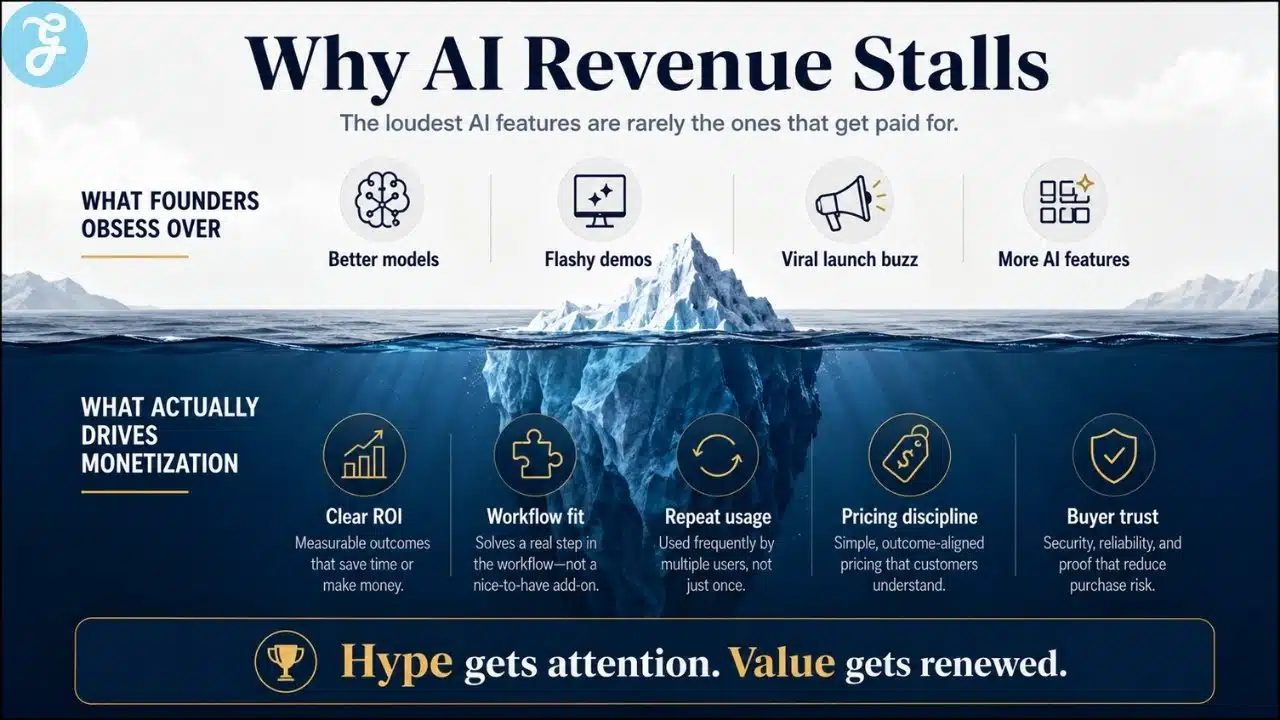
The problem is that too many AI startups confuse attention with revenue. A waitlist is not monetization. A viral launch is not monetization. A few curious enterprise pilots are not monetizing. A Product Hunt badge is definitely not monetization.
Real monetization begins when customers keep paying after the excitement fades. That is where many AI startups will hit the wall in 2026.
Too Many AI Products Are Features, Not Companies
A harsh truth: many AI startups are not startups. They are product features waiting to be copied. A wrapper around a large language model can become useful quickly. It can also become irrelevant quickly. If the core value of the product is “we added AI to this task,” the moat is thin.
The danger is simple. If OpenAI, Anthropic, Google, Microsoft, Adobe, Salesforce, Canva, Notion, HubSpot, or another large platform can add the same feature inside an existing workflow, the startup has a problem. The customer may like the startup’s tool, but they may already be paying for the platform that can bundle the feature tomorrow.
That is why AI Startup Monetization will become brutal in 2026. Buyers will not want another dashboard, another login, another subscription, and another tool that does almost the same thing as something they already have.
The winning startups will not just generate content, summarize documents, create images, or answer questions. They will solve narrow, expensive, annoying business problems better than the default tools. The rest will become nice demos with bad renewal rates.
Enterprises Are Tired Of Experiments Without ROI
The first AI buying wave was emotional. Executives were afraid of missing out. Teams wanted to test everything. Startups could get meetings just by saying “generative AI” with enough confidence. That phase is ending.
McKinsey’s 2025 global AI survey found that 88% of respondents report regular AI use in at least one business function, but most companies are still in experimenting or pilot stages, and only about one-third have begun scaling AI programs. It also found that only 39% report EBIT impact at the enterprise level.
That matters because startups sell into this mess. If the buyer cannot clearly measure the value, the startup cannot easily justify pricing. If the product improves productivity but nobody tracks the actual savings, the renewal becomes a debate. If the tool saves employees time but the company does not convert that time into revenue or cost reduction, finance teams will call it “nice to have.”
And “nice to have” is where subscriptions go to die.
The Free AI Problem Is Bigger Than Startups Admit
Consumers have been trained to expect AI for free or almost free.
Stanford’s 2026 AI Index notes that generative AI reached 53% population-level adoption within three years, and that consumers often access these tools for free while still getting substantial value from them.
That creates a monetization headache. If users can get decent writing, images, research, coding help, summaries, and planning from free or low-cost tools, a startup must offer something meaningfully better. Not slightly cleaner. Not slightly faster. Not “powered by advanced AI.”
Meaningfully better. This is where many consumer AI startups will struggle. They may attract users, but they will not easily convert them into paying customers. People will use free AI tools casually, but they will only pay when the product solves a painful, repeated, high-value problem. In 2026, “fun to try” will not be enough.
AI Margins Can Look Beautiful Until Usage Starts
Software used to have a beautiful promise: build once, sell many times.
AI broke that simplicity.
Every query, generation, image, video, agentic workflow, or retrieval task can carry real infrastructure cost. If the pricing is wrong, growth can make the business worse, not better.
A normal SaaS startup wants more usage. An AI startup with bad unit economics may quietly fear it. That is a strange place to be.
The startup may celebrate new users while computing costs rise in the background. It may land enterprise accounts but discover that heavy customers are the least profitable. It may offer unlimited plans because competitors do the same, then realize “unlimited” is a dangerous word when GPUs are involved.
Gartner says AI infrastructure alone will add $401 billion in spending in 2026, with AI-optimized servers driving a major share of spending growth. That money is not imaginary. Someone pays for it.
For many startups, that someone will be them.
The Market Will Reward Boring AI More Than Flashy AI
The most monetizable AI products in 2026 may not look exciting on social media.
They may be boring workflow tools for insurance claims, legal review, procurement, medical coding, compliance monitoring, logistics, accounting, customer support, internal knowledge search, or sales operations.
Why?
Because boring problems often have budgets. A company may not pay much for “AI content inspiration.” But it may pay serious money for reducing support tickets, accelerating document review, lowering compliance risk, improving collections, or cutting manual back-office work.
BCG’s research shows the AI value gap clearly: only 5% of firms worldwide are “AI-future built,” while 60% are seeing hardly any material value from AI despite substantial investment. The companies that do generate value are not just playing with tools; they are changing workflows, operations, and cost structures.
That is the lesson for startups. The market does not need more AI magic tricks. It needs AI that lands inside a business process and improves a number that someone already cares about.
Pricing Will Become A Survival Test
Many AI startups still price like they are guessing.
Some charge per seat. Some charge per credit. Some charge per generation. Some charge based on usage. Some offer enterprise pricing without knowing what enterprise value they actually create.
In 2026, pricing confusion will become a serious problem.
If pricing is too low, startups cannot cover usage and support costs. If pricing is too high, buyers compare them with cheaper foundation model tools. If pricing is too complex, procurement slows down. If pricing is based on usage, customers fear unpredictable bills. If pricing is based on seats, startups may lose money on power users.
Good AI pricing will need to connect to value.
For example:
| Weak Pricing Logic | Stronger Pricing Logic |
|---|---|
| Pay per prompt | Pay per resolved case |
| Pay per image | Pay per approved campaign asset |
| Pay per document | Pay per completed compliance review |
| Pay per agent | Pay per workflow successfully automated |
| Pay per user | Pay by department value, volume, or outcome |
This is not easy. But that is the point.
The startups that survive will understand their customer’s economics better than their own product demo.
Enterprise Buyers Will Trust Incumbents More Than New Tools
This may annoy startup founders, but it is reality.
When AI touches sensitive data, customer information, legal documents, financial records, healthcare workflows, codebases, or internal strategy, buyers become cautious. They ask about security, compliance, privacy, data retention, model risk, audit logs, permissions, uptime, integration, vendor stability, and support.
A small startup can answer those questions. But an incumbent can often answer them faster.
Gartner directly warns that during 2026, AI will often be sold to enterprises by incumbent software providers rather than bought as part of new moonshot projects, because enterprises want improved ROI predictability before scaling.
That is a major threat to AI startups.
A startup may have a better product. But an incumbent may have the customer relationship, procurement approval, compliance paperwork, integrations, and bundled pricing.
In enterprise software, the best tool does not always win. The least risky tool often wins.
The Agent Hype Will Create Another Monetization Trap
AI agents are the new shiny object.
Every startup now seems to have an agent. Sales agents. Coding agents. Research agents. Support agents. Marketing agents. Finance agents. HR agents. Personal agents. Agents for agents, probably coming soon.
Some of this is real. Some of it is theatre.
McKinsey found that 23% of respondents say their organizations are scaling an agentic AI system somewhere in the enterprise, while another 39% have begun experimenting. But in any individual business function, no more than 10% report scaling AI agents.
That gap matters.
Experimentation is not monetization. Curiosity is not retention. A pilot is not a business model.
Agent startups will face a specific problem: the more autonomous the product claims to be, the more trust it must earn. If an agent makes mistakes, breaks workflows, exposes data, sends bad messages, books wrong actions, or creates compliance risks, buyers will slow down.
The agent pitch sounds powerful. The implementation is messy.
In 2026, many agent startups will discover that customers do not want autonomy as much as they want reliability.
The Winners Will Be Narrower Than The Hype
The AI startups most likely to monetize in 2026 will probably share a few traits.
They will target a painful use case, not a vague market.
They will integrate into existing workflows instead of forcing users into a new one.
They will prove ROI in numbers, not adjectives.
They will control infrastructure costs carefully.
They will have a clear reason to exist even if foundation models improve.
They will sell to customers with budget, urgency, and repeated need.
That sounds obvious.
But the AI market has rewarded the opposite for too long: broad claims, beautiful demos, massive TAM slides, and unclear revenue logic.
Menlo Ventures estimated that enterprises spent $37 billion on generative AI in 2025, up from $11.5 billion in 2024, with the largest share going to application-layer products. It also noted that several AI products have reached major ARR levels, proving that monetization is possible when products are tied to real enterprise demand.
So the argument is not that no AI startups will make money.
Some will make a lot.
But most will not.
The Uncomfortable Truth About AI Startup Monetization
The AI gold rush has created a strange illusion.
Because the technology is powerful, people assume the businesses will be powerful too. That is not always true.
A product can be impressive and still have weak margins.
A tool can be useful and still be easy to replace.
A startup can grow fast and still fail to retain paying customers.
A demo can go viral and still have no business model.
A company can raise millions and still not know who will pay at scale.
That is why AI Startup Monetization will be one of the toughest business stories of 2026.
The startups that fail will blame the market, the models, the customers, the cloud bills, the incumbents, or the investors. Some of that may be fair. But the deeper reason will be simpler.
They built around AI capability before they built around customer value.
And in 2026, that mistake will become expensive.
Frequently Asked Questions (FAQs) About AI Startup Monetization
What Is AI Startup Monetization?
AI Startup Monetization means turning an AI product, tool, or platform into reliable revenue. It includes pricing, customer retention, margins, paid adoption, enterprise contracts, usage costs, and long-term value creation.
Why Will Most AI Startups Struggle To Monetize In 2026?
Most will struggle because buyers are becoming more skeptical, computing costs are high, free AI tools are widely available, and many AI products are easy to copy. Startups must prove measurable ROI, not just show impressive demos.
Which AI Startups Are More Likely To Make Money?
Startups focused on specific business problems are more likely to monetize. These include tools for compliance, healthcare workflows, legal operations, customer support, finance, cybersecurity, logistics, and internal enterprise automation.
Is The AI Startup Market Still A Good Opportunity?
Yes, but it is no longer an easy opportunity. The market is large, but customers are more demanding. Startups with strong unit economics, clear ROI, and deep workflow integration still have room to win.
What Is The Biggest Mistake AI Startups Make?
The biggest mistake is building a product around what AI can do instead of what customers will repeatedly pay for. Capability creates attention. Value creates revenue.