A manager schedules a 45-minute “sync” to discuss async culture. There is no agenda. The invite says, “Let’s align.” Someone joins from another time zone, with dinner getting cold beside the laptop. Someone else is quietly handling school pickup. One person has already written the answer in a shared doc, but now everyone must perform collaboration in front of a webcam. And that, to me, is the perfect image of remote management 2026.
Remote work won. Async work won. The strongest individual contributors adapted, documented, automated, and learned how to ship without being watched. But a lot of managers? They moved the office into Slack, Teams, Zoom, and Google Calendar, then called it leadership.
I have seen this pattern too many times to pretend it is a temporary adjustment issue. Many companies do not have a remote work problem. They have a remote management problem.
The hard truth is simple: the async revolution made strong ICs unstoppable and made weak middle managers look obsolete. Most companies still have not noticed, probably because they are in a meeting about it.
Remote Work Did Not Break Management, It Revealed It
Remote work gets blamed for everything now. Low engagement? Remote work. Poor collaboration? Remote work. Slow decisions? Remote work. Culture feels weak? Remote work. Someone did not reply to a Slack message in seven minutes? Apparently, civilization has collapsed.
But remote work did not break management. It revealed what was already broken. In the office, a manager could survive by being visible. Walk around. Ask casual questions. Attend meetings. Look concerned near a whiteboard. Reward the person who stayed late because, clearly, sitting in a chair after 7 p.m. was once considered a personality trait.
Remote work removed that theater. Suddenly, managers could not rely on body language, desk presence, or hallway pressure. They had to define outcomes. They had to write clearly. They had to trust adults. They had to judge work by results instead of ambient busyness. Some did beautifully. Many did not.
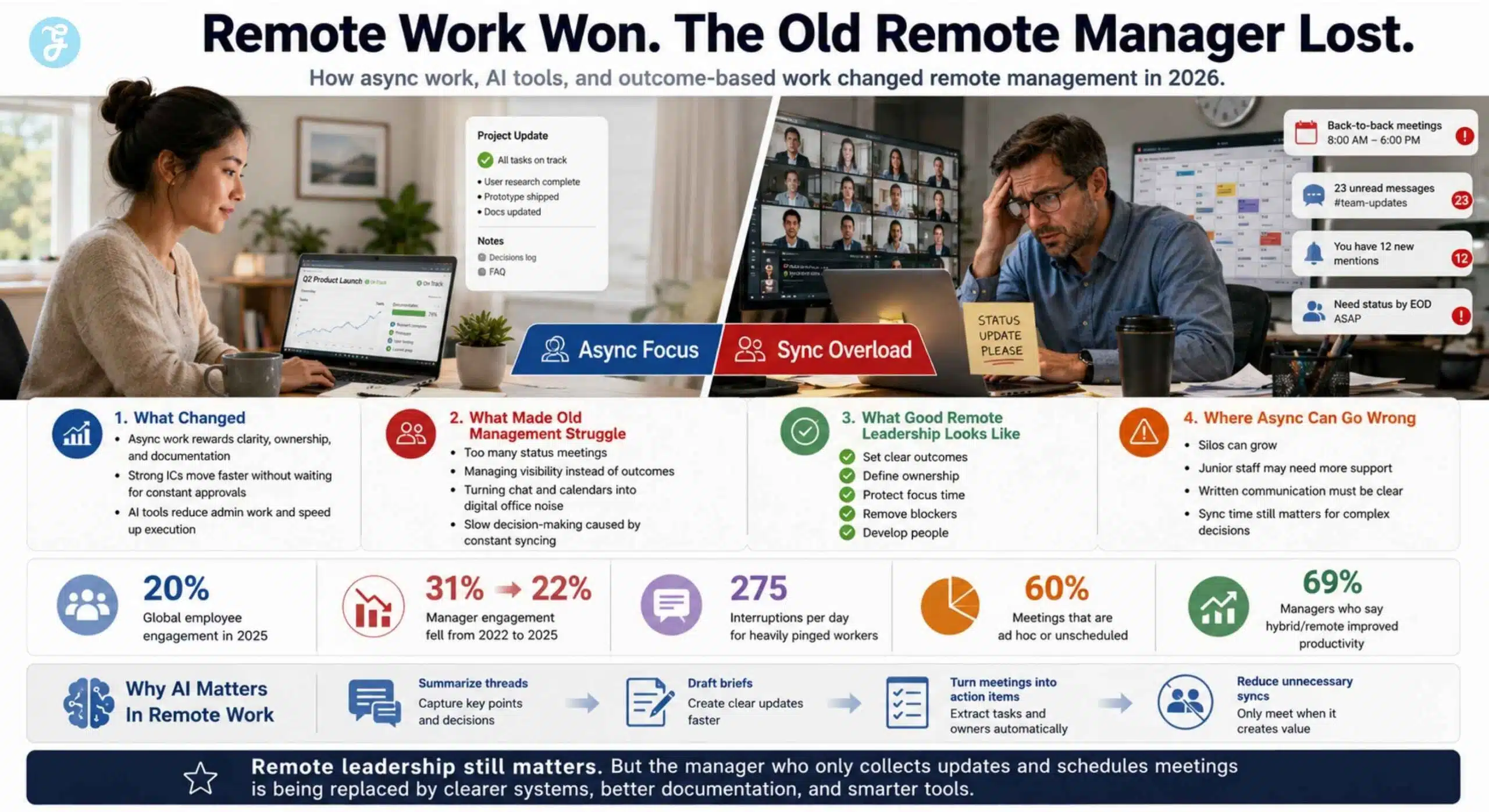
Gallup’s 2026 workplace report gives this problem a useful data backbone. Global employee engagement fell to 20% in 2025, its lowest level since 2020, and Gallup says low engagement costs the global economy around $10 trillion in lost productivity. More importantly for this argument, Gallup found that manager engagement dropped from 31% in 2022 to 22% in 2025, while non-manager engagement barely moved by comparison.
That tells me the middle layer is under pressure. Not because employees forgot how to work. Because the old management operating system does not fit the new workplace.
Async Work Made Strong ICs Faster Than The System
The biggest winners of async work are not the loudest people in the meeting. They are the people who can think, write, decide, and deliver without needing constant supervision.
I have seen strong ICs become almost unfairly productive in remote settings. They use documentation instead of permission. They use project boards instead of status calls. They use AI tools to summarize research, draft first versions, clean up messy notes, analyze patterns, and reduce admin work. They do not wait for a manager to “circle back” when the information already exists.
This is where AI tools matter in remote work. Not as a shiny toy. Not as another dashboard for leadership theater. But as leverage for people who already know how to own work.
A good AI tool in a remote team can summarize long threads, turn meeting notes into action items, draft project briefs, extract decisions, clean up documentation, and help people work across time zones without dragging everyone into another call.
But AI only helps when the team already has clarity. If the manager is vague, AI just produces faster confusion. Future Forum defines async work as work that happens on people’s own time, but it also warns that async does not mean throwing people into an unstructured sea of tasks. It works when leaders set high standards for communication, documentation, shared goals, and deadlines.
That is the part many managers miss. Async work is not “send a message and disappear.” It is not “everyone figures it out.” It is structured autonomy. It rewards people who can communicate with precision and punishes teams that confuse flexibility with chaos.
The Middle Manager’s Old Job Was Mostly Status Translation
A lot of middle management was built around status translation. Collect updates from the team. Repackage them for leadership. Bring pressure back down. Ask who is blocked. Schedule a meeting. Send a recap. Ask for another update tomorrow.
That was useful when information was scattered and invisible. But in a well-run remote team, progress should already be visible. Decisions should be written. Owners should be clear. Deadlines should be known. Blockers should be logged. The work should not need a human traffic cone standing in the middle of it.
This is why the phrase manager is obsolete makes people nervous. It sounds like an attack on leadership. It is not. It is an attack on outdated management rituals pretending to be leadership.
A manager who only asks for updates is competing with a dashboard. A manager who only schedules meetings is competing with a document. A manager who only checks if people are online is competing with common sense and often losing.
The remote manager did not become obsolete because people stopped needing leadership. The remote manager became obsolete when their only product was interruption.
The Sync Meeting Became The New Open Office
Remember when people complained that open offices destroyed focus? Congratulations. Many companies rebuilt the open office inside the calendar.
The Microsoft 2025 Work Trend Index found that during core work hours, employees are interrupted every two minutes by meetings, emails, or pings. When activity outside core hours is included, it adds up to 275 interruptions a day for the most heavily pinged users. Microsoft also reported that 60% of meetings are ad hoc rather than scheduled.
This is not collaboration. This is digital noise wearing a productivity costume. I have seen teams claim they are async while expecting replies in five minutes. I have seen managers ask for written updates and then schedule a meeting to “talk through” the written updates. I have seen people spend more time explaining what they are doing than actually doing it.
The worst version of remote management is not remote. It is an office management with Wi-Fi.
It says:
- “Quick sync?”
- “Just checking in.”
- “Can we align?”
- “Let’s discuss live.”
- “Can everyone give a status update?”
- “Sorry, I missed the doc. Can you summarize it on a call?”
Translation: I did not adapt, so everyone else must donate focus time.
A good remote leader does not treat silence as a threat. Sometimes silence means people are working. What a scandal.
Remote Leadership Is Not Dead, Remote Supervision Is
This is where the argument needs balance. I am not saying managers are useless. I am saying the old manager is exposed.
Real remote leadership is more important now, not less. But it looks different. The job is no longer to watch work. The job is to design the conditions where work can happen without constant watching.
The useful remote manager does five things well:
- They define the outcome.
- They clarify ownership.
- They protect focus.
- They remove blockers.
- They develop people.
That is leadership.
What is not leadership? Asking adults to prove they are working by staying visibly online. Calling a meeting because the manager did not read the document. Measuring commitment by how fast someone reacts to a notification.
Microsoft’s 2026 Work Trend Index makes a related point about AI adoption. It says employees are often ready, but the systems around them are not. Microsoft found that organizational factors such as culture, manager support, and talent practices account for more than twice the reported AI impact of individual mindset and behavior.
That matters because remote work and AI have the same lesson: tools do not fix bad operating models. A remote team with weak leadership becomes fragmented. A remote team with strong leadership becomes fast. The difference is not location. It is clarity.
Async Work Punishes Vague Managers
In an office, vague leadership can hide behind energy. A manager can walk into a room, talk loudly, draw arrows on a whiteboard, say “big opportunity” four times, and somehow everyone leaves thinking something strategic happened.
Async work is less forgiving. In async work, vague thinking becomes visible. Bad instructions sit there in writing, embarrassing everyone. “Let’s align” is exposed as a sentence with no owner, no deadline, no decision, and no courage.
Bad async sounds like this:
- “Thoughts?”
- “Can you take a pass?”
- “Let’s discuss.”
- “Looping everyone in.”
- “Any updates?”
- “Can we jump on a call?”
Good async sounds like this:
- “Decision needed by Thursday.”
- “Here are the three options.”
- “My recommendation is option B.”
- “Owner: Maria.”
- “Deadline: Friday.”
- “If no one objects by 4 p.m., we move forward.”
- “Success metric: reduce response time by 20%.”
This is why writing is now a management skill. Not fancy writing. Clear writing. Useful writing. Writing that saves time instead of creating new confusion in full sentences.
A manager who cannot write a clear brief will struggle in remote work. A manager who cannot define “done” will create chaos. A manager who cannot separate urgent from merely loud will burn out the team and then call it a culture problem.

AI Makes The Best ICs Stronger And The Weakest Managers Louder
AI deserves its own place in this conversation because it changes the balance of power. Before AI, a manager could sometimes justify constant coordination because work had more manual friction. Research took longer. Summaries took longer. Drafting took longer. Reporting took longer. Now, a strong IC with the right AI workflow can move very fast.
They can summarize a 40-message thread. They can turn a messy call transcript into a clean action plan. They can compare options, draft reports, create outlines, analyze customer feedback, and prepare decision memos before the next “alignment meeting” even gets scheduled.
That does not remove the need for leadership. It removes the excuse for lazy coordination. In remote teams, AI tools should help reduce unnecessary management load. They should make knowledge easier to find. They should make handoffs smoother. They should help people document decisions. They should make async work cleaner.
But there is a danger. Bad managers can also use AI to produce more noise: more reports, more summaries, more automated nudges, more fake productivity signals.
So the question is not “Does the team use AI?” The better question is: “Does AI reduce friction, or does it help management scale confusion?” That is the difference between useful remote leadership and digital bureaucracy with a subscription plan.
The Real Fight Is Trust Vs Control
Most companies frame the debate as remote vs office. I think that is the wrong fight. The real fight is trust vs control.
When leaders demand office returns without fixing unclear goals, broken communication, overloaded calendars, and weak managers, they are not solving work. They are restoring visibility. And visibility is comforting because it lets leaders feel informed without actually improving the system.
Owl Labs’ 2025 State of Hybrid Work report found that 69% of managers believe hybrid or remote work made their teams more productive. The same report also found that 80% of employees use or have experimented with AI at work.
So no, the simple story that remote workers are all secretly watching Netflix in pajama pants is getting old. Are some people abusing flexibility? Of course. Some people also wasted time in offices. They just did it near fluorescent lighting and called it professionalism.
The better question is whether companies know how to measure output. If the only way a company knows someone is working is by seeing them, that is not a remote work problem. That is a measurement problem.
If the only way a manager creates urgency is by interrupting people, that is not a culture problem. That is a leadership problem. If the only way HR can define fairness is by forcing everyone into the same schedule, that is not a strategy. That is administrative nostalgia.
But Async Has A Dark Side Too
Now, let’s not turn async work into a religion. Async can go wrong. Very wrong.
It can create silos. It can make junior employees feel abandoned. It can slow down decisions when everyone is waiting politely in different time zones. It can turn written communication into passive-aggressive theater. It can reward people who write well and quietly punish people who need more coaching. It can hide burnout because nobody sees the person struggling behind the clean project update.
A Nature Human Behaviour study of more than 61,000 Microsoft employees found that firm-wide remote work made collaboration networks more static and siloed, with fewer bridges between different parts of the organization.
That is the part remote-work evangelists should not ignore. Async work needs design. It needs rituals, but not too many. It needs documentation, but not documentation worship. It needs meetings, but only the useful kind.
Some conversations should be live: conflict, sensitive feedback, creative debate, onboarding, relationship repair, and complex decisions where speed matters. The problem is not meetings. The problem is using meetings as a substitute for thinking.
The best remote teams are not async-only. They are async-first. That means they default to writing, clarity, ownership, and documented decisions. Then they use live conversation when live conversation actually adds value. Very radical. Almost suspiciously sensible.
HR Has Been Solving The Wrong Problem
HR often responds to remote work with policies. Camera policies. Office-day policies. Response-time policies. Engagement surveys. Meeting etiquette. Attendance tracking. Tool rules. Sometimes, even surveillance software, because apparently nothing says “high trust culture” like measuring mouse movement.
But the deeper issue is manager capability.
HR should be asking harder questions:
- Can our managers write clear briefs?
- Can they define outcomes?
- Can they coach without hovering?
- Can they evaluate work without watching the process every hour?
- Can they manage across time zones?
- Can they use AI tools responsibly?
- Can they protect focus time?
- Can they build documentation habits?
- Can they tell the difference between accountability and control?
A remote-work policy cannot fix a manager who thinks leadership means “just checking in.” And operators should care because this is not just a people issue. It is an execution issue. Bad remote management slows decisions, wastes payroll, burns out strong people, and turns high-performing ICs into calendar janitors. The cost is not only morale. It is speed.
What The Surviving Remote Manager Looks Like
The remote manager who survives will not look like the old boss with better video lighting. They will look more like a system designer.
- They will replace status meetings with written updates.
- They will replace vague goals with clear outcomes.
- They will replace surveillance with useful metrics.
- They will replace “Who is online?” with “What is blocked?”
- They will replace urgency theater with prioritization.
- They will replace meeting notes with decision logs.
- They will replace control with trust and accountability.
That last part matters. Trust does not mean “do whatever you want.” Accountability does not mean “reply instantly.” A good remote team has both freedom and standards.
This is the future of remote management 2026: less babysitting, more clarity. Less calendar worship, more operating discipline. Less performance of work, more proof of work.
The best managers will still matter. Maybe more than ever. But the middle manager who only exists to collect updates, schedule calls, and translate confusion from one layer to another? That role is in trouble. And honestly, it should be.
Remote Work Won, Now Management Has To Catch Up
Remote work won because people learned they could produce without being watched. Async work won because the calendar is no longer the only operating system of business. AI tools are accelerating that shift because strong ICs can now research, draft, summarize, document, and execute faster than the old approval chain can arrange a sync.
If your team becomes less effective when you stop watching them, you were never managing performance. You were managing anxiety.
The future does not belong to managerless chaos. It belongs to better remote leadership. It belongs to managers who can create clarity, build systems, coach people, use AI intelligently, and get out of the way when adults are doing the work.
So yes, schedule the sync about async culture if you must. But do not be surprised when the best person on the team has already solved the problem in a document, linked the AI summary, assigned the next steps, and moved on.
That is not disrespect. That is the future arriving without waiting for your calendar invite.