Studying abroad can sound like a luxury reserved for students with rich parents, suspiciously generous grandparents, or a magical bank account that never says “insufficient funds.” But that is not the full story. American students have access to several government-funded scholarships, grants, and fellowships that can cover major international study costs, including tuition, travel, housing, language instruction, research expenses, and living support.
The trick is understanding what “free” really means. To Study Abroad For Free, students usually need to win funding, choose the right program, meet eligibility rules, and apply early enough that the deadline does not sneak up like a financial jump scare. This guide focuses on U.S. government-backed opportunities, including State Department, Defense Department, Education Department, National Science Foundation, and exchange programs.
Our Selection Process
This list includes programs that help American students study, intern, research, teach, or learn languages abroad with government funding. Some are direct scholarships to students. Others are fellowships or institutional programs that fund student participation.
Here is the selection logic used for this guide.
| Selection Factor | Why It Matters |
|---|---|
| Government Funding | The program needed U.S. government backing or official public funding |
| Student Eligibility | The opportunity had to serve high school, undergraduate, graduate, doctoral, or recent graduate applicants |
| Abroad Component | The program needed a real overseas study, research, language, teaching, or exchange element |
| Cost Coverage | Stronger preference went to programs covering major costs |
| Career Value | Programs with language, research, public service, or federal career value ranked higher |
| Accessibility | Need-based, merit-based, and specialized eligibility paths were considered |
| Official Verification | Priority went to official government or program pages |
A quick note: not every program below is a “study abroad semester” in the traditional sense. Some are language immersion programs, research grants, teaching assistantships, or high school exchange scholarships. But all can help American students gain funded international experience.
Whom This Is For
This guide is useful for American high school students, undergraduates, graduate students, doctoral candidates, recent graduates, military dependents, STEM students, language learners, and public-service-minded applicants.
It is especially relevant for:
- Pell Grant recipients;
- students interested in critical languages;
- students planning government or public service careers;
- high school students seeking fully funded exchange programs;
- graduate students conducting research abroad;
- STEM students looking for international research experience;
- recent graduates considering Fulbright;
- students trying to avoid debt while studying abroad.
Top 12 Government Grants For American Students To Study Abroad For Free
These programs are not identical. Some are best for undergraduates, some for high schoolers, some for graduate students, and some for specific career paths. The smartest move is to match the grant to your profile instead of applying blindly and hoping enthusiasm pays the airfare.
1. Benjamin A. Gilman International Scholarship
The Benjamin A. Gilman International Scholarship is one of the best-known U.S. government-funded options for undergraduates with high financial need. The Gilman Program provides scholarships to American undergraduate students with high financial need to study or intern abroad, and nearly 3,000 scholarships of up to $5,000 are awarded in an academic year.
This is often the first stop for Pell Grant recipients who want to Study Abroad For Free or at least slash the cost dramatically. The State Department says the Gilman Program supports Pell Grant recipients, with supplemental funding available for students studying critical languages or conducting STEM-related research abroad.
Best for:
- Pell Grant undergraduate students
- U.S. students studying or interning abroad for academic credit
Why We Chose It:
- One of the strongest need-based U.S. government study abroad awards
- Directly designed for students with financial need
- Can support study abroad or international internships
- Has useful supplemental funding options
Things to consider:
- You must meet Pell Grant eligibility rules
- It is competitive, so essays and advisor certification matter
2. Gilman Critical Need Language Award
The Gilman Critical Need Language Award is supplemental funding for Gilman applicants studying languages critical to U.S. national security. The State Department says students studying critical languages may apply for up to $3,000 in additional funding through this award.
This is not a separate standalone program for everyone. It works as an add-on for eligible Gilman applicants. But for the right student, it can be the extra funding that turns “maybe I can afford this” into “okay, this is actually happening.”
Best for:
- Gilman applicants studying critical languages
- Pell Grant students targeting language-intensive programs abroad
Why We Chose It:
- Adds meaningful extra funding on top of Gilman
- Rewards strategic language study
- Supports languages tied to national security priorities
- Can help cover remaining study abroad costs
Things to consider:
- You need to qualify for Gilman first
- Language and program fit must be strong
3. Gilman STEM Supplemental Award
The Gilman STEM Supplemental Award provides additional funding for eligible Gilman applicants conducting STEM-related coursework or internships abroad. The official Gilman page says applicants doing STEM-related coursework or internships as part of their overseas program can apply for a supplemental award of up to $1,000.
This is especially useful because STEM students sometimes assume study abroad does not fit their degree plan. That is not always true. With the right program, STEM coursework, research, or internships abroad can be both academically useful and financially supported.
Best for:
- Gilman applicants in STEM fields
- Students doing STEM coursework, internships, or research abroad
Why We Chose It:
- Supports STEM students who often overlook study abroad
- Can stack with the main Gilman Scholarship
- Helps cover extra overseas academic or research costs
- Encourages career-aligned international experience
Things to consider:
- It is supplemental, not a full standalone scholarship
- STEM activity must be part of the overseas program
4. Gilman-McCain Scholarship
The Gilman-McCain Scholarship supports undergraduate child and spousal dependents of active-duty military members who receive Title IV federal financial aid. The State Department says Gilman-McCain provides specific support for dependents of active-duty military members who receive any form of Title IV federal financial aid.
This is a strong but more targeted route. If a student is military-connected and eligible, this program can make study abroad far more realistic.
Best for:
- Eligible military dependents
- Undergraduate students receiving Title IV federal financial aid
Why We Chose It:
- Designed for a specific student group that may miss other funding routes
- Supports study abroad and international internships
- U.S. government-backed and highly relevant
- Can reduce the financial barrier for military families
Things to consider:
- Eligibility is specific
- Students should confirm military and financial-aid requirements before applying
5. Critical Language Scholarship Program
The Critical Language Scholarship, or CLS, is a U.S. Department of State program for intensive language and cultural study. CLS announced approximately 315 U.S. undergraduate and graduate students selected for the 2026 program, and its eligibility page says applicants must be U.S. citizens or nationals, at least 18 years old, and enrolled in an accredited U.S. degree-granting program.
CLS is best for students who want language immersion, not just a casual overseas semester with three café photos and one museum essay. The program is especially valuable because it focuses on languages of strategic importance.
Best for:
- Undergraduate and graduate students
- Students serious about critical language study
Why We Chose It:
- Fully government-backed language opportunity
- Strong academic and career value
- Open to several student levels
- Builds serious language and cultural competence
Things to consider:
- Very competitive
- Some languages require prior study, while others may not
6. Boren Scholarships
Boren Scholarships fund U.S. undergraduate students studying languages and regions critical to U.S. interests. The Boren Awards official page says Boren Scholarships fund study abroad by U.S. undergraduate students in world regions critical to U.S. interests, with maximum awards determined by duration abroad.
This is one of the most powerful options for undergraduates who are serious about language, national security, and public service. It is not ideal for students who only want a classic Western Europe semester. Boren focuses on less commonly studied regions and languages tied to U.S. national priorities.
Best for:
- Undergraduate students
- Students interested in critical languages, public service, and national security
Why We Chose It:
- Can provide substantial support for longer study abroad
- Strong career value for public service-minded students
- Focuses on underrepresented regions and languages
- Builds a serious international profile
Things to consider:
- Comes with a federal service requirement
- Destination and language choices must match Boren priorities
7. Boren Fellowships
Boren Fellowships are the graduate-level version of the Boren opportunity. The Institute of International Education says Boren Fellowships provide up to $30,000 to U.S. graduate students to add an international and language component to graduate education through study and research in areas critical to U.S. interests.
This is a strong route for graduate students who need funding for overseas research, language study, or area specialization. It is especially useful for students whose work connects with national security, international affairs, public policy, development, technology, or regional studies.
Best for:
- Graduate students
- Students combining research, language, and public service goals
Why We Chose It:
- Higher award ceiling than many undergraduate programs
- Supports advanced academic and research goals
- Strong national-security and language focus
- Useful for government and international careers
Things to consider:
- Requires a serious service commitment
- Applicants need a strong national-security argument
8. Fulbright U.S. Student Program
The Fulbright U.S. Student Program provides grants for graduating seniors, graduate students, young professionals, and artists to study, research, or teach abroad. USA StudyAbroad says Fulbright sends recent college graduates and early-career professionals to live, study, and conduct research abroad in 140 countries.
Fulbright is not usually for a current sophomore trying to fund a normal semester abroad. It is more often a post-graduation or graduate-level pathway. But for the right applicant, it is one of the most prestigious funded international opportunities available.
Best for:
- Graduating seniors
- Graduate students, recent graduates, young professionals, and artists
Why We Chose It:
- Prestigious U.S. government-funded international program
- Supports study, research, and teaching pathways
- Available across a wide range of countries
- Strong career and graduate-school value
Things to consider:
- Requires a strong proposal and country fit
- Campus deadlines often come earlier than national deadlines
9. Fulbright English Teaching Assistant Program
The Fulbright English Teaching Assistant, or ETA, Program places Fulbrighters in classrooms abroad to assist local English teachers and serve as cultural ambassadors. The official Fulbright page says ETAs help teach English while serving as cultural ambassadors for the United States, and award details vary by country.
This is not a study abroad grant in the classroom-credit sense. But it is a funded overseas educational experience for recent graduates, and it can be a powerful route for students interested in teaching, language, diplomacy, public service, or international education.
Best for:
- Recent graduates
- Students interested in teaching, cultural exchange, and public diplomacy
Why We Chose It:
- Funded international teaching placement
- Strong cultural-exchange value
- Good fit for education and language-focused applicants
- Available in many country contexts
Things to consider:
- You apply to one country
- Teaching role, age group, and placement conditions vary by country
10. Foreign Language And Area Studies Fellowships
Foreign Language and Area Studies, or FLAS, Fellowships are funded by the U.S. Department of Education through institutions of higher education. The Department of Education says FLAS provides academic year and summer fellowships to institutions to assist meritorious undergraduate and graduate students studying modern foreign languages and related area or international studies; eligible students apply directly through institutions that received FLAS allocations.
FLAS is important because it can support intensive summer language study, including some study abroad programs depending on the university and language center. This is one of those opportunities students often miss because it hides inside university centers, not giant scholarship ads.
Best for:
- Undergraduate and graduate students
- Students studying foreign languages and area studies
Why We Chose It:
- U.S. Department of Education-backed funding
- Can support summer language study
- Useful for students in area studies, international studies, and language-heavy programs
- Often available through university National Resource Centers
Things to consider:
- Students apply through participating institutions
- Eligible languages and abroad options vary by university
11. NSF International Research Experiences For Students
The National Science Foundation’s International Research Experiences for Students, or IRES, program supports international research opportunities for undergraduate and graduate students. NSF says IRES offers international research opportunities to undergraduate and graduate students, with participants mentored by researchers at a foreign lab.
This is not a normal study abroad grant where you pick a country and go. Students usually participate through NSF-funded projects run by U.S. institutions or researchers. But for STEM students, it can be a strong funded route into international research experience.
Best for:
- STEM undergraduates and graduate students
- Students seeking international lab or research experience
Why We Chose It:
- Government-funded STEM international research pathway
- Supports research abroad rather than classroom tourism
- Valuable for graduate school and research careers
- Gives students experience with foreign research mentors
Things to consider:
- Usually accessed through NSF-funded institutional projects
- Students should search for active IRES opportunities through their university and NSF project listings
12. Congress-Bundestag Youth Exchange
The Congress-Bundestag Youth Exchange, or CBYX, is a U.S.-German scholarship program for American and German participants. The State Department says CBYX is a merit-based scholarship for motivated high school students who want to experience German culture, share American culture, and learn a language through full immersion.
The official CBYX scholarship site also says the program is for motivated high school students who want to study abroad in Germany, live with a host family, and attend a German high school.
Best for:
- U.S. high school students
- Students interested in Germany, language learning, and cultural exchange
Why We Chose It:
- Strong fully funded high school exchange option
- Backed by the U.S. Congress and German Bundestag
- Includes immersion through school and host-family life
- Excellent for younger students seeking a funded year abroad
Things to consider:
- It is Germany-specific
- High school students need family and school support to plan for a full academic year abroad
An Overview Of 12 Government Grants To Study Abroad For Free
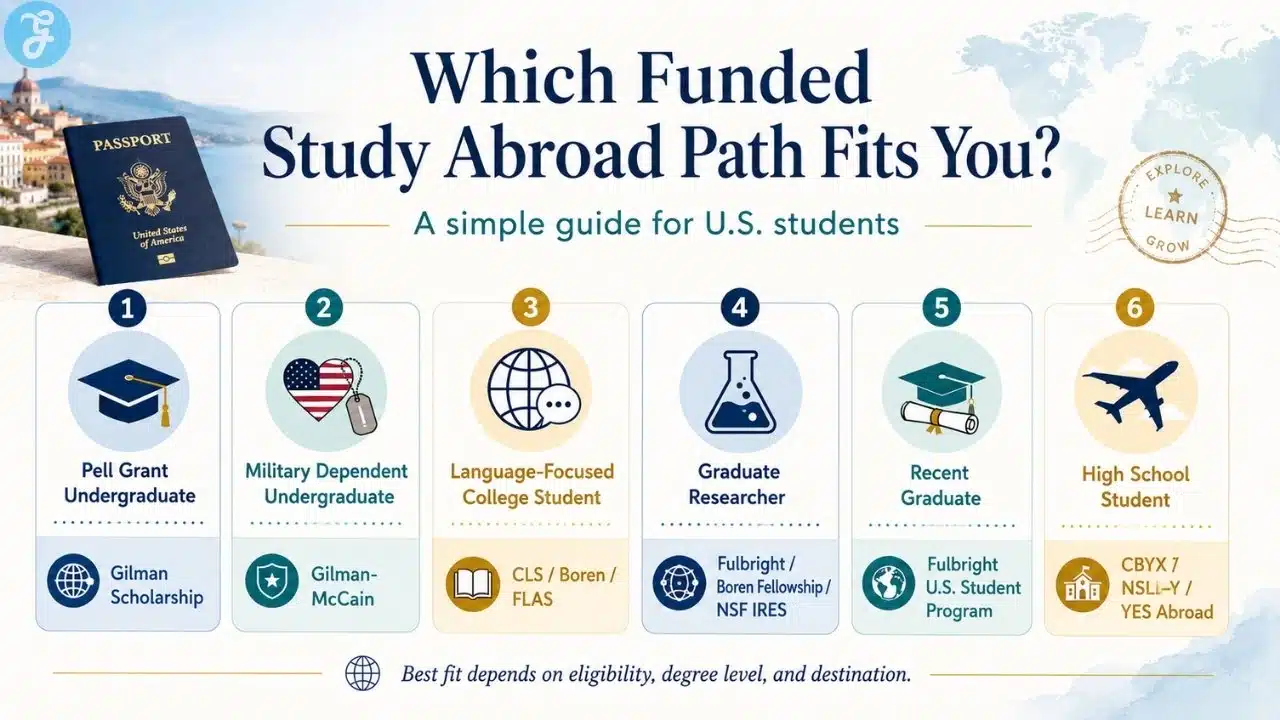
These programs cover different student levels and goals. A high school student should look at CBYX, YES Abroad, or NSLI-Y. A Pell Grant undergraduate should start with Gilman. A critical-language student should look at CLS, Boren, FLAS, or NSLI-Y. A graduate student should compare Fulbright, Boren Fellowships, FLAS, NSF IRES, and Fulbright-Hays-style research funding.
Overview Comparison
| Program | Best Student Type | Main Funding Purpose |
|---|---|---|
| Gilman Scholarship | Pell Grant undergraduates | Study or intern abroad |
| Gilman Critical Need Language Award | Gilman language applicants | Extra funding for critical language study |
| Gilman STEM Supplemental Award | Gilman STEM applicants | Extra STEM study or internship funding |
| Gilman-McCain Scholarship | Eligible military dependents | Study or intern abroad |
| Critical Language Scholarship | Undergraduate and graduate students | Intensive critical language study |
| Boren Scholarships | Undergraduates | Critical language and national security study abroad |
| Boren Fellowships | Graduate students | International language and research |
| Fulbright U.S. Student Program | Graduating seniors and graduate-level applicants | Study, research, or teaching abroad |
| Fulbright ETA | Recent graduates | English teaching abroad |
| FLAS Fellowships | Undergraduate and graduate students | Language and area studies |
| NSF IRES | STEM undergraduate and graduate students | International research experience |
| CBYX | High school students | Academic year exchange in Germany |
Our Top 3 Picks And Why?
| Pick | Why It Stands Out |
|---|---|
| Gilman Scholarship | Best first stop for Pell Grant undergraduates who want study abroad funding |
| Critical Language Scholarship | Strongest fully funded intensive language pathway for college students |
| Boren Awards | Best for students serious about critical languages and public service careers |
Fulbright is the prestige heavyweight for graduating seniors and graduate students, while CBYX is one of the strongest fully funded options for high school students.
How To Choose The Right Study Abroad For Free Grant By Yourself
Choosing the right grant starts with your student level, not the country you are daydreaming about during class.
The Selection Framework:
- Start With Eligibility: High school, undergraduate, graduate, doctoral, Pell Grant status, military-dependent status, and citizenship rules matter first.
- Match The Goal: Language study, research, internships, teaching, and cultural exchange all point to different programs.
- Check The Service Requirement: Boren awards are powerful, but they come with federal service obligations.
- Build A Funding Stack: One award may not cover everything, so combine grants, campus aid, and low-cost programs when allowed.
The Final Checklist
Before applying, ask these five questions.
- Am I eligible by citizenship, age, degree level, and enrollment status?
- Does the program fund my exact type of abroad experience?
- What costs are covered and what costs remain?
- Do I need campus nomination, advisor certification, or institutional application?
- Is there a service requirement after the program?
The Real Secret Is Matching The Grant To The Student
The biggest mistake students make is asking, “Which grant gives the most money?” That is the wrong first question. The better question is, “Which government program was built for someone like me?”
A Pell Grant undergraduate should look at Gilman before anything else. A student serious about Arabic, Chinese, Korean, Russian, or other critical languages should look at CLS, Boren, NSLI-Y, or FLAS depending on age and degree level. A graduating senior should look at Fulbright. A STEM student should investigate NSF IRES. A high school student should not ignore CBYX, YES Abroad, or NSLI-Y.
That is how American students can Study Abroad For Free without pretending money is not a problem. They do it by finding the program that matches their profile, applying early, writing strong essays, choosing realistic destinations, and building a funding plan that does not depend on one miracle email.
The truth is blunt: government-funded study abroad is competitive. But it is real. And for students who plan early, the difference between “I cannot afford it” and “I got funded” is often not luck. It is strategy.
Frequently Asked Questions (FAQs) About Study Abroad For Free
Can American Students Really Study Abroad For Free?
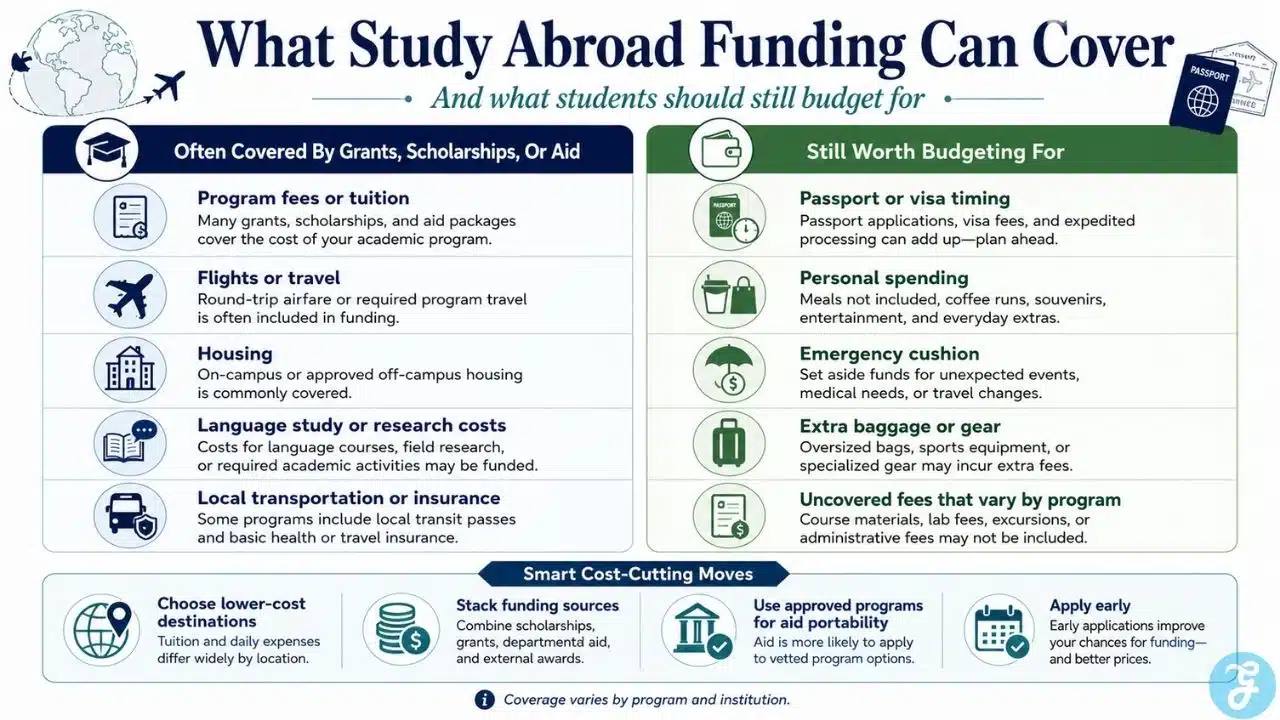
Yes, but “free” usually means the cost is covered through grants, scholarships, fellowships, financial aid, or exchange funding. Students still need to meet eligibility rules and apply competitively.
What Is The Best Government Grant For Pell Grant Students?
The Gilman Scholarship is usually the best starting point for Pell Grant undergraduates. It offers scholarships of up to $5,000 for eligible students to study or intern abroad.
Which Government Program Is Best For Critical Language Study?
The Critical Language Scholarship is one of the strongest options for college students, while NSLI-Y is a major option for high school students. Boren and FLAS can also support serious language study depending on eligibility.
Are Fulbright Grants For Undergraduate Study Abroad?
Usually not in the ordinary semester-abroad sense. Fulbright U.S. Student awards are mainly for graduating seniors, graduate students, young professionals, and artists pursuing study, research, or teaching abroad.
What Is The Biggest Mistake Students Make When Applying?
Starting too late. Many government programs require essays, recommendations, advisor certification, campus review, or institutional application steps. Waiting until the final week is basically choosing stress as a major.