
Search used to be the great traffic highway for publishers. Write useful stories, rank on Google, earn clicks, sell ads, grow subscriptions, repeat. Then AI search arrived and politely placed a giant answer box between the reader and the newsroom. Suddenly, the old bargain looked less reliable: publishers still produced the journalism, but search engines and chatbots increasingly summarized it before users clicked.
That is the heart of AI Search Disruption for UK news publishers. It is not only a technical SEO problem. It is a business-model problem, a copyright problem, a reader-relationship problem, and frankly, a survival problem. Google still dominates UK search, and Reuters reported in January 2026 that Google accounts for more than 90% of search queries in Britain. The UK regulator also proposed changes that would let publishers opt out of AI Overviews without disappearing from regular search results, after publishers complained that AI summaries were sharply reducing click-through rates.
Our Selection Criteria
This list focuses on practical survival strategies already visible across the UK and wider publisher market. The aim is not to pretend there is one magic solution. There is not. If anyone says “just do GEO” and smiles like they solved journalism, please escort them gently toward a spreadsheet.
Here is the selection logic used for this guide.
| Selection Factor | Why It Matters |
|---|---|
| Traffic Resilience | Publishers need channels beyond Google search |
| Revenue Diversification | Ads tied to pageviews are weaker when clicks fall |
| Direct Audience Ownership | Email, apps, memberships, and subscriptions reduce platform dependence |
| Editorial Trust | Human reporting remains the biggest advantage over AI summaries |
| Legal And Licensing Strategy | Copyright and compensation are now core business issues |
| Product Innovation | Publishers need formats AI search cannot easily replace |
| Commercial Fit | Survival strategies must support revenue, not just visibility |
| UK Relevance | The list prioritizes issues affecting UK publishers and regulators |
These strategies matter because the traffic picture is getting harder. A Reuters Institute report cited by The Guardian in January 2026 warned that media leaders expected search referrals to news sites to fall by 43% over the next three years, while Google search traffic was already down 33% globally.
Whom This Is For
This guide is useful for newsroom leaders, SEO editors, audience teams, media investors, publishers, journalism students, and digital strategists trying to understand how news businesses can survive when search becomes answer-first.
It is especially relevant for:
- UK news publishers;
- local and regional media groups;
- digital subscription teams;
- SEO and audience editors;
- newsletter and membership teams;
- media policy researchers;
- journalism entrepreneurs;
- Publishers worried about zero-click search.
Now let’s break down the strategies UK publishers are using, testing, or being forced to consider.
12 Proven Ways UK News Publishers Are Surviving AI Search Disruption
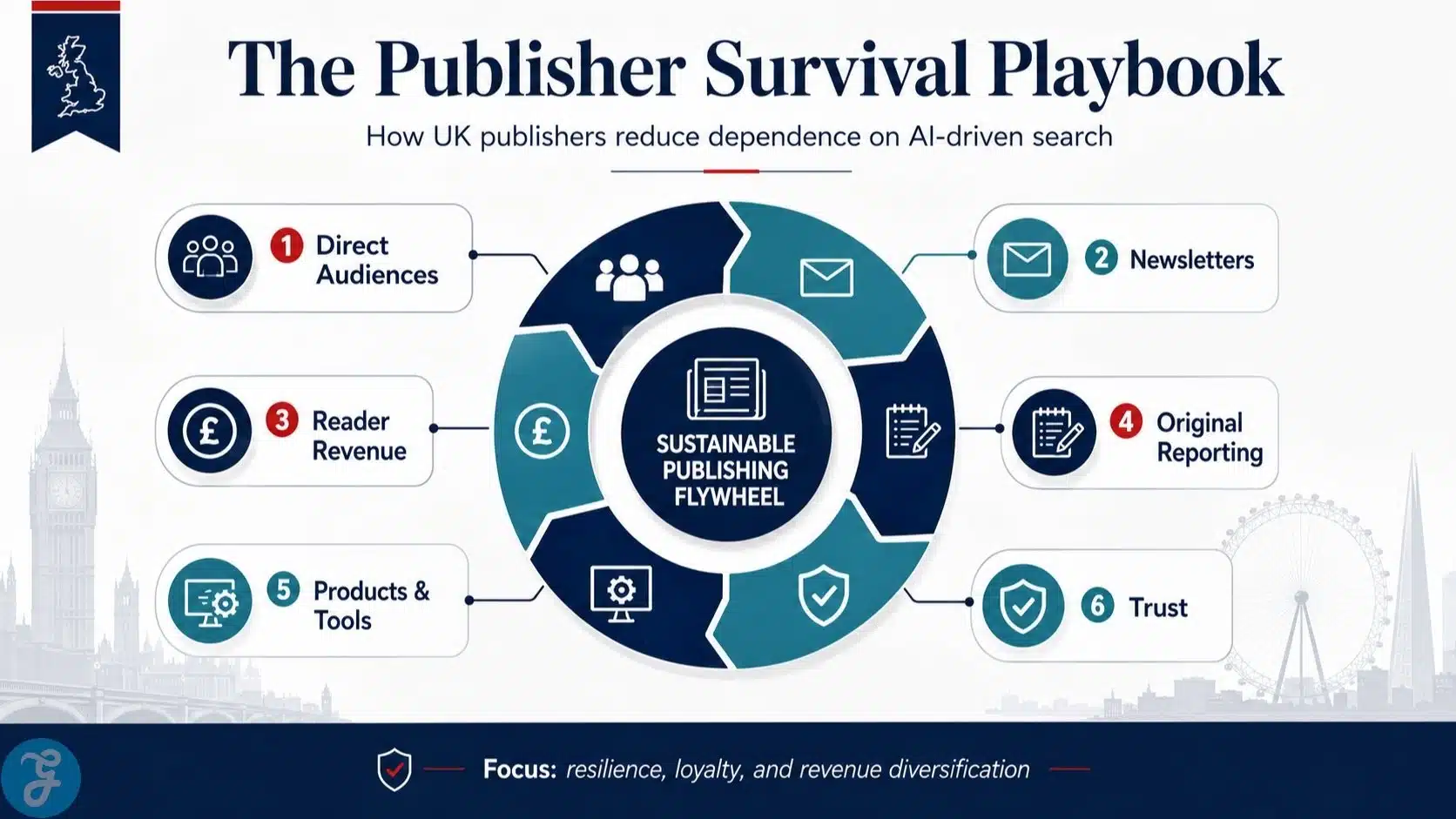
The strongest publishers are not relying on one fix. They are building a portfolio of survival tactics: direct traffic, loyal audiences, licensing pressure, product depth, creator-style distribution, and stronger commercial models.
1. Building Direct Audience Relationships Instead Of Renting Google Traffic
For years, many publishers treated search traffic as if it were a permanent asset. AI search has made the weakness of that assumption painfully obvious. When Google or an AI assistant answers the question directly, the publisher loses the visit, the ad impression, the recirculation opportunity, and often the subscription chance.
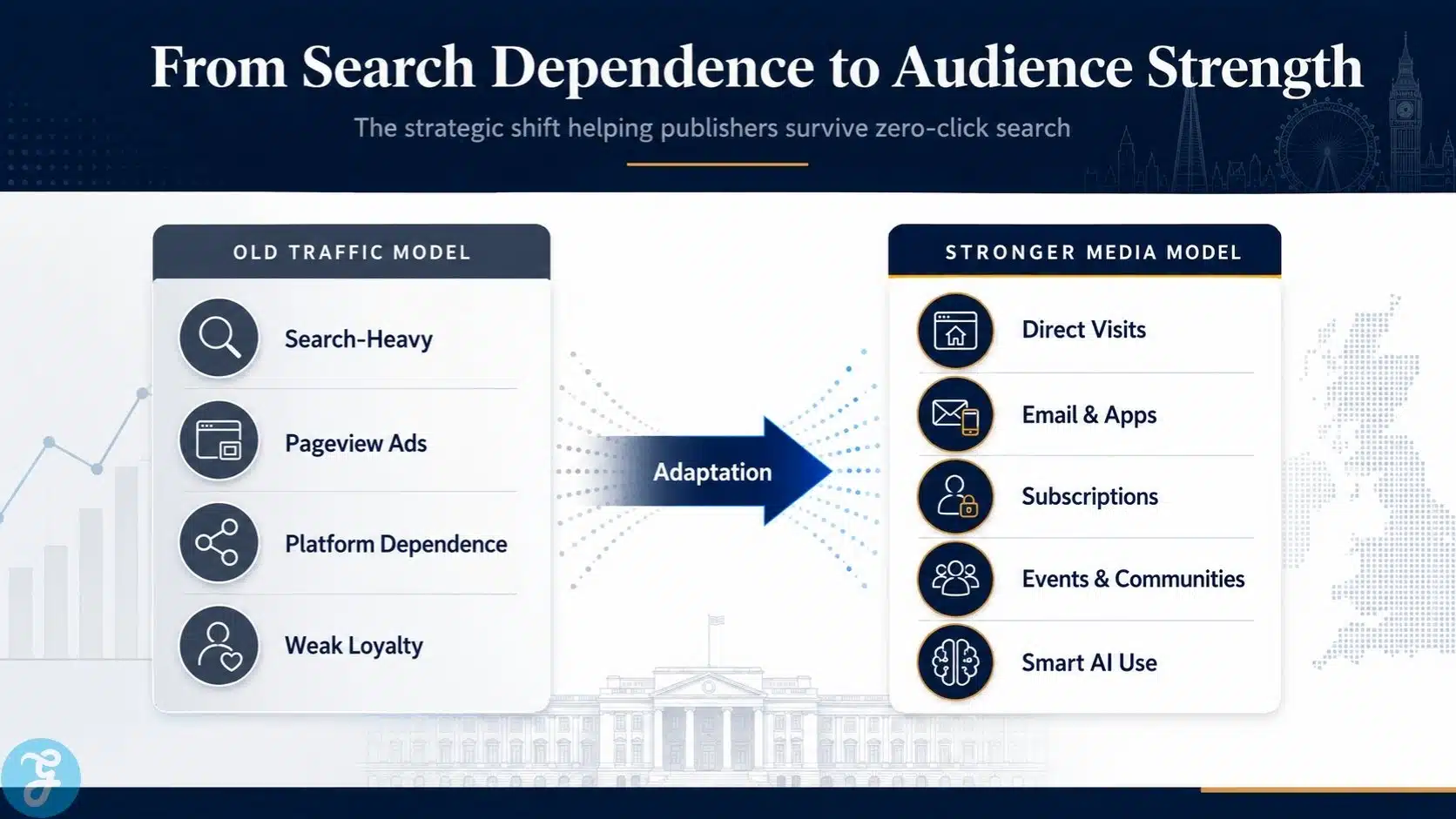
That is why direct audience building has become the first survival strategy. UK publishers are pushing readers toward newsletters, apps, alerts, registered accounts, memberships, podcasts, and habitual homepage visits. The goal is simple: make the reader relationship belong to the publisher, not the platform.
Best For:
- Publishers with loyal communities
- Newsrooms trying to reduce dependence on search referrals
Why We Chose It:
- Direct audiences are more durable than platform traffic
- Email and app users are easier to convert into subscribers or members
- Habitual readers create more predictable revenue
- Direct relationships protect publishers from sudden search changes
Things To Consider:
- Building direct habits takes time
- Registration walls and app prompts must not annoy casual readers too early
2. Turning Newsletters Into A Core Distribution Channel
Newsletters are no longer just a “nice weekly roundup.” They have become one of the most reliable tools for surviving AI search because they bypass search results entirely. A newsletter lands in the reader’s inbox, where the publisher controls the headline, the relationship, and the call to action.
For UK publishers, newsletters can serve many purposes: breaking news alerts, politics briefings, local updates, finance newsletters, culture recommendations, sports roundups, and premium analysis. The more specialized the newsletter, the more useful it becomes as a loyalty product.
Best For:
- Specialist journalism and recurring reader habits
- Publishers with strong columnists, beats, or local communities
Why We Chose It:
- Email is a direct channel
- Newsletters support subscriptions, memberships, events, and sponsorships
- They help publishers segment audiences by interest
- They are less vulnerable to AI answer boxes
Things To Consider:
- Generic newsletters perform poorly
- Publishers need strong subject lines, consistent frequency, and clear value
3. Moving Toward Subscriptions, Memberships, And Reader Revenue
When search traffic falls, ad-supported pageview models become fragile. That is why many publishers are pushing harder into subscriptions, memberships, donations, and reader revenue. The Reuters Institute’s 2025 Digital News Report found that publishers continue trying to diversify revenue, but digital subscriptions remain difficult to grow, with the proportion paying for online news stable at 18% across a basket of 20 richer countries.
That statistic is both encouraging and sobering. Reader revenue is essential, but it is not easy. People will not pay for commodity news that AI summaries can replace. They pay for distinctive journalism, trust, expertise, local relevance, analysis, investigations, useful tools, or a sense of belonging.
Best For:
- Publishers with strong brand trust or niche authority
- Newsrooms producing original reporting and analysis
Why We Chose It:
- Subscriptions reduce dependence on volatile referral traffic
- Reader revenue rewards trust and loyalty
- Memberships can deepen community engagement
- Paid products create a clearer value exchange
Things To Consider:
- Subscription fatigue is real
- Paywalls can reduce reach if not balanced carefully
4. Creating Journalism AI Cannot Easily Summarize Away
AI search is most dangerous to publishers when the content answers simple informational questions. If the user asks “What time is the match?” or “Who won the award?” an AI summary can often satisfy the need. But original reporting, investigations, exclusive interviews, expert analysis, live coverage, opinionated columns, local accountability journalism, and deeply reported explainers are harder to replace.
This is where UK publishers have a defensive advantage. AI can summarize known facts. It cannot attend a council meeting, cultivate sources, confront officials, interview victims, investigate companies, or build years of local trust.
Best For:
- Investigative teams, local newsrooms, specialist desks, and analysis brands
- Publishers shifting from commodity content to distinctive journalism
Why We Chose It:
- Original reporting creates defensible value
- Exclusive journalism is harder for AI search to replace
- Distinctive voices build loyalty
- Investigations and analysis support subscriptions and reputation
Things To Consider:
- Original reporting is expensive
- Publishers must resist filling sites with low-value search bait
5. Diversifying Traffic Through Aggregators, Social Platforms, And News Apps
UK publishers are not simply waiting for Google traffic to recover. Reach, one of the UK’s biggest news groups, has been diversifying beyond Google by leaning on news aggregators and monetizing Facebook engagement to offset the zero-click threat, according to Digiday.
This is a practical strategy, not a perfect one. Aggregators and social platforms are also controlled by outsiders. But the logic is clear: if one gatekeeper becomes less reliable, publishers need several traffic doors instead of one giant door with Google written on it.
Best For:
- Large publishing groups with audience teams
- Local and lifestyle publishers exposed to search declines
Why We Chose It:
- Diversification reduces single-platform risk
- Aggregators can replace some lost search discovery
- Social engagement can support brand visibility
- Multiple channels give publishers more testing room
Things To Consider:
- Social platforms can change algorithms suddenly
- Aggregator traffic may not convert as well as loyal direct readers
6. Using Creator-Style Distribution Without Abandoning Journalism Standards
Publishers are increasingly borrowing from creators: stronger on-camera personalities, short videos, platform-native explainers, audience comments, behind-the-scenes posts, and journalist-led social channels. The Reuters Institute report cited by The Guardian said about 75% of media managers planned to promote creator-style engagement in 2026, while about half aimed to collaborate with creators for distribution.
This does not mean every political editor needs to start dancing on TikTok. Mercifully. It means publishers are recognizing that distribution now depends on personalities, trust, formats, and community habits, not only homepage placement and Google ranking.
Best For:
- Publishers targeting younger audiences
- Newsrooms with strong reporters, columnists, or presenters
Why We Chose It:
- Creator-style formats help reach audiences outside search
- Journalists can become trusted distribution assets
- Short video can package complex stories accessibly
- Personality-led journalism can deepen loyalty
Things To Consider:
- Creator formats need editorial guardrails
- Popularity should not replace accuracy or public-interest value
7. Licensing Content To AI Companies, But Negotiating Harder
Some publishers are responding to AI search by licensing content to AI companies. These deals can create new revenue, attribution, and product partnerships. Digiday’s timeline of 2025 AI publisher deals showed how licensing became a major part of publisher strategy, with agreements involving companies such as OpenAI, Google, Microsoft, Meta, and major media groups.
For UK publishers, licensing is tempting but risky. A deal may bring money now, but if AI systems use that content to answer users without sending traffic back, the long-term value of the audience relationship may shrink. The smartest publishers will negotiate not only for training access, but for attribution, links, usage limits, revenue share, data access, and protection against traffic substitution.
Best For:
- Large publishers with valuable archives and trusted brands
- Media groups with leverage in negotiations
Why We Chose It:
- Licensing can create new revenue streams
- It recognizes that journalism has value in AI systems
- Attribution and links can preserve some discovery
- Deals may fund newsroom innovation
Things To Consider:
- Smaller publishers may lack bargaining power
- Poorly structured deals can trade long-term audience value for short-term cash
8. Fighting For Regulation, Copyright Protection, And Fair Choice
Publishers are not only adapting commercially. They are also fighting politically and legally. The UK government’s March 2026 report on copyright and artificial intelligence followed the 2024 to 2025 consultation and examined how copyright works are used in AI development.
Meanwhile, the European Publishers Council filed an EU antitrust complaint against Google’s AI Overviews in February 2026, arguing that Google used publisher content without consent, fair compensation, or meaningful ways to opt out without losing search visibility. Google rejected the claims, saying its AI features help surface web content and offer control options.
Best For:
- Publishers seeking fair compensation and platform accountability
- News organizations worried about content extraction without traffic return
Why We Chose It:
- Regulation may shape the future economics of AI search
- Copyright rules affect publisher bargaining power
- Opt-out rights matter only if publishers do not lose normal visibility
- Collective industry action can pressure dominant platforms
Things To Consider:
- Legal and regulatory processes move slowly
- Publishers still need business adaptation while policy debates continue
9. Optimizing For AI Visibility Without Depending On It
Some publishers are experimenting with AI search optimization, often called generative engine optimization or answer-engine optimization. The idea is to make journalism easier for AI systems to cite, summarize, and attribute correctly through clear structure, author authority, schema, source transparency, and concise explainers.
But this strategy needs caution. A 2026 empirical study of Google Search, Gemini, and AI Overviews found that AI Overviews were generated for 51.5% of representative real-user queries and appeared above organic results. It also found low overlap between sources retrieved by traditional Google search, AI Overviews, and Gemini, and noted that websites blocking Google’s AI crawler were less likely to be retrieved by AI Overviews.
That means AI visibility is real, but unstable. Publishers should make content machine-readable and citation-worthy, but not treat AI search as the new guaranteed traffic machine. We have seen this movie. The platform usually gets a sequel. The publisher gets a memo.
Best For:
- SEO and audience teams are adapting the technical strategy
- Publishers with evergreen explainers, service journalism, and specialist authority
Why We Chose It:
- AI systems need reliable sources
- Structured content can improve citation chances
- Author expertise and clear sourcing may support visibility
- AI search optimization is becoming part of modern SEO
Things To Consider:
- AI citations do not guarantee traffic
- Over-optimizing for machines can weaken human reader experience
10. Building Products That Search Cannot Replace
News publishers are increasingly moving beyond article pages into products: apps, live blogs, calculators, election trackers, local guides, personalized alerts, podcasts, video series, newsletters, premium briefings, and interactive data tools. These products are harder for AI search to replace because they provide ongoing utility, not just a one-time answer.
A mortgage calculator, football live blog, local election tracker, or curated morning briefing creates habits. It gives the reader a reason to return directly. That is exactly what publishers need when AI search reduces casual discovery.
Best For:
- Publishers with strong product, data, audio, or live coverage teams
- Newsrooms trying to build repeat usage
Why We Chose It:
- Tools and products create direct habits
- Live and interactive formats are harder to summarize fully
- Product experiences support registration and subscriptions
- Utility can increase reader loyalty
Things To Consider:
- Product development requires investment
- Weak tools can become maintenance burdens if not updated
11. Leaning Into Events, Communities, And Offline Revenue
AI search can summarize articles. It cannot fully replace a live conference, local debate, subscriber Q&A, awards program, expert roundtable, training session, or community event. That is why publishers are looking at events and communities as revenue and loyalty engines.
For UK publishers, this can work at several levels: national media can host policy, business, climate, finance, technology, culture, and leadership events. Local publishers can host town halls, business awards, schools guides, community panels, and local economy briefings.
Best For:
- Publishers with strong brands or local authority
- Media businesses looking for non-search revenue
Why We Chose It:
- Events create revenue beyond pageviews
- Communities deepen loyalty
- Sponsors value direct audience access
- Offline and hybrid experiences are less vulnerable to AI summaries
Things To Consider:
- Events require sales, operations, and audience trust
- Not every newsroom has the brand power to make events profitable
12. Using AI Internally To Improve Efficiency Without Replacing Editorial Judgment
The uncomfortable irony is that publishers are fighting AI search while also using AI inside their own workflows. Used responsibly, AI can help with transcription, tagging, archive search, headline testing, translation drafts, summarization for editors, personalization, data analysis, and workflow automation.
The Reuters Institute’s 2025 generative AI and news report found that public attitudes toward AI in journalism are complicated, with people generally more comfortable with AI assisting journalists than with AI replacing them.
That is the line UK publishers need to respect. AI can improve workflow. It should not become an excuse to flood the web with synthetic filler, weaken editorial accountability, or replace the human reporting that makes journalism valuable in the first place.
Best For:
- Newsrooms trying to improve productivity responsibly
- Publishers with clear editorial standards and AI policies
Why We Chose It:
- AI can reduce repetitive newsroom tasks
- Better workflows free journalists for reporting and analysis
- Responsible AI use can improve speed and personalization
- Editorial judgment remains the core value
Things To Consider:
- AI use needs transparency and governance
- Poor automation can damage trust quickly
An Overview Of 12 Ways UK Publishers Are Surviving AI Search Disruption
The strongest survival strategies are not only technical. They combine audience ownership, revenue diversification, editorial distinctiveness, legal pressure, product development, and careful use of AI inside the newsroom.
Overview Comparison
Here is a quick view of the 12 strategies and what each one protects.
| Strategy | What It Protects | Main Challenge |
|---|---|---|
| 1. Direct Audience Relationships | Reader loyalty | Building habits takes time |
| 2. Newsletters | Distribution control | Inbox competition |
| 3. Reader Revenue | Business stability | Subscription fatigue |
| 4. Original Journalism | Editorial value | High reporting costs |
| 5. Traffic Diversification | Discovery | Platform dependence remains |
| 6. Creator-Style Distribution | Younger audiences | Needs editorial discipline |
| 7. AI Licensing | New revenue | Risk of traffic substitution |
| 8. Regulation And Copyright | Fair bargaining | Slow policy process |
| 9. AI Visibility Optimization | Citation chances | Uncertain traffic return |
| 10. Publisher Products | Habit formation | Product investment |
| 11. Events And Communities | Non-search revenue | Operational complexity |
| 12. Internal AI Workflows | Efficiency | Trust and governance risks |
Our Top 3 Picks And Why?
Three survival strategies matter most because they reduce the biggest weakness of the old search-dependent model.
| Priority Strategy | Why It Matters |
|---|---|
| Direct Audience Relationships | Publishers need readers they can reach without Google |
| Original Journalism | AI can summarize information, but it cannot replace reporting |
| Revenue Diversification | Search traffic uncertainty makes single-stream revenue dangerous |
These three are the foundation. Licensing, AI optimization, and creator distribution may help, but without loyal audiences, distinctive journalism, and diversified revenue, publishers remain exposed.
The Final Checklist
Before building an AI search survival plan, publishers should ask five questions.
- Which sections are most exposed to zero-click search?
- Which journalists, formats, or beats create loyalty?
- How many readers can we reach directly today?
- What revenue is not dependent on search traffic?
- What is our policy on AI licensing, crawling, and attribution?
The Hard Truth For UK Publishers
AI search is not a passing weather event. It is a structural change in how people find information. The old model assumed search engines needed publishers enough to send them traffic. The new model is less generous. AI systems can read, summarize, remix, and answer using publisher content, while the publisher may receive fewer clicks in return.
That does not mean UK news publishers are doomed. But it does mean survival depends on being less replaceable. The publishers that endure AI Search Disruption will be the ones that own audience relationships, produce journalism worth seeking out, build products readers use habitually, diversify revenue, and negotiate harder with platforms that depend on their work.
The uncomfortable truth is that weak content will suffer first. Thin explainers, recycled listicles, generic lifestyle pieces, and commodity answers are exactly what AI search is designed to absorb. But serious journalism still has power because it creates new facts, verifies claims, challenges institutions, explains consequences, and gives communities a shared record of reality.
The future of UK publishing will not be won by chasing every AI answer box. It will be won by becoming the source readers, regulators, platforms, and AI systems cannot afford to ignore.
Frequently Asked Questions (FAQs) About AI Search Disruption
What Is AI Search Disruption?
AI Search Disruption refers to the shift from traditional search results to AI-generated answers, summaries, and chatbot-style responses. For publishers, the main risk is that users get answers without clicking through to the original news site.
Why Are UK News Publishers Worried About AI Search?
UK publishers are worried because AI summaries can reduce click-through rates, weaken advertising revenue, and limit opportunities to convert casual readers into loyal users or subscribers. Reuters reported that UK regulators proposed changes after publishers raised concerns about sharp traffic declines from AI Overviews.
Can Publishers Block AI Crawlers?
Some publishers can use technical controls to block certain AI crawlers, but the issue is complicated. Research on LLMs and news publishers found that blocking GenAI bots can sometimes reduce traffic for large publishers, showing that defensive blocking may create trade-offs.
Are Licensing Deals A Good Solution?
They can help, but they are not a complete solution. Licensing deals may create revenue and attribution, but publishers must consider whether AI answers could reduce long-term audience value and search traffic.
What Is The Best Survival Strategy For UK Publishers?
The best strategy is a mix of direct audience growth, distinctive journalism, diversified revenue, smart licensing, product innovation, and careful AI use. No single tactic can fully solve the AI search problem.