
An author bio can be completely truthful and still tell readers almost nothing. A page can have citations, schema markup, an expert reviewer, and a recent update date, and still feel strangely unreliable. That is where a lot of E-E-A-T advice goes wrong.
When traffic falls or competitors begin ranking higher, it is tempting to add a few visible “trust signals” and expect Google to notice. But E-E-A-T is not a collection of badges. It is the difference between saying, “You can trust this page,” and giving people a genuine reason to trust it. I prefer to think about E-E-A-T through one simple question:
What evidence would a reasonable reader need before relying on this information?
The answer changes with the topic. Someone reviewing a coffee maker may need first-hand testing. Someone explaining a medical treatment needs a much higher level of expertise and evidence.
The following E-E-A-T SEO tactics focus on that difference. They are designed to strengthen the content itself, the people behind it, and the reputation supporting it.
E-E-A-T Is Not a Score You Can Increase
Before working through the tactics, one misconception needs to be cleared up. Google says E-E-A-T is not a specific ranking factor. There is no public E-E-A-T score, and quality raters do not personally move pages up or down the results.
Instead, Google’s systems use a mixture of factors that may identify content demonstrating experience, expertise, authoritativeness, and trust. Google also says that trust is the most important part of the framework. Strong E-E-A-T receives more consideration for subjects that could affect a person’s health, safety, financial stability, or wider well-being. These are often called YMYL topics.
Therefore, when I use the word “boost,” I do not mean increasing a hidden score. I mean making the content, creator, and website easier to verify and safer to trust.
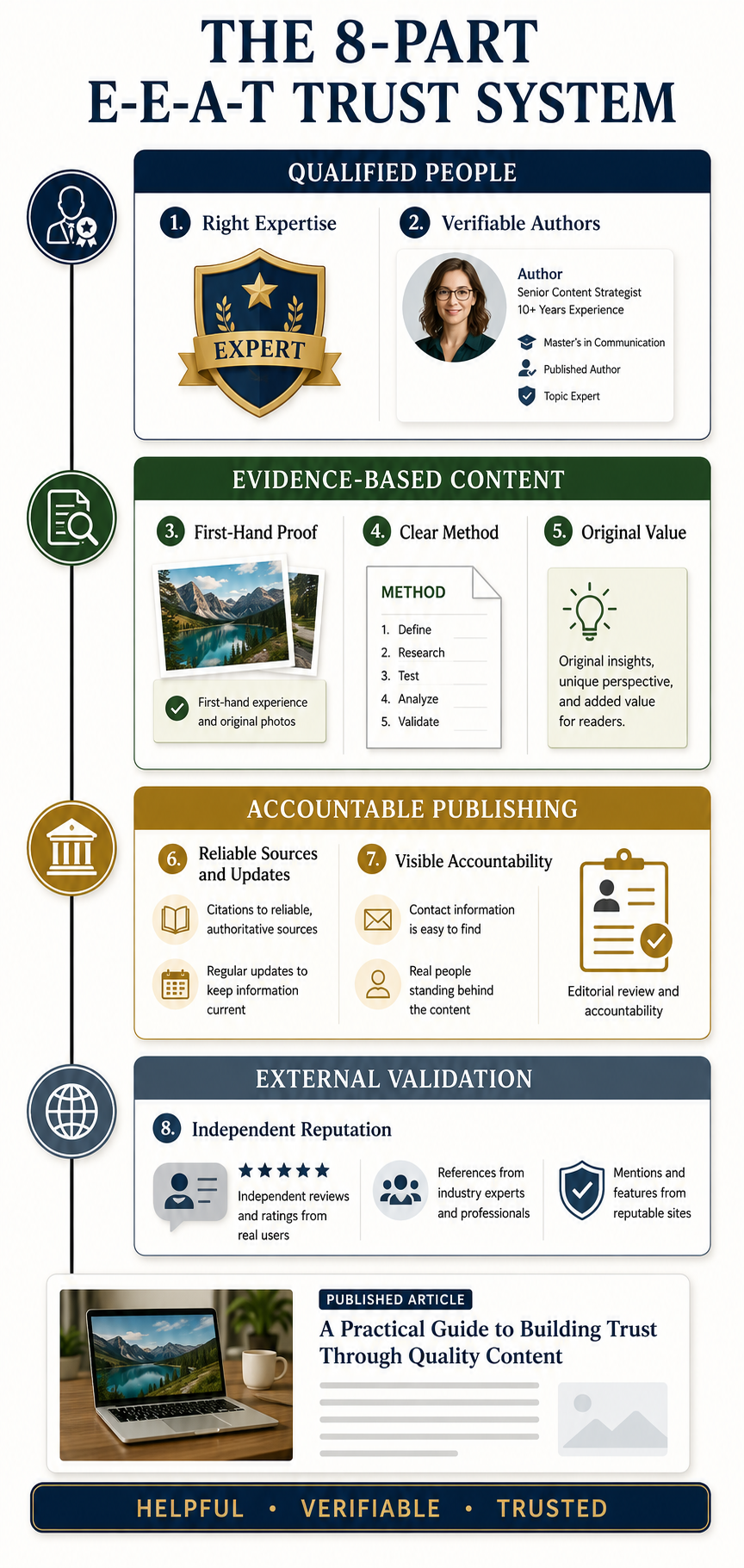
8 E-E-A-T Boosting Tactics for More Credible Content
The following tactics are not shortcuts for raising an imaginary E-E-A-T score. Each one strengthens a specific reason people may trust, or question, your content. Some improve the evidence on the page. Others make the author, editorial process, or website easier to verify.
The right priorities will depend on your subject, audience, and the harm inaccurate information could cause. Start with the weaknesses that create the greatest risk rather than trying to add every possible trust signal at once.
1. Match the Required Expertise to the Risk of the Topic
Not every article needs to be written by someone with formal qualifications. But every article should be created by someone with the right kind of knowledge for that subject.
A home cook can offer useful advice about a recipe they have prepared many times. A frequent traveler can explain what happened during a particular trip. A customer can describe living with a health condition.
However, personal experience alone may not be enough to recommend medication, interpret a legal contract, or tell someone how to invest their savings.
This is where experience and expertise must be separated:
- Experience comes from doing, using, visiting, testing, or living through something.
- Expertise comes from developed knowledge or skill. Some subjects may also require formal training.
- Trust depends on whether the experience or expertise is appropriate for the claim being made.
Before assigning an article, consider what could happen if the information is wrong. The greater the possible harm, the stronger the evidence and professional oversight should be.
For sensitive topics, a qualified reviewer can help. But the review must be real. Adding a professional’s name after publication without meaningful involvement is not expert review.
2. Make Authors and Reviewers Easy to Verify
Readers should not have to investigate the entire internet to discover who wrote an article. Use a clear byline when readers would reasonably expect one. Link it to a useful author page containing relevant information, such as:
- The author’s genuine areas of knowledge
- Relevant qualifications or professional experience
- First-hand experience connected to the topics they cover
- Articles they have written or reviewed
- Links to legitimate professional profiles
- A practical way to contact them or the editorial team
Keep the information specific. “Jane is passionate about wellness” does not explain why Jane should be trusted to write about nutrition. “Jane is a registered dietitian who reviews nutrition content” provides something readers can verify.
The same rule applies to reviewers. State what they reviewed and why their background is relevant.
Article and ProfilePage structured data can help Google connect an article with its creator. Google recommends using an author.url or sameAs property to identify authors more clearly. However, schema is only a description of information. It does not prove that the person is experienced or qualified.
A short, honest biography is more useful than a long one filled with vague authority claims.
3. Support First-Hand Experience With Original Evidence
Writing in the first person does not automatically demonstrate experience. Anyone can write, “I tested this product.” The stronger question is: What on the page proves that testing took place?
Useful evidence might include:
- Original photographs or videos
- Screenshots from the process
- Measurements and test results
- Dates or testing periods
- Comparisons with similar options
- Problems discovered during use
- Specific details that cannot be taken from a product description
The evidence should suit the subject. A travel article might include original photographs, route details, costs, accessibility observations, and practical issues encountered during the visit. A software review could show screenshots, tested features, limitations, and the tasks used for comparison.
Google’s review guidance recommends original visuals, quantitative measurements, comparisons, decision-making factors, and benefits and drawbacks based on original research. It also says that “best” recommendations should include first-hand supporting evidence.
If no first-hand testing was conducted, do not write as though it was. A well-researched comparison can still be useful when its limitations are stated honestly.

4. Explain How the Content Was Created
A good methodology section does more than say, “We researched the topic carefully.” It explains what the research involved.
Depending on the article, that could include:
- When the research took place
- How products or examples were selected
- How many options were considered
- Which tests or comparisons were performed
- Which sources were consulted
- What was excluded and why
- Who checked the final claims
- Any important limitations
Google encourages publishers to consider the “Who, How, and Why” behind their content. For product reviews, it gives examples such as explaining how many products were tested, how testing was performed, and what the results showed. Google also recommends considering an AI or automation disclosure when readers would reasonably want to know how the content was produced.
That does not mean every use of a spellchecker or brainstorming tool needs a dramatic disclosure. The important issue is whether automation played a substantial role and whether human verification was necessary.
A methodology should make the work more transparent. It should never be used to create the appearance of research that did not happen.
5. Replace Commodity Summaries With Original Value
Search results are crowded with articles that repeat the same advice in a slightly different order.
Google’s updated guidance for generative AI search calls this type of generic material “commodity content.” It says unique, useful, non-commodity content will likely influence long-term visibility in generative search more than the other suggestions in its guide. Google also advises publishers not to recycle information that already exists online or could easily be produced by a generative AI model.
Original value does not always require an expensive study. It can come from:
- A first-hand case study
- An expert interview
- Original survey data
- A useful calculation
- A new decision framework
- Local or industry-specific context
- An honest analysis of failed approaches
- A template readers can use
- A clearer comparison based on relevant criteria
The goal is to give readers something they could not get by opening the first three competing pages.
Topical focus matters too. Publishing hundreds of loosely related pages does not automatically create authority. Google defines scaled content abuse as producing many low-value or unoriginal pages primarily to manipulate rankings, regardless of whether humans or automated tools created them.
Depth should come from having something useful to contribute, not simply covering more keywords.
6. Create a Reliable Sourcing and Updating Process
A list of sources at the bottom of an article does not help much if readers cannot tell which source supports which claim. Place citations close to the relevant information. When possible, link to the original source rather than another article summarizing it.
For example:
- Use official government data for public statistics.
- Link to the original research paper rather than a press release about it.
- Use a company’s official documentation for its current product features.
- Check study dates, sample sizes, and limitations before repeating a percentage.
- Distinguish correlation from causation.
Accuracy also needs maintenance. A recipe may remain useful for years, while an article about tax rules, software features, prices, or health guidance can become outdated quickly.
Set review schedules according to how quickly the subject changes. When an article receives a meaningful update, describe what changed when that information would help readers.
Do not change a date simply to make an old page appear fresh. Google specifically lists changing dates without substantial content changes as a warning sign of search-first content.
If an error is found, correct it. For serious changes, a visible correction note can build more trust than silently rewriting the page.
7. Make the Website Accountable for What It Publishes
A strong article can still lose trust when the website behind it is vague. Readers should be able to understand who operates the site, why it exists, and how to contact the people responsible. The exact information needed depends on the website.
A publisher may need:
- An About page
- Editorial and fact-checking standards
- A corrections policy
- Author and reviewer information
- Ownership or funding disclosures
- Advertising and affiliate policies
- Accessible contact details
An online store may also need clear shipping, returns, payment, privacy, and customer-support information.
These pages should be useful, not written as SEO filler. An affiliate disclosure hidden behind a vague link does not offer much transparency. Neither does an About page that talks about a “passionate team” without identifying anyone.
Google’s quality-rater guidelines state that information about who created the content and who is responsible for the website is critical for pages requiring a high level of trust. The guidelines also tell raters to look for contact information where it would be expected.
Trust often grows through small signs of accountability: clear ownership, honest disclosures, accessible help, and a willingness to correct mistakes.
8. Earn a Reputation That Exists Beyond Your Website
A website can describe itself as trusted, leading, or authoritative. That does not make the description true. Real authority is confirmed by other people.
Google’s quality-rater guidelines instruct raters to look for independent reviews, expert recommendations, references, news coverage, and other credible reputation information. When a website’s claims conflict with reliable independent sources, raters are told to trust the independent sources.
A sustainable reputation strategy can include:
- Publishing original research that others genuinely reference
- Contributing useful expertise to industry discussions
- Taking part in relevant interviews, events, or professional groups
- Earning reviews from real customers
- Responding responsibly to valid criticism
- Making qualified experts available to journalists
- Correcting inaccurate business information across trusted platforms
- Producing resources worth citing
This is not the same as buying mentions or creating fake reviews.
Third-party research offers useful context. An Ahrefs analysis of 75,000 established brands found that web mentions had a 0.664 correlation with AI Overview visibility, compared with 0.218 for backlink count. The study does not prove that mentions caused visibility, and its sample favored established brands. Still, it supports a sensible point: online reputation is broader than the number of links pointing to a website.
The safest way to earn authority is to become genuinely useful within a clearly defined subject area.
Where Should You Start Improving E-E-A-T?
Begin with the pages where inaccurate or unproven information could cause the most harm. These may include health, financial, legal, safety, or high-value purchasing content.
First, check whether the author and reviewer are suitable for the subject. Then examine the page’s claims, sources, first-hand evidence, and update history. Finally, look beyond the article. Make sure readers can identify the website owner, understand any commercial interests, and find clear contact or correction information.
Do not begin by adding schema, rewriting every author biography, or changing publication dates across the site. Those changes cannot repair unsupported advice or weak research.
A sensible order is:
- Correct harmful or unsupported claims.
- Add appropriate expert review.
- Strengthen original evidence and sourcing.
- Improve authorship and editorial transparency.
- Address independent reputation problems.
This order puts reader safety and factual trust before cosmetic SEO changes.
Final Thoughts
The most effective E-E-A-T SEO tactics are rarely quick cosmetic changes. They involve choosing appropriate creators, showing real evidence, explaining the work, checking facts, accepting accountability, and earning recognition outside your own website.
That may sound less exciting than discovering a hidden ranking shortcut. But it creates something far more durable: content that deserves to be trusted.
Start with the page where trust matters most. Identify the claim that carries the greatest risk, then strengthen the author, evidence, sourcing, and transparency around it. That is a far more useful approach than trying to increase an E-E-A-T score that does not exist.
Frequently Asked Questions on E-E-A-T SEO Tactics
1. What does E-E-A-T mean, and which part is most important?
E-E-A-T stands for experience, expertise, authoritativeness, and trustworthiness. Google says trust is the most important element because an untrustworthy page has weak E-E-A-T regardless of how experienced or authoritative its creator may appear.
2. Is E-E-A-T a direct Google ranking factor?
No. Google explicitly says E-E-A-T is not a specific ranking factor. Its systems use a mixture of factors that may identify content demonstrating strong E-E-A-T. Quality-rater scores also do not directly change page rankings.
3. Can I measure my website’s E-E-A-T score?
Google does not provide an E-E-A-T score. You can monitor useful indicators such as factual accuracy, qualified authorship, credible citations, independent reviews, relevant mentions, corrections, and reader trust. However, these should not be combined into a made-up Google score.
Accurate author bios make creators easier for readers to evaluate. Article and ProfilePage schema can help Google understand who created a page. Neither tactic proves expertise or guarantees higher rankings. The visible information and schema must be truthful and supported by real qualifications or experience.
5. Does AI-generated content damage E-E-A-T?
AI use alone does not determine whether content is helpful or trustworthy. The larger risks are factual errors, generic summaries, false experience claims, weak human review, and scaled low-value publishing. An Ahrefs study of 600,000 pages found almost no correlation, 0.011, between its estimated AI-content percentage and ranking position, although the study relied on an imperfect AI detector.
6. How should E-E-A-T be handled for YMYL content?
YMYL content needs stronger trust and expertise because incorrect information could cause serious harm. Use qualified creators or reviewers where formal expertise is necessary, rely on authoritative evidence, keep the information current, disclose conflicts, and avoid presenting personal experience as professional advice.