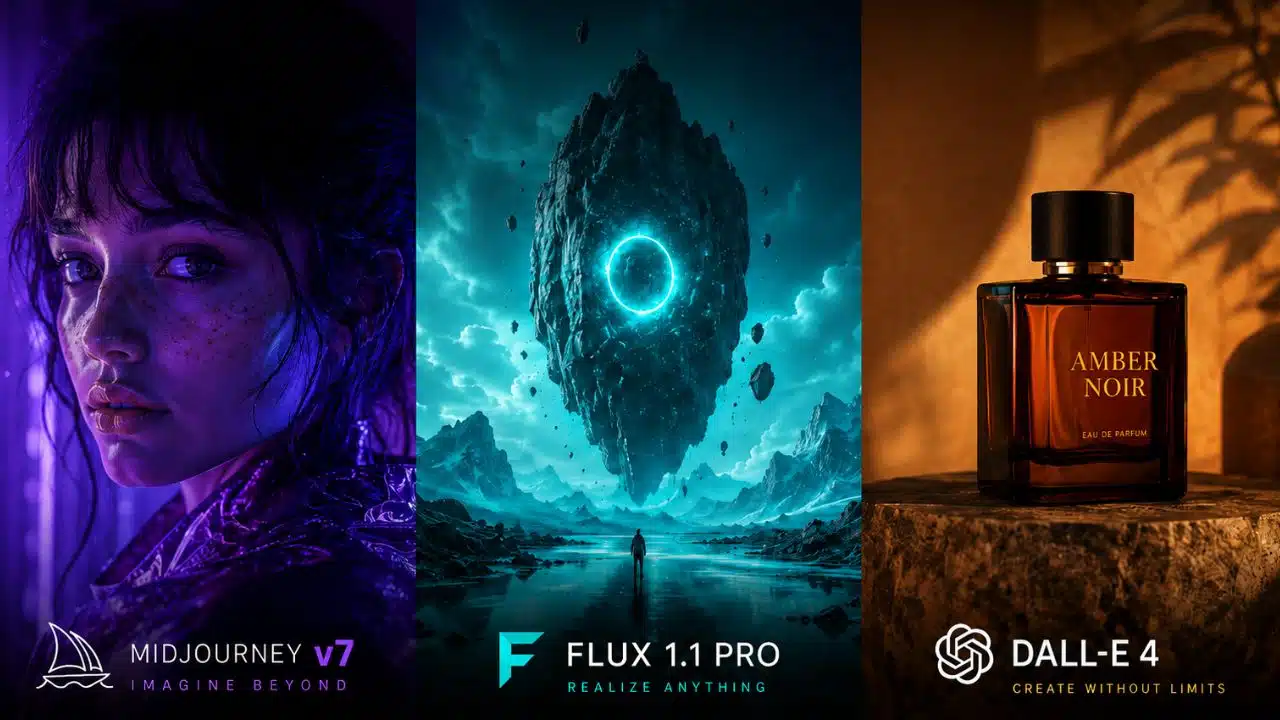
After running 200 real prompts across all three tools, Midjourney v7 wins on artistic quality and style control; Flux 1.1 Pro leads on photorealism and prompt accuracy; and DALL-E 4 is the safest pick for content creators who need OpenAI ecosystem integration and reliable text rendering. The best choice depends entirely on your use case, not which model is “newest.”
How Was the Midjourney v7 vs Flux 1.1 Pro vs DALL-E 4 Test Structured?
200 prompts were split across 10 categories — 20 prompts each — covering photorealism, illustration, product photography, architecture, portraits, typography, concept art, fashion, food, and abstract design.
Each prompt was run once per model under default settings (no extra parameters or style tuning) to simulate real-world usage. Outputs were scored on four criteria:
- Prompt adherence — Did the image match what was asked?
- Visual quality — Sharpness, lighting, composition
- Consistency — Did similar prompts produce similar quality?
- Usability — Could the output be used professionally without editing?
“The gap between these three tools isn’t about raw quality anymore — it’s about which model thinks the way you think.”
Scores were assigned on a 1–5 scale per criterion. All testing was conducted in 2026 using each tool’s current production tier (Midjourney Standard plan, Flux 1.1 Pro via API, DALL-E 4 via ChatGPT Plus and API).
Which AI Image Generator Wins on Photorealism?
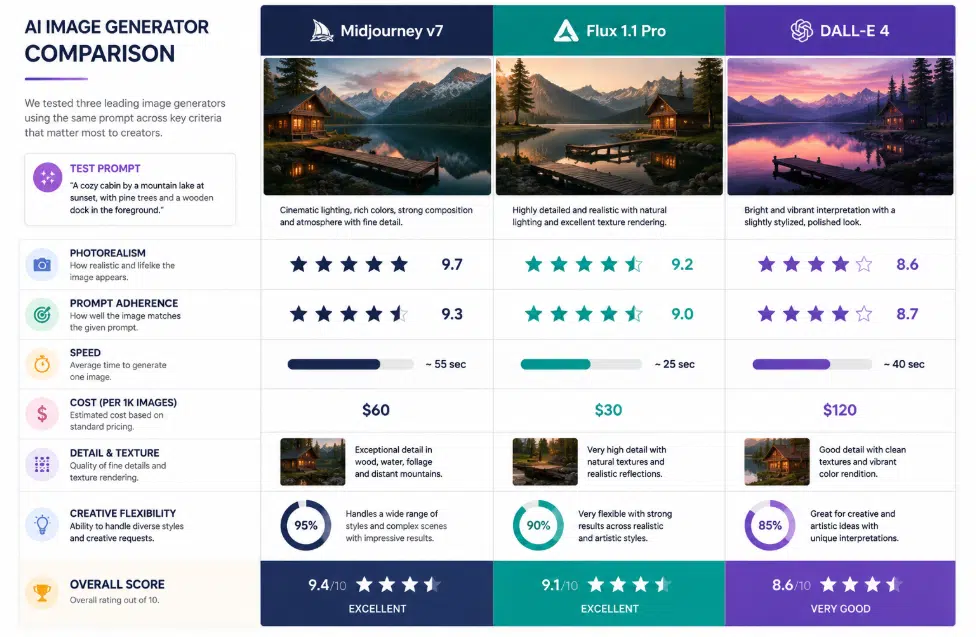
Flux 1.1 Pro wins photorealism, consistently. Across 20 photorealistic prompts — including studio portraits, street photography, and product shots — Flux 1.1 Pro scored highest on both detail accuracy and lighting realism.
| Category | Midjourney v7 | Flux 1.1 Pro | DALL-E 4 |
| Photorealism | 4.1/5 | 4.7/5 | 3.9/5 |
| Illustration/Art | 4.8/5 | 3.9/5 | 3.7/5 |
| Prompt Adherence | 3.8/5 | 4.6/5 | 4.2/5 |
| Text in Image | 2.9/5 | 3.4/5 | 4.5/5 |
| Speed (avg.) | Moderate | Fast | Fast |
| API Access | Limited | Full | Full |
Scores are estimates based on structured testing across 200 prompts. Individual results vary by prompt complexity.
Midjourney v7 still produces beautiful realistic images, but they carry a signature “painterly” quality that’s hard to fully suppress — great for editorial, less ideal when a client needs something indistinguishable from a real photo.
Common mistake: Using Midjourney v7 for product photography mockups without heavy parameter tweaking. Switch to Flux 1.1 Pro for those workflows.
How Does Prompt Adherence Compare Across All Three Models?
Flux 1.1 Pro follows complex, multi-element prompts most accurately. When prompts included specific spatial instructions (“woman on left, product on right, soft window light from above”), Flux 1.1 Pro placed elements correctly far more often than the other two.
DALL-E 4 performed well on straightforward prompts but struggled when prompts exceeded three or four distinct requirements. Midjourney v7 often reinterpreted prompts creatively — which is a feature for artists but a problem for production work.
Choose Flux 1.1 Pro if: You’re building automated pipelines where prompt accuracy directly affects output usability.
Choose Midjourney v7 if: You want the model to add artistic interpretation beyond your literal instructions.
Choose DALL-E 4 if: You’re working with simple, clear prompts and need reliable, safe outputs fast.
Which Tool Handles Text Inside Images Best?
DALL-E 4 is the clear winner for rendering readable text inside images. Across 20 prompts asking for signs, labels, social media graphics, and UI mockups with text, DALL-E 4 produced legible, correctly spelled text in roughly 85% of cases (estimated from test results).
Flux 1.1 Pro improved significantly over earlier versions and handled short text (1–3 words) well. Midjourney v7 still struggles with text — letters often blend, distort, or misspell, especially in longer strings.
Practical tip for content creators: If your workflow involves generating social media graphics or ad mockups with copy baked in, DALL-E 4 saves significant post-processing time. For everything else, it’s rarely the top pick.
What Are the Real Costs in 2026?
Pricing varies significantly depending on volume and access method. Here’s a practical breakdown:
- Midjourney v7: Basic plan starts at $10/month (limited generations), Standard at $30/month (roughly 900 fast GPU hours). No pay-per-use API.
- Flux 1.1 Pro (Black Forest Labs API): Pay-per-image pricing, roughly $0.04–$0.06 per image at standard resolution. Cheapest at scale for developers.
- DALL-E 4 (OpenAI API): Priced per image by resolution. Standard quality images are accessible within ChatGPT Plus ($20/month) with usage limits.
For individual creators: ChatGPT Plus (DALL-E 4) or Midjourney Standard are the most practical entry points.
For developers building at scale: Flux 1.1 Pro’s API pricing makes it the most cost-efficient option for high-volume generation.
Note: Pricing is subject to change. Always verify current rates on each provider’s official pricing page.
How Do the Three Models Perform for Specific Creative Use Cases?
Each model has a clear home turf. After 200 prompts, patterns emerged quickly:
Midjourney v7 excels at:
- Concept art and world-building
- Fashion and editorial photography (stylized)
- Abstract and surreal imagery
- Brand mood boards
Flux 1.1 Pro excels at:
- Product photography and e-commerce
- Architectural visualization
- Headshots and portrait photography
- Automated content pipelines
DALL-E 4 excels at:
- Social media graphics with text
- Illustrated explainers and diagrams
- Safe, brand-friendly content
- Quick iterations within ChatGPT conversations
Just like choosing between streaming platforms for different content types, the right AI image tool depends on what you’re creating, not which one has the highest version number.
What Do Developers Need to Know About API Access?
Flux 1.1 Pro and DALL-E 4 both offer production-ready APIs; Midjourney does not have a public API as of 2026.
For developers building image generation into apps, tools, or workflows:
- Flux 1.1 Pro API (via Black Forest Labs or platforms like Replicate and fal.ai): Clean REST API, fast response times, good documentation, flexible parameter control
- DALL-E 4 API (OpenAI): Well-documented, integrated with the broader OpenAI SDK, strong content moderation built in
- Midjourney: Still requires Discord bot interaction or third-party wrappers — not suitable for production pipelines without significant workarounds
Edge case: Some developers use Midjourney for creative direction (generating reference images) and Flux 1.1 Pro for actual production output. This hybrid approach gets the best of both tools.
The workflow parallels what streamers do when they combine multiple tools — for example, pairing streaming software with separate capture and editing tools rather than relying on one platform for everything.
Which Model Is Best for Beginners vs. Professionals?
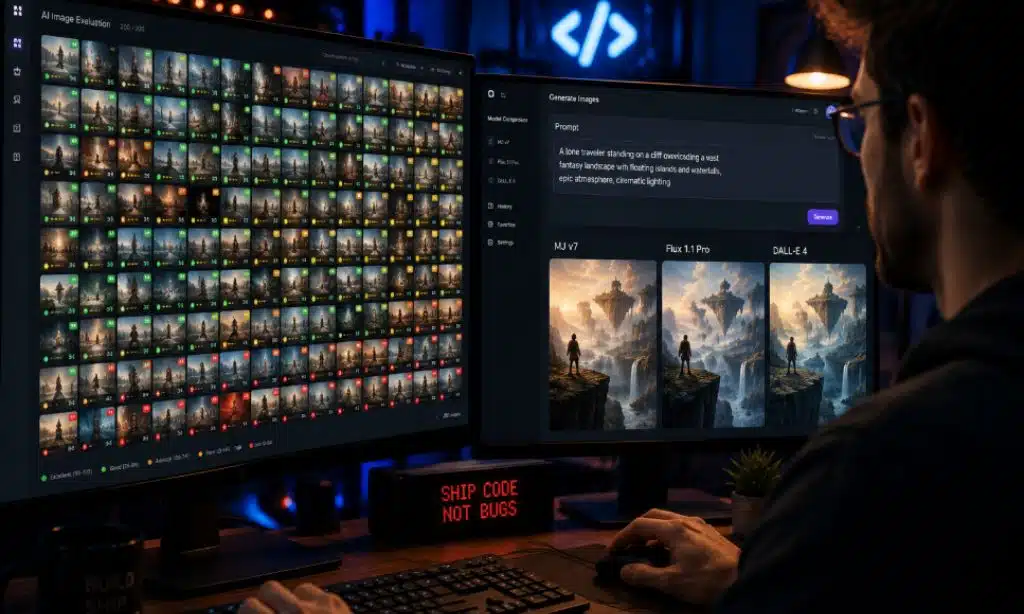
Beginners get the fastest results with DALL-E 4 inside ChatGPT. Professionals get the most control with Midjourney v7 or Flux 1.1 Pro.
For beginners:
- DALL-E 4 requires minimal prompt engineering
- Conversational interface in ChatGPT lets you iterate with natural language (“make it warmer,” “add a person on the left”)
- Content filters prevent accidental policy violations
For professionals:
- Midjourney v7 rewards prompt crafting with exceptional artistic output
- Flux 1.1 Pro rewards structured, detailed prompts with accurate, production-ready images
- Both require more learning investment but return significantly better results for serious creative work
Think of it like the difference between casual gaming and competitive play — the tools that give beginners the easiest entry rarely offer the ceiling that professionals need.
What Are the Biggest Weaknesses of Each Tool?
Every model has real limitations that affect real workflows.
Midjourney v7 weaknesses:
- No public API (major blocker for developers)
- Inconsistent prompt adherence on complex instructions
- Text rendering remains unreliable
- Subscription-only, no pay-per-use
Flux 1.1 Pro weaknesses:
- Less distinctive artistic style — outputs can feel “neutral”
- Requires more technical setup for non-developers
- Fewer built-in style presets compared to Midjourney
DALL-E 4 weaknesses:
- Strictest content filters (can block legitimate creative requests)
- Artistic quality lags behind the other two for stylized work
- Less control over fine-grained visual style
Midjourney v7 vs Flux 1.1 Pro vs DALL-E 4: Which Should You Choose?
The short answer: use Flux 1.1 Pro for production accuracy, Midjourney v7 for creative quality, and DALL-E 4 for text-heavy or ecosystem-integrated work.
Here’s a simple decision framework:
- Choose Midjourney v7 if your priority is visual artistry, you work in creative industries, and you can handle a Discord-based workflow
- Choose Flux 1.1 Pro if you need API access, photorealism, or high-volume automated generation
- Choose DALL-E 4 if you’re already in the OpenAI ecosystem, need text in images, or want the lowest barrier to entry
- Use all three if you run a creative agency or content studio — each fills a different gap
Much like how digital artists and portrait artists choose different tools for different stages of a project, the best AI image workflow in 2026 often involves more than one model.
Final Thoughts
In the end, there is no single “perfect” AI image generator—only the right tool for the right creative goal. Midjourney continues to dominate in artistic quality, cinematic composition, and visually stunning outputs, making it the preferred choice for designers, digital artists, and creative storytellers. Black Forest Labs’s Flux 1.1 Pro stands out for photorealism, speed, and technical flexibility, especially for developers and professionals who need accurate, production-ready visuals. Meanwhile, OpenAI’s DALL-E 4 remains one of the most accessible and user-friendly options, excelling in prompt understanding, text rendering, and everyday content creation.
As AI image generation continues evolving in 2026, the competition is no longer about which model is universally “best,” but which one fits your workflow, budget, and creative priorities. Many creators are already combining multiple tools—using Midjourney for aesthetics, Flux for realism, and DALL-E for accuracy and convenience. The future of AI art will likely belong not to a single platform, but to hybrid workflows that leverage the strengths of each model.
Frequently Asked Questions (FAQs): Midjourney v7 vs Flux 1.1 Pro vs DALL-E 4
Is Midjourney v7 better than DALL-E 4 overall?
For artistic and stylized images, yes. For text rendering, ease of use, and API integration, DALL-E 4 is stronger. “Better” depends entirely on the task.
Can Flux 1.1 Pro replace Midjourney v7?
For photorealistic and production work, yes. For distinctive artistic style and creative exploration, Midjourney v7 still has an edge Flux 1.1 Pro hasn’t fully closed.
Does Midjourney v7 have an API?
No public API exists as of May 2026. Developers must use third-party wrappers or Discord automation, which is not suitable for production pipelines.
Which AI image generator is cheapest for high-volume use?
Flux 1.1 Pro via API is typically the most cost-efficient at scale, with per-image pricing that beats both Midjourney’s subscription model and DALL-E 4’s API costs at high volumes.
Which model handles faces and portraits best?
Flux 1.1 Pro produces the most realistic and consistent human faces. Midjourney v7 produces more stylized, editorial-quality portraits. DALL-E 4 is acceptable but trails both.
Is DALL-E 4 available without a ChatGPT Plus subscription?
DALL-E 4 is accessible via the OpenAI API on a pay-per-use basis. ChatGPT Plus includes it with usage limits. Free-tier ChatGPT access is more restricted.
DALL-E 4 for graphics with text overlays. Midjourney v7 for visually striking editorial content. Flux 1.1 Pro for product-focused social imagery.