


If you want to grow your digital brand, the Nordic region is one of the smartest places to look. We are talking about Sweden, Norway, Denmark, and Finland—countries with some of the highest internet usage and spending power on the planet. By 2026, these markets aren’t just an “option” for brands; they are a gold mine for anyone who knows how to handle the local search landscape.
But here is the thing you can’t just flip a switch and expect to rank. You need a strategy built on Nordic e-commerce SEO that respects the local culture and technical high standards of these tech-savvy shoppers.
The competition in the North is fierce but predictable once you know the rules. These shoppers are smart, skeptical of generic ads, and they value their time. If your site doesn’t feel local or load in the blink of an eye, you are invisible. This guide isn’t about general tips you find anywhere. We are going deep into the specific tactics that actually move the needle in Stockholm, Oslo, Copenhagen, and Helsinki. From the way you handle local domains to the “green” keywords you pick, every detail matters. Let’s look at how you can build a presence that truly resonates.
1. Master the Language Nuances of the North
One of the biggest mistakes international brands make is assuming English is enough because most Nordics speak it perfectly. While they can read English, they rarely search in it for everyday items. A Swedish shopper looking for a new winter jacket won’t type “winter jacket” into Google; they will type “vinterjacka.” If your site isn’t using native keywords, you aren’t even in the race. You have to think about how people actually talk and search at home.
The Danger of Direct Translation
Directly translating your English site using a basic tool is a fast way to lose trust. Each Nordic language has its own quirks and synonyms that change based on intent. For instance, the word for “sale” isn’t the same in Sweden as it is in Denmark. If you use a Swedish term on a Danish page, you look like an outsider. You need native speakers to check your keyword lists to ensure they match how locals actually speak.
| Language | Primary “Sale” Term | Search Behavior | Localization Difficulty |
| Swedish | Rea | High volume, price-sensitive | Moderate |
| Norwegian | Salg | Focus on quality and durability | Moderate |
| Danish | Udsalg | Very competitive, bargain-driven | Moderate |
| Finnish | Ale | Highly specific grammar rules | Very High |
2. Localize Beyond Just Translating Words
Localization is about the vibe of the site, not just the text. Nordic culture values honesty, transparency, and a clean aesthetic. If your site is cluttered with pop-ups and aggressive “Buy Now” buttons, you will turn people off. The concept of “Lagom” in Sweden—meaning “just the right amount”—is a great rule of thumb for your web design and marketing copy. Don’t over-promise; just provide the facts clearly.
Adapting to the Seasonal Search Cycle
The Nordics live by the seasons because their environment changes so drastically. In the dark winter months, people search for cozy home items and heavy-duty outdoor gear. In the bright summer, the focus shifts to outdoor living and gardening. Your Nordic e-commerce SEO strategy must be proactive. You should start ranking your summer content while there is still snow on the ground to stay ahead of the seasonal search spikes.
| Culture Value | Impact on Content | Recommended Strategy |
| Transparency | High | Clear pricing and return policies |
| Sustainability | Very High | Mention eco-friendly shipping |
| Directness | High | Use short, punchy product descriptions |
| Tech-Savvy | High | Ensure all site features work perfectly |
3. Optimize for Local Payment and Logistics
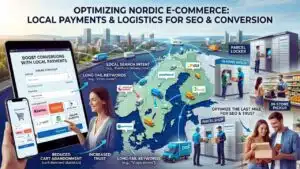
If a customer reaches your checkout and doesn’t see their favorite local payment method, they’ll leave. This kills your conversion rate and tells Google your site isn’t satisfying users. In the North, local apps are king. You need to mention things like Klarna, Vipps, and MobilePay right on your product pages. This helps you rank for “long-tail” keywords where people search for stores that accept their specific payment type.
The Last Mile: Shipping as an SEO Factor
Nordic shoppers have very specific ideas about how they want their packages delivered. Many prefer picking up items at a local grocery store or a secure locker rather than home delivery. By including these shipping brands—like PostNord or Helthjem—in your footer and FAQ pages, you capture local search intent. People often search for “PostNord delivery times” or “Vipps shops,” and having this info helps your Nordic e-commerce SEO.
| Country | King of Payments | Top Delivery Partner | Preferred Pickup |
| Sweden | Klarna / Swish | PostNord / Budbee | Parcel Locker |
| Norway | Vipps | Posten Norge / Bring | In-store Pickup |
| Denmark | MobilePay | GLS / DAO | Parcel Shop |
| Finland | Online Banking | Posti | SmartPost Locker |
4. Leverage Country-Specific Domains (TLDs)
Using a .com domain with folders can work, but it isn’t the gold standard here. Nordic people are very protective of their consumer rights and feel safer on a .se, .no, or .dk site. A local domain tells the user—and the search engine—that you are physically and legally present in that country. It is a massive trust signal that can instantly improve your click-through rates in the search results.
Norway is particularly strict about its .no extension. You usually need a local organization number to register one. While this sounds like a lot of work, it acts as a barrier to entry. If you take the time to set this up, you have a huge advantage over competitors who are just using a generic global site. It proves to both Google and the Norwegian shopper that you are serious about their market.
| Domain Type | Trust Level | SEO Signal Strength | Management Effort |
| .se / .no / .dk | Maximum | Very Strong | High |
| /se/ or /no/ | Moderate | Moderate | Low |
| se.brand.com | Low | Weak | Moderate |
| .com (English) | Minimal | Neutral | Very Low |
5. Focus on Regional Trust Signals
Trust is the currency of the North. Because these populations are so tech-savvy, they can spot a low-quality site from a mile away. You need to display recognized local trust badges to survive. These aren’t just for show; they tell Google that your site is a legitimate business that follows strict European and Nordic consumer laws. This helps your Nordic e-commerce SEO by keeping users on your site longer.
The Power of Local Certifications
In Denmark, everyone looks for the “e-mærket” badge. In Sweden, it is “Trygg E-handel.” When you get these certifications, you often get a high-quality backlink from their official site. These are some of the most powerful links you can get in the region. They tell search engines that your store is a safe place for locals to spend their money, which can give your rankings a steady boost.
| Certification | Region | Main Benefit | Trust Impact |
| Trygg E-handel | Sweden | Verified ethics | 5/5 |
| E-mærket | Denmark | Legal compliance | 5/5 |
| Trusted Shops | Europe-wide | Buyer protection | 4/5 |
| Bring Verified | Norway | Shipping trust | 3/5 |
6. Prioritize Mobile-First Performance
The Nordics have some of the highest smartphone penetration and fastest mobile networks in the world. If your site is slow or clunky on a phone, you are done. Google uses mobile-first indexing, meaning it looks at your mobile site to decide where you rank. In a region where people shop on their phones while commuting or sitting in a cafe, your mobile experience is your storefront.
Speed as a Competitive Edge
Don’t just think about how the site looks; think about how it feels. It needs to be snappy. Nordic users have zero patience for pages that jump around or images that take forever to load. Use local servers or a high-end CDN to make sure your site responds in milliseconds. This improves your “Core Web Vitals,” which are a major part of how Google judges your site’s quality in 2026.
| Performance Area | Target Goal | Why It Matters | Priority |
| Load Time | < 1.5 Seconds | High user expectations | Critical |
| Visual Stability | No shifting | Mobile usability | High |
| Interactivity | < 100ms | Smooth checkout | High |
| Mobile Layout | Finger-friendly | Touch navigation | Critical |
7. Build Links Within the Small Nordic “Pond”

Link building in the Nordics is about quality over quantity. The digital space is small, so a few links from major local newspapers or popular blogs are worth more than a thousand generic global links. You want to get mentioned in local media like Aftonbladet in Sweden or NRK in Norway. These links carry massive authority and tell Google you are a relevant player in the local economy.
Digital PR and Local Collaborations
Instead of traditional link building, think about digital PR. Reach out to local influencers or write a story about a trend in the Nordic market. If you can provide data that local journalists find interesting, they will link back to you. Collaborating with other Nordic brands that don’t compete with you is also a great way to build a natural and powerful link profile that search engines love.
| Link Source | Authority Level | SEO Value | Difficulty |
| National News | Extremely High | Massive | Hard |
| Niche Nordic Blogs | High | Strong | Medium |
| Local Directories | Low | Minimal | Easy |
| Partner Sites | High | Consistent | Medium |
8. Fine-Tuning Technical Nordic E-Commerce SEO
Technical SEO is the engine that makes everything else work. For international brands, the biggest challenge is using “hreflang” tags correctly. These tags tell Google which version of your site to show to which person. If you get this wrong, your Swedish site might show up in Norway, which confuses users and hurts your rankings. Proper technical setup is the foundation of any successful Nordic e-commerce SEO campaign.
Server Location and Latency
Physical distance still matters for site speed. If your servers are in the US, there will be a slight delay for a user in Helsinki. Using a server located in a Nordic hub like Stockholm or Copenhagen can shave precious milliseconds off your load time. This might seem small, but in a highly competitive market, these technical wins add up to higher search rankings and better user engagement.
| Technical Aspect | Best Practice | Expected Result |
| Hreflang Tags | Use specific codes (se-SE, nb-NO) | Better user targeting |
| Site Speed | Use Nordic-based CDN nodes | Improved rankings |
| Schema Markup | Include price and availability | Higher click rates |
| XML Sitemaps | Separate by country | Faster indexing |
9. Harness the Power of Local Social Proof
Nordic shoppers don’t just take your word for it; they want to see what their neighbors think. Integrating local reviews is a huge part of winning the SEO game. Trustpilot is a massive name in the region, especially in Denmark where it started. Showing these reviews directly on your product pages provides fresh, native-language content that search engines can crawl and index.
Encouraging Native Language Feedback
A review in Swedish is worth ten reviews in English for your Swedish store. It provides “semantic” signals to Google that your products are being used and loved by local people. You should proactively ask your Nordic customers for feedback in their own language. This creates a loop where local content helps you rank for more keywords, which brings in more local customers, which leads to more reviews.
| Review Platform | Popularity | SEO Benefit | Best For |
| Trustpilot | Extremely High | Very High | General E-com |
| Google Reviews | High | Massive | Local Search |
| Lipscore | High in Norway | Strong | Product Trust |
| Moderate | Low | Social Signal |
10. Align with Nordic Sustainability Trends
Sustainability is not a niche interest in the North; it is a core value. Nordic consumers are some of the most environmentally conscious in the world. They will actively search for “eco-friendly” or “sustainable” options. If you don’t mention your green initiatives on your site, you are missing out on a huge amount of search traffic and failing to meet a basic customer expectation.
Optimizing for “Green” Keywords
By 2026, searches for carbon-neutral shipping and recycled packaging are expected to hit record highs in Scandinavia. You should have dedicated pages explaining your environmental impact. Using keywords like “miljövenlig” (eco-friendly in Swedish) or “bærekraftig” (sustainable in Norwegian) helps you capture this high-intent traffic. This isn’t just good for the planet; it’s a vital part of a modern Nordic e-commerce SEO strategy.
| Sustainability Fact | Consumer Priority | Content Idea |
| Carbon Neutrality | Very High | “Our Green Shipping Path” |
| Recycled Materials | High | “Product Lifecycle Details” |
| Fair Trade | Moderate | “Meet Our Suppliers” |
| Plastic-Free | High | “Eco-Packaging Guide” |
Final Thoughts
The Nordic market is a rewarding place for those willing to do the work. Success in Nordic e-commerce SEO is not about a single “hack” or a quick fix. It is about showing the local shopper that you understand their language, their values, and their technology. By focusing on native keywords, building trust through local domains, and ensuring your site is lightning-fast, you create a foundation for long-term growth.
Don’t be afraid of the complexity. Start with one country—usually Sweden—and get the details right before moving on to the next. The effort you put into localizing your payments, shipping, and content will pay off in a big way. These are loyal customers who value quality. If you can provide a seamless, local experience that ranks well in their search results, you will build a brand that thrives in the North for years to come.
Frequently Asked Questions (FAQs) About Nordic E-commerce SEO
1. Why should I focus on Nordic e-commerce SEO instead of just using paid ads?
Paid ads are great for quick wins, but they stop working the moment you stop paying. SEO builds a permanent asset. Nordic shoppers also tend to trust organic search results more than “Sponsored” tags. A strong SEO presence builds long-term authority and lowers your customer acquisition costs over time.
2. Is Finland significantly different from the rest of the Nordics for SEO?
Yes, Finnish is a completely different language family. While Swedish, Norwegian, and Danish are somewhat similar, Finnish has no relation to them. This means you cannot “guess” keywords. You absolutely need a native speaker to handle your Finnish content, as the grammar and search patterns are unique.
3. How often should I update my Nordic keyword research?
At least twice a year. The Nordic markets move fast, and search trends change with the seasons. New local slang or changing attitudes toward things like sustainability can shift the keywords people use. Keeping your content fresh ensures you don’t lose ground to newer, more agile competitors.
4. Does site speed really matter that much in countries with fast internet?
It actually matters more. Because Nordic users are used to incredibly fast 5G and fiber connections, they have a lower tolerance for lag. If a site takes three seconds to load, it feels like an eternity to someone in Stockholm. High-speed expectations mean you must optimize every byte to keep your bounce rate low.
5. Can I manage all four Nordic countries from one website?
You can, but it is much harder to rank. Using separate local domains or very clearly defined subfolders is the best way to tell Google you have specific offerings for each country. If you mix languages or currencies on one page, search engines will get confused and your rankings will suffer across the board.






















