

Tired of watching your power bill do its best impression of a space rocket? The Solar vs Coal debate has officially shifted from environmental idealism to hard-nosed economics. Across the United States, solar energy isn’t just a “green” dream—it’s actively outcompeting fossil fuels on price.
The shift is driven by three pillars: plummeting Levelized Cost of Energy (LCOE), high-efficiency battery storage, and smart grid technology. Whether your goal is cutting greenhouse gas emissions or simply slashing monthly expenses, the data tells a clear story.
Let’s break down the math behind why solar power is making it impossible for coal to keep up.
The Rise of Solar Energy
Solar power is not a side story anymore. It is becoming a core part of the U.S. energy transition, and the scale of new projects shows that utilities, developers, and major buyers now treat it like mainstream infrastructure.
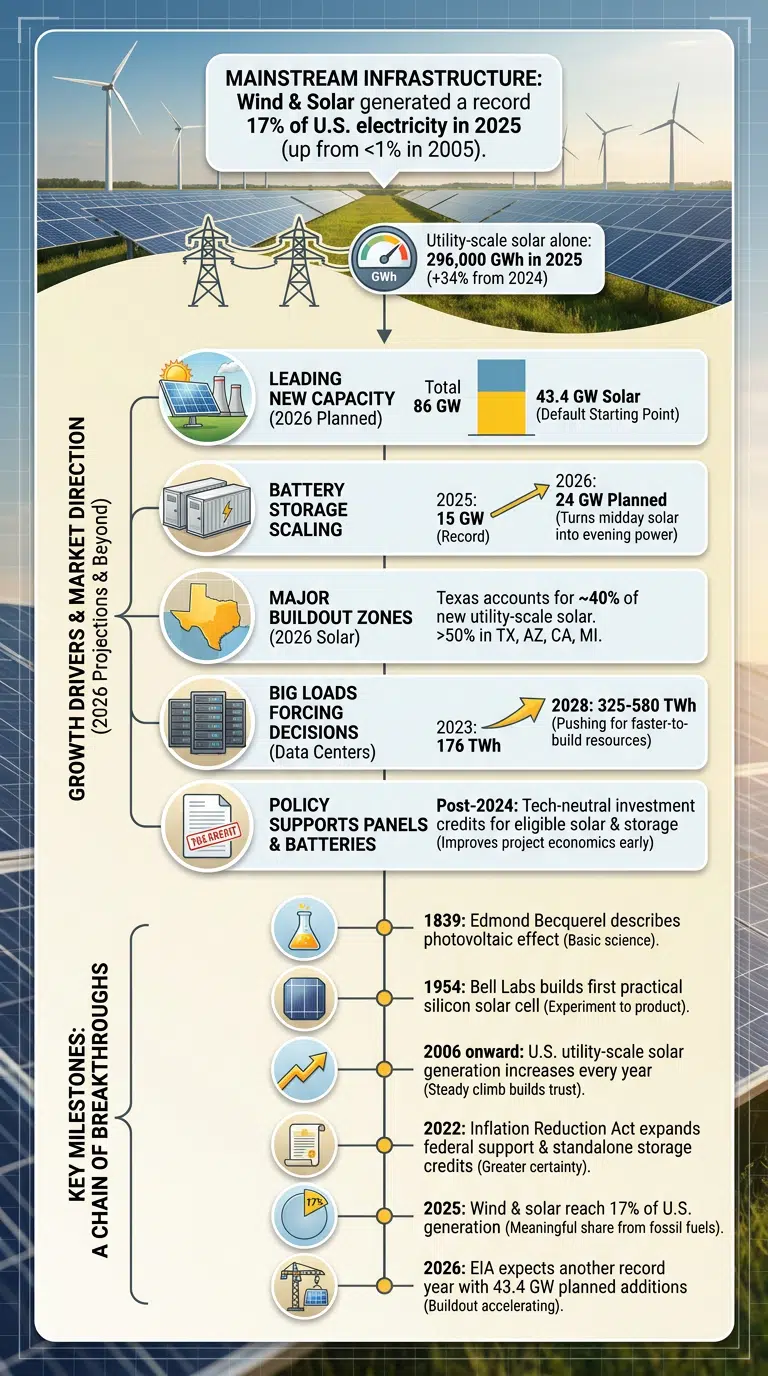
EIA reported in March 2026 that wind and solar generated a record 17% of U.S. electricity in 2025, up from less than 1% in 2005. Utility-scale solar alone produced 296,000 gigawatt-hours in 2025, which was 34% more than in 2024. That kind of growth tells you solar energy is no longer a niche bet.
Growth in solar adoption in the United States
If you want to see where the market is heading, look at what developers are planning to build next, not what people were debating five years ago.
- Solar is leading new capacity: EIA expects 86 gigawatts of new U.S. utility-scale capacity in 2026, and 43.4 gigawatts of that is solar. If you are comparing future electricity generation options, that makes solar the default starting point.
- Battery storage is scaling with it: EIA says developers plan to add 24 gigawatts of utility-scale battery storage in 2026, after a record 15 gigawatts in 2025. That matters because storage turns cheap midday solar into useful evening power.
- Texas is becoming a major clean energy buildout zone: More than half of new utility-scale solar in 2026 is planned in Texas, Arizona, California, and Michigan, with Texas alone accounting for about 40%. If you operate in a high-growth state, solar pricing pressure is likely to show up faster.
- Big loads are forcing faster decisions: DOE and Lawrence Berkeley National Laboratory say U.S. data centers used 176 terawatt-hours of electricity in 2023 and could reach 325 to 580 terawatt-hours by 2028. That growing energy demand is pushing utilities to favor resources that can be built faster than new coal plants.
- Policy now supports both panels and batteries: As of 2026, Treasury and the IRS list technology-neutral clean electricity investment credits for eligible solar and energy storage projects placed in service after 2024. For developers, that improves project economics before a single panel is installed.
Key milestones in solar energy development
The big story is not one invention. It is a long chain of breakthroughs that kept lowering cost and improving performance.
- 1839: Edmond Becquerel first described the photovoltaic effect, which is the basic science behind turning sunlight into electricity.
- 1954: Bell Labs built the first practical silicon solar cell, moving solar from experiment to product.
- 2006 onward: EIA notes that U.S. utility-scale solar generation has increased every year since 2006. That steady climb matters because markets trust trends that last.
- 2022: The Inflation Reduction Act expanded federal support for solar and made standalone battery storage eligible for key credits. That gave developers more certainty on project payback.
- 2025: Wind and solar reached 17% of U.S. generation, showing renewables are now taking meaningful share from fossil fuels.
- 2026: EIA expects another record year for solar additions, with 43.4 gigawatts planned. That tells you the buildout is still accelerating, not slowing down.
Declining Costs of Solar Energy
The reason solar keeps winning headlines is not hype. It is cost. The hardware is better, the manufacturing is larger, and the operating profile is much simpler than coal.
Advancements in solar panel technology
In Lazard’s 2025 U.S. analysis, new utility-scale solar came in at about $38 to $78 per megawatt-hour, while coal landed around $71 to $173 per megawatt-hour.
That range matters because it compares new-build projects on an unsubsidized basis. If you are choosing new capacity, solar already starts with a lower cost window than coal.
A 2024 DOE benchmark put representative utility-scale solar in an average U.S. climate at about $47 per megawatt-hour. The same benchmark put utility-scale solar plus energy storage at about $94 per megawatt-hour, which is a useful reminder that batteries add cost but also add much more practical value.
NREL said in 2025 that improving perovskite-silicon tandem efficiency can lower module cost per watt. In plain English, more efficient cells let developers get more electricity from the same land, racking, and labor.
A 2024 University of Surrey study from the Advanced Technology Institute, led by researchers including Professor S. Ravi P. Silva, reported lead-tin perovskite solar cells above 23% power conversion efficiency and a 66% improvement in device lifetime. That is exactly the kind of improvement that can push next-generation panels closer to commercial reality.
Mass production and economies of scale
Cheaper solar is not just about clever science. It is also about making millions of modules, inverters, and battery cells with better yield and less waste.
- Installed system prices are far lower than they used to be. DOE’s 2024Q1 benchmark modeled utility-scale PV at $1.12 per watt on a market-price basis in the United States.
- Utility projects benefit most from scale. The benchmark minimum sustainable price for the same type of project was even lower, at $0.98 per watt, which shows how competitive large projects can get in a stable market.
- Storage is joining the scale curve. NREL’s 2025 battery storage update projects mid-case utility-scale lithium-ion storage costs at $247 per kilowatt-hour by 2035, with a lower-cost case at $152. That is why solar-plus-storage keeps getting easier to finance.
- Domestic incentives can trim delivered costs. DOE’s benchmark notes that battery module production credits and clean electricity credits can push real project pricing down further, especially for U.S.-assembled systems.
Reduction in installation and maintenance costs
Coal plants keep burning fuel every day. Solar does not. That single difference changes the long-term math more than many people realize.
NREL defines levelized cost of energy, or LCOE, as the total life-cycle cost of a project spread across the electricity it produces. Solar benefits because it has no fuel cost, fewer moving parts, and lower routine maintenance than a coal plant.
DOE’s benchmark puts annual utility-scale solar operations and maintenance around $19 per kilowatt-year, while utility-scale solar plus storage is about $48 per kilowatt-year. If you are budgeting a project, those numbers show why owners like predictable operating costs.
- Remote monitoring helps operators catch inverter or string issues early.
- Lower maintenance visits mean less labor expense over time.
- No fuel purchases mean less exposure to coal and natural gas price swings.
- Simple maintenance planning gives lenders more confidence in long-term returns.
Comparing Solar Energy to Coal
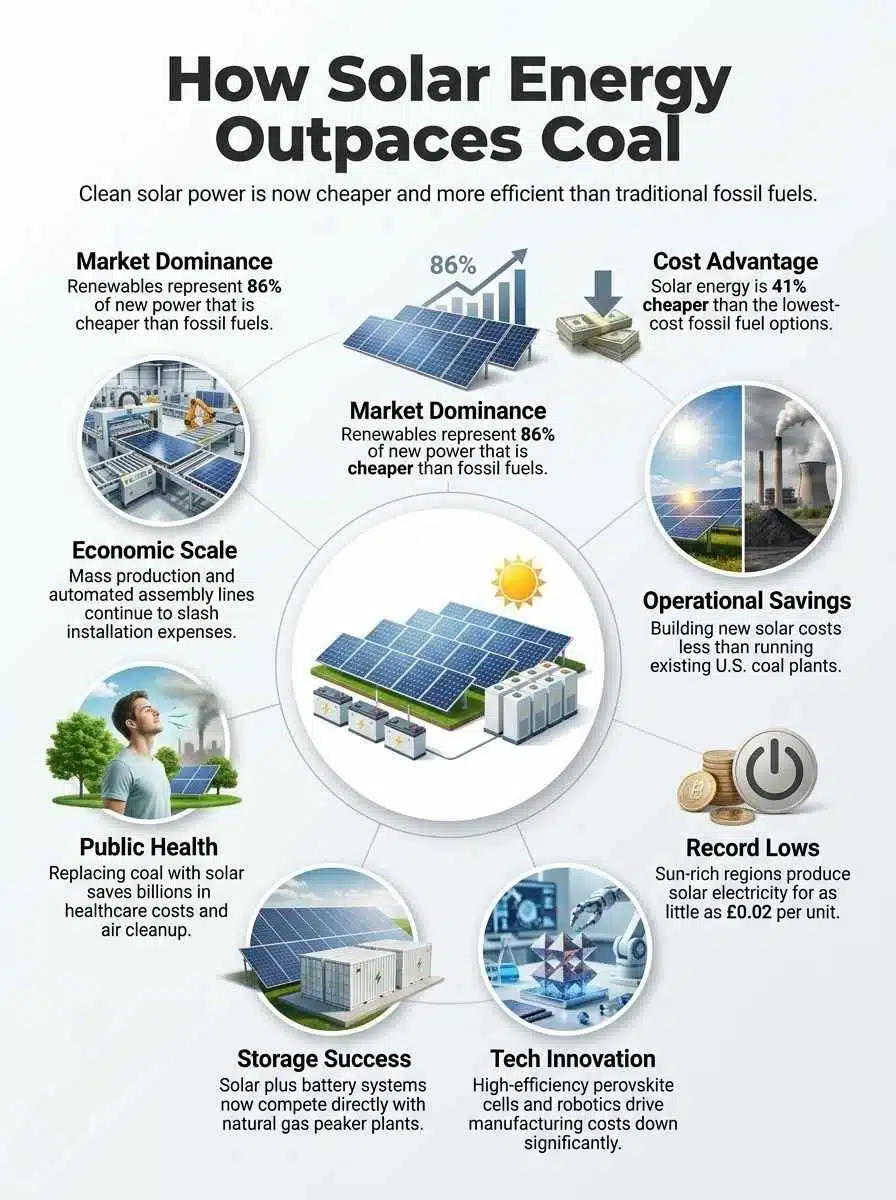
Here’s the simple version: LCOE is a way to compare the lifetime cost of producing electricity from different technologies. It is not a power bill, but it is a very useful tool for comparing solar energy and coal on equal footing.
Levelized cost of electricity (LCOE) comparison
| Metric | Solar PV | Coal | What it means for you |
|---|---|---|---|
| Unsubsidized new-build LCOE | $38 to $78 per MWh | $71 to $173 per MWh | New utility-scale solar often starts cheaper than new coal before incentives are counted. |
| Average U.S. benchmark LCOE | About $47 per MWh | Varies widely, but coal remains well above low-cost solar in new-build comparisons | DOE’s representative benchmark shows solar is already in an attractive cost band for U.S. projects. |
| Solar plus storage benchmark | About $94 per MWh | Coal still carries fuel, maintenance, and pollution-control costs | Storage costs more than solar alone, but it improves evening reliability and reduces curtailment. |
| Fuel cost exposure | None | Continuous fuel purchases required | Solar is easier to budget because sunlight does not show up as a line item. |
| Build momentum in the U.S. | 43.4 GW planned in 2026 | Very little new coal development | Capital is flowing to solar, storage, and wind power, not to new coal plants. |
Environmental and health cost considerations
Coal’s visible cost is the power plant. Its hidden cost is the pollution that comes with it. EPA says fossil-fuel power plants remain the largest stationary source category of sulfur dioxide and nitrogen oxides, and they are also a significant source of mercury and fine particle emissions.
That matters because fine particles and ozone-forming pollution aggravate heart and lung disease. WHO also lists coal-fired power plants among major sources of harmful outdoor air pollution, which means the true environmental impact of coal reaches far beyond the fence line.
Solar PV avoids those combustion emissions during operation. So when a utility or business compares solar to coal, the smarter question is not just “Which one is cheaper today?” but also “Which one avoids fuel, cleanup, and public health risk over the next 20 to 30 years?”
Innovations Driving Solar Affordability
Solar got cheap because several technologies improved at the same time. Better cells lift output, batteries make solar more useful after sunset, and smarter controls help the electric grid absorb more renewable energy without losing reliability.
Solar plus battery storage systems
Storage is the piece that makes solar feel less intermittent in everyday use. DOE explains it clearly: batteries can absorb electricity when solar production is high and release it later when demand is higher or sunlight is weaker.
That is why utilities keep pairing the two. EIA says developers plan to add 24 gigawatts of utility-scale battery storage in 2026, and one of the biggest combined projects expected online is Tehuacana Creek 1 Solar and BESS in Texas, with 837 megawatts of solar and 418 megawatts of battery capacity.
- Batteries move cheap noon solar into expensive evening hours.
- Short-duration storage helps ride through passing clouds and sharp ramps.
- Co-located storage reduces curtailment, which means less wasted generation.
- Solar plus storage gives grid operators a firmer, more predictable resource.
High-efficiency photovoltaic cells
Higher conversion efficiency means a panel turns more sunlight into electricity. That lowers balance-of-system costs because the developer can produce more power from the same site, labor crew, and support structure.
NREL’s 2025 work on tandem modules makes this point directly: better efficiency can lower module cost per watt. That is why perovskite solar cells keep drawing attention from researchers and manufacturers.
The University of Surrey’s Advanced Technology Institute is one good example of why this matters. Its 2024 perovskite work improved both performance and stability, which addresses one of the biggest commercial questions about next-generation solar PV, not just how efficient it is, but how long it lasts.
Floating solar farms
Floating solar farms solve a land-use problem. Instead of taking up valuable open land, they place panels on reservoirs and other calm water bodies.
DOE notes that floating PV can reduce evaporation and use otherwise unused space. A 2025 NREL-led study found federally controlled U.S. reservoirs could technically support up to 1,476 terawatt-hours of floating solar generation a year, enough to power roughly 100 million homes annually.
That does not mean every reservoir should be covered with panels. It does mean floating solar gives utilities another practical tool in places where land is expensive, permitting is tight, or water conservation matters.
Benefits of Solar Energy Over Coal
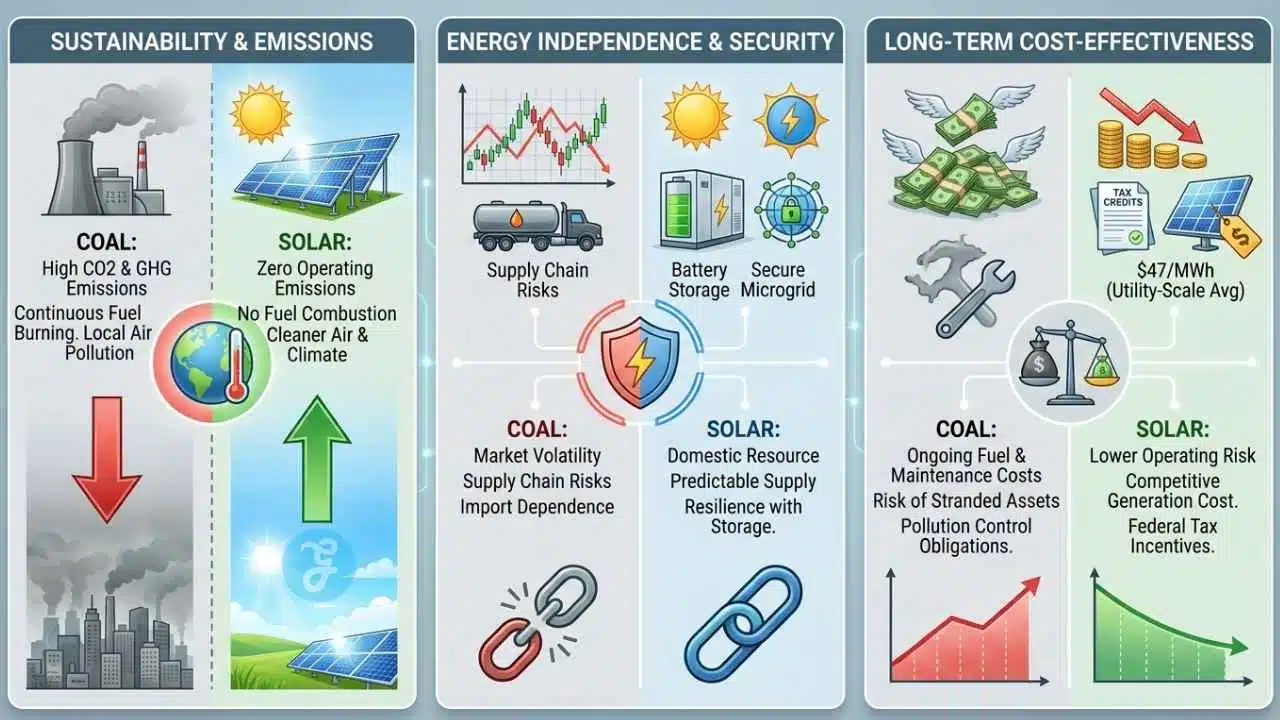
Solar does more than lower headline generation costs. It also changes risk. You remove fuel exposure, cut operating emissions, and gain a cleaner path to meeting new electricity demand.
Sustainability and reduced greenhouse gas emissions
Coal adds carbon dioxide and other greenhouse gas emissions every hour it runs. Solar power does not burn fuel during operation, so its operating emissions are dramatically lower.
That benefit shows up twice. First, it helps reduce climate change pressure. Second, it lowers the local air pollution tied to fossil fuels, which matters for communities near power plants and for businesses tracking environmental impact.
If your goal is lower-carbon electricity generation, solar gives you a direct path without waiting for carbon capture or fuel switching to mature at scale.
Energy independence and security
Coal and natural gas markets can swing with supply disruptions, transport costs, and commodity pricing. Solar energy uses a domestic resource that shows up every day, and that makes long-term planning easier.
Battery-backed solar also improves resilience. DOE says solar and storage can keep critical facilities operating during electrical disruptions and can support microgrids for communications and essential services.
- No fuel deliveries means fewer supply-chain weak spots.
- Fixed-cost generation is easier to hedge than fuel-driven generation.
- Distributed solar can reduce stress on parts of the power grid.
- Storage gives solar a reliability role that coal once dominated.
Long-term cost-effectiveness
Long-term value is where solar really stands out. A coal plant can still look useful in a tight market, but it keeps carrying fuel, maintenance, and pollution-control obligations year after year.
Solar starts with lower operating risk. DOE’s latest benchmark puts utility-scale solar at about $47 per megawatt-hour in an average U.S. climate, and even solar plus storage sits in a range that many utilities now consider workable for new capacity planning.
As of 2026, Treasury and the IRS list clean electricity investment credits for eligible solar and storage projects, and the IRS also continues to list a 30% Residential Clean Energy Credit for qualifying home solar and battery systems through 2032. That can shorten payback for households and project owners who move before equipment and interconnection queues tighten further.
Challenges and Future Outlook
Solar is cheaper, but cheaper does not mean effortless. The next phase of the clean energy transition depends on grid upgrades, smarter operations, and better financing structures that turn good project economics into real projects.
Grid integration issues
More solar on the electric grid means operators need better visibility and faster control. DOE says utilities need real-time information, forecasting, communication, and control systems to manage variable renewable energy reliably.
This is especially important because much of today’s solar sits behind the meter and is not always directly visible to grid operators. DOE also points to storage, transmission expansion, and better forecasting as the main ways to unlock more flexibility.
The pressure is rising because electricity demand is rising. DOE and Lawrence Berkeley National Laboratory say data centers used 176 terawatt-hours in 2023, and their share of U.S. electricity could rise from 4.4% in 2023 to 6.7% to 12% by 2028.
- More solar requires better forecasting.
- More batteries require better dispatch software.
- More distributed generation requires better utility visibility.
- More demand from AI and data centers raises the cost of slow planning.
Financing solutions for emerging markets
Even though this phrase often points overseas, the financing lesson applies in the U.S. too: good projects still need low-friction capital.
For American solar and storage projects, the most useful tools right now are clarity and bankability. Treasury’s final rules for the technology-neutral clean electricity credits give developers clearer guidance on what qualifies, and that makes lenders more willing to commit.
| Financing tool | Why it matters | Best use case |
|---|---|---|
| Clean Electricity Investment Credit | Lowers upfront project cost for qualifying solar and energy storage placed in service after 2024 | Utility-scale and commercial projects |
| Residential Clean Energy Credit | Can cover 30% of qualifying home solar and battery costs through 2032 | Homeowners comparing rooftop solar to rising retail power prices |
| Domestic content and manufacturing incentives | Can improve project economics and support U.S. supply chains | Projects sourcing more equipment domestically |
| Solar plus storage financing | Improves revenue options by shifting output into higher-value hours | Projects facing evening peak demand or curtailment risk |
If you are evaluating a project now, the practical move is to model incentives, interconnection timing, and storage value together. Looking at panel price alone will miss the real investment picture.
Final Thoughts
Solar energy is becoming cheaper than coal because the full package improved: panels got better, factories got larger, batteries got more useful, and U.S. project economics got stronger.
The data now point in the same direction. New utility-scale solar often beats coal on cost, and solar plus storage is making reliable clean energy easier to deliver across the electric grid.
If you are comparing future power options, treat solar power as the baseline. It is already reshaping electricity generation in the United States, and the cost curve still favors more clean energy ahead.
Frequently Asked Questions (FAQs) About Solar vs Coal Energy Cost
1. Why is solar energy becoming cheaper than coal?
Solar panels and large solar farms cost much less to build now, and manufacturing gets better, faster. Better scale, smart supply chains, and cheaper rechargeable batteries cut the long-term cost, so solar beats coal on price.
2. Do subsidies and market changes matter?
Yes, subsidies helped early growth, but prices kept falling even after support dropped. Economies of scale, better tech, and smarter grid planning pushed costs down, and markets picked up the trend quickly.
3. Can solar meet big power needs, like coal does?
Yes, when you add energy storage and grid upgrades, solar can cover most demand, it just needs smart planning.
4. What does this mean for consumers and businesses?
People pay less for electricity, and firms lower fuel bills, while cutting pollution. It’s like swapping an old, thirsty car for a new model that sips fuel, and the whole market moves away from coal.





















