Food supply chains are notoriously complex and, historically, very easy to manipulate. Today, a simple sticker claiming a product is “organic” or “sustainably sourced” is no longer enough to win over skeptical consumers or strict regulatory bodies. If you are a business operating in the agricultural sector, partnering with the right UK blockchain food traceability startups is quickly becoming the ultimate competitive advantage.
To understand how to source the best tech for your supply chain, we have to look at why this industry is shifting so rapidly.
Why Farm-to-Fork Tech is Booming Right Now
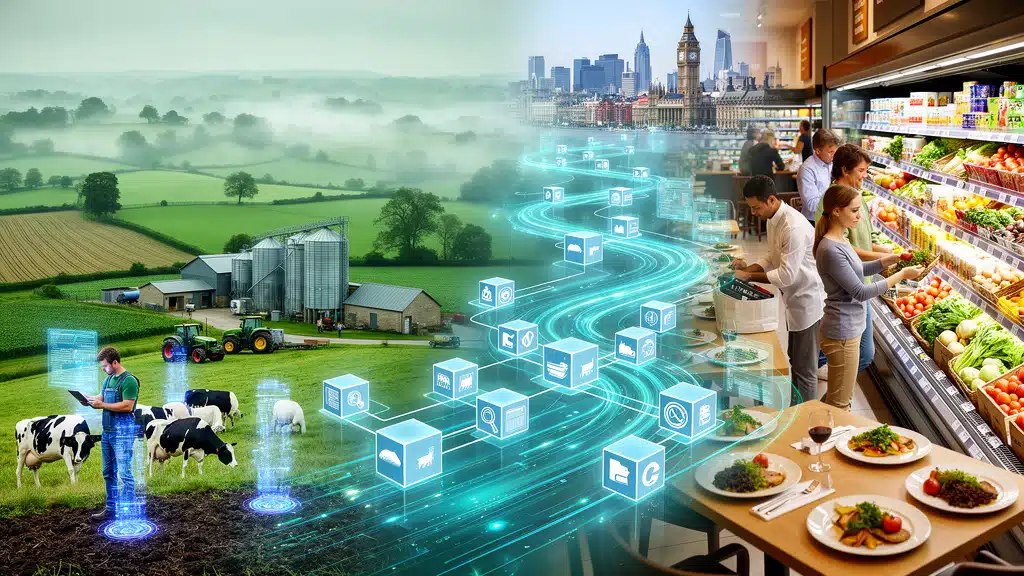
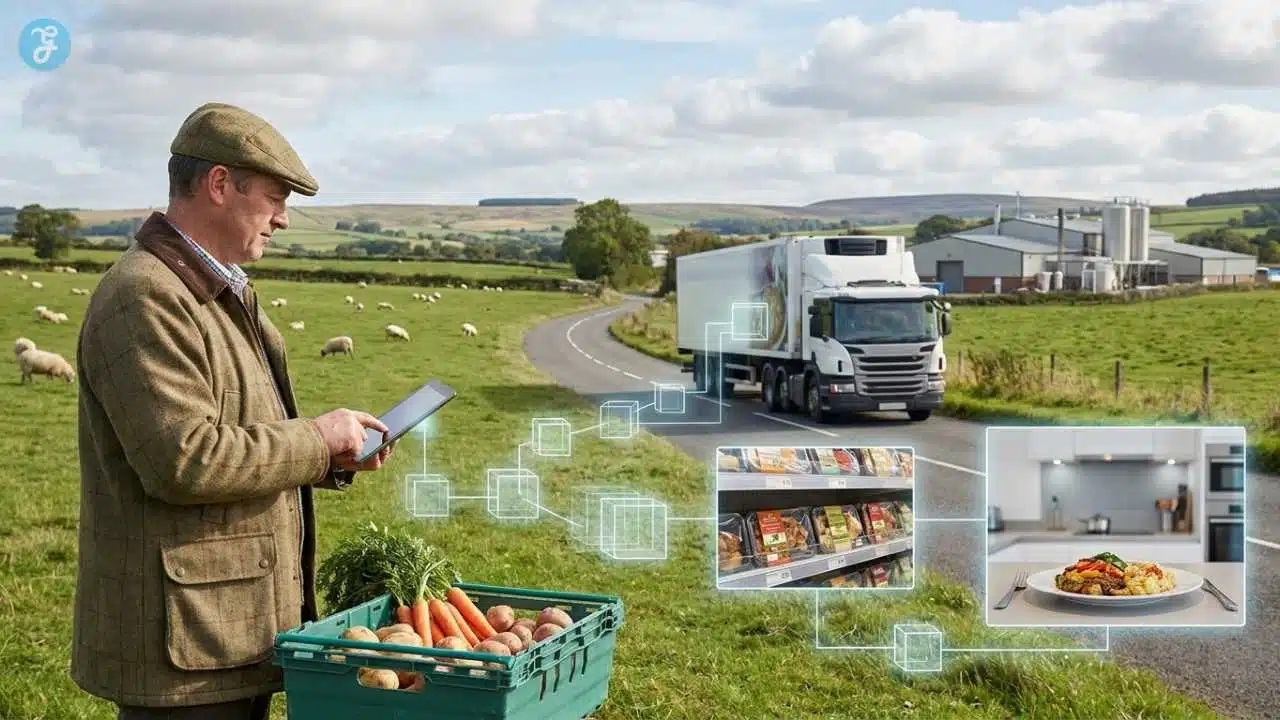
The sudden rush toward digital ledgers and smart supply chains is not a passing tech fad; it is a mandatory evolution. Government-backed initiatives, such as the UK’s SecQuAL (Secure Quality Assured Logistics), are aggressively pushing the industry to digitize. Meanwhile, food brands can no longer afford the financial and public relations nightmares associated with food fraud, massive product recalls, or accusations of greenwashing.
Consumers and regulators alike are demanding absolute, immutable proof of where food comes from, how it was raised, and how it traveled. Blockchain provides exactly that: an unchangeable digital record.
The Compliance Countdown: Why 2026 is the Tipping Point
If you think farm-to-fork blockchain is just a clever marketing tool to win over eco-conscious millennials, you are missing the bigger picture. In 2026, supply chain traceability is rapidly becoming a strict legal requirement.
Major regulatory shifts, such as the EU Deforestation Regulation (EUDR), now mandate that companies prove their agricultural products (like coffee, cocoa, and beef) do not contribute to global deforestation. If a UK company wants to export to the EU, a standard paper trail is no longer accepted at the border. They need immutable, geolocation-backed data.
Furthermore, the UK government’s push for digital borders and the SecQuAL initiative means that the grace period for opaque, legacy supply chains is officially ending. Partnering with a blockchain startup today is no longer an experimental innovation; it is the only way to ensure your food business remains legally compliant and operational in tomorrow’s market.
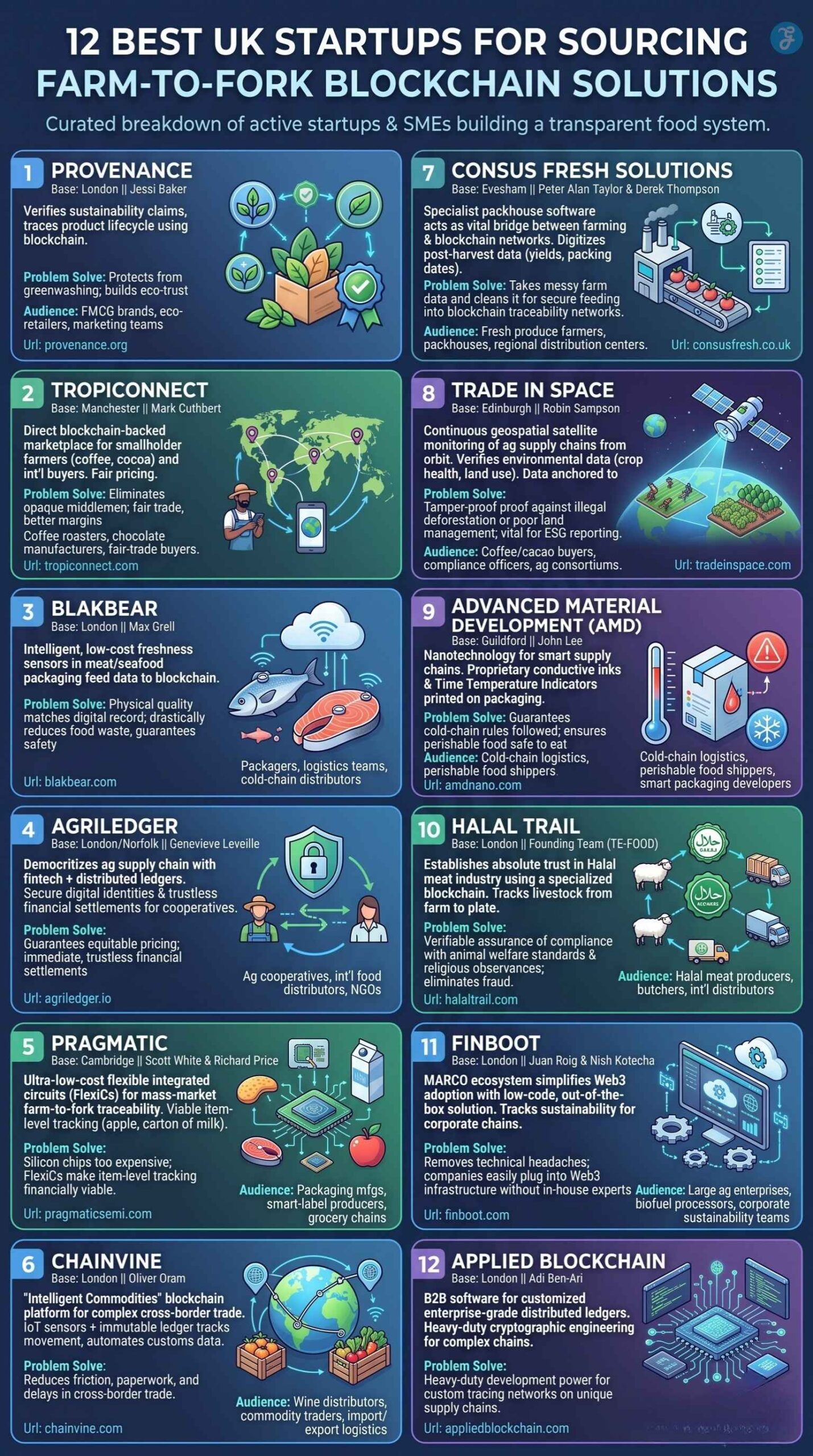
12 Best UK Startups for Sourcing Farm-to-Fork Blockchain Solutions
Below is a curated breakdown of the most legitimate, active startups and SMEs building the software and hardware for a transparent food system.
1. Provenance
Base of Operations: London || The Innovator: Jessi Baker
Core Business: Provenance is a pioneering London-based software company that empowers consumer packaged goods (CPG) and food brands to make verifiable, data-backed sustainability claims. The platform utilizes blockchain technology to trace the entire lifecycle of a product, from its raw agricultural origins to the retail shelf.
By anchoring physical supply chain data to an immutable digital ledger, Provenance prevents corporate greenwashing and allows brands to confidently prove their ethical sourcing, fair labor practices, and environmental impact directly to the modern, conscious consumer. Their technology effectively turns abstract ESG goals into transparent, marketable assets.
The Problem They Solve: It completely protects food brands from greenwashing accusations and builds ultimate trust with modern, eco-conscious shoppers.
Who Needs This: FMCG brands, eco-conscious food retailers, and marketing teams looking to verify their ESG (Environmental, Social, and Governance) claims.
Connect Online: provenance.org
2. TropiConnect
Base of Operations: Manchester || The Innovator: Mark Cuthbert
Core Business: TropiConnect is a highly innovative agritech startup focused on revolutionizing the often-exploitative tropical commodity trade. The company provides a transparent, blockchain-backed digital marketplace that directly connects smallholder farmers, particularly in the coffee and cocoa sectors, with international buyers and roasters.
By eliminating opaque middlemen and digitizing the trade process, TropiConnect ensures that farmers receive fair, equitable pricing while providing buyers with an immutable record of the crop’s origin and cultivation methods. This end-to-end transparency fosters sustainable agroforestry practices and guarantees ethical sourcing for global food brands.
The Problem They Solve: It eliminates opaque middlemen, ensuring fair trade practices, ethical sourcing, and better profit margins for the actual farmers.
Who Needs This: International coffee roasters, chocolate manufacturers, and fair-trade commodity buyers.
Connect Online: tropiconnect.com
3. BlakBear
Base of Operations: London || The Innovator: Max Grell
Core Business: BlakBear operates at the critical intersection of physical food science and digital ledger technology. The startup specializes in developing intelligent, low-cost freshness sensors that are embedded directly into meat and seafood packaging. These sensors continuously monitor the microbiological quality of the food and feed real-time, highly accurate shelf-life data into cloud APIs and blockchain traceability networks.
By ensuring that the digital record matches the physical reality of the food, BlakBear helps logistics companies and retailers drastically reduce unnecessary food waste while guaranteeing consumer safety.
The Problem They Solve: A blockchain is useless if the initial data is wrong. BlakBear ensures that the physical quality of the food accurately matches its digital record, drastically reducing food waste.
Who Needs This: Meat and seafood packagers, large-scale grocery logistics teams, and cold-chain distributors.
Connect Online: blakbear.com
4. AgriLedger
Base of Operations: London / Norfolk || The Innovator: Genevieve Leveille
Core Business: AgriLedger is a UK-based social enterprise and agritech firm dedicated to democratizing the agricultural supply chain through the integration of financial technology and distributed ledgers. The company focuses heavily on empowering agricultural cooperatives and smallholder farmers by providing them with secure digital identities and transparent, trustless financial settlement tools.
Their platform ensures that every transaction, from seed purchase to final crop sale, is permanently recorded, creating a fair ecosystem where producers are guaranteed equitable market access and protection from supply chain fraud.
The Problem They Solve: It guarantees equitable pricing for producers and provides immediate, trustless financial settlements, which is critical for agricultural stability.
Who Needs This: Agricultural cooperatives, international food distributors, and NGOs focused on food equity.
Connect Online: agriledger.io
5. Pragmatic
Base of Operations: Cambridge || The Innovators: Scott White & Richard Price
Core Business: Pragmatic is a deep-tech manufacturing powerhouse that provides the essential hardware required for mass-market farm-to-fork traceability. The company has revolutionized the semiconductor industry by designing and manufacturing flexible integrated circuits (FlexICs) that completely eliminate the need for expensive, brittle silicon.
These ultra-low-cost, microscopic chips can be embedded directly into everyday food packaging, turning standard grocery items into smart, blockchain-traceable assets. Their innovation makes it financially viable for food producers to track millions of individual low-margin products, like a single apple or a carton of milk, throughout the global supply chain.
The Problem They Solve: Traditional silicon RFID chips are too expensive to put on everyday food items. Pragmatic makes item-level blockchain tracking financially viable for the average grocery store product.
Who Needs This: Food packaging manufacturers, smart-label producers, and high-volume grocery chains.
Connect Online: pragmaticsemi.com
6. Chainvine
Base of Operations: London || The Innovator: Oliver Oram
Core Business: This company is transforming standard agricultural shipments into what they term “Intelligent Commodities.” Their proprietary blockchain platform is heavily utilized in complex cross-border trade, particularly within the global wine and fresh produce sectors.
By integrating Internet of Things (IoT) sensors with their immutable ledger, Chainvine tracks the physical movement of commodities while simultaneously automating and securing the heavy burden of customs and compliance data. This significantly reduces the friction, paperwork, and delays associated with international food import and export logistics.
The Problem They Solve: It reduces the massive friction, paperwork, and delays involved in cross-border food trade while ensuring the product is tracked securely.
Who Needs This: International wine distributors, global commodity traders, and food import/export logistics firms.
Connect Online: chainvine.com
7. Consus Fresh Solutions
Base of Operations: Evesham || The Innovators: Peter Alan Taylor & Derek Thompson
Core Business: Consus Fresh Solutions is a specialized software developer acting as the vital digital bridge between raw farming operations and high-level blockchain networks. The SME is a market leader in building operational software specifically tailored for fresh produce processing facilities and packhouses.
They digitize the messy, immediate post-harvest supply chain, capturing critical data regarding crop yields, packing dates, and batch sorting right on the factory floor. By cleaning and organizing this initial operational data, Consus ensures that the information fed into national traceability ledgers is highly accurate and reliable.
The Problem They Solve: They act as the essential bridge, taking messy, real-world farm data and cleaning it up so it can be fed securely into high-level blockchain traceability networks.
Who Needs This: Fresh produce farmers, packhouses, and regional food distribution centers.
Connect Online: consusfresh.co.uk
8. Trade in Space
Base of Operations: Edinburgh || The Innovator: Robin Sampson
Core Business: Trade in Space is a groundbreaking startup that merges the capabilities of geospatial satellite observation with the security of blockchain technology. The company utilizes advanced satellite imagery to continuously monitor global agricultural supply chains from orbit, verifying critical environmental data such as crop health, land use, and the absence of illegal deforestation.
This verified environmental data is then securely anchored to a blockchain ledger, providing large-scale food operators and commodity buyers with indisputable, tamper-proof evidence that their supply chains comply with strict international ESG regulations.
The Problem They Solve: It provides unquestionable, tamper-proof proof that a farm is not engaging in illegal deforestation or poor land management, which is vital for modern ESG reporting.
Who Needs This: Global coffee and cacao buyers, environmental compliance officers, and large agricultural consortiums.
Connect Online: tradeinspace.com
9. Advanced Material Development (AMD)
Base of Operations: Guildford || The Innovator: John Lee
Core Business: Advanced Material Development is a cutting-edge materials science SME specializing in the application of nanotechnology for smart supply chains. A key player in the UK’s food traceability infrastructure, AMD develops proprietary carbon-based conductive inks and Time Temperature Indicators (TTIs) that are printed directly onto food packaging.
These intelligent inks act as physical triggers; if a perishable food item breaches its safe temperature zone during cold-chain transit, the ink reacts and automatically logs a permanent warning on the blockchain, ensuring that spoiled food never reaches the consumer.
The Problem They Solve: It guarantees that cold-chain rules were strictly followed, ensuring that perishable food is actually safe to eat by the time it reaches the consumer.
Who Needs This: Cold-chain logistics providers, perishable food shippers, and smart packaging developers.
Connect Online: amdnano.com
10. Halal Trail
Base of Operations: London || The Innovators: Halal Trail Founding Team (Powered by TE-FOOD)
Core Business: Halal Trail is a specialized, London-based startup dedicated to establishing absolute trust and transparency within the highly regulated global Halal meat industry. Utilizing a specialized blockchain network, the company meticulously tracks livestock from the initial breeding farm, through the certified slaughterhouse, and ultimately to the retail butcher or consumer’s plate.
This immutable ledger provides consumers with verifiable assurance that the meat they purchase strictly complies with rigorous animal welfare standards and specific religious observances, effectively eliminating fraud and mislabeling within the Halal supply chain.
The Problem They Solve: It provides absolute assurance of compliance with animal welfare standards and strict religious observance, creating a “new norm” of trust for Muslim consumers.
Who Needs This: Halal meat producers, specialty butchers, and international Halal food distributors.
Connect Online: halaltrail.com
11. Finboot
Base of Operations: London || The Innovators: Juan Roig & Nish Kotecha
Core Business: Finboot is an enterprise technology SME that developed MARCO, a powerful ecosystem designed to make blockchain adoption seamless for massive corporate value chains. Within the agricultural and biofuels sectors, Finboot’s platform is utilized to track complex sustainability criteria, carbon emissions, and land eligibility across the entire lifecycle of a product.
By providing a low-code, out-of-the-box solution, Finboot removes the technical barriers and high costs associated with Web3 infrastructure, allowing large food conglomerates to easily transition to transparent, blockchain-backed operations without needing an in-house cryptography team.
The Problem They Solve: They remove the technical headaches of blockchain, allowing food companies to easily plug into Web3 infrastructure without needing an in-house team of cryptography experts.
Who Needs This: Large agricultural enterprises, biofuel processors, and corporate sustainability teams.
Connect Online: finboot.com
12. Applied Blockchain
Base of Operations: London || The Innovator: Adi Ben-Ari
Core Business: Applied Blockchain is a premier B2B software development firm based in London that specializes in architecting and building highly customized, enterprise-grade distributed ledgers. While many companies offer SaaS products, Applied Blockchain caters to mid-market food brands, massive grocery conglomerates, and niche agricultural consortiums that require bespoke tracing networks tailored to highly complex or unique supply chains.
Their team provides the heavy-duty cryptographic engineering required for secure physical asset tokenization, smart contract auditing, and the development of impenetrable, decentralized food tracking systems.
The Problem They Solve: They provide the heavy-duty development power required to build custom tracing networks for highly complex or unique food supply chains.
Who Needs This: Mid-market food brands, massive grocery conglomerates, and niche agricultural consortiums needing custom software.
Connect Online: appliedblockchain.com
What These Startups Tell Us
Looking at the innovations brought forward by these 12 companies, four clear trends emerge regarding the future of the food industry.
Hardware is just as Important as Software
Blockchain ledgers are useless if the data entered into them is inaccurate. Startups like BlakBear, Pragmatic, and AMD prove that smart sensors and cheap microchips are essential for trusting physical food data.
Trust is Now a Tangible Product
Companies are no longer just selling food; they are selling the verified story of that food. Platforms like Provenance are turning ethical sourcing into a highly marketable asset.
Direct-to-Buyer is the New Standard
By utilizing decentralized technology, startups like TropiConnect are cutting out the murky middlemen, proving that fair trade can be achieved through technological transparency.
Compliance is Driving Innovation
Satellites and blockchain aren’t just for marketing. Tech like Trade in Space shows that businesses are preparing for a future where strict, legal proof of environmental compliance is mandatory to sell food.
How to Pilot a Blockchain Solution [Without Breaking Your Operations]
For many supply chain managers, the idea of ripping out a legacy ERP system (like SAP or Oracle) to install a Web3 blockchain feels like an operational nightmare. Fortunately, the UK startups on this list are designing their systems for seamless integration. If you are ready to source a farm-to-fork solution, here is the safest way to pilot the technology:
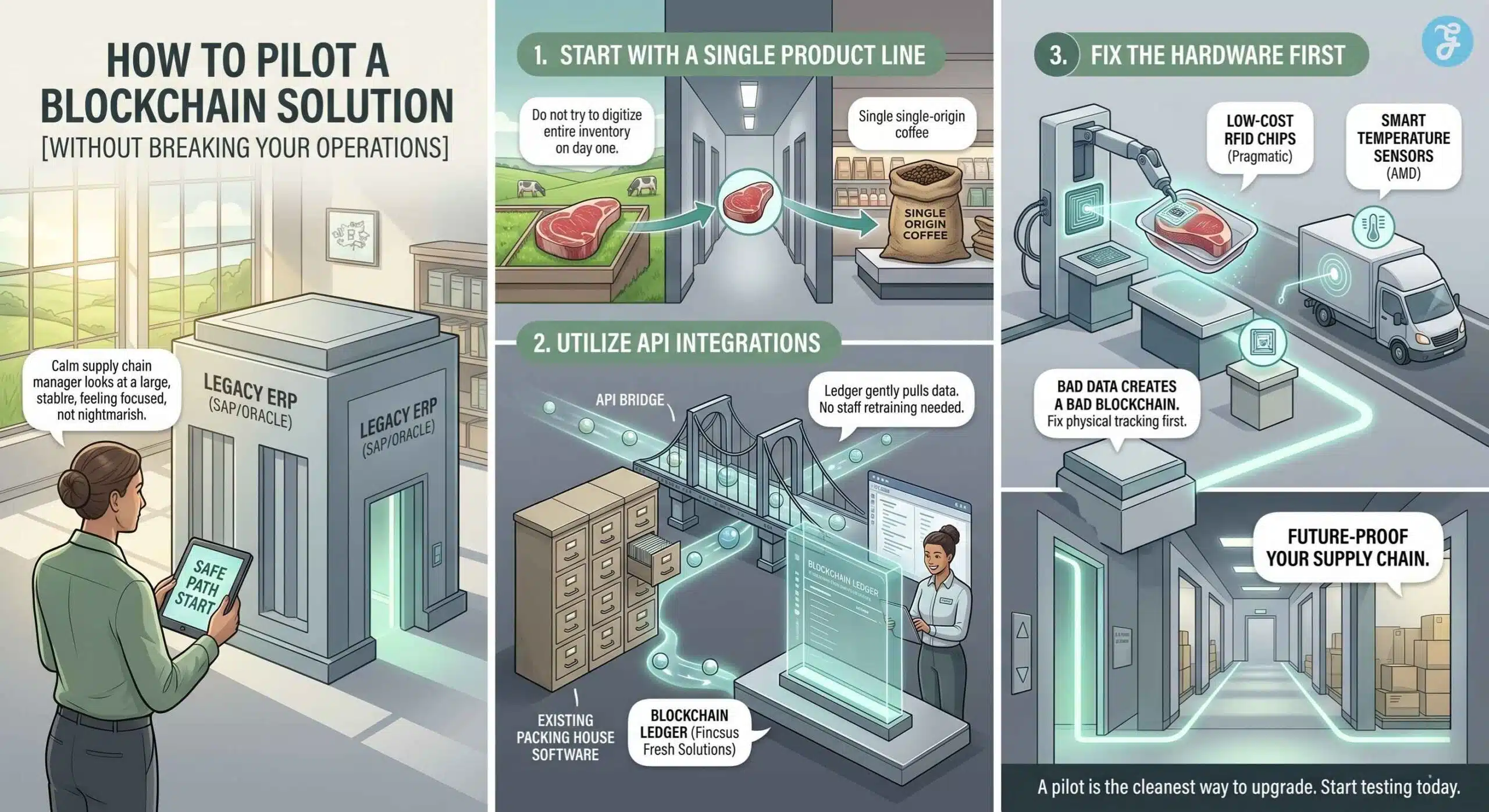
Start with a Single Product Line
Do not try to digitize your entire global inventory on day one. Pick one high-value or high-risk commodity (like premium organic beef or single-origin coffee) and track it from a specific farm to a specific retail region.
Utilize API Integrations
Look for startups (like Finboot or Consus Fresh Solutions) that offer robust APIs. This allows their blockchain ledger to quietly pull data from your existing packing house software without requiring your staff to learn a completely new operating system.
Fix the Hardware First
Remember that bad physical data creates a bad blockchain. Before investing heavily in software, ensure you have the right physical tracking in place, utilizing low-cost RFID chips (like Pragmatic) or smart temperature sensors (like AMD).
At A Glance: The UK Food Traceability Ecosystem
For readers who need to review the ecosystem quickly, here is a breakdown of the 12 UK innovators leading the charge in farm-to-fork traceability.
| Company | Location | Core Service | Best Fit For |
| Provenance | London | AI & Blockchain sustainability tracking | FMCG brands & Eco-retailers |
| TropiConnect | Manchester | Direct farmer-to-buyer tropical trade | Coffee/Cocoa buyers |
| BlakBear | London | Smart packaging freshness sensors | Meat/Seafood logistics |
| AgriLedger | London / Norfolk | Digital identity & supply chain fintech | Agricultural cooperatives |
| Pragmatic | Cambridge | Ultra-low-cost flexible tracking chips | High-volume grocery chains |
| Chainvine | London | Intelligent commodity & customs tracking | Global commodity traders |
| Consus Fresh Solutions | Evesham | Fresh produce packhouse software | Fresh produce farmers |
| Trade in Space | Edinburgh | Satellite & blockchain ESG tracking | Environmental compliance teams |
| AMD | Guildford | Temperature-sensitive smart inks | Cold-chain logistics |
| Halal Trail | London | Immutable Halal authentication | Halal meat producers |
| Finboot | London | Enterprise blockchain integrations | Corporate sustainability teams |
| Applied Blockchain | London | Bespoke supply chain development | Mid-market food brands |
Future-Proofing the UK Supply Chain
For founders entering the agritech space, the message is clear: the most lucrative opportunities lie in bridging the gap between physical farming reality and digital ledgers. For SMB buyers and procurement officers, waiting to upgrade your tracking infrastructure is a massive risk. Implementing these solutions now will shield your business from compliance fines and win over a highly skeptical consumer base. For investors, the UK is currently a goldmine. The companies mastering this complex blend of IoT hardware, satellite data, and blockchain ledgers are perfectly positioned to become the next giants of the global supply chain.
Frequently Asked Questions (FAQs) on UK Blockchain Food Traceability Startups
1. Does using blockchain mean my food business has to buy or trade cryptocurrency?
Absolutely not. This is the most common misconception holding businesses back. The startups listed here use “enterprise” or “permissioned” blockchains. They use the underlying technology, a highly secure, unchangeable digital ledger, to track data, not digital money. You pay for these tech services using standard fiat currency (like GBP or USD) through traditional software subscription models.
2. How does a digital blockchain actually know if physical food is fresh or spoiled?
A digital ledger is only as smart as the physical data entered into it. This is exactly why hardware agritech startups are so vital to the ecosystem. Companies like BlakBear and AMD create smart freshness sensors and temperature-sensitive inks that are attached directly to the packaging. If a shipment of meat gets too warm in transit, the physical sensor triggers an automatic, permanent warning on the digital blockchain.
3. Will we have to rip out our existing supply chain software to use these solutions?
No. Ripping out legacy ERP systems (like SAP or Oracle) is a massive operational risk that most tech innovators want you to avoid. Startups like Finboot and Consus Fresh Solutions build their platforms with flexible APIs. This means their blockchain ledgers operate quietly in the background, automatically pulling and securing data from the software your packing house is already using.
Your trade secrets remain completely private. Unlike public networks (like Bitcoin), enterprise food traceability networks are heavily permissioned. As the network owner, you control exactly who sees what. A consumer scanning a QR code on a package might only see the farm’s location, a border agent might see the environmental compliance certificates, and your competitors will see absolutely nothing.
5. Is this technology only affordable for massive global food corporations?
Not anymore. While retail giants like Walmart pioneered early food tracking, the UK startups operating in 2026 are specifically making this tech accessible to SMEs. Thanks to ultra-low-cost flexible tracking chips from companies like Pragmatic and affordable cloud-based SaaS models, even mid-market regional food brands can now afford item-level traceability without breaking their margins.
6. How do smallholder farmers in developing nations interact with this advanced technology?
Startups focused on equitable global trade, such as TropiConnect and AgriLedger, design their platforms to be “mobile-first” and highly accessible. A coffee or cocoa farmer in a remote area does not need a high-end computer or a cryptography degree. They can log their harvest data, verify fair pricing, and secure digital payments using a basic smartphone. The complex technology runs entirely in the background.