Nobody likes filling out endless forms. You probably dread calling a broker just to get a simple quote on your car or home. The paperwork piles up, the jargon makes no sense, and you often end up paying for things you do not really need. For a long time, the financial sector felt stuck in the past, relying on outdated systems and frustrating delays. That is finally changing.
Tech startups and smart applications are flipping the script on how we protect our assets, our health, and our families. If you want to know what is truly changing the game right now, look no further than the South Africa insurtech revolution. This movement is stripping away the red tape and bringing financial products straight to your pocket.
The Core Drivers of Insurance Technology in SA
Understanding the forces behind the South Africa insurtech revolution requires looking at how people actually live and work. You cannot just copy and paste an American or European business model here and expect it to succeed. The local market has unique challenges, from massive wealth gaps to the way people access the internet. Startups saw these hurdles not as dealbreakers, but as massive opportunities to build something genuinely better for the public. By addressing the specific daily realities of everyday citizens, these tech platforms are growing faster than anyone expected.
1. A Heavily Mobile-First Population
Most people in this country do not own a laptop or desktop computer, making traditional online portals practically useless for the masses. Instead, they access the internet entirely through their smartphones, relying on mobile networks and chat apps. Startups quickly realized that if you want to sell a financial product here, you absolutely have to put it on a mobile screen first. They bypass the need for physical branch offices by building incredibly light, fast mobile applications and simple USSD codes.
Even better, many platforms now integrate directly with WhatsApp, a tool almost everyone already uses daily. You can simply text a bot, answer a few questions to get a quote, and activate your policy without ever leaving your chat app. This mobile-first mindset removes all the usual friction from buying cover. It makes securing your assets as easy and familiar as sending a quick text message to a friend.
| Feature Area | Traditional Approach | Mobile-First Insurtech |
| Primary Access | Call centers and physical branches | WhatsApp, Apps, and USSD codes |
| Hardware Needed | Desktop computer or phone call | Basic smartphone or feature phone |
| Customer Effort | High (waiting on hold, driving to branches) | Very Low (instant messaging) |
| Operating Costs | Extremely high (rent, large staff) | Low (automated digital servers) |
2. Closing the Historical Protection Gap
A massive chunk of the population has always lived without formal financial safety nets because they simply could not afford them. High minimum premiums and strict background checks meant that low-income families remained excluded from the traditional system for decades. When disaster struck, they had to rely on expensive, short-term cash loans just to survive. Digital startups are aggressively fixing this broken system from the ground up.
Because tech companies do not have to pay for massive corporate office buildings or thousands of call center agents, their daily running costs are incredibly low. They pass these massive savings directly back to the consumer. For the first time ever, everyday people can afford basic, decent cover that actually protects them from sudden financial shocks.
| Protection Factor | The Old Reality | The New Insurtech Reality |
| Target Demographic | Middle to upper-class earners | Everyone, including minimum wage earners |
| Monthly Premiums | High, fixed minimums | Scalable, often starting at a few Rands |
| Emergency Recourse | Predatory payday loans | Instant, fair insurance payouts |
| Financial Security | Low for the majority | Rapidly increasing across communities |
3. The Power of Alternative Data Scoring
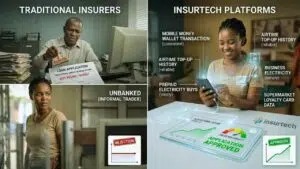
If you do not have a credit card or a formal bank loan, traditional banks treat you like a ghost in the system. They cannot calculate your financial risk using old methods, so they simply reject your application outright. New tech firms are much smarter about how they figure out exactly who you are. They use alternative digital data points to build a highly accurate profile of your reliability.
They look at how consistently you buy prepaid electricity, how you top up your mobile airtime, or how you use mobile money wallets. Some systems even analyze supermarket loyalty card data to see your spending habits over time. This clever use of alternative data means a person working in the informal sector can finally prove they are reliable enough to get a decent policy.
| Data Type | Traditional Insurers | Insurtech Platforms |
| Risk Assessment Basis | Formal credit bureau scores | Digital behavior and transaction habits |
| Unbanked Citizens | Automatically rejected | Evaluated fairly based on alternative data |
| Processing Speed | Takes days to verify history | Instantaneous algorithmic checks |
| Information Sources | Bank statements, payslips | Airtime purchases, loyalty cards, mobile money |
Innovations Changing How We Buy Insurance
Technology is completely tearing up the old rulebook on how products are built and sold to the public. We are moving far away from rigid, one-size-fits-all packages toward highly personalized, dynamic experiences. The things happening behind the scenes are genuinely fascinating, relying heavily on math, mobile sensors, and clever code. These innovations do not just make the apps look flashy or modern on your phone screen. They fundamentally change the basic math behind risk and reward, making things fairer for you.
4. Artificial Intelligence in Underwriting
In the past, human actuaries and underwriters spent days crunching numbers to figure out what your specific premium should be. Today, artificial intelligence does that exact same job in milliseconds without breaking a sweat. AI algorithms can process thousands of tiny details about your lifestyle, your location, and your physical assets instantly.
This means you do not have to wait around anxiously for an underwriter to review your paper file. You just open an app, answer three or four simple questions, and the AI gives you a firm, binding quote right then and there. Plus, as the AI processes more claims and data over the years, it gets significantly smarter and prices local risk much more accurately.
| Underwriting Aspect | Human-Led Underwriting | AI-Driven Underwriting |
| Quote Turnaround | 24 to 48 hours | Milliseconds |
| Risk Factors Analyzed | Dozens | Thousands simultaneously |
| Human Bias | Present (mood, fatigue, prejudice) | Completely eliminated |
| Pricing Accuracy | Based on broad demographic averages | Hyper-personalized to the individual |
5. Telematics and Pay-How-You-Drive Models
Car insurance historically punished you for the terrible mistakes of other drivers on the road. Even if you drove perfectly every day, your premium stayed high just because you fit a certain age or gender profile. Telematics changes that unfair dynamic entirely. By placing a small tracking device in your car, or simply using the GPS and accelerometer already inside your smartphone, the company tracks exactly how you drive.
If you brake smoothly, stay strictly under the speed limit, and avoid driving late at night, the app notices your good behavior. You get rewarded with cash back, much cheaper monthly payments, or even free retail vouchers. It essentially turns safe driving into an interactive game where you actually win real money.
| Driving Metric | Standard Car Insurance | Telematics Insurtech |
| Cost Determinant | Age, gender, zip code | Actual on-road driving behavior |
| Late Night Driving | No impact on monthly bill | Increases risk profile and cost |
| Safe Driving Habits | Rarely rewarded quickly | Instant cash back or premium discounts |
| Tech Required | None | Smartphone GPS or onboard OBD device |
6. Instant Claims Processing via Chatbots
Filing a claim after an accident is usually a total nightmare for the customer. You have to fill out long PDF forms, email blurry photos, and wait weeks for someone to actually call you back. Insurtech companies have introduced incredibly smart chatbots to handle all the messy parts of this process. If someone backs into your car in a grocery store parking lot, you just open WhatsApp immediately.
You send a quick picture of the dent directly to the bot. The AI scans the image, compares it to thousands of other dents in its database, calculates the exact repair cost, and approves the claim. In many small, straightforward cases, the money lands straight in your bank account before you even drive away from the scene.
| Claim Stage | The Old Way | The Chatbot Way |
| Initial Reporting | Phone calls during office hours | 24/7 via WhatsApp or mobile app |
| Damage Assessment | Waiting for a physical human assessor | AI visual recognition of uploaded photos |
| Approval Time | Days or weeks | Minutes or seconds for minor claims |
| Payout Speed | Slow, manual bank transfers | Automated, instant digital clearing |
7. Blockchain for Fraud Prevention
Organized fraud is a massive headache for the whole financial industry right now. Syndicates often stage fake accidents or submit the exact same medical claim to three different companies hoping no one notices. Honest customers end up footing the bill for this widespread crime through much higher monthly rates. Blockchain technology offers a brilliant, foolproof solution to this problem. It acts like a digital, completely unchangeable public record book.
When you submit a claim, it gets logged permanently on a highly secure network that multiple companies share. If a fraudster tries to submit that exact same bill to a second company, the system immediately flags it as a duplicate. By cutting out this fraud, tech platforms can easily keep their prices extremely low for honest folks.
| Fraud Issue | Traditional Record Keeping | Blockchain Solution |
| Duplicate Claims | Easy to slip past unconnected insurers | Impossible; shared ledger flags instantly |
| Document Forgery | Common with PDF and paper bills | Cryptographic hashes verify authenticity |
| Data Security | Centralized servers are hackable | Decentralized nodes are highly secure |
| Cost to Honest Users | High premiums to cover fraud losses | Lower premiums due to reduced crime |
Financial Inclusion and Microinsurance
A big part of the South Africa insurtech revolution involves reaching people who never had any access to financial safety nets before. We are talking about designing products uniquely tailored for folks who live day-to-day, rather than month-to-month. Traditional, bloated companies ignored this space entirely because the profit margins were just too small for them. But when you automate everything with clever code, selling a policy that costs just a few Rands suddenly makes perfect business sense.
8. Bite-Sized Policies for the Gig Economy
The way we work as a society has changed dramatically over the last decade. Thousands of people now make their living driving for ride-hailing apps, delivering fast food, or doing freelance photography. These gig workers do not have a steady monthly paycheck, so signing a rigid 12-month contract is far too risky. Insurtech offers brilliant bite-sized, on-demand cover to solve this.
A delivery driver can buy accident cover just for the specific four hours they are logged into the app on a Friday night. A freelance DJ can insure their expensive sound equipment just for the weekend of a big outdoor festival. You turn it on exactly when you need it, and you stop paying the absolute second you are done.
| Gig Worker Need | Traditional Annual Policy | On-Demand Microinsurance |
| Contract Length | Locked into 12-month terms | Bought by the hour or the day |
| Payment Flexibility | Fixed monthly debit orders | Pay only when actively working |
| Suitability | Built for 9-to-5 office workers | Built for unpredictable freelancer schedules |
| Activation Method | Brokers and heavy paperwork | A single swipe on a smartphone app |
9. The Digitization of Funeral Cover
Funeral cover holds deep, profound cultural importance locally across all communities. Families desperately want to ensure their loved ones get a dignified send-off without falling into crippling debt. Traditionally, people relied heavily on community stokvels or cash collectors who walked door-to-door every month. This old method was highly risky, as physical cash could easily get stolen, lost, or completely mismanaged by collectors.
Tech startups boldly digitized this entire cultural process. You can now join a comprehensive funeral plan using a basic feature phone without internet. You simply pay your small monthly fee using airtime or at a local grocery store till point. When a tragedy finally happens, the claim is processed fully digitally, and the payout hits the grieving family’s bank account within a few short hours.
| Feature | Legacy Funeral Cover | Digitized Funeral Insurtech |
| Premium Collection | Door-to-door cash collection | USSD airtime, mobile money, retail tills |
| Risk of Theft | High (carrying physical cash) | Zero (fully encrypted digital rails) |
| Sign-up Process | Filling out paper forms locally | Dialing a quick shortcode on any phone |
| Payout Delivery | Manual cash handovers | Direct deposits into bank accounts quickly |
10. Agricultural Insurtech for Smallholder Farmers
Farming is an incredibly tough business, especially with unpredictable weather patterns and harsh, extended droughts. While big commercial farms can easily afford complex crop protection, smallholder farmers are often left entirely exposed to the brutal elements. Agricultural tech platforms are stepping in right now with brilliant parametric cover.
Instead of sending an expensive human inspector to walk the ruined fields after a dry season, the system uses live satellite imagery and local weather station data. If the software detects that a specific area received less than 50 millimeters of rain over a crucial month, it automatically pays out all the farmers in that designated zone. There is absolutely no paperwork involved, and no arguing with stubborn claims adjusters.
| Farming Challenge | Standard Crop Insurance | Parametric Tech Insurance |
| Claim Trigger | Physical proof of damaged crops | Pre-set weather data (e.g., low rainfall) |
| Assessment Process | Human visits the farm to inspect | Satellites monitor conditions remotely |
| Target Audience | Massive commercial farms | Smallholder and rural community farmers |
| Payout Speed | Months of arguing over damages | Automatic transfer when conditions are met |
Evolving Business Models and Partnerships
Tech companies are rethinking the very structure of how a financial business should operate. The old way relied heavily on a company collecting your hard-earned money and secretly hoping you never asked for it back. That old setup naturally creates a nasty conflict of interest. The new digital models focus heavily on fairness, community trust, and treating the customer like a real human being. Even the big corporate giants are waking up and changing their tune to keep up with the newcomers.
11. Peer-to-Peer Insurance Networks
Peer-to-peer models totally and completely change the relationship you have with your chosen provider. Instead of paying into a giant corporate black hole, you pool your money together with a small group of friends, family, or people with similar lifestyles. The tech platform takes a very small, transparent flat fee upfront to manage the heavy administration. If someone in your specific group makes a claim, it safely gets paid from the communal pool.
If there is money left over at the end of the year because everyone drove safely and took care of their stuff, the remaining cash goes straight to a charity of the group’s choice. This brilliantly removes the incentive to submit fake claims, because you are essentially stealing from your own friends or your favorite charity.
| Network Trait | Traditional Corporate Model | Peer-to-Peer (P2P) Model |
| Profit Motive | Deny claims to keep shareholder profit | Flat admin fee; no profit from denied claims |
| Leftover Funds | Absorbed completely by the company | Returned to users or given to charity |
| User Mindset | “Me versus the big corporation” | “Protecting my community and friends” |
| Fraud Incentive | High (victimless crime mentality) | Very low (hurts people you actually know) |
12. Subscription-Based Coverage
Think carefully about how you pay for streaming movies or digital music right now. You pay a simple flat fee, and if you get bored or broke, you cancel it immediately with absolutely no penalty. Insurtech brings this exact, beloved subscription model to your personal assets. You do not ever get locked into complex, multi-year agreements with heavy fines.
You simply load your credit card onto the secure app, take a quick picture of your bicycle or laptop, and your subscription starts immediately. If you decide to sell your laptop next week, you just swipe a button on the app, and the billing stops instantly. It is highly transparent, deeply flexible, and completely stress-free for modern consumers.
| Billing Aspect | Old-School Contracts | Modern Subscription Tech |
| Commitment | 12 to 24 month lock-ins | Month-to-month, cancel anytime |
| Cancellation Fees | Very high penalties | Zero fees for leaving |
| Activation | Days of processing | Instant app-based activation |
| User Control | Dictated by the broker | Fully controlled by the user via smartphone |
13. Incumbents Teaming Up with Agile Startups

When these fast-moving tech startups first appeared on the scene, the massive, established banks and financial institutions panicked completely. Now, they quickly realize that fighting the future is a losing game. We are currently seeing a massive trend where giant legacy companies form strategic partnerships with young, agile startups.
The big guys bring millions of existing, loyal customers, massive cash reserves, and deep regulatory knowledge to the table. The startups bring lightning-fast coding, clean app designs, and brilliant AI algorithms. By teaming up, traditional companies get to modernize their outdated computer systems quickly, while startups get the massive financial backing they need to survive and scale.
| Partnership Role | The Legacy Incumbent | The Insurtech Startup |
| Biggest Asset | Capital, trust, and customer base | Innovative tech, AI, and speed |
| Biggest Weakness | Slow, outdated legacy IT systems | Lack of funding and brand recognition |
| Goal of Teaming Up | Avoid becoming obsolete | Gain access to a massive market |
| End Result | Old banks offer modern digital apps | Startups achieve financial stability |
Regulation, Funding, and the Ecosystem
We absolutely cannot talk about the South Africa insurtech revolution without looking at the strict rules and the big money fueling the fire. Financial tech cannot simply grow in a wild vacuum. It needs extremely smart laws that protect vulnerable consumers without suffocating brilliant new ideas. It also requires heavy, sustained investment to pay for expensive developers, marketing, and cross-border expansion. Thankfully, the local environment is currently highly supportive of this kind of rapid tech growth.
14. The FSCA Regulatory Sandbox
The financial sector is heavily regulated for a very good reason: to stop normal people from losing their life savings to scams. But strict, old-fashioned rules make it very hard for a legitimate startup to test a weird, brand-new idea legally. The Financial Sector Conduct Authority recognized this severe problem and created a brilliant regulatory sandbox. Think of it as a highly monitored, safe playground for finance.
Startups can apply to enter this sandbox, where they are allowed to test their crazy new products on a small group of real customers without having to follow every single traditional rule immediately. The government regulators watch closely, learn how the tech actually works, and decide if the national laws need to be updated to fit the modern world.
| Sandbox Feature | Standard Regulatory Environment | The FSCA Sandbox |
| Rule Rigidity | 100% strict compliance required | Temporary exemptions granted for testing |
| Innovation Speed | Very slow due to red tape | Fast-tracked to test viability |
| Risk to Public | Minimized by strict laws | Controlled by capping user numbers |
| Goal | Maintain the status quo | Learn and adapt laws to new technology |
15. Venture Capital Pouring into Local Tech
Building highly secure, AI-driven applications from scratch is certainly not cheap. You need to hire the absolute smartest software engineers and data scientists on the continent to make it work. That is precisely why venture capital is flooding into the local market right now. Wealthy tech investors from Silicon Valley, Europe, and aggressive local African funds see massive potential here.
They firmly realize that if a tech platform can successfully figure out how to sell digital cover in a complex market like this, the platform can easily be scaled and sold anywhere in the world. This heavy cash injection gives young startups the crucial breathing room they need to innovate without worrying about going bankrupt in the first year.
| Funding Source | Impact on the Startup | Ecosystem Benefit |
| Silicon Valley VC | Massive cash injections and global advice | Puts local tech on the global map |
| Local African Funds | Deep understanding of regional problems | Solves uniquely African financial issues |
| Angel Investors | Early-stage survival money | Helps young founders build prototypes |
| Corporate Buyouts | Massive exits for founders | Encourages more people to start tech firms |
Roadblocks and Future Trajectories
It is certainly not all smooth sailing in the tech world. The digital shift brings its own highly unique set of headaches. While the apps look incredibly pretty and the AI works fast, there are serious security risks that keep developers awake at night. Plus, growing a digital business beyond the local borders is much harder than it sounds on a pitch deck.
When you run your entire financial life through a smartphone app, you generate a mountain of highly sensitive data. You upload photos of your private ID document, link your main bank account details, and let the app track your exact GPS location daily. Hackers absolutely love this kind of rich data. A single successful cyberattack could ruin a tech startup’s reputation forever in the eyes of the public.
Insurtechs must spend a huge chunk of their budget building military-grade encryption to lock down their cloud servers. They also have to comply perfectly with strict local privacy laws, ensuring they only collect the data they absolutely need and never sell your personal information to shady third-party marketers.
| Security Challenge | The Threat Level | The Insurtech Defense |
| Data Breaches | High (hackers want ID and bank details) | Military-grade cloud encryption |
| Privacy Laws | Strict (POPIA compliance is mandatory) | Transparent data collection policies |
| GPS Tracking | High risk if location data is leaked | Anonymizing user tracking data |
| User Trust | Easily broken by one single hack | Constant security audits and updates |
17. Expanding Across the African Continent
The absolute biggest dream for any local tech founder is to take their winning app and launch it in massive places like Kenya, Nigeria, or Egypt. The software code itself works brilliantly, but the actual physical launch is brutally difficult. Every single country has its own central bank, its own highly complicated licensing rules, and its own deep cultural feelings about money and trust.
What works perfectly in Johannesburg might fail miserably in Nairobi without tweaks. To survive across the continent, these ambitious companies have to hire local experts on the ground, rewrite their payment gateways to accept wildly different local currencies, and sometimes completely change how the product looks to fit a brand new audience.
| Expansion Hurdle | The Reality of Pan-African Scaling | The Required Solution |
| Regulatory Borders | 50+ different central banks and laws | Hiring dedicated local legal teams |
| Currency Tech | Multiple different currencies and fiat | Integrating localized payment gateways |
| Cultural Trust | High skepticism of foreign tech apps | Partnering with trusted local brands |
| Infrastructure | Varying internet speeds and data costs | Creating “lite” versions of the application |
Final Thoughts
The South Africa insurtech revolution is not just a passing trend or a flashy buzzword. It is a fundamental, ground-up redesign of how financial resilience is built in a modern emerging economy. By stripping away the bloated corporate paperwork, using data intelligently, and speaking to consumers in simple, human terms, these tech platforms are finally fixing a system that was broken for decades.
Yes, they face very real hurdles with terrifying cyber threats and the immense difficulties of expanding into new, fragmented countries. However, the forward momentum is completely undeniable. Whether you are a gig worker looking for flexible cover, or just someone tired of arguing with robotic call centers, this digital wave is bringing much-needed relief, fairness, and lightning speed to the entire industry.
Frequently Asked Questions (FAQs) About South Africa Insurtech Revolution
1. What happens to my policy if an insurtech startup goes bankrupt?
You are generally very safe. Even though the modern app is run by a cool tech startup, the actual heavy financial risk is usually underwritten by a massive, highly regulated traditional financial institution behind the scenes. If the startup sadly closes its doors, your policy remains legally binding and held by that giant partner, meaning your claims will still get paid out.
2. Do I run out of mobile data when using WhatsApp to claim?
Many local digital platforms have cleverly partnered directly with major cellular networks to zero-rate their specific services. This means that even if your prepaid data balance is completely empty, you can still access the company’s app or their specific WhatsApp bot to get a quote, update your details, or submit an emergency claim without spending a cent.
3. Can I still talk to a human if the AI chatbot misunderstands my claim?
Absolutely. While the AI handles the simple, boring stuff to speed things up immensely, every reputable platform has a fast human escalation button. If your claim is highly complex, involves severe physical injuries, or the bot simply gets confused by the photos, you can tap a button to immediately transfer the chat to a real, living support agent who takes over.
4. How do digital platforms handle customers who only use physical cash?
This is a huge focus for real financial inclusion. If you do not have a debit order facility or a bank card, digital apps allow you to pay your monthly premium at physical retail stores. You get a unique barcode on your phone screen, walk into a local supermarket or spaza shop, hand over physical cash to the cashier, and the app instantly updates to show your account is fully paid up.