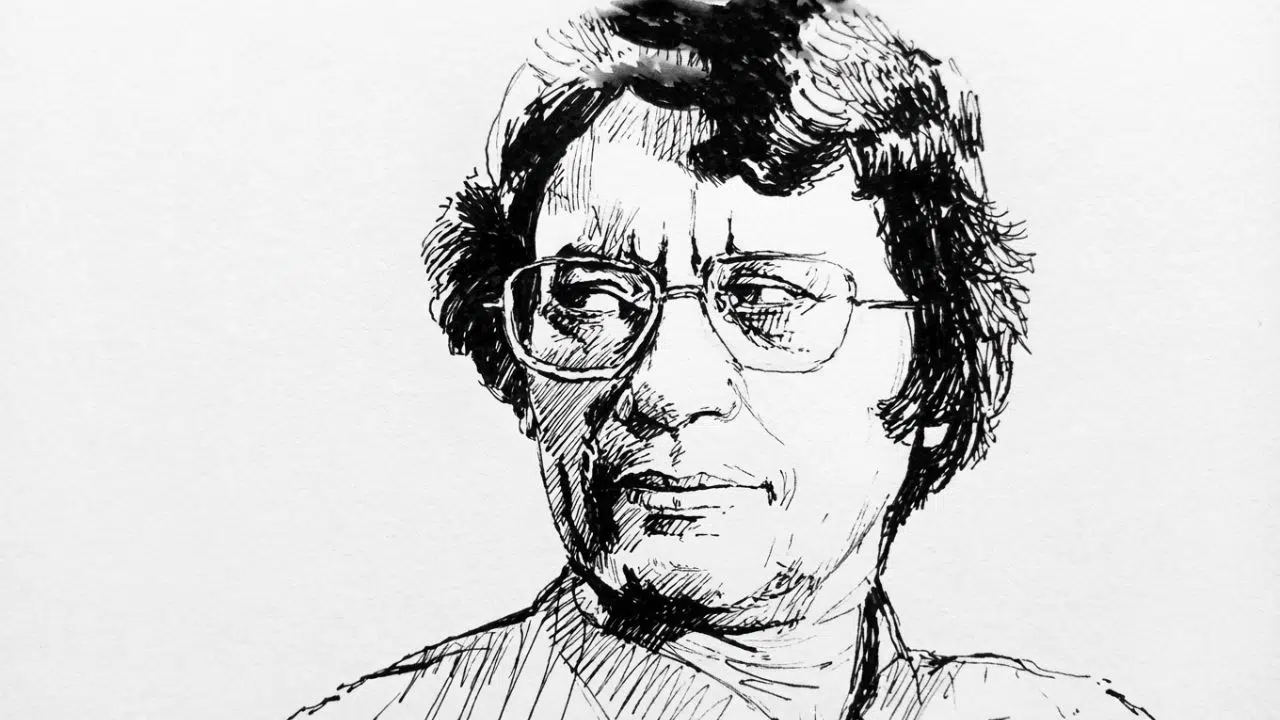
The person whose free-spirited footsteps artistically transformed the Bengali language and literature into a new trend in the post-Rabindranath era is the renowned professor of Dhaka University, the fearless pioneer of freethinking knowledge practice, and the stalwart of modern Bengali language and literature, Humayun Azad. He was simultaneously the leading anti-establishment and multidimensional writer, poet, novelist, linguist, critic, and political commentator of Bengali literature. His vast body of work has deeply enriched the Bengali language and literature.
He used his pen to question injustice, religious extremism, social hypocrisy, political corruption, and the oppression of women. He did not write to please powerful people. He wrote to tell the truth, even when that truth was dangerous.
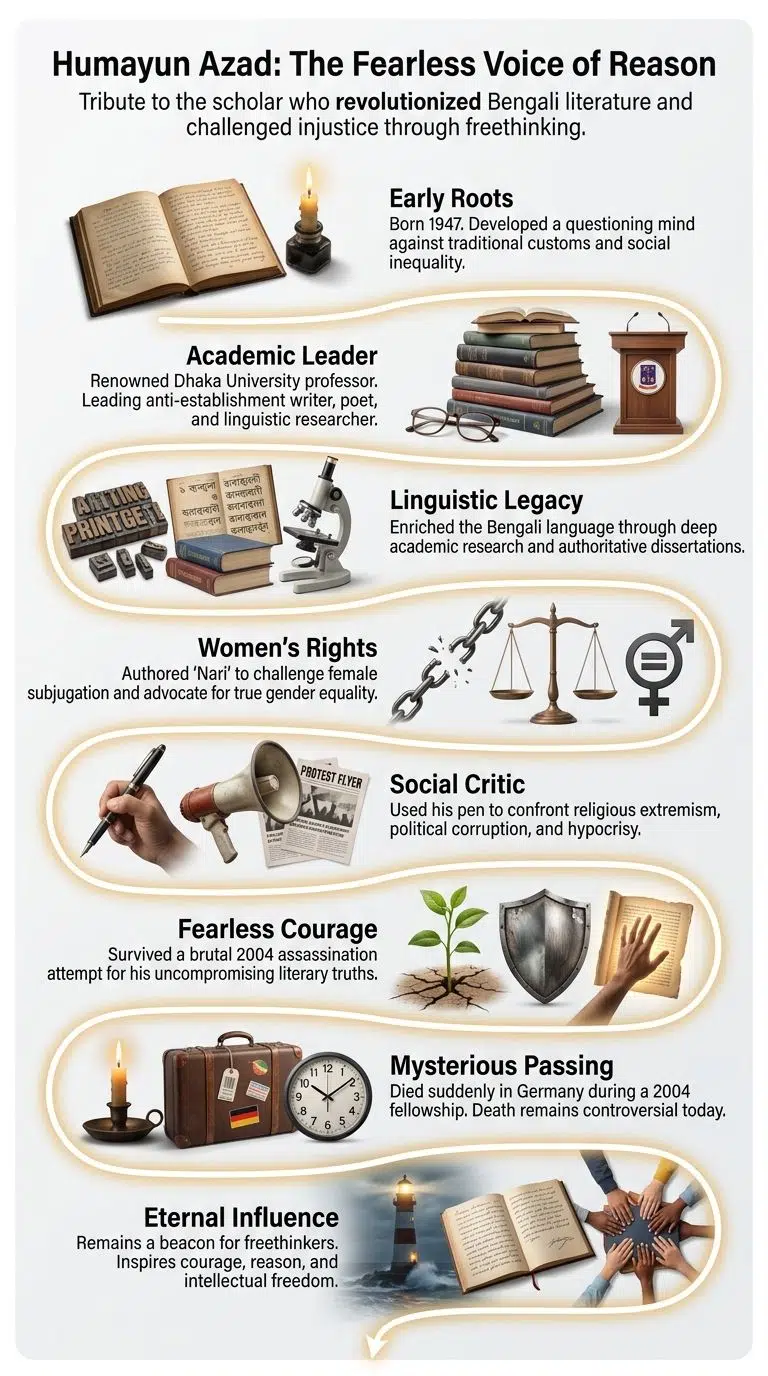
For many readers, Humayun Azad was not just a writer. He was a symbol of courage, reason, and intellectual freedom. On his 80th birthday today, this is my heartfelt tribute on him.
Early Life and Background of Humayun Azad
Just moments before the people of this subcontinent were awaiting freedom from British colonialism, he was born on April 28, 1947, in Rarikhal village of Bikrampur in the present-day Munshiganj district.
From an early age, he grew up in a society full of old customs, religious pressure, social inequality, and political confusion. But he did not accept everything blindly. He learned to question. He tried to understand life through reason, truth, and human values.
This questioning mind later became the foundation of his writing.
Humayun Azad: Growth as a Freethinker and Humanist
As he grew up and learned to perceive truth in the mirror of reality, he completely rejected the foundation of all the traditional customs and beliefs that had been widely prevalent as an epidemic for thousands of years in this so-called social system. He began to think about life, the world, and humanity as a freethinker and humanist; as a bearer and carrier of the spirit of the Liberation War, he gave birth to a progressive, freethinking philosophy within himself.
He engaged himself in the noble pursuit of seeking knowledge in the ocean of wisdom throughout his life. During his tenure as a university teacher, he unhesitatingly distributed his ultra-modern philosophy and consciousness among the students and youth. By beautifully and objectively analyzing the truth in clear language, becoming infinitely courageous, this great man endowed with extraordinary, unique intellect and multifaceted genius, flared up in different ways through the evolution of time.
With a firm consciousness of state and social change, using his pen as a weapon to achieve the rightful rights of the people, he sometimes unhesitatingly wrote articles in newspapers, sometimes expressed the radiant emotions-feelings-efforts of human life in poetry, sometimes flared up in composing informative essays, and sometimes became vocal in constructive criticism. The person under whose endless inspiration he moved forward, overcoming hundreds of obstacles, was his most revered teacher, one of the greatest professors in the history of Dhaka University, the unique knowledge-seeking researcher of Bengali language-literature, and the timeless progressive writer of freethought, Ahmad Sharif.
Contributions to Bengali Language and Linguistics
Awakened by the dream of establishing an exploitation-free, self-reliant society, he deeply concentrated his intellect, mind, and wisdom in direct and indirect research to drive away the lies hidden inside the people of the society. While obtaining his Ph.D. at the University of Edinburgh in the UK, he composed an insightful dissertation titled Pronominalization in Bengali to enrich the Bengali language.
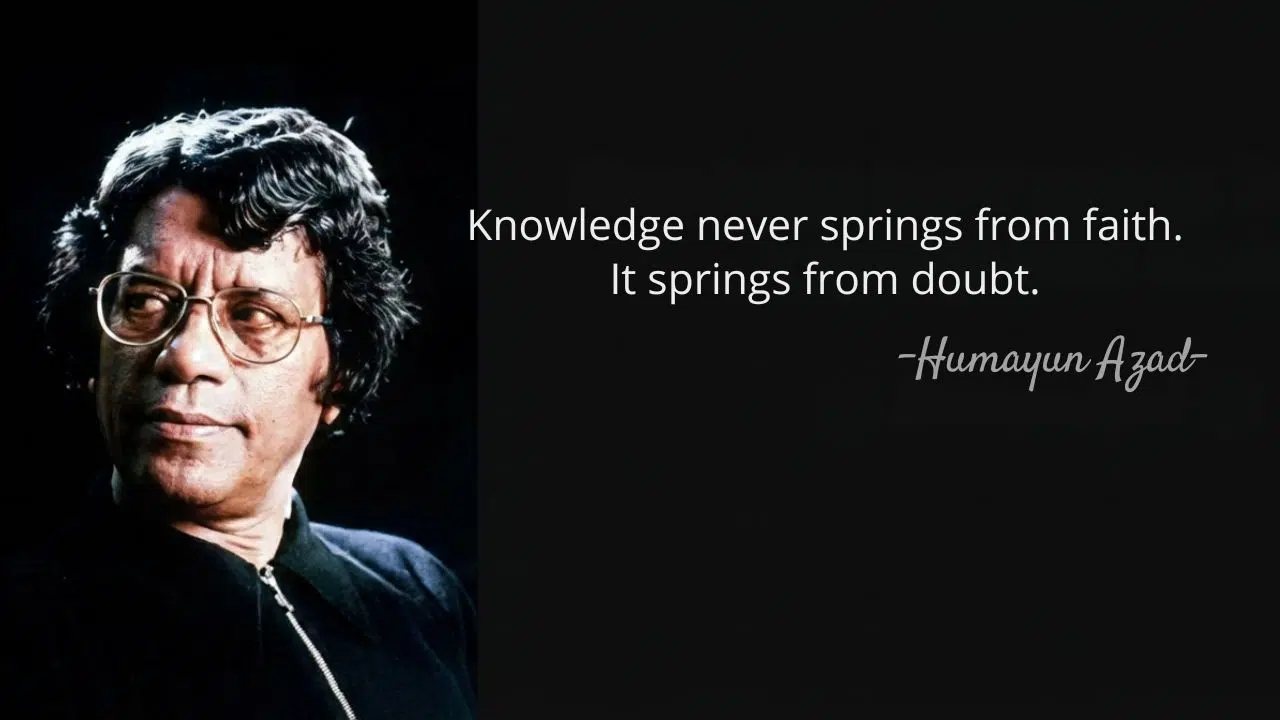
Furthermore, aiming to elevate the Bengali language to a supreme position, he edited Bangla Bhasha (Volumes 1 and 2) and authored Bakyototto (Syntax), Tulamulak o Oitihashik Bhashabigyan (Comparative and Historical Linguistics), Orthobigyan (Semantics), Bhasha Andolon: Shahittik Potobhumi (Language Movement: Literary Background), Koto Nodi Shorobor ba Bangla Bhashar Jiboni (How Many Rivers and Lakes or the Biography of the Bengali Language), Lal Nil Dipabali ba Bangla Shahittyer Jiboni (Red Blue Sparkles or the Biography of Bengali Literature), and Bhasha Shikkha o Bhashabigyan Porichiti (Introduction to Language Learning and Linguistics – published posthumously).
Women’s Rights and the Book Nari
Living a very ordinary and short life, Humayun Azad wanted to spread himself from one end of the world to another for the purpose of seeking the means of human liberation and living righteously. To establish women’s rights in this society and to free women from the chains of subjugation so they could become true human beings, he wrote the timeless book of Bengali literature, Nari (Woman), as the harvest of extensive research.
The 2004 Attack and National Outrage
Fundamentalist, militant, fanatic, reactionary, communal, and anti-liberation forces, aiming to eliminate him forever, hacked his body with machetes outside the premises of the Amar Ekushey Book Fair on February 27, 2004; he narrowly escaped death. Bangladesh and the entire Bengali nation became turbulent in protest against the attack on him.
The hyena fundamentalists and fanatics did not want to let him live because of his composition of Pak Sar Jamin Sad Bad, one of the finest, exceptionally unique, and truth-and-reality-seeking novels of Bengali literature. Where the real picture of injustice, tyranny, rape, fundamentalism, militancy on the canvas of reactionary religion, and the past and present political context of Bangladesh was clearly revealed.
Awakening an Unconscious Nation
In the light of visionary intellectual wisdom and realistic philosophy, Humayun Azad understood where the ultimate destination of this Bengali nation actually was. Thus, to awaken the aimless, directionless, unconscious, sleeping nation, he continuously struck hard on people’s brains throughout his life with the immense power of his pen.
Major Works and Freethinking Literature
By diversely arranging things through his creative and imaginative works, he remained resolute in the determination to light the lamp of hope inside himself and others. Among the books he wrote to immerse people in the freethinking practice of knowledge, freeing them from the chained, superstitious, backward society and state—books that will provide a quest for a new era in the light of reality.
Few notable books of Humayun Azad include: Amar Obishshash (My Disbelief), Mohabishsho (The Universe), Shob Kichu Noshtoder Odhikare Jabe (Everything Will Go to the Possessors of the Corrupt), Shimaboddhotar Shutro (The Formula of Limitations), Amader Shohore Ekdol Debdut (A Flock of Angels in Our City), Chappanno Hajar Borgomail (Fifty-six Thousand Square Miles), Rajnitibidgon (The Politicians), Shob Kichu Bhenge Pore (Everything Falls Apart), Abbuke Mone Pore (I Remember Father), Shubhobroto, Tar Shomporkito Shushomachar (Shubhobrata, His Related Gospel), Amra Ki Ei Bangladesh Cheyechilam? (Did We Want This Bangladesh?), Protikriyashilder Dirgho Chayar Niche (Under the Long Shadow of the Reactionaries).
Few other works of him include: Humayun Azader Probachon Guccho (Aphorisms of Humayun Azad), Humayun Azad Sreshtho Kobita (Best Poems of Humayun Azad), Atotayider Sathe Kothopokothon (Conversation with Assassins), Shakkhatkar (Interview), Amar Notun Jonmo (My New Birth), and Ekush Amader Oghoshito Shadhinota Dibosh (Ekushey is Our Undeclared Independence Day) (The last two books were published posthumously).
Munich Fellowship and Sudden Death
Even after enduring heart-wrenching trauma and agony, he harbored the desire to live solely to guide people towards an enlightened new horizon, yet he had to bid a permanent farewell to life. Nearly six months after the attack at the Ekushey Book Fair, on August 7, 2004, under the subtle conspiracy of the supposedly democratic government, he was sent to Munich, Germany, at the invitation of PEN for fellowship research on the German poet Heinrich Heine.
Five days later, on August 12, 2004 (according to Bangladesh Standard Time), through the completion of an unresolved task by the subtle conspiracy of a criminal syndicate, he had to suddenly bid a permanent farewell in the land of the dictator Hitler. He was found dead in his own bedroom in a flat in Munich, Germany. His sudden death still raises questions among freethinkers! A deep suspicion arises: was his death the conclusion of the conspiratorial activities of that evil faction?
The Final Flame of Hope
Before blowing out due to the severity of the wind, a lamp flares up brightly for the last time; it seems that the fire will burn down everything around it. Out of immense love and respect for the motherland, Humayun Azad also wanted to flare up again to permanently crush the dark hands while remaining steadfast in revealing the truth.
With the aim of further enriching the Bengali language and literature and practicing knowledge freely, perhaps he had the ultimate desire to burn brightly one last time by moving away from the suffocating, terrorized, and endangered environment of Bangladesh. Therefore, perhaps being sent to Germany on a fellowship did not seem like a conspiracy to him; in his realization, it awoke as the last refuge of life.
The Unfinished Trial and Demand for Justice
However, the proper trial for that attack on him has not yet concluded. Even with the culprits imprisoned before our eyes, investigation activities are ongoing for the trial. Various religious hypocrites and war criminals and many others labeled Humayun Azad as a ‘Murtad’ (apostate) countless times in different meetings and gatherings; even after the barbaric attack on him, they mocked him up to the “National Parliament” and applauded the attack.
Despite having proof of all these, why is the rightful justice for their injustice stalled? Interrogating them properly on remand would let the cat out of the bag! Because it is an evident truth that the ghost is hidden inside the mustard seeds! (Translator’s note: A Bengali idiom implying that the problem or corruption lies within the very system meant to cure it).
Questions of Accountability in an Independent Country
In an independent country, every citizen has the right to get proper justice for an injustice! Then why is the punishment of the attackers behind the most heinous, primitive, and brutal attack on one of the greatest sons of the Bengali nation, Humayun Azad, long delayed? In 2022, after 18 years of the brutal attack, the Dhaka Court has sentenced four people to death for the murder of prominent writer and academic Humayun Azad in 2004.
Religious extremism still exists. Women still face oppression. Politics is still often corrupt. Many people are still afraid to speak the truth. Many societies still punish people for asking questions.
This is why reading Humayun Azad is still important. His writing teaches us to think clearly, speak honestly, and stand against injustice.
A Life of Uncompromising Truth
Despite facing death threats at various times, Humayun Azad never backed down from speaking the truth and clear words uncompromisingly during his lifetime.
Legacy Among Freethinkers
Therefore, as long as truth survives on the face of the earth, Humayun Azad, one of the greatest sons of Mother Bengal, a great personality, and the embodiment of a vast and generous heart, will live on as a beacon of light within the truth in the minds of freethinkers. He is his own best example.
Guidance for Future Generations
Realizing Humayun Azad with human consciousness and values, his sharp and invincibly powerful writings will guide the truth-seeking and humanitarian paths in the thoughts and consciousness of the knowledge-thirsty younger generation.
Humayun Azad Tribute: The Writer Who Refused to Be Silent
Humayun Azad’s life teaches us that a writer’s greatest duty is to speak the truth. He showed that words can fight fear. Ideas can challenge power. Literature can wake up a sleeping nation.
He may no longer be physically present, but his writings remain alive. His courage remains alive. His questions remain alive. As long as people search for truth, justice, reason, and freedom, Humayun Azad will continue to shine as one of the brightest lights of modern Bengali literature.
Humayun Azad lives wherever people dare to think freely.