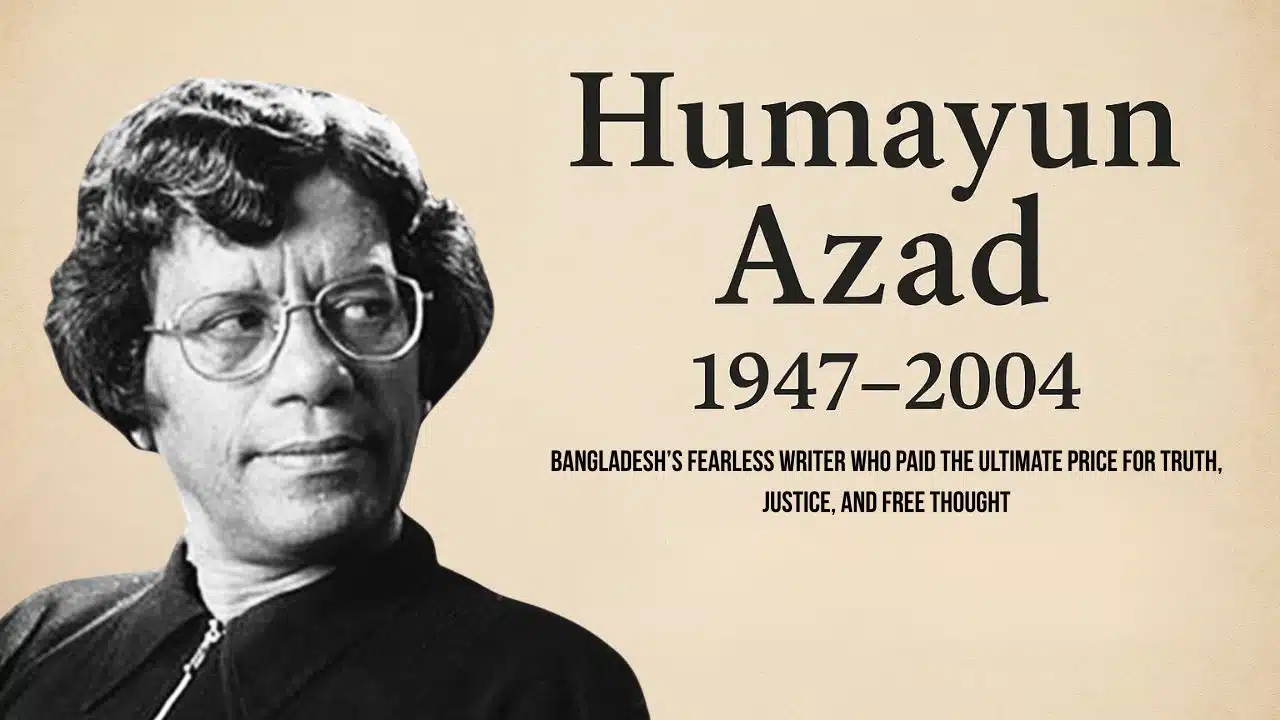
On the night of February 27, 2004, the Dhaka Book Fair was alive with the hum of conversations, the rustle of turning pages, and the scent of fresh ink. Writers signed books, readers wandered between stalls, and the city’s literary pulse beat strong. Among them was Humayun Azad—poet, novelist, linguist, academic, and one of Bangladesh’s most fearless voices.
That evening, after leaving the fair, he was ambushed and attacked with machetes. The assailants were later identified as members of Jama’atul Mujahideen Bangladesh (JMB), a banned extremist group. This was no random act of violence—it was a direct response to his bold critiques of religious fundamentalism, most prominently in his 2004 novel Pak Sar Jamin Sad Bad.
Azad survived the attack, but the wounds—physical and psychological—never fully healed. In August 2004, while recovering in Munich, Germany, he was found dead in his apartment. The official cause was a heart attack, but suspicions lingered. His death symbolized the ultimate question—Humayun Azad and the price of truth in a society still struggling to protect its free thinkers.
Humayun Azad: Life & Legacy
| Category | Details |
|---|---|
| Full Name | Humayun Kabir (changed to Humayun Azad in 1988 — “Azad” meaning free) |
| Date of Birth | April 28, 1947 |
| Place of Birth | Rarhikhal, Bikrampur (now Munshiganj District), East Bengal (then part of British India) |
| Date of Death | August 12, 2004 |
| Place of Death | Munich, Germany |
| Cause of Death | Officially reported as heart attack; suspicions of foul play remain due to prior assassination attempt |
| Nationality | Bangladeshi |
| Education | – BA in Bengali, University of Dhaka – MA in Bengali, University of Dhaka – PhD in Linguistics, University of Edinburgh (1976) |
| Academic Career | – Lecturer, Chittagong University (1970) – Lecturer, Jahangirnagar University (1972) – Associate Professor, University of Dhaka (1978) – Professor, University of Dhaka (1986) |
| Fields of Work | Linguistics, Bangla grammar, literature, poetry, political essays, feminist criticism |
| Major Literary Genres | Poetry, Novels, Essays, Linguistics, Literary Criticism |
| Notable Works | – Alaukik Istimar (1973, poetry) – Naree (1992, feminist critique) – Chhappanno Hajar Borgomail (1994, political novel) – Pak Sar Jamin Sad Bad (2004, anti-extremism novel) |
| Themes in Writing | Secularism, Rationalism, Feminism, Anti-authoritarianism, Freedom of Expression |
| Major Awards | – Bangla Academy Literary Award (1986, Linguistics) – Ekushey Padak (2012, posthumous) |
| Key Life Events | – 1988: Changed surname to Azad – 1995: Naree banned; ban overturned in 2000 – 2004: Survived machete attack at Ekushey Boi Mela – 2004: Passed away in Munich |
| Attack Details | February 27, 2004—attacked by Islamist militants (Jama’atul Mujahideen Bangladesh) after publishing Pak Sar Jamin Sad Bad |
| Justice | April 2022— Four JMB members sentenced to death for involvement in his killing |
| Advocacy | Women’s rights, secularism, linguistic modernization, free speech |
| Legacy | – Recognized as one of Bangladesh’s boldest intellectuals – Over 70 published books across genres – Symbol of resistance against religious extremism and censorship |
| Family | Children include writer Ananya Azad, who also faced threats for secular views |
| Impact on Society | Continues to inspire writers, academics, and activists in Bangladesh and abroad to uphold freedom of thought |
Early Life and Formation of a Rebel Mind
Born Humayun Kabir, he grew up in a rural setting rich with oral traditions and cultural rhythms. He excelled in school, earning a BA and MA in Bengali from the University of Dhaka. Later, he traveled to Scotland, where he earned a PhD in linguistics from the University of Edinburgh in 1976.
These years abroad exposed him to diverse philosophies, sharpening his commitment to secularism, rationalism, and equality. His decision to change his surname to “Azad” was more than symbolic—it was a lifelong declaration of intellectual freedom.
Academic Career and Linguistic Contributions
Azad joined the Department of Bengali at the University of Dhaka in 1978 and became a full professor in 1986. He was a rigorous academic who pushed for the modernization of Bangla grammar and usage, aiming to make the language clearer, more inclusive, and free from outdated conventions.
His linguistic works, such as Bhashar Shatru Bhasha, bridged scholarly research with public discourse, making complex theories accessible to ordinary readers. Scholars note that he embraced the role of public intellectual at a time when such positions often came with political and social risks.
The Literary Voice That Challenged Power
Azad’s literary journey began with poetry—his debut collection, Alaukik Istimar (1973), showcased a young writer unafraid of experimentation. But he soon expanded into novels, essays, and polemics that directly challenged patriarchy, authoritarianism, and religious extremism.
Key Works:
-
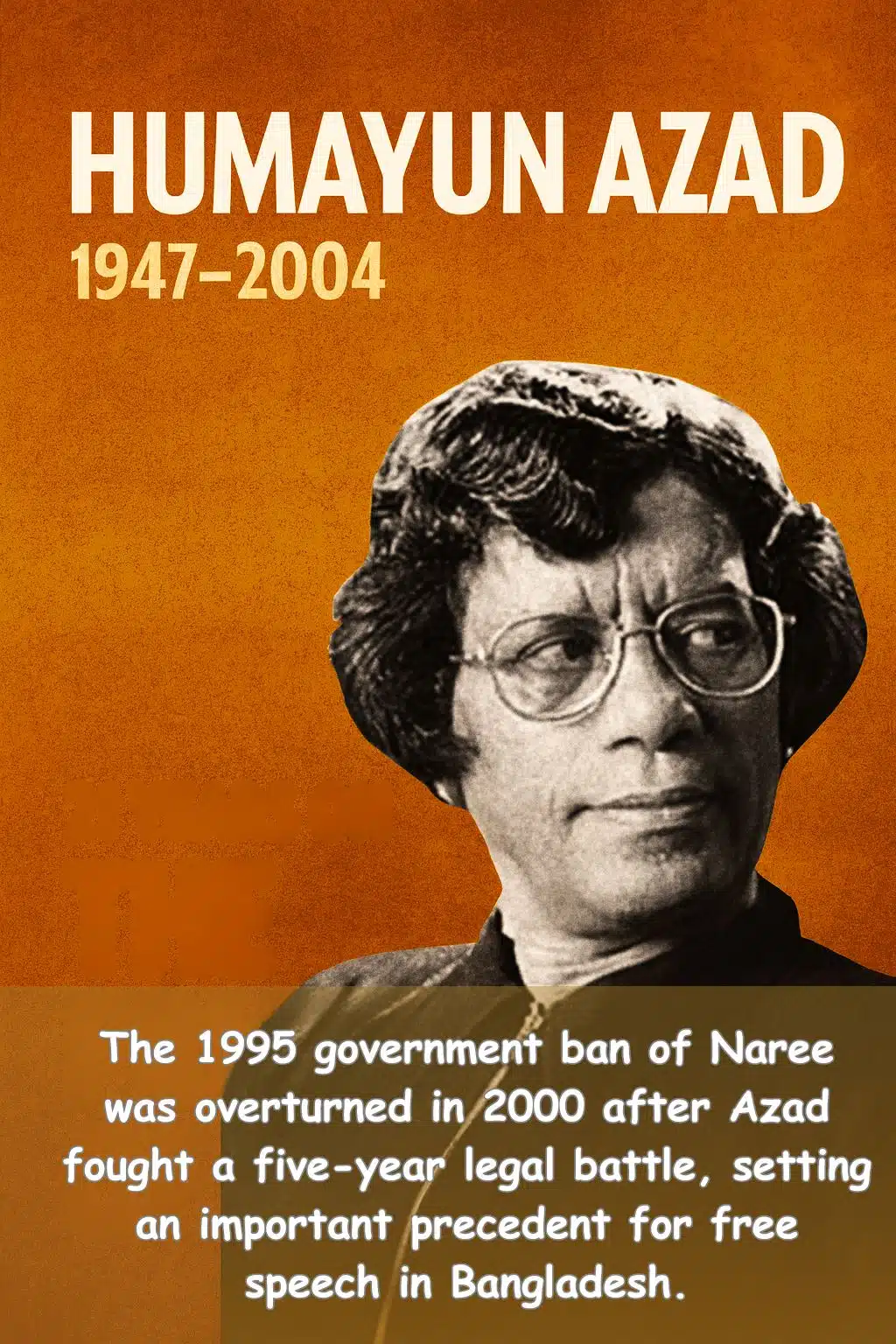
Naree (1992): A feminist manifesto critiquing patriarchal norms in Bengali society. It was banned in 1995 but reinstated in 2000 after a High Court appeal—a legal battle that defined his public image.
-
Chhappanno Hajar Borgomail (1994): A political allegory depicting life under the Ershad dictatorship. It remains a landmark in Bangladeshi political fiction.
-
Pak Sar Jamin Sad Bad (2004): A searing critique of Islamist extremism. This novel, which targeted fundamentalist ideologies head-on, is widely regarded as the work that provoked the fatal attack.
Confronting Fundamentalism: Courage in the Face of Danger
By the early 2000s, Bangladesh was grappling with rising religious extremism. Azad used his platform to call out the dangers—warning against the politicization of religion, the erosion of women’s rights, and the silencing of dissent.
Fatwas were issued against him, death threats became routine, and security warnings were ignored by authorities. Yet, as friends urged him to soften his tone, Azad remained adamant: “If I remain silent, I will betray not only myself but also the generations to come.”
Language & Research Contributions
-
Trained linguist (PhD, University of Edinburgh), Azad pushed for modernization of Bangla grammar and usage, bridging scholarly linguistics with public-facing critique. (Use this line to frame his academic standing alongside his public persona.)
-
Scholarly commentary highlights how Azad embraced pariah status to defend free inquiry—analyzed as a “danse macabre” of dissent versus intolerance in Bangladesh’s culture wars.
The Night of the Attack
On February 27, 2004, after attending the Ekushey Boi Mela at Bangla Academy, Azad was walking home when he was set upon by armed assailants. The brutality of the attack shocked the nation—a public intellectual, hacked with machetes, for writing a book.
Rushed to the Combined Military Hospital, he survived against the odds. But the attempt on his life was a chilling message to all writers and thinkers in Bangladesh: dissent had consequences.
Final Days and Mysterious Death
In July 2004, Azad traveled to Munich, Germany, for medical treatment and academic work. Just a month later, on August 12, he was found dead in his apartment. While German authorities ruled it a natural death, speculation persisted about possible foul play, given the threats he faced.
Justice and Aftermath
Justice was painfully slow. For nearly 18 years, the case languished. Finally, in April 2022, a Dhaka court sentenced four JMB members to death for their role in the attack. The verdict brought symbolic closure but also underscored the persistent dangers faced by free thinkers in Bangladesh—threats that extended even to his son, writer Ananya Azad.
Humayun Azad and The Price of Truth
Humayun Azad’s legacy lies at the intersection of literature, linguistics, and activism. His over 70 published works are now part of the Bangladeshi canon, studied in universities and debated in literary circles.
He remains a model of the public intellectual—one who accepts personal risk in defense of freedom of thought. His feminist writings in Naree, political allegories in Chhappanno Hajar Borgomail, and unflinching critiques in Pak Sar Jamin Sad Bad continue to inspire new generations to speak out against injustice.
Essential Works of Humayun Azad
-
Naree—Groundbreaking feminist critique; challenged patriarchal icons and faced legal censorship.
-
Chhappanno Hajar Borgomail—A fictional yet accurate portrayal of dictatorship in Bangladesh.
-
Pak Sar Jamin Sad Bad—A fearless literary confrontation with religious extremism.
Takeaways
Humayun Azad was not just a writer—he was a truth-teller whose pen was sharper than any blade. Twenty-one years after his death, his voice still resonates, urging us to resist fear, challenge injustice, and defend the right to think freely.
To truly honor him, we must protect the space for dissenting voices in our society—so that no writer, anywhere, is silenced for telling the truth.