Mental health is a topic we finally talk about out loud. Families, schools, and workplaces are opening up, which is a massive step forward for society. But the public systems built to support this incredible surge in demand are practically breaking under the pressure. The Health Service Executive frequently struggles to keep pace with the rising need for psychological and psychiatric care. This creates a dangerous void where vulnerable people sit on endless waitlists instead of getting the help they desperately deserve.
This is exactly where the non-profit sector steps up to the plate. When state resources fall short of the mark, the mental health charities Ireland trusts become the ultimate safety net for everyday people. Groups like Pieta House, Jigsaw, and Aware do not just offer a temporary, band-aid fix. They actively save lives, shift cultural attitudes from the ground up, and provide immediate safe spaces. Below, we look at the reality of the crisis and the massive, undeniable impact these organizations have on the country.
1. The Waitlist Crisis for Public Mental Health Care
One of the most alarming realities in the country right now is the excruciating length of time people wait to see a public mental healthcare professional. You finally take a brave step to ask for help, only to find out you are just another number on a painfully long list. Recent parliamentary data shows that community care systems are completely overwhelmed by the sheer volume of referrals. Because of this administrative gridlock, non-profit organizations are forced to step in to provide immediate, accessible therapy. The situation is incredibly severe for young people relying on the Child and Adolescent Mental Health Services. Late 2025 figures revealed that despite government funding increases, thousands of children were sitting on waiting lists.
Out of that number, hundreds had been waiting for more than 12 months just to get an initial, basic assessment. A year is an absolute eternity for a teenager sitting in a state of distress. Charities actively step in to offer interim counseling, text support, and community interventions so these kids are not left entirely alone to fight their battles while waiting for state care. The demand for these services jumped massively, proving that public health infrastructure simply cannot function without the charity sector acting as a pressure valve.
| HSE Public System Reality | Charity Intervention Strategy |
| Long wait times for initial assessments | Immediate crisis helpline access |
| Strict referral requirements from a GP | Self-referral and walk-in community options |
| Geographically limited public clinics | Mobile units and secure online therapy portals |
| Understaffed public clinical teams | Volunteer-led and heavily community-funded operations |
2. Pieta House Provides Free, Life-Saving Interventions
When we talk about acute crisis intervention, Pieta is usually the very first name people mention across the country. Founded specifically to combat self-harm and suicide, this organization built its entire operational model around breaking down strict financial barriers to therapy. They realized early on that when someone is in a dark, desperate place, handing them a massive therapy bill only makes things infinitely worse. By offering completely free interventions, Pieta ensures that anyone can get professional help regardless of their bank balance or employment status. You cannot mention Pieta without talking about the Darkness Into Light movement. What started as a small, quiet walk in Phoenix Park exploded into a massive, highly emotional global movement.
Every May, hundreds of thousands of people wake up before dawn to walk together as the sun comes up. This event is not just a massive fundraiser to keep the clinics open. It acts as a profound visual representation of hope and pure solidarity. It shows people who are struggling that their community stands firmly with them, literally walking them from the darkness into the light. This grassroots movement proves exactly how mental health charities Ireland supports can unify an entire nation around a single, life-saving cause.
| Service Type | Description of Support |
| Crisis Intervention | Free, one-on-one therapy for active suicidal ideation |
| Bereavement Support | Specialized counseling for families who lost a loved one to suicide |
| Helplines | 24/7 free telephone and text support systems for sudden panic |
| Community Education | School and workplace training to spot early warning signs in peers |
3. NGOs Intervene Where State Funding Falls Short
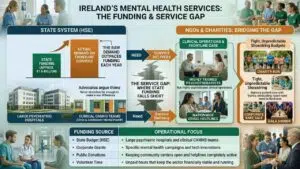
The government obviously allocates a specific portion of the national health budget to psychiatric care, but frontline advocates consistently argue it never stretches far enough to make a real difference. While the state recently pushed funding to around €1.6 billion, the raw demand outpaces the cash flow every single year. Because state funding continually falls short of the actual need on the ground, charities carry a massive portion of the nation’s healthcare burden on their own shoulders. These organizations run highly sophisticated clinical operations on incredibly tight, unpredictable shoestring budgets. They do the heavy lifting of a public service but operate entirely on a fragile charity model.
They employ highly trained psychotherapists, manage complex logistical networks, and run nationwide crisis helplines. Yet, they constantly have to balance patient care with the frantic, exhausting need to fundraise. The best mental health charities Ireland has to offer often spend as much time organizing charity runs, corporate bake sales, and gala dinners as they do planning clinical expansions. They seamlessly bridge the gap between what the government legally provides and what the public actually desperately needs to survive.
| Funding Source | Operational Focus |
| State Budget (HSE) | Large psychiatric hospitals and clinical CAMHS teams |
| Corporate Grants | Specific mental health campaigns and tech innovations |
| Public Donations | Keeping community centers open and helplines completely active |
| Volunteer Time | Unpaid hours that keep the sector financially viable and running |
4. Youth Mental Health is a Major Priority for Nonprofits
Growing up today is overwhelmingly complicated and filled with hidden landmines. Teenagers face intense academic pressure, lingering social anxiety, and an aggressive, always-on digital landscape. Young people easily check their phones over 150 times a day, feeding an endless cycle of social comparison that slowly destroys their baseline self-esteem. Charities deeply recognize that catching these issues early is the only real way to prevent long-term psychiatric struggles in adulthood. They build specific, highly tailored services designed strictly for the teenage brain and modern adolescent experiences. Jigsaw is a phenomenal example of an organization entirely dedicated to youth wellbeing.
They focus on people aged 12 to 25, offering free and strictly confidential support in communities nationwide. Interestingly, recent verified survey data shows exactly 35% of young adults cite excessive screen time and digital peer pressure as a massive barrier to their mental wellbeing. Jigsaw directly combats this by meeting young people where they already hang out, heavily investing in synchronous live chat counseling and digital primary care programs. They actually listen to young people, treat them like adults, and give them practical tools to manage their anxiety before they fall into a much deeper crisis.
| Stress Factor | Charity Response |
| Excessive screen time | Digital detox programs and anonymous online youth chat services |
| Academic burnout | School-based resilience workshops and peer-to-peer support |
| Social isolation | Safe physical drop-in centers located in local communities |
| Financial insecurity | Entirely free therapy without requiring parental health insurance |
5. Rural Ireland Relies Heavily on Charity Outreach
Getting to a therapist in the middle of Dublin or Cork is tough enough, but in deeply rural areas, geography makes things ten times harder. A severe lack of public transport and fewer local clinics leave many farming communities feeling totally isolated and abandoned. Privacy is also a massive, undeniable concern when everyone in town easily recognizes your car parked outside a local counselor’s office. To fix this, non-profits develop heavily targeted outreach programs that go directly into the countryside to meet people on their own turf. Charities use mobile clinics, partner with local community halls, and run specific, hard-hitting campaigns aimed directly at rural populations.
Organizations like Mental Health Ireland have regional volunteer networks that offer grassroots support directly in the quiet villages that need it most. By bringing the services right to isolated areas, these groups ensure that a person’s physical location does not dictate whether they live or die. They actively level the playing field so someone struggling in a remote part of Kerry gets the exact same level of support as someone living right in the center of Dublin.
| Barrier to Access | Charity Solution |
| No public transport | Telehealth appointments and simple text-based counseling |
| Lack of privacy | Anonymous helplines and unbranded, discreet outreach centers |
| Farming isolation | Specific agricultural mental health campaigns run by peers |
| Stigma in tight communities | Local community hall workshops to completely normalize therapy |
6. 24/7 Crisis Helplines Are Almost Exclusively NGO-Run
A sudden panic attack or a severe mental health emergency does not stick to a neat, predictable nine-to-five schedule. Crises frequently happen in the middle of the dark night when public clinics and doctor offices are firmly locked up. In those lonely, desperate hours, telephone and text helplines become a literal lifeline connecting a person to safety. The public health system rarely operates walk-in night clinics outside of general hospitals, meaning the voluntary sector completely owns nighttime crisis intervention. Organizations like the Samaritans have been taking midnight calls for decades, providing a profoundly non-judgmental ear when people feel totally abandoned by the world.
Newer initiatives have smartly adapted to how younger generations prefer to communicate. Services like Text About It offer free, 24/7 text messaging support managed by highly trained volunteers and clinical supervisors. These lines allow people to reach out silently and safely from their bedrooms without waking anyone up. They quickly de-escalate acute crises through a medium people feel completely comfortable using, entirely bypassing the overwhelming anxiety of talking on a phone.
| Support Method | Target Demographic |
| Voice Calls (Samaritans) | Older adults and people needing immediate, soothing vocal comfort |
| Text Services (Text About It) | Youth and people in environments where they cannot safely speak |
| Online Chat (Turn2Me) | Professionals and young adults completely comfortable with digital typing |
| In-person Emergency | Hospital ERs (often loud and generally unsuitable for extreme anxiety) |
7. Bereavement Support is Championed by Volunteers
The deep tragedy of suicide leaves a devastating, chaotic wake that rips aggressively through entire communities. The families and friends tragically left behind face a highly complex, traumatic form of grief that requires incredibly specialized therapeutic support. Unfortunately, the public health system rarely has the budget, time, or the dedicated staffing to provide long-term, specialized suicide bereavement counseling to extended families. Charities have to step in rapidly to catch the people left behind before the shock destroys them. Organizations like Pieta and HUGG operate dedicated, highly trained bereavement liaison services.
These incredibly compassionate teams step in right after a sudden tragedy happens. They offer intensely practical advice, handle overwhelming funeral logistics, and provide deep emotional support to shell-shocked families navigating the unthinkable. They gently guide people through the darkest moments of their entire lives, running group therapy sessions that help fractured communities process the raw pain. Without these dedicated volunteers, thousands of grieving families would have to navigate their trauma completely blind and entirely alone.
| Care Stage | Charity Involvement |
| Immediate Aftermath | Suicide bereavement liaison teams rapidly deployed to families |
| Short-Term Coping | Providing practical, clear advice for funerals and legal inquests |
| Long-Term Therapy | One-on-one counseling to deeply process complex, sudden trauma |
| Community Healing | Group peer support to reduce local stigma, guilt, and fear |
8. Community-Based Centers Reduce Hospital Admissions
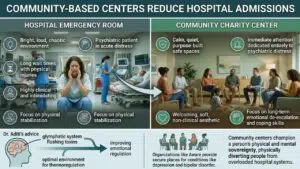
When someone is in acute distress and has nowhere left to go, they often end up sitting in the emergency department of their local public hospital. Emergency rooms are chaotic, loud, aggressively bright, and generally the absolute worst possible environment for someone having a psychiatric break. Charities provide critical community-based support that physically diverts people away from the overloaded hospital system. As clinical psychologist Dr. Sanjay Chugh points out, treating trauma within a familiar, warm community setting rather than a sterile hospital ward makes patients feel vastly less alienated.
Organizations like Aware, which runs local support groups for depression and bipolar disorder, give people a secure place to manage their conditions consistently before a crisis ever hits. Dr. Aditi also adds that physical wellness heavily ties into psychiatric stability. Setting an optimal environment for thermoregulation 1-2 hours before bed strongly supports the brain’s glymphatic system, successfully flushing out toxins and improving emotional regulation. Community centers teach these holistic daily routines, championing a person’s physical and mental sovereignty so they never have to set foot in a terrifying ER.
| Hospital Emergency Room | Community Charity Center |
| Bright, loud, chaotic environment | Calm, quiet, purpose-built safe spaces |
| Long wait times with physical injuries | Immediate attention dedicated entirely to psychiatric distress |
| Highly clinical and intimidating | Welcoming, soft, non-clinical aesthetic |
| Focus on physical stabilization | Focus on long-term emotional de-escalation and coping skills |
9. Stigma Reduction Campaigns Are Charity-Led
Giving someone professional therapy is genuinely only half the battle. The other half is completely changing how Irish society talks about mental illness in the first place. For generations, psychiatric issues in this country were heavily stigmatized, locked away in dark institutions, and strictly never spoken about at the family dinner table. Charities took it completely upon themselves to rip off the bandage and force the entire country to talk about it openly. They are the absolute driving force behind the positive cultural shift we clearly see today.
Campaigns like the See Change Green Ribbon initiative challenge everyday people to simply start a conversation about their silent struggles. By confidently sharing real, lived experiences in local schools, corporate offices, and on national television, these organizations normalize the idea that it is perfectly okay not to be okay. They completely transformed mental illness from a deeply hidden taboo into a normal, highly manageable part of everyday life. The mental health charities Ireland respects the most actively rewrite the social rules so nobody feels ashamed to ask for help.
| Old Cultural Norm | New Charity-Driven Standard |
| Hiding depression from employers | Workplace mental health training and corporate open days |
| Ignoring youth anxiety | School programs proactively teaching emotional literacy |
| Using clinical, isolating language | Mainstream media campaigns openly sharing lived experiences |
| Viewing therapy as a weakness | Promoting counseling as completely routine healthcare maintenance |
10. The Financial Survival of These Services Relies on Public Donations
The absolute most terrifying fact about this entire support system is just how precariously these vital services are funded. Despite doing the incredibly heavy lifting of a national health service, many non-profits rely overwhelmingly on raw public generosity just to keep the lights on and the doors open. The core funding for mental health charities Ireland depends on is rarely guaranteed from one year to the next. A massive percentage of the revenue these groups desperately need comes from local marathon runs, school fundraisers, and individual monthly direct debits.
While this proves the incredible, unmatched generosity of the Irish public, it highlights a deeply flawed, fragile system. These organizations must constantly ask the public for money just to pay their clinical staff. If donations dry up during an unexpected economic downturn, the helplines literally stop answering. This precarious reality proves that while the public is incredibly supportive, the state urgently needs to step up, integrate, and fund these services much more permanently so lives are not put at risk by a bad fundraising quarter.
| Revenue Source | Reliability Level |
| HSE Grants | Moderate (subject to completely unpredictable annual government budget changes) |
| Corporate Sponsorships | Variable (heavily depends on the current global economic climate) |
| Public Fundraising Events | High effort, variable return (marathons, bake sales, galas) |
| Monthly Individual Donors | Most reliable, but incredibly hard to scale up quickly |
Final Thoughts
Looking closely at the system, it is incredibly obvious that the healthcare landscape in the country would completely collapse without the tireless non-profit sector. From answering desperate texts at 3 AM to counseling kids who have been stuck on a state waitlist for over a year, these organizations do heroic, unseen work every single day. However, they simply cannot be the permanent, unpaid substitute for a fully funded, highly functional public health system.
The ultimate, long-term goal must be seamless integration. The state urgently needs to fund robust, immediate clinical interventions while smartly utilizing the grassroots reach of the charity sector. Until politicians step up and fix the waitlists, the mental health charities Ireland supports will continue to be the absolutely vital safety net that catches people when they fall. Supporting them through steady donations, volunteering your time, or simply changing how we talk about mental wellbeing ensures that no one in this country has to face their darkest days completely alone.
Frequently Asked Questions (FAQs) About Mental Health Charities Ireland
1. Why do some charities focus heavily on text-based therapy rather than phone calls?
Many young people today experience severe phone anxiety and find it incredibly difficult to articulate their trauma out loud. Text-based services allow them to communicate silently from their rooms, providing an immediate sense of safety and total control over the pace of the conversation.
2. Can a charity center prescribe psychiatric medication?
No, charity-run community centers and local counselors provide psychotherapy, cognitive behavioral therapy, and general emotional support. If a person requires pharmacological intervention, they must be officially referred to a general practitioner or a public HSE psychiatrist.
3. How does the glymphatic system relate to charity wellness programs?
Many community wellness programs educate people on basic sleep hygiene. Proper sleep, specifically timing thermoregulation properly before bed, powerfully activates the glymphatic system which clears metabolic waste from the brain, directly improving daily psychiatric stability and mood regulation.
4. What happens if I contact a charity helpline but need immediate medical rescue?
If highly trained volunteers on a charity helpline determine you are in imminent, active physical danger, they have strict protocols to contact local emergency services and dispatch an ambulance or the Gardaí to your exact location to ensure your immediate physical safety.