

Denmark did not start its green journey out of a pure desire to save the planet. They started because they ran out of options during a massive energy crisis. Today, their grid serves as the ultimate proof of concept for renewable power on a massive, national scale. I find it amazing that a country with so little landmass managed to build an entirely new global industry from scratch. They simply used the fierce wind blowing off the North Sea to secure their independence and their economic future.
The Danish government decided early on to back renewable technology with real, sustained funding. They gave subsidies to early pioneers and built a testing environment where turbine companies could fail safely, learn, and improve. I have read through the historical data, and it is clear that consistent political support made all the difference. Because the government guaranteed fixed prices for green electricity, private investors felt completely safe pouring money into new hardware. This stable environment allowed local startups to grow into massive global corporations that now build projects worldwide.
| Energy Source | 2025 Contribution Share | Market Status | Future Trajectory |
| Onshore Wind | Dominant (Approx 35%) | Mature | Shifting to repowering old sites |
| Offshore Wind | Rapidly Growing (Approx 25%) | Expanding | Building energy islands |
| Bioenergy | High (Approx 19%) | Stable | Used mainly for district heating |
| Solar Power | Moderate (Approx 14%) | Growing | Supplemental to wind output |
| Fossil Fuels | Low (Under 8%) | Phasing Out | Target to eliminate by 2050 |
12 Key Facts Driving Denmark’s Wind Power Dominance
When you look at the raw generation numbers, the scale of Danish renewable production is absolutely staggering. I put together a detailed list of the 12 most important facts that explain how they got here. These points cover everything from the early days of community cooperatives to the futuristic energy hubs they are building today. If you want to understand how a country scales green power successfully, these facts tell the entire story.
1: A Shift Sparked by the 1970s Oil Crisis
In the early 1970s, Denmark bought almost all of its oil from the Middle East to power its plants and heat its homes. When the 1973 oil embargo hit, the entire country nearly shut down due to shortages. The government had to ban driving on Sundays and ration heating just to save fuel and survive the winter. I think this extreme economic shock is the real reason Denmark acts so aggressively on energy policy today. They realized they could never rely on foreign countries for their basic survival and needed domestic power.
Instead of pivoting to nuclear power, the Danish public protested and demanded cleaner, safer options. Small groups of local engineers and farmers started building crude turbines in their fields just to see if it would work. The government saw the potential to scale this up and stepped in with serious cash. They offered strong financial incentives to anyone who built a turbine, effectively paying citizens to generate power. This turned a grassroots environmental movement into a massive national priority, setting the stage for everything that followed.
| Impact Factor | 1970s Reality | Modern Outcome |
| Energy Independence | 90% reliant on imported oil | Net exporter of green energy |
| Public Sentiment | Feared nuclear power adoption | Embraced local wind generation |
| Government Action | Enforced strict energy rationing | Subsidized turbine research |
| Economic Shift | Vulnerable to global price spikes | Dominates green tech exports |
2: Generating Over Half of the Nation’s Electricity
I track power generation statistics constantly, and the current figures coming out of Denmark are wild compared to the rest of the world. In 2025, wind energy accounts for roughly 60 percent of the country’s total electricity consumption on average. On top of that, total low-carbon sources make up over 90 percent of their daily grid mix. This is not a small pilot program or a limited test for a single city. This is exactly how the entire country runs its factories, homes, and transport every single day.
Most large industrialized countries struggle to push past 15 or 20 percent wind integration before their grid operators panic about voltage stability. Denmark sails past the 50 percent mark easily and without blackouts. They manage the variable nature of wind by using highly accurate weather prediction software and strong interconnectors to neighboring countries. I look at this continuous success as concrete proof that the excuses we hear about renewable unreliability are just outdated thinking.
| Performance Metric | Global Average | Danish Grid Reality |
| Wind Power Share | 5% to 10% | Consistently over 50% |
| Grid Stability | Relies on coal baseload | Relies on smart grid tech |
| Peak Generation | Rarely hits 30% | Frequently exceeds 100% |
| Clean Energy Mix | Heavily mixed with gas | Over 90% low-carbon sources |
3: The Birthplace of Offshore Wind Farms
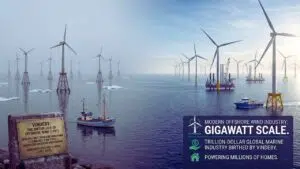
You cannot talk about Denmark wind energy without pointing straight to the Vindeby project. In 1991, Denmark decided to stick 11 small turbines into the ocean just off the coast of Lolland. Everyone in the energy sector thought they were completely crazy and wasting money. People naturally assumed the corrosive saltwater, sea ice, and massive waves would destroy the machines in a matter of months. Instead, Vindeby ran perfectly for an astonishing 25 years before retirement.
I always point to Vindeby as the initial spark that started a trillion-dollar global marine industry. Those 11 small turbines generated just enough juice for a couple of thousand local homes, but they proved the engineering was sound. Today, the offshore industry they birthed uses massive machines the size of skyscrapers that dwarf those early models. Denmark still leads this space, opening up massive new deep-water zones in the North Sea for companies to build farms that power millions of homes at once.
| Project Phase | Vindeby Details | Industry Significance |
| Launch Year | 1991 | World’s first offshore farm |
| Scale | 11 small turbines | Proved marine survival |
| Power Output | 5 Megawatts total | Powered roughly 2,200 homes |
| Lifespan | 25 continuous years | Validated long-term ROI |
4: The Power of Community Ownership
I firmly believe that gaining public acceptance is the hardest part of building massive green infrastructure. People naturally hate looking at giant turbines and complain constantly about the mechanical noise. Denmark fixed this exact problem early on simply by paying the public to be involved. In the 1980s and 90s, local citizens grouped together to buy the turbines directly through financial cooperatives.
These local groups, known as wind guilds, actually owned the vast majority of the machines operating in the country. When you own shares in the massive turbine spinning behind your house, you stop complaining about it because it pays you cash every single month. I think this early community ownership model built a deep cultural acceptance of wind power that still exists today. While massive corporate developers dominate the offshore space now, that early grassroots financial support prevented the intense political backlash we see in other countries.
| Ownership Model | How It Works | Primary Benefit |
| Wind Guilds | Citizens pool money to buy turbines | Directly rewards the community |
| Profit Sharing | Local grids sell power for a return | Turns eyesores into assets |
| Mandated Stakes | Developers must offer local shares | Prevents NIMBY lawsuits |
| Cultural Shift | People view turbines as community property | High national approval rates |
5: Home to Industry Giants Like Vestas
Because the Danish government subsidized the industry so early, local manufacturing companies had a massive head start over the rest of the world. I watch the stock market, and companies like Vestas are absolute heavyweights in the industrial sector. Vestas actually started as a simple agricultural equipment manufacturer before pivoting entirely into building turbines. Today, they design, build, ship, and service giant machines across every single continent.
Having Vestas and Ørsted based locally gives Denmark a huge structural advantage over importing countries. These companies employ thousands of Danish mechanical engineers, software researchers, and factory line workers. They also actively support a giant network of smaller local businesses that make highly specific parts like gearboxes, composite blades, and marine power cables. The whole country essentially functions as a massive, highly skilled supply chain for the global green energy sector.
| Company/Sector | Role in the Market | Economic Contribution |
| Vestas | Turbine manufacturing and design | Employs thousands globally |
| Ørsted | Offshore farm development | Builds massive global projects |
| Sub-contractors | Component manufacturing | Supplies gearboxes and cables |
| R&D Labs | Software and materials testing | Keeps tech ahead of rivals |
6: Pioneering the Concept of Energy Islands
Denmark recently hit a geographic wall with their expansion plans. They are simply running out of good, shallow spots near the shore to put more turbines without disrupting shipping lanes. Their solution to this space problem is completely sci-fi and brilliant. I was amazed when they formally announced plans to build actual energy islands far out in the deep ocean. These are centralized physical hubs designed to collect power from hundreds of deep-sea turbines all at once.
One massive artificial island will sit right in the North Sea, and they are heavily upgrading the existing island of Bornholm in the Baltic Sea to serve as another hub. Instead of running hundreds of separate, expensive cables back to the mainland, all the power flows to the island first. From there, the grid distributes it to Denmark, Germany, and the Netherlands based on demand. They even plan to build chemical factories right on these islands to convert excess electricity directly into green hydrogen fuel for cargo ships.
| Island Feature | North Sea Hub | Bornholm Hub |
| Location | Deep water, North Sea | Existing Baltic Sea island |
| Primary Function | Collects power from offshore arrays | Routes power to multiple nations |
| Secondary Function | Power-to-X hydrogen production | Grid balancing for the region |
| Scale | Massive artificial construction | Upgraded physical infrastructure |
7: Decades of Strong Political Consensus
You cannot successfully rebuild a national power grid in a single four-year election cycle. Politicians usually undo whatever the last administration built, which absolutely terrifies private investors. I noticed that Denmark handles this structural problem very differently from the United States or the UK. They actively form broad political agreements that include almost every major party sitting in their parliament.
When they decide on a national energy target, it stays locked in regardless of who actually wins the next election. This long-term legislative stability is the real secret sauce behind their growth. Energy developers know that if they spend three billion dollars on an offshore wind farm, the government will not suddenly pull the plug on their tax subsidies. This extreme predictability makes large banks eager to lend cheap money for Danish projects. I think other countries fail at green energy simply because their politics are way too chaotic for decade-long infrastructure planning.
| Political Factor | Traditional Politics | The Danish Approach |
| Policy Lifespan | Tied to short election cycles | Decades-long binding agreements |
| Investor Confidence | Low due to sudden tax changes | High due to guaranteed tariffs |
| Party Cooperation | Highly polarized and combative | Broad cross-party consensus |
| Infrastructure Planning | Reactive to current crises | Proactive 30-year roadmaps |
8: Smart Integration with the Nord Pool Grid
A lot of skeptical people ask me what happens when the wind simply stops blowing across Denmark for a week. The answer is incredibly simple: they just borrow power from their neighbors. Denmark is deeply and physically connected to the wider Nord Pool electricity market. They laid massive underground and undersea power cables connecting their domestic grid directly to Norway, Sweden, and northern Germany.
When a massive winter storm hits and Danish turbines make way too much power, they instantly sell the extra juice to the Germans or the Swedes for a profit. When the air is completely still and the turbines stop, Denmark just buys power back. They heavily rely on Norway’s massive mountain hydroelectric dams during these lulls. I view the Norwegian hydro system as a giant, physical external battery for the Danish wind sector. It balances out the grid perfectly and keeps consumer prices relatively stable year-round.
| Grid Partner | Primary Energy Source | Role in Danish Market |
| Norway | Massive Hydroelectric Dams | Acts as a giant physical battery |
| Sweden | Hydro and Nuclear Power | Provides baseline stability |
| Germany | Heavy Industrial Demand | Buys excess wind during storms |
| Nord Pool | Integrated Digital Market | Automates cross-border sales |
9: Breaking Global Production Records
Because of its heavy financial investment and optimal geographic location, Denmark routinely shatters global power generation records. I love looking at the digital power tracking apps during massive winter storms rolling across Northern Europe. There are specific days, usually in late autumn, when strong winds push the Danish turbines to run at their absolute maximum physical capacity.
On these highly productive days, Denmark generates well over 100 percent of its entire national electricity demand strictly from the wind. When they hit 130 or 140 percent of their daily demand, the automated power grid immediately exports the massive surplus. This helps neighboring countries turn off their dirty natural gas and coal plants for the day. Hitting these massive records proves that renewable energy can function as the absolute baseline of a modern, heavily industrialized society.
| Record Metric | Typical Output | Record Output Scenarios |
| Daily Demand Met | 50% to 60% | Surpasses 130% to 140% |
| Weather Conditions | Average coastal breeze | Heavy autumn and winter storms |
| Grid Action | Normal internal distribution | Massive automated export volume |
| Regional Impact | Sustains local grid | Shuts down foreign coal plants |
10: Overcoming Grid Stability Challenges
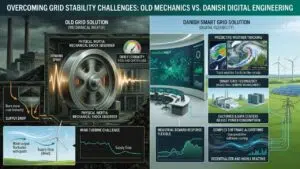
Old coal and nuclear plants use giant, heavy spinning metal generators that provide natural physical inertia to the power grid. That physical inertia acts like a mechanical shock absorber when consumer demand spikes suddenly. Wind turbines do not offer that exact same physical stability because their output fluctuates with every gust. I find the Danish digital engineering solution to this mechanical problem completely fascinating.
Their grid operator uses wildly complex software algorithms to manage the entire decentralized system. They track weather fronts down to the exact minute to predict exactly how much power will hit the grid lines. They also use smart grid technology to manage industrial demand in real-time. Large factories and data centers in Denmark sign contracts to adjust their massive power consumption based on when the wind is blowing hardest. This digital flexibility entirely replaces the physical inertia of the old, dirty coal plants.
| Challenge | Old Grid Solution | Danish Smart Grid Solution |
| Supply Drops | Burn more coal instantly | Import hydro or lower demand |
| Demand Spikes | Rely on physical generator inertia | Use predictive software routing |
| Weather Changes | Ignored by baseload plants | Tracked via advanced algorithms |
| Grid Flexibility | Rigid and centralized | Decentralized and highly reactive |
11: A Massive Export Economy for Wind Tech
Green energy is definitely not just an environmental charity project for Denmark; it is their main economic hustle. I read a recent global market report showing that the Denmark wind energy sector is valued at roughly 18 billion dollars and is projected to explode even further over the next decade. They literally export everything related to this specific industry to the rest of the world.
When the United States or Japan decides they want to build an offshore wind farm, they usually hire Danish engineering consultants to design it. They rent massive Danish installation ships to actually build it out on the water. They buy Danish digital software to run it efficiently once it spins up. By moving first on this technology back in the late 70s, Denmark permanently captured the high ground in a massive market that the entire world is now desperately trying to enter.
| Export Category | What They Sell | Global Buyer Market |
| Hardware | Turbines, blades, and gearboxes | Global wind farm developers |
| Software | Grid balancing and weather tracking | National grid operators |
| Services | Engineering and design consulting | Emerging green energy markets |
| Logistics | Specialized offshore installation ships | Deep-water construction firms |
12: A Strict Goal to Eliminate Fossil Fuels by 2050
Denmark does not plan on stopping at 60 percent wind power and calling it a day. I closely follow their legislative climate targets, and they are incredibly aggressive compared to the rest of Europe. They legally bound themselves to cut national greenhouse gas emissions by 70 percent before the year 2030. More importantly, they fully intend to eliminate fossil fuels entirely from their national economy by 2050.
This means absolutely zero natural gas for heating homes, zero diesel fuel for transport trucks, and zero coal for heavy factories. Everything in the country will eventually run on direct electricity or green hydrogen made strictly from wind power. They are heavily pushing power-to-X chemical technology right now to turn wind energy into synthetic liquid fuels for the massive global shipping industry. I think watching them execute this final, hardest phase of total decarbonization will be the most interesting engineering story of the next two decades.
| Timeline Goal | Target Metric | Required Action |
| By 2030 | 70% reduction in emissions | Massive offshore expansion |
| By 2050 | 100% fossil fuel elimination | Total electrification of transport |
| Ongoing | Decarbonize heavy shipping | Scale up power-to-X hydrogen |
| Ongoing | Remove gas from heating | Expand electric district heating |
How Denmark Inspires Global Climate Action?
The story of Denmark wind energy serves as a completely open-source instruction manual for the rest of the planet. I constantly see other foreign governments sending diplomatic and engineering delegations to Copenhagen just to study how they manage their grid. They desperately want to know how a country with such a high standard of living dropped its carbon emissions so drastically without completely crashing its domestic economy. Denmark actively shares its engineering data and regulatory frameworks with developing nations to speed up the global transition.
Denmark proves every single day that the main barriers to green energy are mostly political, not technical. I look at their decades of success and see a very clear, repeatable formula. You absolutely need government subsidies to kickstart local manufacturing, you need community buy-in to prevent local lawsuits, and you need physical connections to neighboring power grids to handle the variable weather.
| Strategy Pillar | Danish Implementation | Global Adoption Strategy |
| Policy Support | Consistent subsidies and tariffs | Guarantee developer ROI |
| Public Approval | Community ownership models | Share profits with local towns |
| Grid Design | Deep cross-border connections | Wire into neighboring regions |
| R&D Focus | Investing in energy islands | Centralize offshore hubs |
Final Thoughts
I find the entire history of the Denmark wind energy sector to be incredibly motivating for the future. It clearly shows that we have the exact technology right now to completely change how we power our modern lives. We do not need a magical new invention to save the grid; we just need the political will to deploy what already works at scale.
Denmark started with a few stubborn farmers experimenting in muddy fields and ended up building massive artificial islands in the North Sea to power millions of foreign homes. If you want a highly realistic look at what a functioning post-carbon future actually looks like, you just have to look at what the Danes are doing today. They proved to the world that going entirely green is not just good for the environment; it is a massive, undeniable economic advantage.
Frequently Asked Questions About Denmark Wind Energy
People always ask the same basic questions when they first hear about the incredible Danish grid. However, I want to address some of the more complex and uncommon questions that pop up when you look deeply into their energy infrastructure. Managing a dynamic system like this creates highly unique challenges that most people never even think about until they try to build one.
1. Why is Denmark so successful with wind energy?
They had a perfect historical combination of bad luck and excellent geography. The 1970s oil crisis forced them to act quickly, and the shallow, highly windy North Sea gave them the perfect place to build their infrastructure. Combine that geographic luck with politicians who actually agreed on long-term funding, and you get a world-leading, unstoppable industry.
2. How much of Denmark’s power comes from the wind?
Wind power currently generates right around 60 percent of Denmark’s total annual electricity consumption. During highly windy days in the winter, the massive turbines can generate well over 130 percent of the nation’s required electricity. The automated grid exports all that excess juice to neighboring countries like Germany, Norway, and Sweden.
3. What is a wind energy island?
A wind energy island is a massive, large-scale offshore hub designed specifically to collect and distribute power from hundreds of surrounding sea-based wind turbines. Unlike traditional offshore wind farms that send individual cables directly to the shore, these islands act as central power collection points. This allows for much larger total power generation and the future potential to produce green hydrogen fuel directly out at sea.
4. Does Denmark use other renewable sources besides wind?
Yes, they definitely do. While wind is clearly the dominant source of electricity, Denmark also utilizes solar power and a massive amount of bioenergy. Biomass, mostly in the form of compressed wood pellets, agricultural straw, and biodegradable waste, is heavily used in combined heat and power plants. This provides cheap district heating to millions of Danish homes and plays a major role in completely phasing out their old coal plants.






















