Every single day on the calendar holds a unique fingerprint of human triumph, tragedy, innovation, and cultural evolution. Yet, few dates carry the immense, undeniable historical weight of April 15. From the freezing, merciless waters of the North Atlantic to the bustling baseball diamonds of Brooklyn, and from the vibrant cultural festivals of the Indian subcontinent to the quiet, dusty laboratories of Renaissance Italy, this date has been a silent witness to events that fundamentally altered the trajectory of human civilization.
When we peel back the layers of April 15 history, we find a complex tapestry of stories that remind us of our fragility, our resilience, and our endless capacity for reinvention. To truly understand the modern world, we must look back at the milestones that paved the way.
Let us embark on an in-depth journey through the most pivotal events, the visionaries born, and the titans we lost on this extraordinary day.
Global Historical Milestones: Triumphs and Tragedies
Human history is defined by its dramatic turning points—moments of incredible innovation that sit right alongside devastating loss. April 15 stands as a profound testament to this duality, hosting some of the most recognizable and impactful events in global memory.
The Tragic Loss of the RMS Titanic (1912)
The sinking of the supposedly unsinkable ship remains one of the most haunting and widely studied disasters of the 20th century. At 11:40 PM on the night of April 14, the White Star Line’s crown jewel struck an iceberg in the North Atlantic. A mere two hours and forty minutes later, at 2:20 AM on April 15, the RMS Titanic slipped beneath the freezing waves, claiming the lives of over 1,500 men, women, and children. The disaster was a brutal awakening for an industrial era that had grown overly confident in its technological prowess.
The ship was severely under-equipped with lifeboats—carrying only enough for about half the passengers on board, a decision driven by outdated maritime laws and a desire for uncluttered deck space. The ensuing tragedy disproportionately affected third-class passengers, sparking massive international outrage over class inequalities. The sheer scale of the disaster fundamentally altered international maritime law, leading directly to the establishment of the International Convention for the Safety of Life at Sea (SOLAS) and the creation of the International Ice Patrol, ensuring such a preventable catastrophe would never happen again.
The Passing of President Abraham Lincoln (1865)
The United States faced one of its darkest and most uncertain mornings on April 15, 1865. At 7:22 AM, President Abraham Lincoln took his final breath in the Petersen House, a boarding house directly across the street from Ford’s Theatre in Washington, D.C. The night prior, Confederate sympathizer John Wilkes Booth had infiltrated the presidential box and shot Lincoln in the back of the head. As Lincoln passed, Secretary of War Edwin Stanton famously uttered, “Now he belongs to the ages.”
Lincoln’s assassination was not an isolated act, but part of a larger, desperate conspiracy to decapitate the United States government just as the Civil War was concluding. The loss of Lincoln abruptly derailed the nation’s healing process. Without his moderate, guiding hand, the post-war Reconstruction era became fraught with intense political warfare and harsh punitive measures against the South, deeply altering the political and social landscape of the United States for generations. He was instantly martyred in the eyes of the American public, forever cementing his legacy as the Great Emancipator.
Jackie Robinson Shatters Baseball’s Color Barrier (1947)
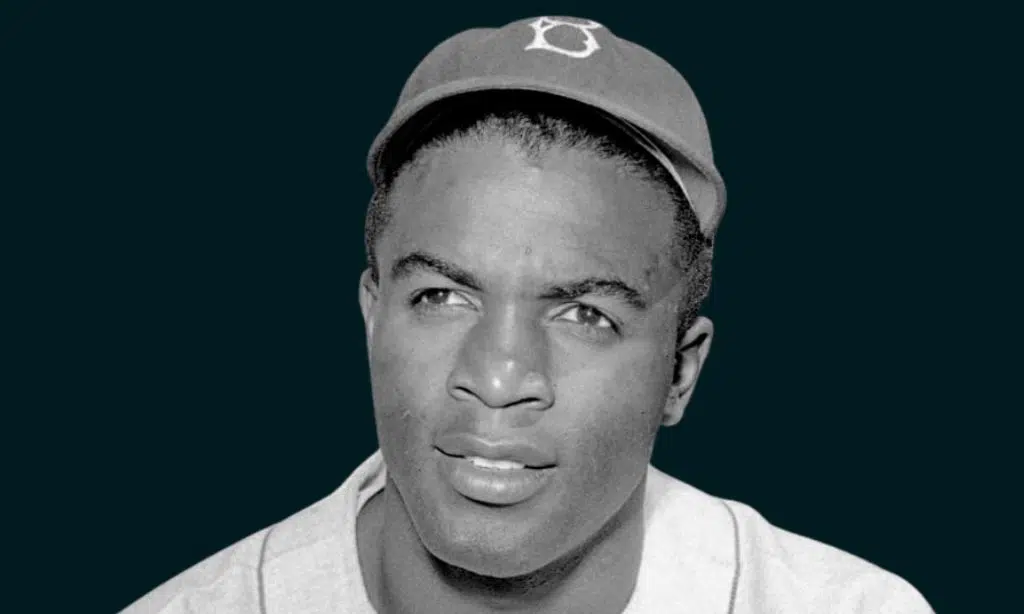
In a monumental leap for civil rights in the United States, a 28-year-old athlete named Jackie Robinson trotted onto Ebbets Field on April 15, 1947, making his Major League Baseball debut for the Brooklyn Dodgers. Stepping up to the plate in front of an electrified crowd of over 26,000 fans—more than half of whom were African American—Robinson permanently shattered the sport’s long-standing, unwritten color barrier.
Orchestrated by Dodgers executive Branch Rickey, this integration was a calculated and deeply perilous endeavor. Robinson had promised Rickey that he would endure the inevitable barrage of visceral racism, beanballs, and slurs without retaliating for his first three years. Robinson’s courage and silent dignity under immense psychological pressure successfully dismantled segregation in professional sports. His spectacular rookie season, which earned him the inaugural Rookie of the Year award, served as a powerful cultural precursor to the broader Civil Rights Movement, proving to a divided nation that talent and character recognize no racial boundaries.
The Liberation of Bergen-Belsen Concentration Camp (1945)
As World War II drew toward its bloody conclusion in the European theater, British and Canadian forces of the 11th Armoured Division entered the Bergen-Belsen concentration camp in northern Germany on April 15, 1945. What the soldiers discovered there defies human comprehension. The camp was severely overcrowded, riddled with typhus, and starving. The troops found over 60,000 emaciated prisoners clinging to life, and the unburied bodies of 13,000 individuals scattered across the compound. Notably, the young diarist Anne Frank and her sister Margot had perished in this very camp just weeks prior to liberation.
The liberation of Bergen-Belsen exposed the international public to the unfiltered, unfathomable horrors of the Nazi regime. Journalists like the BBC’s Richard Dimbleby recorded harrowing, emotional broadcasts that shocked the world and forced a global reckoning. The visceral shock of these discoveries played a crucial role in shaping the post-war pursuit of justice, laying the unshakeable foundation for the Nuremberg Trials and highlighting the desperate, urgent need for international human rights frameworks.
The Birth of the McDonald’s Franchise Empire (1955)
The modern fast-food industry as we know it was officially born on this day when a 52-year-old milkshake machine salesman named Ray Kroc opened his very first franchised McDonald’s restaurant in Des Plaines, Illinois. Kroc had been deeply fascinated by the original McDonald brothers’ restaurant in San Bernardino, California, which utilized a highly efficient “Speedee Service System” modeled after industrial assembly lines.
Kroc’s visionary implementation of this system on a massive, standardized scale revolutionized global dining habits. By removing carhops, utilizing disposable paper packaging, and strictly standardizing the menu (burgers, fries, and shakes), Kroc created an empire built on speed, cleanliness, and exact uniformity. While it brought unprecedented convenience and affordability to the post-war middle class, the explosion of fast-food culture initiated by Kroc on this day has also sparked ongoing, complex debates regarding global dietary health, corporate labor practices, and environmental sustainability.
The Heartbreak of the Hillsborough Disaster (1989)
During a highly anticipated FA Cup semi-final match between Liverpool and Nottingham Forest in Sheffield, England, a fatal human crush occurred that would forever change the landscape of global sports. As thousands of fans descended upon the stadium, severe police mismanagement led to the opening of an exit gate, funneling a massive surge of supporters into the already overcrowded, fenced-in standing terraces of the Leppings Lane end. The resulting crush tragically resulted in the deaths of 97 Liverpool fans.
It remains the deadliest sporting disaster in British history. In the immediate aftermath, South Yorkshire Police and certain media outlets, notably The Sun newspaper, falsely blamed the victims, sparking a grueling, decades-long fight for truth by the victims’ families. The subsequent Taylor Report mandated the removal of standing terraces and the removal of perimeter fencing in major stadiums, completely transforming modern sports architecture. In 2016, a landmark inquest finally vindicated the fans, ruling that the 97 victims were unlawfully killed due to gross negligence by the police and ambulance services.
The Devastating Notre-Dame de Paris Fire (2019)
The world watched in collective, breathless horror on April 15, 2019, as a massive structural fire broke out beneath the roof of the Notre-Dame de Paris cathedral. The blaze rapidly consumed the cathedral’s 850-year-old oak timber roof—affectionately known as “the forest”—and led to the dramatic, heart-wrenching collapse of its iconic 19th-century spire. Over 400 firefighters from the pompiers de Paris battled the inferno for 15 hours, risking their lives to form a human chain to save the cathedral’s most precious relics, including the Crown of Thorns.
The destruction of the cathedral sent profound shockwaves through the global cultural community, transcending religious and national boundaries. It highlighted the extreme vulnerability of our world’s most treasured historical monuments. However, the tragedy also sparked an unprecedented wave of global solidarity, rallying over a billion dollars in international donations within days and initiating a massive, meticulous restoration effort aimed at returning the Gothic masterpiece to its former glory.
The Bangalee Sphere: Subcontinental Shifts on April 15
While Western events often dominate international historical narratives, the Indian subcontinent and the broader Bangalee sphere have experienced monumental cultural, economic, and political shifts on this exact date. These events continue to deeply influence the daily lives of over a billion people in South Asia.
The Nationalization of Indian Banks (1980)
In a sweeping economic maneuver that reshaped the financial architecture of the nation, the Indian government, under the aggressive leadership of Prime Minister Indira Gandhi, nationalized six major private sector banks on April 15, 1980. This marked the second phase of bank nationalization in India, following an initial wave in 1969.
This bold policy shift was designed to wrestle control of the nation’s massive capital reserves away from a few elite industrial conglomerates and redirect it toward the masses. The goal was to pivot the country from “class banking” to “mass banking,” prioritizing rural agriculture, small-scale industries, and poverty alleviation programs. While the move successfully expanded banking networks into deeply rural and previously unbanked areas, it also sowed the seeds for long-term bureaucratic inefficiencies, political interference in lending, and the accumulation of non-performing assets that continue to challenge the Indian banking sector today.
The Vibrant Celebration of Pohela Boishakh (India)
While the independent nation of Bangladesh officially standardized the celebration of the Bengali New Year on April 14, the Indian states of West Bengal, Tripura, and Assam predominantly observe this joyous occasion on April 15, adhering closely to the traditional Hindu solar calendar. Rooted in agricultural cycles and historically tied to tax collection reforms initiated by the Mughal Emperor Akbar, Pohela Boishakh is the vibrant heartbeat of Bangalee culture.
It is a deeply secular festival that unites Bangalees across religious and geographical divides. The day is characterized by early morning cultural programs, the wearing of traditional red and white attire, the eating of Panta Bhat (fermented rice) with fried Hilsa fish, and the vibrant, UNESCO-recognized Mangal Shobhajatra procession featuring massive, colorful masks and floats. For local businesses, it marks the opening of the Haal Khata, the new financial ledger, celebrated with the distribution of sweets. The festival serves as a powerful, living symbol of cultural resilience and linguistic pride in a rapidly globalizing world.
Births of Visionaries: Legends Born on April 15
To fully grasp the human impact of April 15, we must look at the brilliant, complex minds born on this day. The men and women who entered the world on this historic date brought with them talents and ambitions that would irreversibly change the realms of art, mathematics, literature, and global geopolitics.
The following table outlines some of the most influential figures born on April 15.
| Name | Year of Birth | Nationality | Key Contribution / Profession |
| Leonardo da Vinci | 1452 | Italian | The ultimate Renaissance polymath; master painter of the Mona Lisa, pioneering anatomist, and visionary inventor whose sketches predicted helicopters and tanks. |
| Leonhard Euler | 1707 | Swiss | One of history’s greatest mathematicians. He made foundational discoveries in calculus, graph theory, mechanics, and established much of modern mathematical terminology. |
| Henry James | 1843 | American-British | A literary giant known for his profound psychological realism and complex narrative techniques in novels like The Portrait of a Lady and The Turn of the Screw. |
| Bessie Smith | 1894 | American | Crowned the “Empress of the Blues,” she was the most popular female blues singer of the 1920s and a major foundational influence on subsequent generations of jazz vocalists. |
| Nikita Khrushchev | 1894 | Soviet | The fiery, unpredictable Premier who led the Soviet Union during the height of the Cold War, navigating the tense days of the Cuban Missile Crisis and initiating the “de-Stalinization” of the USSR. |
| Kim Il Sung | 1912 | North Korean | The founding Supreme Leader of North Korea, establishing the Juche ideology. His birth is celebrated annually in the nation as the deeply revered “Day of the Sun.” |
| Elizabeth Montgomery | 1933 | American | The beloved television actress best known for her iconic, magical role as Samantha Stephens in the classic sitcom Bewitched. |
| Emma Thompson | 1959 | British | One of Britain’s most acclaimed actors and screenwriters, winning Academy Awards for both acting (Howards End) and writing (Sense and Sensibility). |
| Seth Rogen | 1982 | Canadian-American | A highly influential actor, comedian, and filmmaker who helped define 21st-century cinematic comedy through films like Superbad and Pineapple Express. |
| Emma Watson | 1990 | British | Internationally acclaimed actress famous for her defining role in the Harry Potter series and her passionate advocacy as a UN Women Goodwill Ambassador. |
Farewells to Titans: Notable Deaths on April 15
Just as this day brought life to great visionaries, it also saw the departure of momentous leaders, profound thinkers, and cultural icons. Their deaths, whether through tragic violence, the ravages of war, or natural causes, left behind complex, enduring legacies that we are still navigating today.
The table below details the notable figures who passed away on April 15.
| Name | Year of Death | Nationality | Cause / Enduring Legacy |
| Abraham Lincoln | 1865 | American | Assassinated by a gunshot wound; remembered as the savior of the American Union, the Great Emancipator, and arguably the greatest President in US history. |
| Nikolai Vatutin | 1944 | Soviet | Died of battle wounds; a brilliant, highly decorated Red Army commander whose strategic mastery was vital to the defeat of Nazi forces on the Eastern Front. |
| Narendra Chandra Dutta | 1962 | Indian | Natural causes; a pioneer in the Indian banking sector and the visionary founder of the Comilla Banking Corporation, which laid the groundwork for modern banking in Bengal. |
| Jean-Paul Sartre | 1980 | French | Pulmonary edema; a towering 20th-century philosopher, playwright, and the leading global voice of existentialism, who famously declined the Nobel Prize in Literature. |
| Pol Pot | 1998 | Cambodian | Heart failure; the ruthless, agrarian dictator and leader of the Khmer Rouge whose brutal regime orchestrated a horrific genocide, murdering nearly a quarter of Cambodia’s population. |
| Joey Ramone | 2001 | American | Lymphoma; the towering, iconic lead vocalist of the Ramones, widely recognized as the undeniable godfather of punk rock music and subculture. |
| Brian Dennehy | 2020 | American | Cardiac arrest; a formidable, award-winning character actor of stage and screen, deeply revered for his interpretations of Arthur Miller and Eugene O’Neill plays. |
International Observances and Civic Milestones
Beyond the actions and lives of specific individuals, April 15 is set aside globally and nationally to honor shared human values, celebrate creativity, and fulfill fundamental civic responsibilities.
World Art Day: A Global Celebration of Creativity
Declared by the International Association of Art (IAA/AIAP) and officially supported by UNESCO, April 15 is celebrated globally as World Art Day. The date was meticulously chosen to honor the birthday of the ultimate Renaissance man, Leonardo da Vinci. Da Vinci is viewed globally not just as a painter or inventor, but as a universal symbol of world peace, freedom of expression, tolerance, and brotherhood.
The day aims to promote the development, diffusion, and enjoyment of art worldwide. It serves as a reminder that art is not merely a luxury, but a fundamental human necessity that nurtures creativity, innovation, and cultural diversity. Across the globe, schools, museums, and local galleries host open exhibitions, interactive workshops, and public installations to ensure that the beauty and communicative power of art remain accessible to all communities.
United States Tax Day: The Annual Civic Deadline
In the United States, April 15 is universally known—and often collectively dreaded—as Tax Day. It is the traditional, legal deadline for everyday citizens to file their individual income tax returns to the federal government’s Internal Revenue Service (IRS).
Since the ratification of the 16th Amendment in 1913, which granted Congress the power to levy an income tax, and subsequent adjustments to the tax code in the 1950s, this date has become an unavoidable cultural touchstone in American life. It drives immense financial activity, requires massive administrative mobilization, and often induces national stress. However, the massive influx of capital collected on and leading up to this day is the lifeblood of the nation; it funds the entirety of the United States’ federal infrastructure, military defense, scientific research, and vital social programs, making April 15 the literal economic engine of the American government.
The Enduring Echoes of April 15 in Modern Society
As we trace the vast, sprawling timeline of April 15, a profound picture emerges. From the tragic depths of the icy Atlantic Ocean in 1912 to the triumphant crack of a baseball bat in Brooklyn in 1947, and from the quiet birth of an artistic genius in 1452 to the fiery collapse of a Parisian cathedral in 2019, this day acts as a remarkable microcosm of the human experience.
It reminds us that history is never just a static list of dates committed to memory in a dusty textbook; it is a living, breathing narrative that continuously shapes our present reality. The banking reforms in India, the grueling civil rights victories in America, and the spectacular artistic legacies birthed in Renaissance Europe all reverberate through the daily lives we lead today. By deeply examining what happened on this day in history, we gain the invaluable context and perspective needed to navigate the challenges, innovations, and triumphs of our own time. History is the greatest teacher we have, and April 15 offers one of its most complex, unforgettable masterclasses.