The Danish healthcare landscape has undergone a monumental shift as the national “10-Year Plan for Mental Health” reaches its peak implementation phase. As of April 2, 2026, the system has transitioned from a reactive model to a rights-based framework that legally mandates timely care for the most vulnerable. For residents and international citizens alike, navigating Denmark’s Mental Health Services 2026 requires a move beyond the traditional “Yellow Card” (Sundhedskort) and into a digital-first environment where your age and specific diagnosis now trigger automatic legal guarantees.
Whether you are seeking a fast-track referral for a teenager or anonymous digital therapy, the 2026 protocols offer unprecedented accessibility—provided you know exactly where the “digital front door” is located.
How We Selected Our 10 Best Denmark’s Mental Health Services 2026 Facts
To build this definitive guide, we analyzed the 2026 legislative updates from the Ministry of the Interior and Health and the latest regional performance audits from early 2026. Our selection criteria prioritized the brand-new “Rights in Psychiatry” that took full effect on January 1, 2026, alongside the massive expansion of municipal intervention programs. We also focused on the integration of the national MitID-secured digital platforms and the role of the newly authorized psychologist register under the Danish Patient Safety Authority.
These 10 points were chosen to provide a 360-degree view of the subsidized care, free anonymous resources, and emergency protocols defining the current Danish mental health ecosystem.
10 Essential Truths About Denmark’s Mental Health Services 2026
The following insights break down the technical, fiscal, and behavioral nuances of the Danish mental health system today.
1. The 30-Day Youth Treatment Guarantee
A landmark change for 2026 is the legal “Right to Treatment” for young adults aged 18 to 24. If you are diagnosed with mild-to-moderate anxiety or depression, the public system is now legally obligated to begin your treatment within 30 days of your GP’s referral. Crucially, under this new 2026 mandate, these sessions are now provided with 0 DKK co-payment, removing the previous financial barrier for students and young workers.
Best for: young adults (18–24) struggling with common mental health challenges.
Why We Chose It:
-
It eliminates the “waitlist purgatory” that previously affected thousands of students.
- It is the most significant legislative victory for youth mental health in a decade.
Things to consider: * This right is specific to anxiety and depression; other conditions may still follow standard waitlist protocols.
2. Mandatory Assessment Timelines for Children
For parents, the 2026 “Coordinated Pathway” rule is a game-changer. As of January 1, 2026, any child or adolescent referred to psychiatry must have their assessment started within 30 days and completed within 60 days. If the public regional hospital cannot meet this timeline, they are now legally required to pay for your child’s care at a private contracted provider.
Best for: parents of children (under 18) needing specialized psychiatric evaluation.
Why We Chose It:
- It ensures that developmental issues are addressed before they impact school performance.
- It creates a “safety valve” that forces the government to utilize private capacity.
Things to consider: * You must actively remind your regional coordinator of the “Extended Right to Choose” once the 30-day window expires.
3. The “Yellow Card” Digital Integration
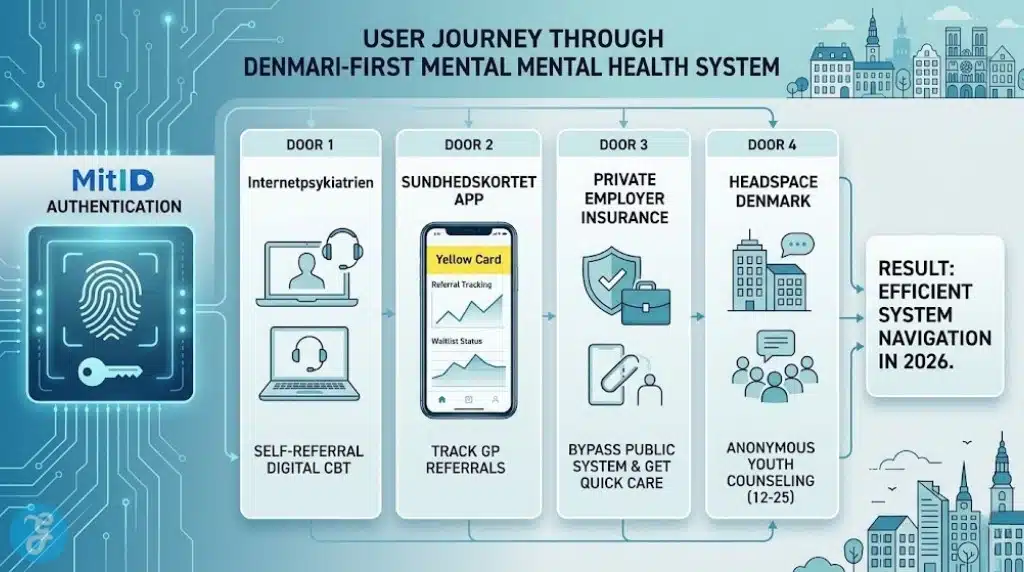
The Sundhedskortet (Yellow Card) app is no longer just an ID; in 2026, it is a fully integrated healthcare hub. Your GP uses it to issue “open referrals” that you can track in real-time. By logging into the app, you can see your position on waitlists for authorized psychologists and psychiatrists across your region.
Best for: all residents wanting to monitor their referral status without calling the clinic.
Why We Chose It:
-
It allows you to quickly switch to a different provider if you find one with a shorter wait.
- It brings transparency to a system that was historically opaque.
Things to consider: * While the app is free, your CPR number must be active for the data to sync.
4. Internetpsykiatrien: The No-Referral “Fast Track”
In 2026, Internetpsykiatrien remains the most efficient “front door” for adults. This shared regional platform offers free, evidence-based digital Cognitive Behavioral Therapy (CBT) for anxiety and depression. The biggest advantage in 2026 is that you do not need a GP referral; you simply apply online using your MitID.
Best for: tech-savvy adults who prefer a structured, self-paced digital approach.
Why We Chose It:
-
It is available 24/7, allowing you to work on your mental health around your schedule.
- It has the shortest wait times in the country, typically under 30 days.
Things to consider: * You must have a Danish GP on file, even though you don’t need a referral from them.
5. The 2026 Psychologist Authorization Reform
As of January 1, 2026, a new authorization scheme is in effect under the Danish Patient Safety Authority. This reform ensures that anyone using the title “Psychologist” in a clinical setting is officially vetted and registered. This provides patients with a higher level of protection and clear paths for formal complaints if care is substandard.
Best for: patients seeking private or subsidized talk therapy who want to verify credentials.
Why We Chose It:
-
It cleans up the private market, making it easier for expats to find qualified help.
- It aligns psychology with other medical professions like nursing and medicine.
Things to consider: * You can check a practitioner’s status for free on the online Autorisationsregister.
6. Subsidized Therapy Costs (~400 DKK)
While psychiatric visits (medical) are 100% free with a referral, psychological therapy sessions generally require a co-payment. In 2026, the standard subsidized rate for a session is approximately 400 DKK. Without a referral, private rates in cities like Aarhus or Copenhagen can exceed 1,400 DKK per hour.
Best for: adults with a diagnosis who need long-term talk therapy.
Why We Chose It:
-
It manages financial expectations for those transitioning from private care.
- It highlights the 70% savings provided by the national insurance scheme.
Things to consider: * A standard referral usually covers 12 sessions, though this can be extended in specific cases.
7. Emergency “Akutmodtagelse” Access
If you are in an immediate mental health crisis, you do not need a referral or an appointment. Every region in Denmark has a Psykiatrisk Akutmodtagelse (Psychiatric Emergency Department) open 24/7. In 2026, these centers are equipped with “Crisis Triage” teams that provide immediate stabilization and short-term stay options.
Best for: individuals in acute distress or those at risk of self-harm.
Why We Chose It:
-
It guarantees that medical safety takes precedence over bureaucracy.
- It is the essential “red button” for life-saving care.
Things to consider: * In the Copenhagen region, you are encouraged to call the Medical Helpline (1813) before showing up, but it is not a requirement.
8. Headspace Denmark: The Anonymous Choice
For those aged 12 to 25 who aren’t ready for a medical “diagnosis,” Headspace is the premier resource in 2026. It offers free, anonymous counseling with no waiting list. You can simply walk in or chat online to talk about anything from school stress to identity or loneliness.
Best for: teenagers and young adults seeking low-threshold, non-clinical support.
Why We Chose It:
- It prevents small issues from spiraling into clinical disorders.
- Since it’s anonymous, it doesn’t show up on your permanent national health record.
Things to consider: * They have physical centers in most major Danish cities and a robust text-based chat service.
9. Employer-Funded Private Insurance
With wait times still fluctuating in the public sector, many people in 2026 utilize private health insurance provided by their employers (e.g., via Danica or PFA). These policies often cover 100% of private psychology costs and can secure an appointment within 7 days, bypassing the GP referral system entirely.
Best for: professionals and employees of mid-to-large sized Danish companies.
Why We Chose It:
- It is a high-value benefit that many employees forget to use.
- It offers a “speed lane” for those who cannot wait 8–12 weeks for a public appointment.
Things to consider: * You must often call your insurance company’s “Health Hotline” first to get the sessions authorized.
10. PsykInfo: The Family Support Hub
Mental illness affects more than just the patient, and 2026 has seen a major funding boost for PsykInfo centers. These regional hubs provide anonymous guidance and education for the “relatives” (family and friends) of those with mental illness, helping them understand the diagnosis and navigate the system.
Best for: family members, partners, and close friends of someone struggling with mental health.
Why We Chose It:
- It supports the “caregiver” who is often overlooked in the medical process.
- They offer specialized evening lectures and support groups at no cost.
Things to consider: * Most PsykInfo centers have librarians who can help you find research and literature on specific conditions.
Strategic Summary of the Danish Mental Health Market
The current state of Denmark’s Mental Health Services 2026 is defined by “Legislated Accountability.” While the system remains decentralized across five regions, the introduction of 30-day and 60-day guarantees has effectively shifted the power to the patient. For the individual, success in 2026 is about a “multi-door” strategy: using Internetpsykiatrien for immediate digital relief while the GP referral moves through the traditional waitlist, or utilizing Headspace for anonymous prevention. The system is highly efficient, provided you treat your “Yellow Card” as a digital tool and proactively claim your legal rights when timelines aren’t met.
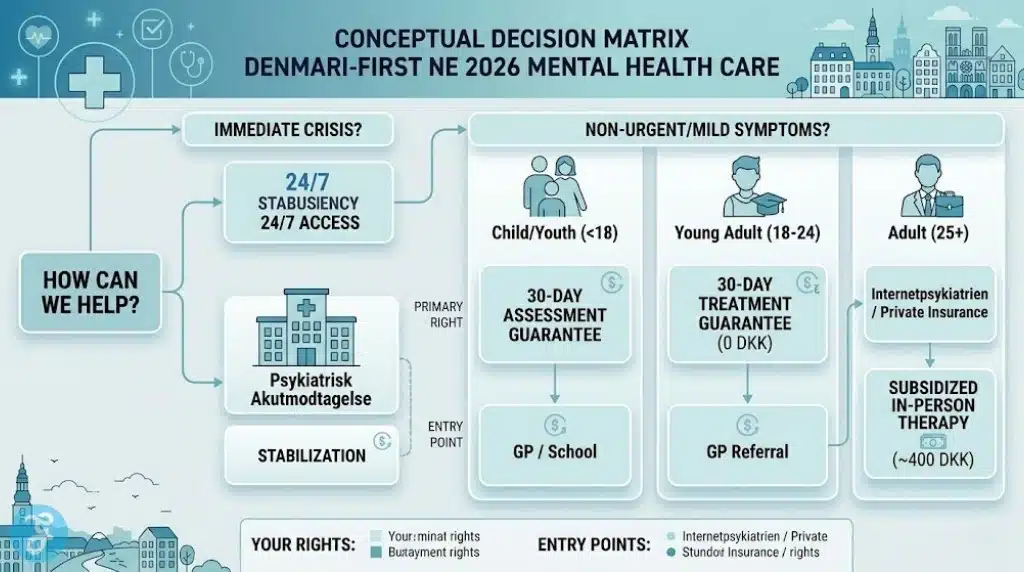
Visualizing Care Paths: Rights, Speed, and Costs
The tables below provide a quick-reference guide to help you choose the right point of entry based on your age and the urgency of your situation.
2026 Access Comparison by Patient Profile
The data below illustrates how the 2026 reforms apply differently across the lifespan.
| Patient Category | Primary 2026 Right | Expected Cost (Subsidized) | Entry Point |
| Child/Youth (<18) | 30-Day Assessment | 0 DKK | GP / School Counselor |
| Young Adult (18-24) | 30-Day Treatment | 0 DKK (for Anxiety/Dep) | GP Referral |
| Standard Adult (25+) | Choice of Hospital | ~400 DKK per session | GP Referral |
| Adult (Digital) | Immediate Self-Referral | 0 DKK | Internetpsykiatrien |
| Acute Crisis (All) | 24/7 Direct Access | 0 DKK | Akutmodtagelse |
Our Top 3 Picks and Why?
-
Internetpsykiatrien: This is our top pick because it is the fastest way into the system. In 2026, it is the only path that offers free, professional CBT with zero referral friction.
-
The 30-Day Youth Guarantee: We chose this because it is a definitive legal protection. It ensures that a young person’s “moderate” struggle doesn’t become “severe” due to administrative delay.
-
Headspace Denmark: This is an essential pick for its anonymity. By providing a safe space outside the medical system, it reaches those who might otherwise be afraid of a formal diagnosis.
Maximizing your care in 2026 requires moving from a passive patient to a proactive “system navigator.”
The Selection Framework
-
Determine Your Urgency: If safety is at risk, skip the GP and go straight to the Akutmodtagelse. If you need talk therapy, verify your age to see if you qualify for the 0 DKK 2026 youth rights.
-
Audit Your “Digital Card”: Ensure your Sundhedskortet app is updated. This allows you to track referrals and see wait times at various clinics in real-time.
-
Compare Private Coverage: Before paying the 400 DKK public co-payment, check your “Pension” or employment contract. You might have private insurance that covers 10 private sessions at 0 DKK cost.
-
Use the “30-Day Clock”: If you are referred to a psychiatrist and haven’t received an appointment date within 30 days, call the regional “Patient Advisor” (Patientvejleder) to exercise your right to private care.
Use the decision matrix below to find the most efficient path for your current needs.
Decision Matrix
| If you need… | Choose X if… | Choose Y if… |
| Fastest Therapy Start | Use Internetpsykiatrien if you have MitID and are 18+. | Use Private Insurance if your employer provides it. |
| Subsidized In-Person Talk | See your GP for a “Psykologhenvisning” (Referral). | Check 18–24 Rights to see if your fee is 0 DKK. |
| Crisis Intervention | Go to Akutmodtagelse for 24/7 psychiatric ER. | Call 1813 for over-the-phone triage and advice. |
| Advice for a Relative | Visit PsykInfo for anonymous books and workshops. | Contact your GP to discuss a family-led intervention. |
The Final Checklist: 5-Point Danish Mental Health Readiness Plan
-
Ensure your MitID is active; you cannot access digital psychiatry or regional journals without it.
-
Check your Digital Post (e-Boks or Mit.dk) daily after a referral is made; this is where your appointment letters arrive.
-
Save the Psychiatric Helpline number for your specific region (e.g., +45 1813 for Copenhagen) in your contacts.
-
Verify if you are in Group 1 or Group 2 of the health insurance; 98% are Group 1 (GP referral required).
-
Bookmark Sundhed.dk to access your personal medical record and view all historical mental health notes.
Taking Control of Your Mental Well-being in 2026
The Denmark’s Mental Health Services 2026 framework is one of the most robust in the world, but its complexity is its biggest hurdle. By 2026, the transition to a “rights-based” system means that the responsibility to “claim” timely care often falls on the patient or their parents. Whether you are utilizing the high-speed digital infrastructure of Internetpsykiatrien or walking into a Headspace center for an anonymous chat, the key is to understand that the “Yellow Card” is your ticket to a vast network of support. In the Danish system, the first step is often the hardest—but with the 2026 guarantees in place, once you knock on the door, the system is now legally required to answer.