
Dealing with the Home Office can feel like hitting a brick wall. The rules change constantly, the fees keep going up, and the paperwork never seems to end. But if your goal is to bring family members to the UK, you have to push through the red tape. Whether you are a British citizen, have indefinite leave to remain, or hold a temporary work visa, you have options.
The system is incredibly strict right now, especially with the recent financial updates that caught many families off guard. The government has steadily tightened the rules to reduce net migration, making family visas harder and more expensive to obtain. The biggest shock to the system was the increase in the minimum income requirement, which jumped to £29,000. You also have to factor in the rising cost of the Immigration Health Surcharge, which now costs thousands of pounds upfront just to use the NHS. Despite these hurdles, the core legal pathways remain open. It is entirely possible to navigate this maze if you know exactly which route fits your situation and how to prepare a flawless application. Let us break down the most effective pathways to get your loved ones settled safely in the United Kingdom.
| Feature | Pre-2024 Rules | Current 2026 Rules | Impact on Applicants |
| Minimum Income | £18,600 | £29,000 | Requires a much higher salary or massive cash savings. |
| NHS Surcharge | £624 per year | £1,035 per year | Significantly increases the upfront cost of applying. |
| Student Dependents | Most Master’s students | Only PhD and Research | Blocks many international students from bringing family. |
Partner and Spouse Immigration Routes
Living apart from your partner is miserable, and the immigration system is often the biggest hurdle to starting your life together. Thankfully, the partner routes remain the most common way to bring family members to the UK. You just have to prove your relationship is completely genuine and not a setup for a visa. The Home Office scrutinizes these applications heavily, so your evidence needs to be absolutely bulletproof. Let us look at the three main ways you can sponsor your significant other.
1. The UK Spouse and Civil Partner Visa
If you are legally married to a British citizen or someone settled in the UK, this is your primary route. This visa lets your spouse live, work, and study freely in the country. It lasts for just over two and a half years, and after that, you have to extend it to reach the five-year mark for settlement. You need to show your marriage certificate, but the Home Office demands much more than that.
They want to see chat logs, photos together over the years, joint bank accounts, and evidence that you actually share a life. The UK sponsor must also meet the £29,000 income threshold and prove they have suitable housing. On top of that, your partner must pass an approved English language test at the A1 level before they even apply. Gathering this evidence takes months of careful planning, so you should start organizing your documents long before you hit the submit button.
| Requirement | Details Needed | Common Pitfalls |
| Genuine Relationship | Marriage certificate, photos, chat logs. | Providing too few photos or unexplained gaps in communication. |
| Financial Threshold | £29,000 annual income from the UK sponsor. | Missing a single payslip or bank statement in the sequence. |
| English Language | A1 level speaking and listening test. | Taking a test from an unapproved provider. |
2. The Unmarried Partner Visa
You do not need a wedding ring to bring your partner over. The unmarried partner visa exists for couples in long-term, serious relationships. Previously, you had to prove you lived together in the same house for two solid years, which was nearly impossible for couples separated by borders. Now, the rules are slightly more flexible. If you could not live together because of strict cultural rules in your home country or unavoidable work placements, you can still apply.
However, the burden of proof is much higher to compensate for the lack of a marriage certificate. You need to show joint financial commitments, shared holidays, and statements from professionals verifying your commitment. You still have to meet the exact same financial, accommodation, and language requirements as a married couple. It is a tough route, but perfectly viable if your documentation is incredibly thorough.
| Acceptable Evidence | Description | Strength of Evidence |
| Joint Bank Accounts | Accounts in both names showing daily use. | Very Strong |
| Tenancy Agreements | Previous leases showing you rented together. | Very Strong |
| Travel Itineraries | Flight tickets and hotel bookings from holidays. | Moderate |
| Chat Logs | WhatsApp or text histories spanning two years. | Supporting |
3. The Fiancé(e) or Proposed Civil Partner Visa

If you want to have your wedding in the UK surrounded by friends and family, the fiancé visa is the way to go. This is a short-term visa that lasts only six months. Your partner cannot work while holding this visa, and they cannot use the NHS for free. The entire point is to get them into the country so you can legally get married within that six-month window. You must show the Home Office concrete proof that a wedding is actively planned.
Receipts for a venue, emails with a registrar, or catering deposits all count as solid proof. Once you are officially married, your partner can switch to a standard spouse visa from inside the UK. This means they do not have to fly back home to apply again, saving you a massive headache and extra flight costs. Just remember that switching visas incurs another set of application fees.
| Feature | Fiancé(e) Visa | Spouse Visa |
| Duration | 6 months | 33 months (if applying outside UK) |
| Work Rights | Strictly prohibited | Full right to work and study |
| NHS Access | Must pay for any treatment | Covered by the NHS Surcharge |
| Goal | Enter the UK to get married | Live permanently as a married couple |
Bringing Children and Parents to the UK
Keeping parents and children together is a fundamental human right, and the immigration rules reflect this up to a certain point. The rules for kids are fairly straightforward if they are young, but they get complicated quickly if the parents are divorced or if the child is approaching adulthood. Relocating a parent to the UK is equally tricky and depends heavily on the child’s age and legal status. Let us break down how these two specific family dynamics work under the current rules.
4. The Child Dependent Visa
If you hold a valid UK visa or are fully settled, you can normally bring your children with you. The golden rule is that the child must be under eighteen when you first submit the application. They also cannot be living an independent life. That means they cannot be married, they cannot be working a full-time job to support themselves, and they must still rely on you for a place to live and financial support.
If your child is over eighteen, they can usually only extend their visa if they originally entered the UK as a dependent before their eighteenth birthday. You will need to show birth certificates proving your relationship. You also have to prove you have enough room in your house for them to live comfortably without relying on public housing funds. Single parents face an extra hurdle, as they usually have to prove they have sole parental responsibility for the child.
| Child’s Age | Independence Status | Visa Eligibility |
| Under 18 | Living with parents, studying. | Highly eligible. |
| Over 18 | Entered UK under 18, still dependent. | Eligible for extension. |
| Over 18 | Applying for the first time from abroad. | Generally ineligible. |
5. The Parent Visa (Parent of a British or Settled Child)
This route is specifically for parents who do not qualify for a partner visa but have a child living in the UK. The child must be British, Irish, or have lived in the UK for seven continuous years. This often applies when a couple splits up, and the foreign parent wants to stay in the UK to help raise their child. You have to prove you have sole parental responsibility or direct access rights granted by a court.
The Home Office will want to see letters from the child’s school naming you as an active emergency contact, medical records showing you attend appointments, or official court orders granting you regular visitation. You cannot simply claim you are involved; you must provide a heavy paper trail. You also have to meet a basic English language requirement and prove you can support yourself financially without claiming state benefits.
| Proof of Involvement | Examples of Documents | Importance |
| Educational | School reports, letters from the headteacher. | High |
| Medical | Letters from the child’s GP or dentist. | High |
| Legal | Court-ordered custody or access agreements. | Critical if separated |
| Financial | Bank transfers showing child maintenance payments. | Moderate |
Caring for Relatives and Humanitarian Routes
Sometimes you need to bring family members to the UK for reasons related to health, safety, or basic survival. These are the most emotionally taxing visas to apply for. The rules here are incredibly strict to prevent strain on the NHS and the social care system, or they are designed strictly to protect those fleeing war and persecution. These applications require a completely different approach compared to standard spouse or child visas.
6. The Adult Dependent Relative (ADR) Visa
This is widely considered the absolute hardest UK visa to get. It is for elderly parents, grandparents, or adult siblings who need constant, daily care due to severe illness or age. The catch is that you must prove this necessary care is completely unavailable in their home country. Even if the care is expensive back home, if it physically exists and you can pay for it, the visa will be refused.
You need letters from foreign doctors explicitly stating that no local nurses, care homes, or extended family members can perform everyday tasks like washing, dressing, and feeding the applicant. The UK sponsor must also sign an undertaking to cover all care costs for five years without any help from UK public funds. The refusal rate is astronomically high, so you must work with a legal expert if you attempt this route.
| ADR Criteria | Explanation | Difficulty Level |
| Need for Care | Must require long-term personal care for daily tasks. | High |
| Care Availability | Care must be totally unavailable or unaffordable locally. | Extremely High |
| Financial Support | UK sponsor must maintain the relative for 5 years. | High |
7. Refugee Family Reunion Visa
If the UK government has granted you refugee status or humanitarian protection, you have the right to bring your immediate family to safety. This is a vital lifeline for people escaping conflict and persecution. Under this route, you can sponsor your spouse and any children under eighteen. Crucially, your relationship must have existed before you fled your home country. If you married someone after you left, you have to use the standard spouse visa route instead.
The best part of the family reunion route is that there is no £29,000 income threshold, no English language test, and the application is completely free of charge. It is a purely humanitarian pathway designed to piece broken families back together without imposing impossible financial burdens on people who have lost everything.
| Route Comparison | Refugee Reunion | Standard Spouse Visa |
| Application Fee | Free | Over £1,800 |
| Income Threshold | None | £29,000 per year |
| English Test | Not required | A1 level required |
| Condition | Relationship pre-dates flight | None |
Joining Workers, Students, and EU Citizens
People move to the UK every day for work and education. If you hold a temporary but long-term visa, the Home Office usually allows you to bring your immediate dependents. The rules for these routes are entirely detached from the standard family visa rules. They rely heavily on your specific job or your course of study rather than a massive £29,000 income requirement.
8. Dependent of a Skilled Worker Visa Holder
If you secured a job with a licensed UK sponsor, you can bring your partner and children with you. You do not need to meet the massive family income threshold here. Instead, you just need to prove you have a small amount of savings to support them when they land. You need £285 for your partner and £315 for your first child sitting in your bank account for 28 consecutive days.
Alternatively, your employer can check a specific box on your sponsorship certificate saying they will cover your family’s living costs for the first month. Dependents on this visa get full rights to work in almost any job they want, which is a massive benefit for partners who want to continue their own careers while living in the UK.
| Dependent Type | Maintenance Funds Required | Work Rights |
| Spouse/Partner | £285 | Full unrestricted work rights. |
| First Child | £315 | Can work if over 16. |
| Additional Child | £200 per child | Can work if over 16. |
9. Dependent of a Student Visa Holder
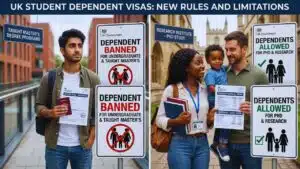
The government cracked down hard on student dependents recently to curb migration numbers. If you are coming to the UK to study a standard undergraduate degree or a taught master’s degree, you are entirely banned from bringing your family. You can only bring your partner and kids if you are studying a PhD, a doctorate, or a research-based higher degree.
If you qualify, you will need to show bank statements proving you can pay your tuition fees plus living costs for yourself and every dependent you bring over. The living costs are calculated based on whether you are studying inside or outside of London. Your dependents will get a visa that lasts exactly as long as your course, and they will have to leave when you do unless you transition to a graduate or work visa.
| Course Type | Can Bring Dependents? | Financial Proof Needed |
| Undergraduate | No | N/A |
| Taught Master’s | No | N/A |
| PhD / Research | Yes | 9 months of living costs per dependent. |
10. The EU Settlement Scheme (EUSS) Family Permit
Brexit changed everything, but the EU Settlement Scheme kept the door open for many European families. If you are an EU, EEA, or Swiss citizen who lived in the UK before the end of 2020 and got settled status, you can still bring certain family members over. You can sponsor a spouse, unmarried partner, child, or even a dependent parent. The EUSS is incredibly generous compared to standard UK immigration routes.
There is no minimum income requirement, no English test to pass, and no visa fee to pay. You just have to prove your relationship started before the Brexit transition period ended on December 31, 2020. If your relationship started after that date, you have to use the expensive standard spouse visa route.
| EUSS Benefits | Details |
| Application Cost | Entirely free. |
| Financial Rules | No minimum income threshold required. |
| Language Rules | No English test needed. |
| Deadline | Relationship must have existed before Jan 1, 2021. |
11. Dependents on the UK Ancestry Visa
If you are a Commonwealth citizen with a grandparent born in the UK, the Channel Islands, or the Isle of Man, you can get an Ancestry visa. This route is fantastic because it allows you to bring your partner and children right from the start. You do not even need a confirmed job offer before you arrive. You just need to show that you intend to work and that you have enough money to support your family without claiming government benefits.
It is a five-year visa, which means you do not have to worry about extending it halfway through like you do with a spouse visa. After those five years are up, you and your entire family can apply to stay permanently in the UK.
| Ancestry Criteria | Requirements for Dependents |
| Main Applicant | Commonwealth citizen with a UK-born grandparent. |
| Dependents Allowed | Spouse, civil partner, unmarried partner, children under 18. |
| Financial Proof | Bank statements showing enough funds to live without state benefits. |
Crucial Financial and General Requirements for 2026
You can have the most genuine relationship in the world, but if you fail the technical requirements, your visa will be rejected. The Home Office operates on a strict checklist. Understanding exactly how to meet the financial and logistical demands is the difference between an approval and a heartbreaking refusal. You have to treat this part of the process like an audit.
The £29,000 Minimum Income Threshold
If you are applying under the standard partner or spouse routes, the UK sponsor must earn at least £29,000 a year. You can meet this through a standard salary, self-employment, pensions, or rental income. You can even combine different income streams in some cases. If you do not earn enough, you can use cash savings to bridge the gap. The formula for cash savings is brutal. You need to hold £16,000 plus two and a half times the shortfall of your income.
If you have zero income and want to rely solely on savings, you need exactly £88,500 sitting in a bank account untouched for six full months. You cannot mix cash savings with self-employment income, which trips up many applicants. You must provide exactly six months of consecutive payslips and matching bank statements to prove your earnings to the penny.
| Income Source | Rules for Using It |
| Salaried Employment | Must be with the same employer for 6 months (Category A). |
| Self-Employment | Requires a full financial year of tax returns and accountant letters. |
| Cash Savings | Must hold the exact amount for 6 continuous months without dropping. |
| Pensions | Gross annual income from state or private pensions is fully accepted. |
English Language and Accommodation Rules
Your partner must prove they can speak and understand basic English before they arrive. They have to pass a secure test at the A1 level for their first visa. If they are from a majority English-speaking country like the USA, Jamaica, or Australia, they are totally exempt from the test. They are also exempt if they have a university degree that was taught entirely in English. Finally, you must prove you have a proper place to live.
You need a tenancy agreement, a mortgage statement, or a letter from family letting you stay with them. The house cannot be overcrowded under UK housing laws. Getting a property inspection report from a local surveyor is the best way to prove your home meets all the legal and public health standards.
| Requirement | Acceptable Evidence |
| English Test | A1 level certificate from a Home Office approved test center. |
| Degree Exemption | UK ENIC certificate proving the foreign degree meets UK standards. |
| Accommodation | Tenancy agreement, mortgage statement, or land registry document. |
| Overcrowding Proof | An independent housing report from an environmental health officer. |
Final Thoughts
The immigration journey is a massive undertaking that tests your patience and your bank account. Figuring out how to bring family members to the UK requires immense preparation and an obsessive attention to detail. The £29,000 income rule has undoubtedly made things harder, locking many families out of the system entirely if they cannot find the cash savings to make up the difference.
But by thoroughly reading the guidelines, gathering every single required document, and picking the precise visa that matches your situation, you can beat the odds. Do not rush the paperwork just to get it done. Double-check your bank statements, ensure your accommodation is legally sound, and present a clear, undeniable case to the caseworker reviewing your file. Getting that approval email makes every moment of stress completely worthwhile.
Frequently Asked Questions (FAQs)
1. How long does it take to get a UK family visa?
Processing times vary depending on where you apply from. If you apply from outside the UK, a standard family visa application generally takes up to twelve weeks. If you apply from inside the UK to switch or extend your visa, the standard processing time is about eight weeks. Expedited priority services are sometimes available for an additional massive fee, cutting the wait down to a few days.
2. Can I bring my sibling to the UK?
Bringing a sibling is exceptionally difficult under current rules. You cannot sponsor a sibling simply for family reunification. They would only qualify if they meet the incredibly strict criteria of the Adult Dependent Relative visa, meaning they require long-term, daily personal care that is totally unavailable in their home country, and you can afford to support them entirely.
3. What happens if I cannot meet the £29,000 financial requirement?
If you fall short of the financial threshold, your application will generally be refused outright. However, the Home Office must consider exceptional circumstances. If refusing the visa would result in unjustifiably harsh consequences for you, your partner, or particularly a child, they may grant the visa under human rights grounds. This puts you on a ten-year route to settlement instead of the standard five-year route.
4. Can I use third-party support to meet the financial rules?
Generally, no. You cannot rely on promises of financial help from your parents or friends to meet the £29,000 threshold for a spouse visa. The money must belong entirely to you or your partner. The only exception is if you are on specific disability benefits like PIP or Carer’s Allowance, which exempts you from the £29,000 rule entirely and drops you down to a lower adequate maintenance test.
5. What is the Immigration Health Surcharge?
It is a mandatory upfront fee you pay during the visa application to access the National Health Service. Currently, it costs £1,035 per year for adults. Since a spouse visa lasts for two and a half years, you have to pay over £2,500 just for the surcharge before you even pay the actual visa application fee.