Do you want to make money trading forex but feel completely lost when looking at price charts? Prices move up and down, yet the reasons behind those movements remain unclear. Many traders watch others succeed and wonder what hidden strategy they are missing. In reality, the answer is often right in front of them—within economic data and global news.
Most beginners focus only on chart patterns and technical indicators. They overlook the bigger forces that actually drive currency prices.
Forex Fundamental Analysis is the method used to evaluate a currency’s strength based on real-world economic factors. Instead of relying solely on charts, it examines the underlying reasons why currencies rise or fall over time.
Key elements such as interest rates, inflation, employment data, and central bank policies play a major role in shaping market direction. These indicators provide valuable insight into which currencies are likely to strengthen and which may weaken.
Understanding how to interpret economic reports and government announcements allows traders to anticipate market movements before they happen. This approach helps identify high-probability trading opportunities and reduces reliance on guesswork.
With a solid grasp of Forex Fundamental Analysis, traders can develop a clearer strategy, make informed decisions, and approach the market with greater confidence.
Ready to stop guessing and start trading with insight?
What is Fundamental Analysis in Forex?
Fundamental analysis in forex is a method traders use to figure out if a currency is strong or weak over time. This approach looks at the big economic picture, rather than focusing solely on price movements.
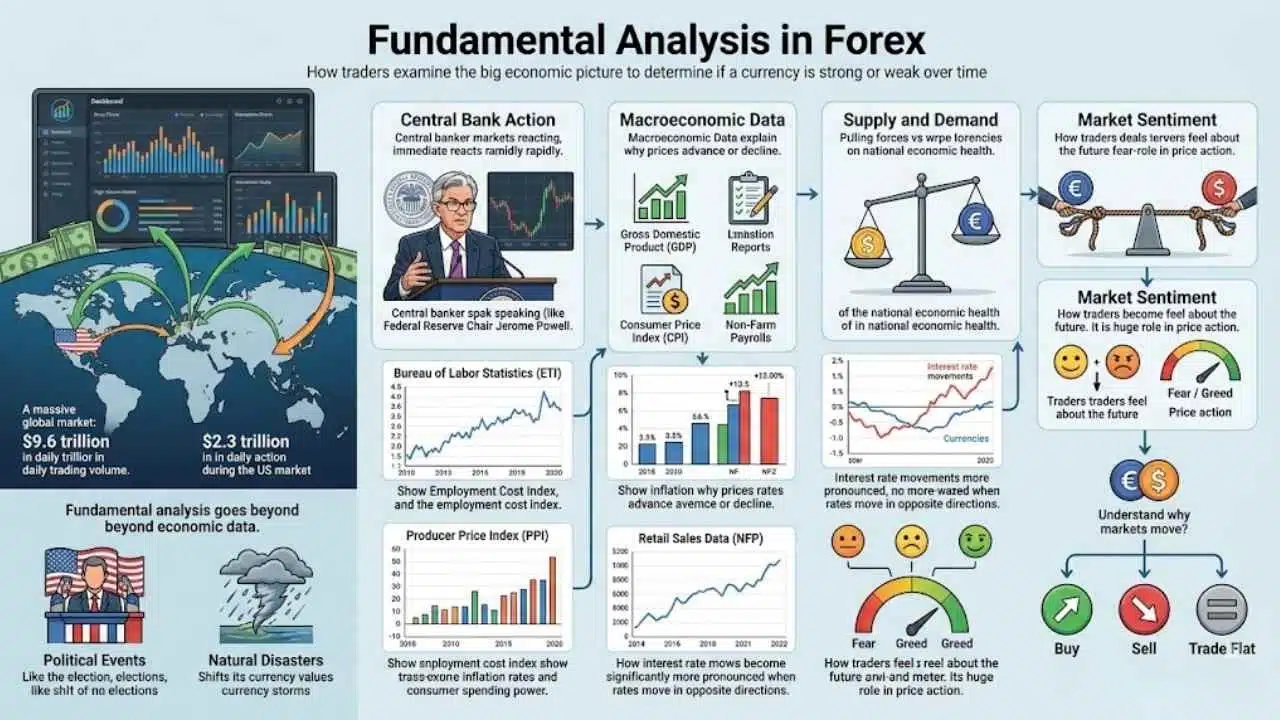
The forex market is massive. A 2025 Bank for International Settlements survey revealed a staggering $9.6 trillion in daily trading volume. The US market alone accounts for about $2.3 trillion of that daily action.
To capture a piece of that volume, traders examine economic data, government decisions, and world events that shape currency values. You will typically look at a few main drivers:
- Central Bank Action: When Federal Reserve Chair Jerome Powell speaks, the markets move fast.
- Macroeconomic Data: Reports like GDP, CPI, and NFP tell traders why prices go up or down.
- Supply and Demand: These forces work behind the scenes to push currencies higher or lower based on national economic health.
- Market Sentiment: How traders feel about the future plays a huge role in price action.
Fundamental analysis takes multiple factors into account that could influence an asset’s price. This method helps traders and investors understand why markets advance and decline.
Traders use fundamental analysis to make three specific choices. They decide to buy, sell, or trade flat. The process involves determining the value of a currency pair by looking at what drives it.
Interest rate movements between two currencies become significantly more pronounced when rates move in opposite directions. A trader might study the Bureau of Labor Statistics reports on the employment cost index and non-farm payrolls to spot trends.
The producer price index and retail sales data show inflation rates and consumer spending power. Trading strategies built on this foundation work across CFDs, futures, bonds, and other financial markets.
Fundamental analysis in forex is not limited to economic data alone. Political events and natural disasters shift currency values too. This approach gives you the information needed to make smart decisions about where money should flow next.
Difference Between Fundamental and Technical Analysis
Two major schools of thought guide forex traders, and they take completely different paths to predict price movements.
Technical traders ignore economic reports entirely. They believe price charts tell the whole story.
| Aspect | Fundamental Analysis | Technical Analysis |
|---|---|---|
| Primary Focus | Examines economic data, government announcements, and macroeconomic factors that influence currency value over time | Studies past price movements and chart patterns to identify trading opportunities |
| What Gets Analyzed | GDP, CPI, employment rates, interest rate movements between currencies, trade balance, and political events determine asset strength | Charts, historical price data, support and resistance levels, and trading volume drive decisions |
| Time Horizon | Works best for long-term trading positions and swing trades spanning weeks or months | Suits short-term traders who capitalize on daily or hourly price swings |
| Core Belief | Prices will eventually reflect true economic value, so traders must assess an instrument’s strength to predict future direction | Past price patterns repeat, so historical data reveals future price movements |
| Key Drivers | Interest rate movements between two currencies serve as a key driver of forex trends; opposite direction movements create pronounced trends | Supply and demand reflected in price action; momentum and trend strength shown through indicators |
| Decision Making | Provides traders with specific trade decisions: buy, sell, or trade flat based on economic outlook | Generates buy and sell signals from technical indicators and pattern formations |
| Information Sources | Central bank statements, employment reports, inflation data, political developments, and natural disasters inform analysis | Candlesticks, moving averages, RSI, MACD, and other technical tools form the toolkit |
| Why Markets Move | Informs traders and investors about why markets advance and decline through economic reasoning | Assumes market participants create predictable patterns regardless of underlying reasons |
| Risk Factor | Unexpected news or policy shifts can drastically shift economic outlook and invalidate analysis | False signals occur frequently; past patterns don’t guarantee future results |
| Best For | Traders seeking to understand the “why” behind currency movements and building conviction over time | Traders who want quick entry and exit signals without analyzing economic reports |
Fundamental analysts dig into economic data instead. They want to know why currencies move, not just when they might move. Interest rate movements between two currencies create the most powerful trends.
When rates shift in opposite directions, currency trends become significantly pronounced. Technical analysts miss this connection, but fundamental analysts use it to make better predictions.
A popular insider tip among day traders is to watch how proprietary trading firms handle these two methods. Many prop firms strictly forbid executing trades two minutes before and after major fundamental news releases, knowing that technical indicators like the Relative Strength Index completely break down when huge fundamental data hits the market.
Speed separates these approaches too. Technical signals appear instantly on charts, while fundamental analysis takes time. A trader using technical tools might execute twenty trades daily, whereas a fundamental trader might make two trades monthly.
Both approaches have merit, and many successful traders blend them together. Your trading style determines which method works best for your goals and personality.
Why Fundamental Analysis is Important in Forex Trading
Forex traders need fundamental analysis to understand why currency prices move, not just where they go. Technical analysis shows price patterns on charts, but fundamental analysis reveals the real reasons markets advance and decline.
Macroeconomic data such as gross domestic product, consumer price index, and employment rates tell traders what is happening in the economy. Interest rate movements between two currencies act as key drivers of forex trends.
The Federal Reserve Bank of New York, Federal Reserve Bank of St. Louis, and Department of Commerce release this data regularly. Many US professionals rely directly on the FRED database from St. Louis to track these exact figures.
“Tracking databases like FRED gives you a direct look at the same numbers the central banks use, allowing you to position your trades before the broader market reacts.”
Traders who ignore these numbers miss the bigger picture. They make trades without knowing if a currency will strengthen or weaken over time.
Fundamental analysis informs traders and investors about why markets move, giving them confidence in their decisions. Interest rate movements between two currencies create powerful trading opportunities.
When interest rates between two currencies move in opposite directions, currency trends become significantly more pronounced. For instance, the US Core Consumer Price Index stood at 2.5 percent in February 2026.
A trader watching that stubborn inflation data might anticipate the Federal Reserve keeping rates high, causing the US Dollar to rise sharply against currencies with falling rates. This approach takes multiple factors into account that could influence an asset’s price, rather than focusing solely on price movements.
Government announcements matter too, so they are not limited to economic data alone. Traders using fundamental analysis gain specific trade decisions to buy, sell, or trade flat.
Quantitative analysis of numbers combines with qualitative analysis of news and events to build a solid trading strategy based on facts.
Key Components of Fundamental Analysis
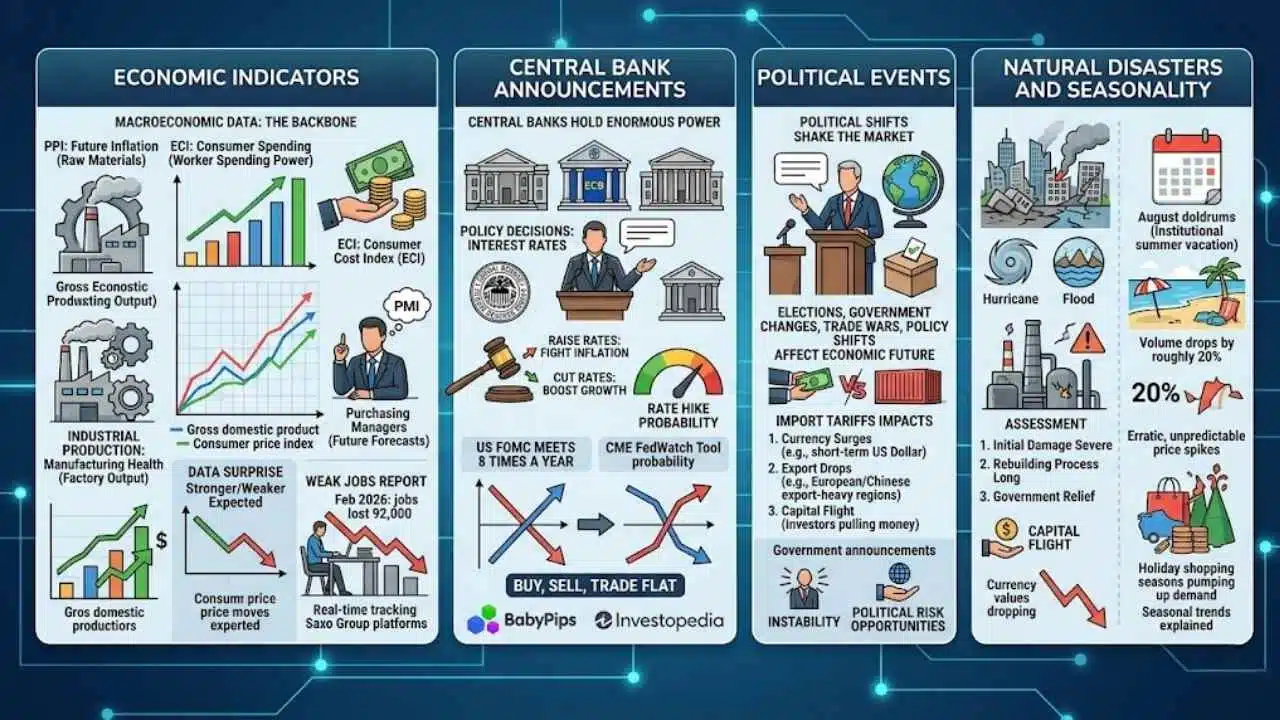
Economic data, central bank moves, political shifts, and natural events shape currency prices in ways that charts alone cannot show. These forces work together to move markets, and traders who understand them gain a real edge in forex trading.
Economic Indicators
Macroeconomic data forms the backbone of fundamental analysis in forex trading. Traders study gross domestic product, consumer price index, and employment rates to understand how strong an economy truly is.
These numbers tell you whether a country’s currency will likely rise or fall. Traders track several key metrics:
- Producer Price Index (PPI): Shows what manufacturers pay for raw materials, offering a peek into future inflation.
- Employment Cost Index (ECI): Reveals how much companies spend on workers, affecting consumer spending power.
- Industrial Production: Shows factory output each month, signaling the health of the manufacturing sector.
- Purchasing Managers Index (PMI): Business leaders share their outlook on the months ahead.
All these indicators work together like puzzle pieces, helping traders see the full picture of currency strength. Interest rate movements between two currencies drive forex trends in powerful ways.
Macroeconomic data explains why central banks raise or lower rates. Traders monitor these releases because they move markets fast and hard.
Saxo Group platforms and SaxoTrader tools let investors track these indicators in real time. Supply and demand shift when economic data surprises the market, either stronger or weaker than expected.
A major example is the US Bureau of Labor Statistics jobs report. In February 2026, the US surprisingly lost 92,000 non-farm payroll jobs due to strikes and federal cuts.
A weak report like that instantly pushes the dollar lower, while a strong report drives it higher. These economic signals guide traders toward buying, selling, or staying flat on currency pairs.
Central Bank Announcements
Central banks hold enormous power over currency markets. The Federal Reserve, European Central Bank, and Bank of England shape forex trends through their policy decisions.
Interest rate movements between two currencies are a key driver of forex trends. Traders watch these announcements carefully because they signal future economic direction.
A central bank might raise rates to fight inflation or cut rates to boost growth. Each move sends currency values up or down in seconds.
“The US Federal Open Market Committee meets exactly eight times a year to decide on interest rates. Smart traders use the CME FedWatch Tool to see the exact percentage probability of a rate hike before the meeting even happens.”
Central bank officials speak carefully, and every word matters to forex traders. When interest rate changes between two currencies move in opposite directions, currency trends become significantly more pronounced.
If one bank raises rates while another holds steady, the stronger currency gains value fast. Supply and demand shift immediately after these announcements hit the market.
Fundamental analysis informs traders and investors about why markets advance and decline through these policy signals. Traders use this information to make specific trade decisions to buy, sell, or trade flat.
Sites like BabyPips and Investopedia break down these announcements for regular investors. Your trading strategy must account for central bank calendars, because missing a major announcement costs real money.
Political Events
Political events shake the forex market like earthquakes shake the ground. Elections, government changes, trade wars, and policy shifts all move currency prices.
Traders must track these events closely because they affect a nation’s economic future. A new government might raise taxes or cut spending, which changes how investors view a country’s currency.
Trade tensions between nations can weaken one currency while strengthening another. For example, when the US announces new import tariffs, it directly impacts global supply chains in several ways:
- Currency Surges: It often strengthens the US Dollar in the short term.
- Export Drops: It weakens currencies in export-heavy regions like Europe or China.
- Capital Flight: Political instability makes investors nervous, causing them to pull their money out and drop a currency’s value fast.
Government announcements are an important consideration in forex fundamental analysis, and smart traders watch for them constantly. Political risk creates real trading opportunities for those who pay attention.
A country’s leader might announce new policies that boost the economy or hurt it. Investors react quickly to these announcements, moving money in and out of currencies.
Traders who understand these political moves can predict price swings before they happen. Political events inform traders and investors about why markets advance and decline, giving them specific trade decisions to buy, sell, or trade flat.
Natural Disasters and Seasonality
Natural disasters shake up forex markets in big ways. Earthquakes, hurricanes, and floods hit countries hard, and traders watch closely.
These events damage infrastructure, hurt supply chains, and slow economic growth. A major hurricane hitting the US Gulf Coast often disrupts oil refineries, which immediately impacts oil prices and commodity-linked currencies.
Fundamental analysis takes multiple factors into account that could influence an asset’s price, and natural disasters rank high on that list. Traders assess three main things:
- How severe the initial damage is to the local economy.
- How long the rebuilding and recovery process will take.
- What kind of financial relief the government provides.
Supply and demand shifts follow quickly. Currency values drop when disasters strike because investors pull money out and seek safer places to put their cash.
Seasonality patterns also shape forex trading throughout the year. Experienced traders know about the “August doldrums.”
During this month, major institutional traders in the US and Europe go on summer vacation, causing market volume to drop by roughly 20 percent. This leads to erratic, unpredictable price spikes.
Holiday shopping seasons pump up demand for goods, affecting trade balances and interest rates between nations. Fundamental analysis informs traders and investors about why markets advance and decline, and seasonal trends explain many of those moves.
Types of Fundamental Analysis
Traders pick between two main approaches when they study forex markets: top-down analysis and bottom-up analysis. Read on to see which method works best for your trading style.
Top-Down Analysis
Top-down analysis starts at the big picture. You look at the entire economy first, then work your way down to specific currency pairs.
This approach examines macroeconomic data such as GDP, CPI, and employment rates across countries. Interest rate movements between two currencies act as a key driver of forex trends, so top-down analysts pay close attention to central bank announcements.
Government announcements matter too. A trader using top-down analysis asks broad questions first to guide their decisions:
- Which countries have strong, expanding economies?
- Which nations face inflation or employment challenges?
- What is the global risk appetite looking like right now?
The answers guide investment decisions in stocks, commodities, ETFs, and forex markets. Major hedge funds use this exact approach.
They look at the US Dollar Index and broad market ETFs like the SPY to gauge global risk appetite before ever picking a specific currency pair. This method helps you spot which currency pairs offer the best opportunities before examining further details.
Top-down analysis reveals why markets advance and decline at the macro level. You assess supply and demand across entire economies rather than focusing on single companies like Apple.
Interest rate movements between two currencies become significantly more pronounced when they move in opposite directions, creating strong trading signals. These indicators inform traders and investors about future price movements, letting you make specific trade decisions to buy, sell, or trade flat.
Bottom-Up Analysis
Bottom-up analysis starts with individual currency pairs, not the big picture. Traders study specific economic data for each country involved in the pair.
They look at gross domestic product, consumer price index, and employment rates for both nations. This approach lets traders spot opportunities that the broader market might miss.
“When doing bottom-up analysis, comparing the specific interest rate movements between two currencies drives forex trends in powerful ways.”
A trader might notice that the US economy added jobs while a European nation lost jobs. That same trader could find a trade signal worth taking on the EUR/USD pair.
Bottom-up traders examine central bank announcements and policy changes. They assess supply and demand for each currency separately.
A producer price index report from one nation might signal inflation coming soon. Higher inflation often leads to interest rate increases, so traders then evaluate market sentiment around that specific currency pair.
Important Economic Indicators in Forex
These numbers move currency markets like nothing else, so smart traders watch GDP, inflation rates, jobs data, and interest rates closely.
Gross Domestic Product (GDP)
Gross Domestic Product, or GDP, measures the total value of goods and services a country produces in a specific time frame. Forex traders track GDP data because it shows how strong an economy really is.
A growing GDP means the economy is expanding, which typically makes that country’s currency stronger. In the US, the Bureau of Economic Analysis releases GDP data in three stages:
- Advance Estimate: The earliest and most impactful look at economic health.
- Second Estimate: Fills in missing data points with slight revisions.
- Third Estimate: The final confirmed numbers for the quarter.
Traders use this macroeconomic data to explain and anticipate price movements in the forex market. Strong GDP numbers signal economic health, so investors and traders pay close attention when these reports come out.
GDP announcements act as major catalysts for currency swings, making them critical for anyone trading forex seriously. Interest rate movements between two currencies become more pronounced when one country shows significantly better economic growth than another.
A nation with strong GDP growth may see its central bank raise interest rates to control inflation. This attracts more foreign investment and strengthens the currency.
Saxoinvestor platforms and other trading services highlight GDP releases because they drive substantial market activity. This macroeconomic indicator helps traders make specific trade decisions to buy, sell, or trade flat based on the economic reality behind each currency.
Consumer Price Index (CPI)
Inflation rates matter more than you think in forex trading, and the Consumer Price Index shows you exactly what is happening with prices. This tool measures how much the cost of goods and services changes over time for everyday people.
Central banks watch CPI data carefully because it tells them if inflation is climbing or falling. Traders use CPI reports to predict interest rate moves, and interest rate movements between two currencies are a key driver of forex trends.
“Smart traders always check the Core CPI, which strips out volatile food and energy prices, to get the truest picture of underlying US inflation trends.”
High inflation often pushes central banks to raise rates, which makes a currency stronger. Low inflation might lead to rate cuts, which weakens a currency instead.
The stock market and mutual funds also react to CPI news because investors shift their money around based on inflation fears. CPI data arrives on a set schedule, usually once each month.
Traders prepare for these releases like they are waiting for a big game day. The actual number gets compared to what experts predicted, and the difference creates trading opportunities.
Large CPI surprises move currency pairs fast and hard. Traders who understand CPI trends gain an edge because they see why markets advance and decline before others do.
Employment Rates
Employment rates tell you how many people have jobs in a country. Forex traders watch these numbers closely because they move currency prices.
A strong job market makes a country’s currency stronger. More people working means more spending power.
More spending lifts the entire economy. Central banks notice this data and may raise interest rates.
“A common pitfall for beginners is trading exactly at 8:30 AM on NFP Friday. Experienced traders warn that order slippage is massive during the release, meaning you might get filled at a much worse price.”
Interest rate movements between two currencies are a key driver of forex trends. When one country creates jobs faster than another, its currency often rises against the other.
The Non-Farm Payroll report comes out every first Friday of the month at 8:30 AM Eastern Time in the United States. Traders get excited or nervous on NFP days because the number swings currency prices hard.
If job creation beats expectations, the dollar typically strengthens. If job creation disappoints, the dollar often falls.
Employment data gives traders specific trade decisions to buy, sell, or trade flat. A trader might buy dollars if the NFP report shows strong hiring, but sell dollars if the report shows job losses.
Trade Balance and Interest Rates
Trade balance and interest rates work together like two sides of a coin in forex trading. A country’s trade balance shows whether it exports more goods than it imports, or the other way around.
Interest rate movements between two currencies are a key driver of forex trends, so traders watch these numbers closely. A strong trade surplus, meaning a country sells more than it buys, often makes its currency stronger.
Conversely, a large trade deficit weakens currency value. The United States frequently runs a massive trade deficit, importing far more than it exports, which naturally puts downward pressure on the dollar.
Interest rates tell the real story though. Central banks set rates to control their economy, and these decisions shake the forex market hard. Traders capitalize on these rate differences using specific strategies:
- The Carry Trade: Borrowing money in a currency with a low interest rate to buy a currency with a high interest rate.
- Yield Hunting: Shifting capital instantly into a currency right after a central bank announces a surprise rate hike.
This supply and demand battle pushes prices up or down fast. Macroeconomic data like trade reports and rate announcements give traders specific trade decisions to buy, sell, or trade flat.
Smart forex traders track both trade balance reports and central bank statements because these factors shape which currency strengthens or weakens over time.
How to Trade Forex Using Fundamental Analysis
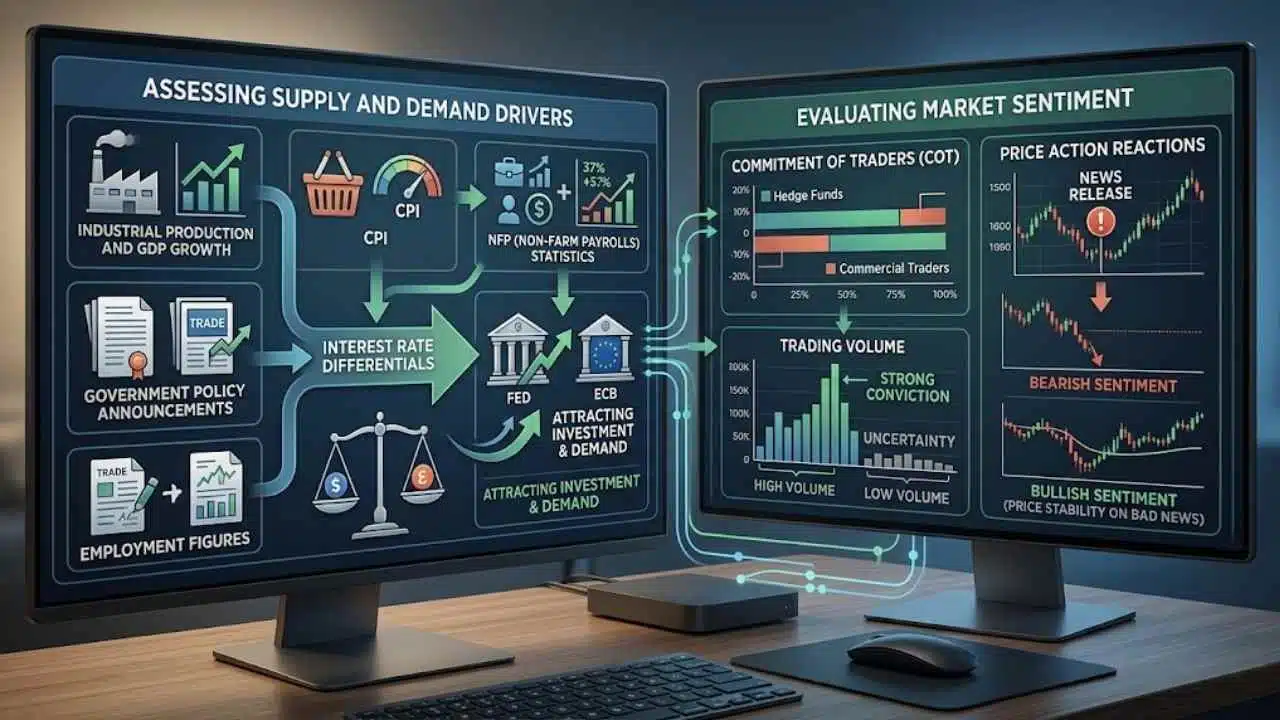
You can use supply and demand forces to spot trading opportunities before other traders do. Market sentiment tells you what other investors think, so you pay attention to their moves and adjust your strategy accordingly.
Assessing Supply and Demand
Supply and demand form the backbone of forex price movements. Traders study how many people want to buy a currency against how many want to sell it.
Interest rate movements between two currencies drive these forces in powerful ways. When rates rise in one country, investors flock to that currency for better returns.
The opposite happens when rates fall. This creates real buying and selling pressure that moves prices.
Macroeconomic data such as GDP, CPI, and NFP reveal whether a country’s economy strengthens or weakens. Strong economic reports attract foreign institutional money into that nation’s currency.
Fundamental analysis informs traders about why these shifts occur in the market. To gauge supply and demand properly, traders watch a few key areas:
- Government Announcements: Policy shifts change capital flow instantly.
- Employment Figures: Job growth equals economic spending power.
- Trade Reports: Export-heavy months drive demand for the local currency.
Market sentiment tells you what traders actually feel about a currency’s future. Good news sparks optimism and buying interest, while bad news triggers fear and selling pressure.
Interest rate movements between two currencies become significantly more pronounced when they move in opposite directions, creating strong supply and demand imbalances. Fundamental analysis provides traders with specific trade decisions to buy, sell, or trade flat.
Evaluating Market Sentiment
Market sentiment tells you what other traders think about a currency pair. Traders and investors study news, economic reports, and government announcements to form opinions.
You need to read the mood of the market. Positive sentiment pushes currencies higher, while negative sentiment pulls them lower.
Evaluating market sentiment means looking at what traders actually do, not just what they say. To track this, professionals use a few specific methods:
- The COT Report: The US Commodity Futures Trading Commission releases the Commitment of Traders report every Friday, showing exactly how hedge funds position their money.
- Trading Volume: High volume means strong conviction, while low volume means traders doubt the direction.
- Price Action Reactions: Watching how a currency reacts to news is vital, because if bad news hits but the price stays stable, sentiment is strongly bullish.
Fundamental analysis informs traders about why markets advance and decline. This knowledge helps you make smart trade decisions to buy, sell, or trade flat.
Fear and greed drive most trades. Your edge comes from reading sentiment before the crowd does.
Benefits and Limitations of Fundamental Analysis
Fundamental analysis gives traders real tools to understand why markets move, but it has real drawbacks too. One of the biggest pitfalls new traders face is a phenomenon called “buy the rumor, sell the news.”
Often, the market prices in a good economic report weeks before it happens. When the actual data drops, the currency price might fall even though the news was great, usually because institutional traders are cashing out their profits.
| Benefits of Fundamental Analysis | Limitations of Fundamental Analysis |
|---|---|
| Explains Price Movements: Fundamental analysis informs traders about why markets advance and decline. You get the “why” behind currency shifts. This knowledge beats guessing. | Time-Intensive Research: Analyzing macroeconomic data takes serious effort. GDP reports, CPI figures, and employment numbers require deep study. Traders spend hours reviewing data. |
| Provides Clear Trade Decisions: Fundamental analysis gives traders specific actions: buy, sell, or trade flat. You get definitive direction, not vague signals. This clarity helps you act with confidence. | Lagging Indicators Delay Signals: Economic data comes out after events happen. GDP and CPI lag behind real market conditions. By the time you see the numbers, price has already moved. |
| Long-Term Value Assessment: Fundamental analysis assesses an instrument’s strength over a period of time and into the future. You build a roadmap for months ahead. Short-term noise fades away. | Unexpected Events Derail Predictions: Political events and natural disasters shift everything instantly. Government announcements catch traders off guard. No amount of data preparation stops surprise announcements. |
| Takes Multiple Factors Into Account: Fundamental analysis considers numerous elements affecting currency prices. Interest rate movements between two currencies drive forex trends. When rates move opposite directions, trends become significantly more pronounced. You see the full picture. | Interpretation Varies By Trader: Two traders read the same data differently. One sees bullish signals; another sees bearish ones. Personal bias shapes your conclusions about economic indicators. |
| Determines True Asset Value: Fundamental analysis involves determining the value of an asset in trading. You find what currencies are truly worth. This prevents you from overpaying or underselling. | Doesn’t Predict Short-Term Moves: Fundamental factors take time to play out. Prices swing wildly in the short term, ignoring your analysis. Day traders find this approach frustrating and ineffective. |
| Goes Beyond Economic Data: Fundamental analysis in forex isn’t limited to economic data alone. You evaluate market sentiment and supply and demand factors. This comprehensive approach catches opportunities others miss. | Requires Continuous Monitoring: Economic calendars stay full of releases. New data arrives constantly. You must track dozens of indicators to stay current. This demands constant attention and updates. |
Final Thoughts
You now grasp how economic data, central bank moves, and political events shape currency prices in real time. Interest rate shifts between two currencies act as powerful drivers that push forex trends in specific directions. Supply and demand forces, combined with market sentiment, give you practical tools to make trading calls.
Top-down and bottom-up analysis methods work together to paint a complete picture of where money flows. Start applying these strategies today by tracking GDP reports, employment numbers, and inflation data before you trade. Your success in forex depends on understanding why markets move, not just watching them move.