Have you ever typed a question into Google and immediately noticed those handy little drop-down boxes with quick answers? That section is a massive opportunity, and you might be wondering about what people also ask and how to rank and optimize for it. It feels like magic, but there is a clear strategy to get your website featured right at the top.
A recent Semrush study showed that these question boxes appear in over 60% of all US desktop searches. Snagging one of those spots brings fresh eyes straight to your content.
I will walk you through the exact steps to find the right questions and write answers that Google loves. Grab your favorite drink, and let’s go through this process together.
What is “People Also Ask”?
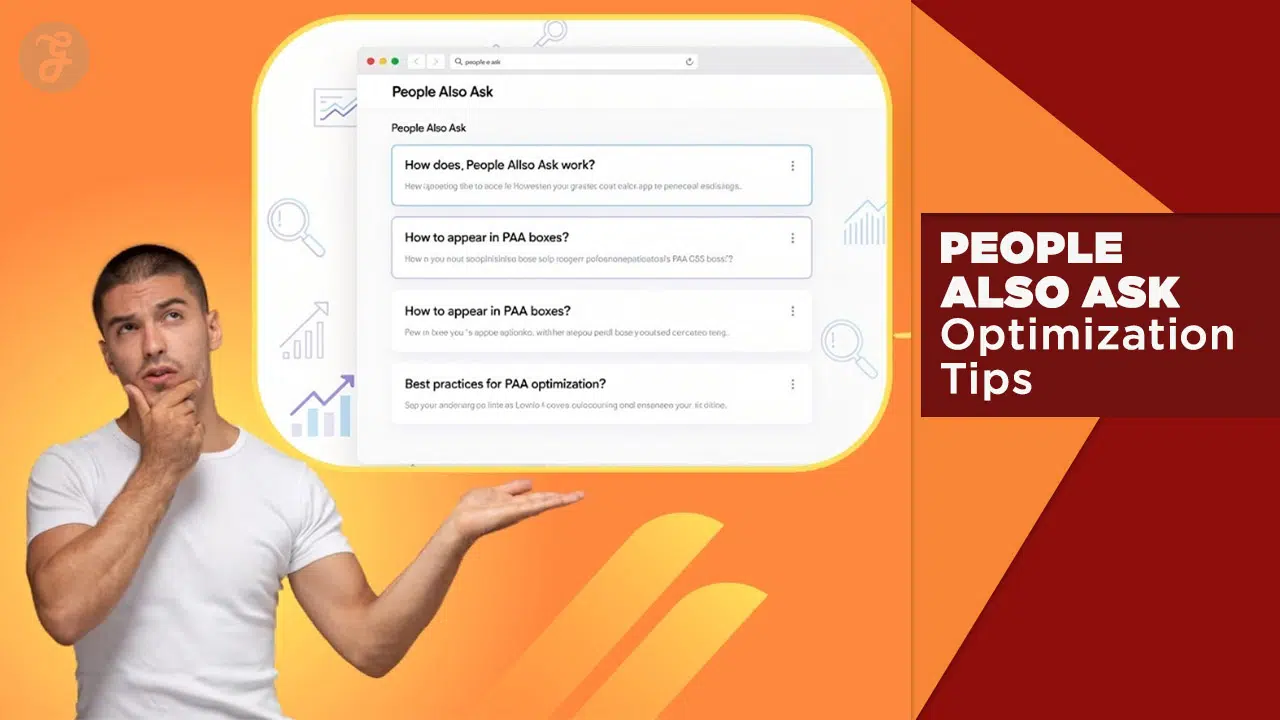
“People Also Ask” is a dynamic box on Google that shows questions other users ask about your search. It pops up near the top of the page, teasing more helpful information with each click.
Definition and purpose in SEO
“People Also Ask” is a special feature directly integrated into Google search results. It shows users extra related questions and short answers right below their main query. This box helps people find quick, clear information without having to hunt through multiple websites.
For Search Engine Optimization SEO, this box brings highly targeted traffic to your content. A 2024 Backlinko study found that the exact same PAA question can show up across hundreds of different search results. Marketers use this specific tool to answer real user questions and grab a prime spot on page one.
Ranking here builds instant trust with your audience. You can increase your odds of showing up by writing clear answers, making smart keyword choices, and using specific code called FAQPage structured data.
Great content wins clicks when it provides immediate, factual answers to real human questions.
How it appears in Google search results
After grasping why this feature supports your SEO goals, you should look at how it actually functions on the Search Engine Results Page, or SERP. In 2026, these question boxes typically appear just below the new AI Overviews or the top organic links.
Each box holds a specific question, a short answer snippet, and a link directly to the site supplying that information. Initially, Google displays about four questions.
If you click one of these questions, the box expands like a digital accordion to reveal the answer. Plus, Google instantly adds two or three more related questions to the bottom of the list. Sites featured here always use clear language and offer direct answers in a tight QuestionAnswer format.
Why is “People Also Ask” Important for SEO?
Getting your answers in these special boxes puts your brand directly under the spotlight. It means more eyes, higher click rates, and a real chance to rise above your biggest competitors.
Enhancing search visibility
Google displays the “People Also Ask” box for a massive chunk of daily searches. According to 2025 data from Advanced Web Ranking, these boxes show up in about 65% of all US Google queries. Answering these common questions with clear text helps you land higher on the page and earn more clicks.
Top sites use a deliberate keyword strategy and build question clusters to catch Google’s eye. Smart optimization helps you stand out from a crowded market.
You can attract major organic search ranking boosts by focusing intensely on user intent. Give the searcher exactly what they asked for, and Google will reward your page.
Driving organic traffic
Ranking in the question box sends a highly motivated flow of organic traffic right to your site. Each answer link acts like a VIP pass on the search engine results page, inviting users to visit your full article.
Users who search with specific questions are highly likely to click these featured snippets. SEO experts on the r/BigSEO Reddit community often note that traffic from these boxes has a much lower bounce rate. Visitors get exactly what they expected.
Including structured data and clear text helps boost these visitor numbers. Targeting long-tail keywords inside your responses lets you reach people who ask highly specific questions, which drastically increases the quality of your website visits.
Google deeply trusts sites that answer search queries accurately. Every clear, factual answer you provide boosts your topic authority in the eyes of search engines.
You can easily prove your expertise by adhering to Google’s E-E-A-T guidelines (Experience, Expertise, Authoritativeness, and Trustworthiness). Here are the best ways to build that authority:
- Cite specific statistics from current-year industry reports.
- Link to trusted sources like university studies or official Google documentation.
- Group related questions into clusters around one main theme so users stay on your page longer.
- Keep every answer simple, direct, and free of confusing jargon.
How to Find “People Also Ask” Questions
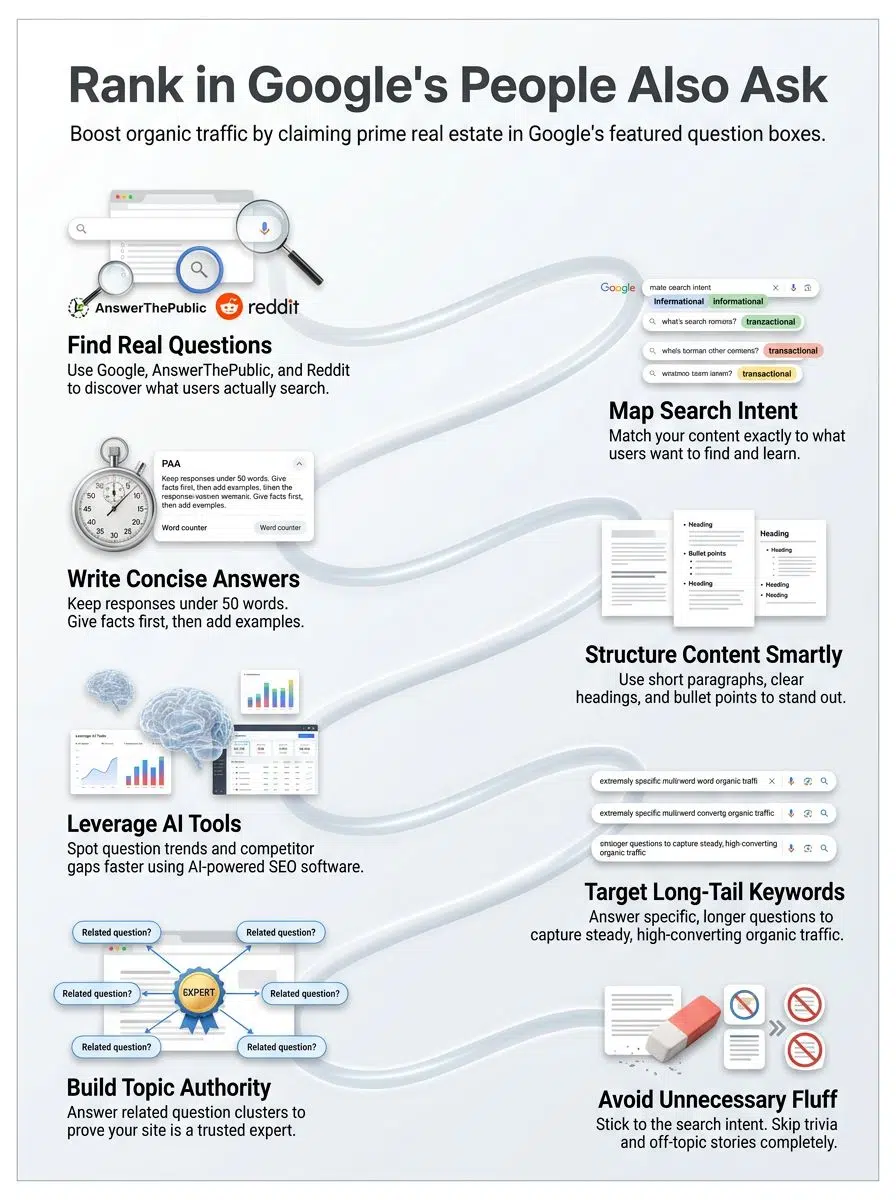
You can spot these questions right in the standard search results, usually tucked below the top links like little treasure chests. Digging deeper with special software and community forums opens up an entire world of smart questions to target.
Using Google search results
Google displays the actual PAA box right on the SERP. It is a completely free gold mine for anyone wanting to improve their content optimization.
- Type your target keyword into the US Google search bar. The box usually pops up right after the first few results.
- Use a free Chrome extension like SEO Minion to download a spreadsheet of these questions with just one click.
- Click any question inside that box. This triggers an infinite expansion feature, loading dozens of related long-tail keywords in seconds.
- Check how the top answers are formatted. Most winning responses use short paragraphs, bulleted lists, or data tables.
- Study the exact phrasing and synonyms used in the questions. This helps you craft your own answer formatting using natural language.
- Observe what extra SERP features appear nearby, such as Featured Snippets. These clues show how search intent shapes Google’s final choices.
Utilizing tools like AlsoAsked and AnswerThePublic
Finding the exact right questions is the foundation of a great keyword strategy. Professional tools make this task much faster and far more accurate.
- AlsoAsked pulls live user questions straight from US search results. Their basic plan costs about $15 per month and groups queries by how people naturally search.
- AnswerThePublic listens to autocomplete data from search engines. A basic subscription runs around $9 a month and creates visual maps of top queries.
- Both tools help you quickly spot gaps in your own content optimization strategy.
- Plug in any phrase related to Search Engine Optimization SEO. Watch as both platforms instantly lay out fresh ideas for subheadings.
- Combine their insights to create concise answers for each query. This directly increases your odds of appearing in the top results.
- Regular use keeps your content totally aligned with new trends, keeping you a step ahead of competitors who rely on outdated data.
Exploring Reddit and Quora for insights
Reddit and Quora are fantastic places to find the real questions people ask every day. They show immediate trends, clear user intent, and fresh ideas for your next article.
- Specific subreddits like r/explainlikeimfive reveal exactly what users struggle to learn. This makes it incredibly easy to spot common pain points.
- Quora’s “Related Questions” sidebar highlights which topics get the most answers and views.
- Search both platforms for your main keywords to find highly related question clusters in minutes.
- The best answers on these platforms are usually short and direct, which makes them perfect models for your own content.
- Top community responses follow a clear structure. They give a straight answer first, then add extra detail below.
- Community upvotes highlight popular search intents. Answers with high visibility match exactly what the public wants to know.
- You can easily conduct competitor analysis here by seeing how other brands respond to customer complaints or questions.
- Watch out for heavy industry jargon. Keep your answers simple and specific so a broader audience can read them easily.
How to Optimize Content for “People Also Ask”
Crafting clear, crisp answers in your content is the absolute best way to snag those top spots.
Mapping search intent
Search intent tells you exactly what a person wants to achieve when they type a phrase. Search marketers usually divide this intent into four main categories: informational, navigational, transactional, and commercial.
Most queries in the question box are informational. People want quick, factual answers, like “What is SEO?” or “How does Google rank pages?” If your text perfectly matches their specific intent, you have a massive advantage.
To get this right, you must study the actual questions that appear in live SERPs. Use the exact phrases from real search queries, not just robotic keywords, so Google knows your page solves the user’s exact problem.
Writing concise and direct answers
Clear, direct answers win the most clicks. SEO experts generally agree that the ideal length for a featured paragraph is between 40 and 50 words.
Write sentences that state the facts right away. Then, support your main point with a quick example or a verified statistic. For example, a “What is SEO?” answer could say, “SEO stands for Search Engine Optimization. It improves your website’s visibility on Google and brings more targeted visitors to your pages.”
Google loves quick answers because people scroll through search results incredibly fast. Cut out the extra fluff and leave only what matters to the user intent. Stick to one main idea per paragraph so your readers never get lost.
Structuring content effectively
You must group your answers clearly on the page using short paragraphs, lists, or bullet points. Write a clear H2 or H3 heading for each specific question. You should aim for a Flesch reading ease score of 60 or higher so anyone can read it quickly.
Mix up long and short sentences to keep the pacing lively. Toss in relevant keywords like SERP features where they fit naturally, but never force them into a sentence.
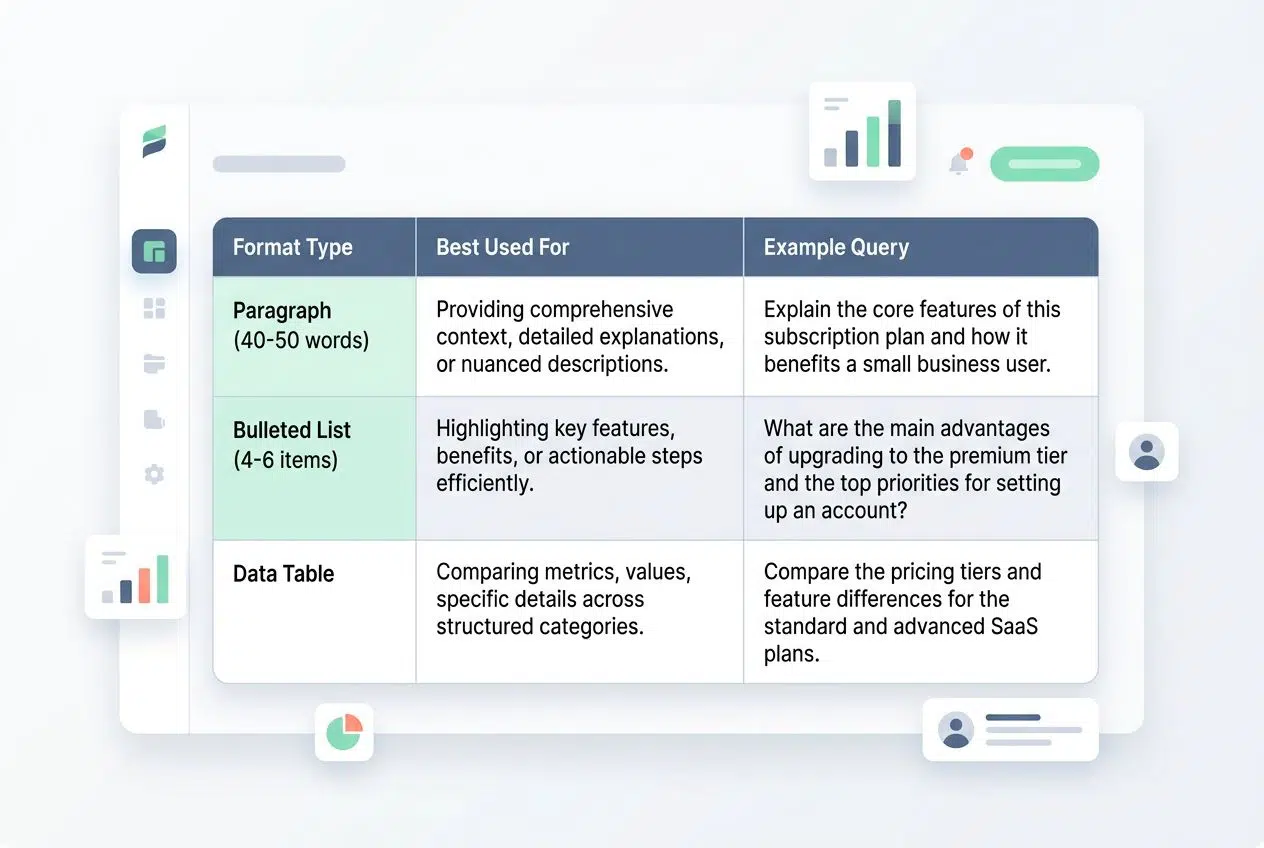
| Format Type | Best Used For | Example Query |
|---|---|---|
| Paragraph (40-50 words) | Clear definitions and simple explanations. | “What is a keyword strategy?” |
| Bulleted List (4-6 items) | Step-by-step instructions or quick tips. | “How do I clear my browser cache?” |
| Data Table | Pricing comparisons or feature lists. | “Ahrefs vs Semrush pricing” |
Tools to Help Rank for “People Also Ask”
Smart software can spot daily question trends faster than any manual search. Picking the right tool saves you hours of frustrating spreadsheet work.
AI-powered keyword research tools
AI-powered keyword research tools sift through mountains of search data in seconds. Industry standard tools like Semrush and Ahrefs show exactly which keywords pop up most often.
Semrush features a specific Keyword Magic Tool that includes a dedicated toggle just for filtering questions. Ahrefs offers a similar question-filtering feature in its Site Explorer. These platforms reveal what people actually type into Google on a daily basis.
These tools also let you compare competitor content side-by-side. By scanning SERPs at lightning speed, they find valuable question clusters you would easily miss by hand. This shortcut helps you optimize for featured snippets rapidly.
Search listening tools
Search listening tools help you spot brand new questions people ask online before they become highly competitive. These platforms monitor the entire internet for fresh conversations and rising trends.
BuzzSumo features a powerful Question Analyzer that scans thousands of active forums like Reddit to find popular queries. You can also use a site like Exploding Topics to catch rising industry trends weeks before your competitors do.
You can use these direct insights to match search intent perfectly. Search listening shows you the actual words trending among real readers, not just estimated search volume on a chart.
Bulk search and clustering tools
After finding your keywords, bulk search and clustering tools organize them into logical groups. These tools group hundreds of similar queries together so you can spot content patterns instantly.
For someone managing a large content optimization project, spotting these related clusters is a game-changer. Keyword Insights, which starts at around $58 a month, can sort thousands of phrases based on live search results.
These clusters reveal exact topic gaps. Imagine sorting through Google’s question box for fifty keywords at once instead of typing them one by one. This is a massive time saver.
- Keyword Insights: Best for grouping thousands of keywords by search intent.
- Cluster AI: Great for finding related long-tail phrases from massive lists.
- Surfer SEO: Perfect for optimizing your final clustered content on the page.
Benefits of Ranking in “People Also Ask”
Landing a spot in these question boxes lifts your site to entirely new heights. More visibility means a much better chance to build real connections with your future customers.
Increased engagement and trust
Users actively click on answers that show up in the top boxes. Providing a clear, helpful answer builds immediate trust with your reader. According to a 2023 Moz report, ranking in these featured elements significantly increases brand credibility.
Current statistics show nearly 60% of US searches include a PAA box. This presents a massive opportunity to raise your organic search ranking and improve your total clickthrough rates.
If readers find your helpful answers right away, they stay on your website much longer. This prolonged engagement tells Google your site offers massive value.

Winning a featured spot tells the searcher that Google trusts your answer, which means the searcher can trust you too.
Capturing long-tail keyword traffic
Long-tail keywords help you catch searchers who use very specific, detailed phrases. Someone might type “how to fix a leaky Delta kitchen faucet at home” instead of just “fix faucet.”
These longer, highly specific searches make up about 70% of all daily online queries. Google’s question section heavily favors these exact long-tail phrases. Voice search also relies on these long-tail questions, as most smart speaker queries follow a natural conversational format.
Targeting these longer keywords pulls in steady, high-converting organic traffic. A clear, direct answer signals strong topic authority to Google’s algorithms, making your content dominate the SERP features.
Common Mistakes to Avoid
Simple errors can trip up even the sharpest writer. It is like tripping over your own shoelaces on a sunny day. Stay curious, because there is always another tip to sharpen your content strategy!
Ignoring user intent
Ignoring what the user actually wants will tank your organic search ranking. Google’s 2026 algorithms focus intensely on showing answers that perfectly match the searcher’s true goal.
If a user asks a simple “yes or no” question, do not force them to read a 500-word introduction just to find the answer. SEO professionals often call this the bait and switch. Always provide the requested answer immediately at the top of your section.
Aligning with actual user intent means writing exactly what the person needs to read. Tools like AnswerThePublic help you see real search data, so you hit the target every single time.
Overloading content with irrelevant information
Packing your page with off-topic trivia severely hurts your SEO performance. Google prefers clean, factual answers. Readers want quick help, not a dense maze of words.
Stick strictly to the topic at hand. If someone asks about featured snippets, keep your answer entirely focused on that subject. A paragraph full of unnecessary fluff pushes impatient readers away quickly.
- Never start an answer with a long, rambling personal story.
- Avoid complex industry jargon if a simple word works better.
- Do not try to answer three different questions in a single paragraph.
Final Thoughts
Mastering the art of answering questions is simpler than it seems. Every small change you make helps your site become a highly helpful resource for your audience. If you are focusing on the topic of People Also Ask: How To Rank And Optimize For It?, your main goal is simply to provide clear value.
Keep practicing these simple steps to structure your content. Soon, you will see your answers popping up right where your readers need them most!