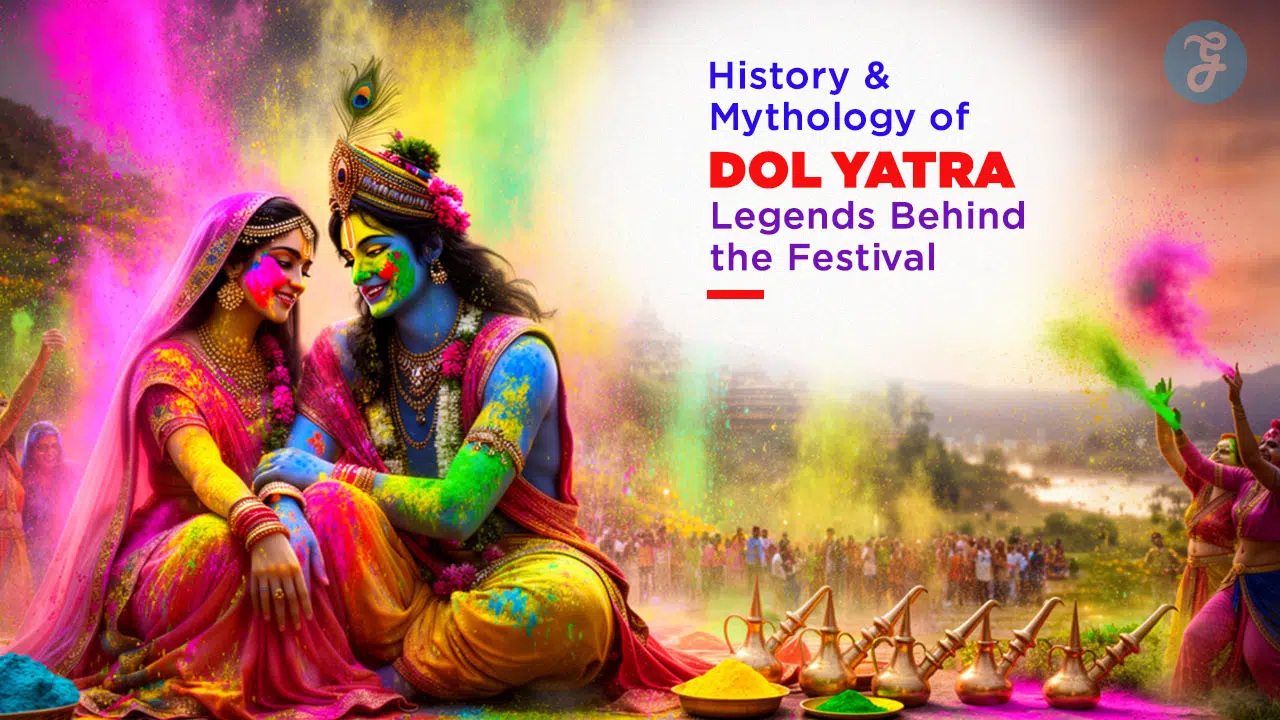
The arrival of spring brings a massive shift in cultural activities across the Indian subcontinent. People step out of the harsh winter months and prepare for agricultural renewal. They express their hope and joy through bright, energetic celebrations. Eastern Indian states like West Bengal, Assam, Odisha, and Tripura observe a very distinct tradition during this time. They celebrate the spring season with a unique festival of colours, music, and deep devotion. To truly understand this cultural event, you must look closely at the history and mythology of the Dol Yatra legends behind the festival.
Locals call this event Dol Yatra, Dol Purnima, Dolotsava, or simply the Swing Festival. It takes place on the full moon day (Purnima) of the Hindu month of Phalguna. The festival falls on 3 March 2026. This event perfectly blends agricultural harvest traditions with ancient religious stories. It goes far beyond just throwing coloured powder at friends and family. It stands as a highly structured, multi-day cultural phenomenon that unites different communities.
Scriptural Roots and the Evolution of Spring Festivals
The celebration of the spring season relies heavily on ancient historical records and changing religious practices. Looking at the timeline of this festival reveals how simple indigenous spring rituals slowly mixed with the large-scale Bhakti movement. The festival kept its core values while adapting to the social changes of different historical periods. We can track its growth from the ancient Gupta period all the way to the modern digital age. These early records help us understand why people still follow these customs today.
Early Mentions in Ancient Indian Texts
You must read early Sanskrit literature to find the exact origins of these spring festivals. Ancient Indian scriptures provide detailed descriptions of early colour festivals, which they called “Holikotsav” or “Vasanta-Mahotsava”. You can find these references in Jaimini’s Purva Mimamsa Sutras and the Kathaka-Grhya-Sutras. Researchers also found a stone inscription dating back to the 3rd century BCE at Ramgarh in the Vindhya region. This stone carving provides early archaeological evidence of organised seasonal celebrations and theatrical performances that predate modern spring rituals.
During the 4th century, the famous poet Kalidasa wrote about the festival during the reign of Chandragupta II. A few centuries later, King Harsha placed the festival directly into his 7th-century Sanskrit drama called Ratnavali. European traders and British colonial staff also documented their fascination with these events when they arrived in the 17th century. They spelt the festival name in many different ways, like “Houly” in 1687 and “Hoolee” in 1825, based on how it sounded to them.
The Shift in the Puranas
As the Bhakti movement spread across medieval India, the festival changed shape. It moved away from celebrating the fire deity Agni and focused heavily on the worship of Lord Krishna. The Sanskrit word Dola translates directly to “swing”, and the word Yatra means “procession” or “journey”. This linguistic shift created the modern concept of the ceremonial swing procession.
Vaishnava texts like the Narada Purana and the Bhavishya Purana record this specific change in detail. These texts detail the story of the demon king Hiranyakashipu and his devout son Prahlad. The king’s sister, Holika, tried to burn Prahlad in a fire, but her evil intentions caused her to burn instead. While northern India focuses on burning Holika (Holika Dahan), the eastern texts focus more on the romantic swing festival.
| Historical Era | Key Texts & Evidence | Significance to the Spring Festival |
| 300 BCE | Ramgarh Stone Inscription | Provides the earliest archaeological mention of the Holikotsav celebration. |
| 4th Century CE | Works of Kalidasa | Documents the cultural importance of the festival during the Gupta period. |
| 7th Century CE | Ratnavali by King Harsha | Features detailed theatrical descriptions of the festival of colours. |
| Medieval Period | Narada Purana, Bhavishya Purana | Shifts the focus towards the Radha-Krishna swing procession (Dolotsava). |
History and mythology of Dol Yatra: The Romantic Roots
The religious foundation of this event rests entirely upon the romantic relationship between Radha and Krishna. Eastern India focuses heavily on the peaceful, pastoral, and playful aspects of the divine. This regional preference strongly shapes the stories people tell during the spring season.
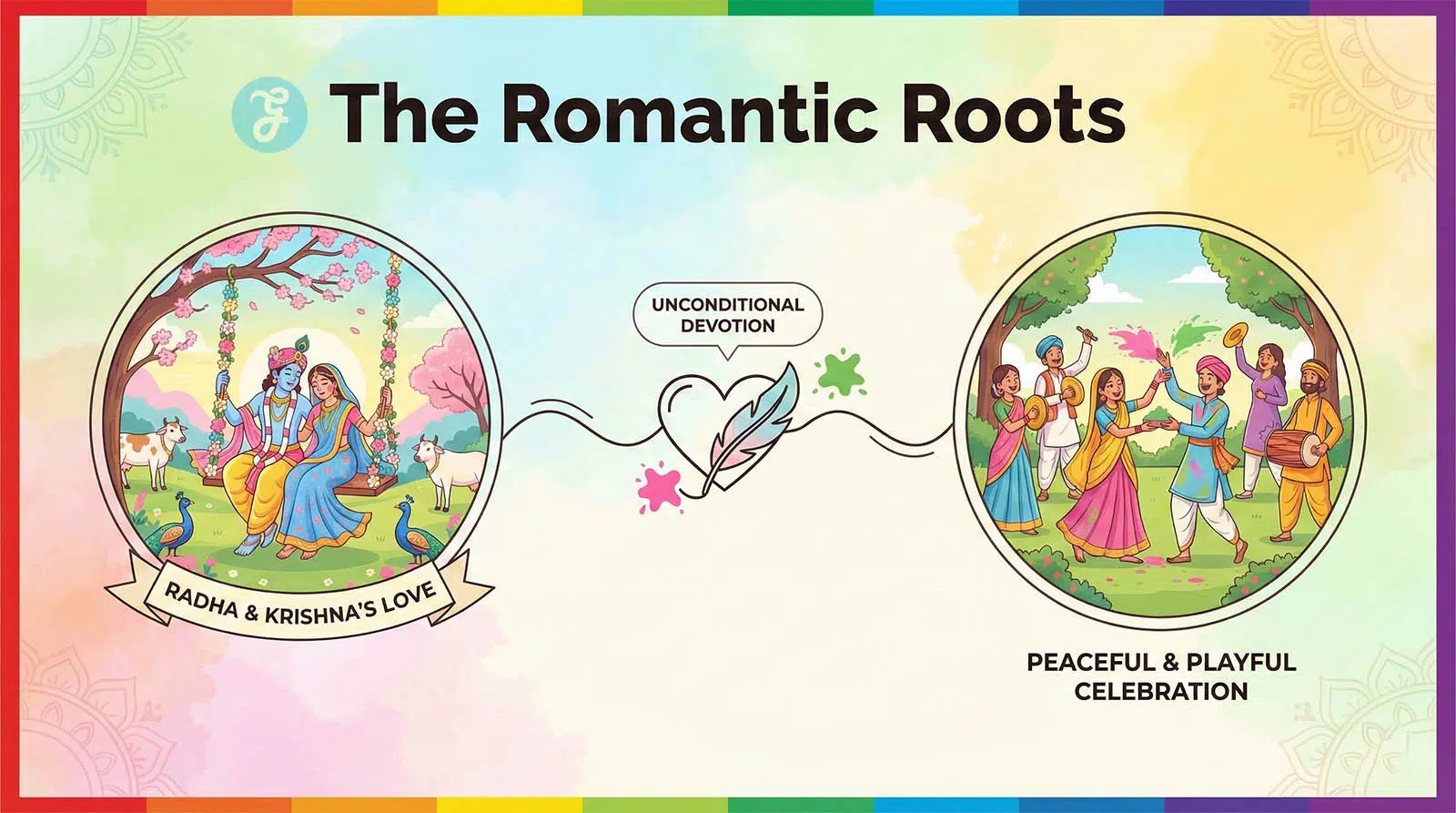 You can see a distinct departure from Northern Indian customs when you study the history and mythology of the Dol Yatra legends behind the festival. Instead of celebrating a violent victory over demons, the narrative highlights the supreme power of unconditional love and devotion.
The Garga Samhita and Divine Romance
The Garga Samhita stands as a crucial Vaishnava text authored by Sage Garga. It gives us some of the earliest and most detailed accounts of Krishna and Radha playing together during the spring. According to this sacred text, the divine couple gathered in the blooming forests of Vrindavan along with the gopis (cowherd girls).
The queens of Dwarka heard about this legendary Rasa dance and desperately wanted to see it. They approached Krishna and asked for his permission. Krishna replied that the dance could only start if Radha, the undisputed queen of the Rasa, wanted it to happen. He then took his 16,000 queens to see Radha, and they all marvelled at her unmatched beauty. This specific story places Radha at the very centre of the festival’s theology.
The Significance of the Swing (Dola)
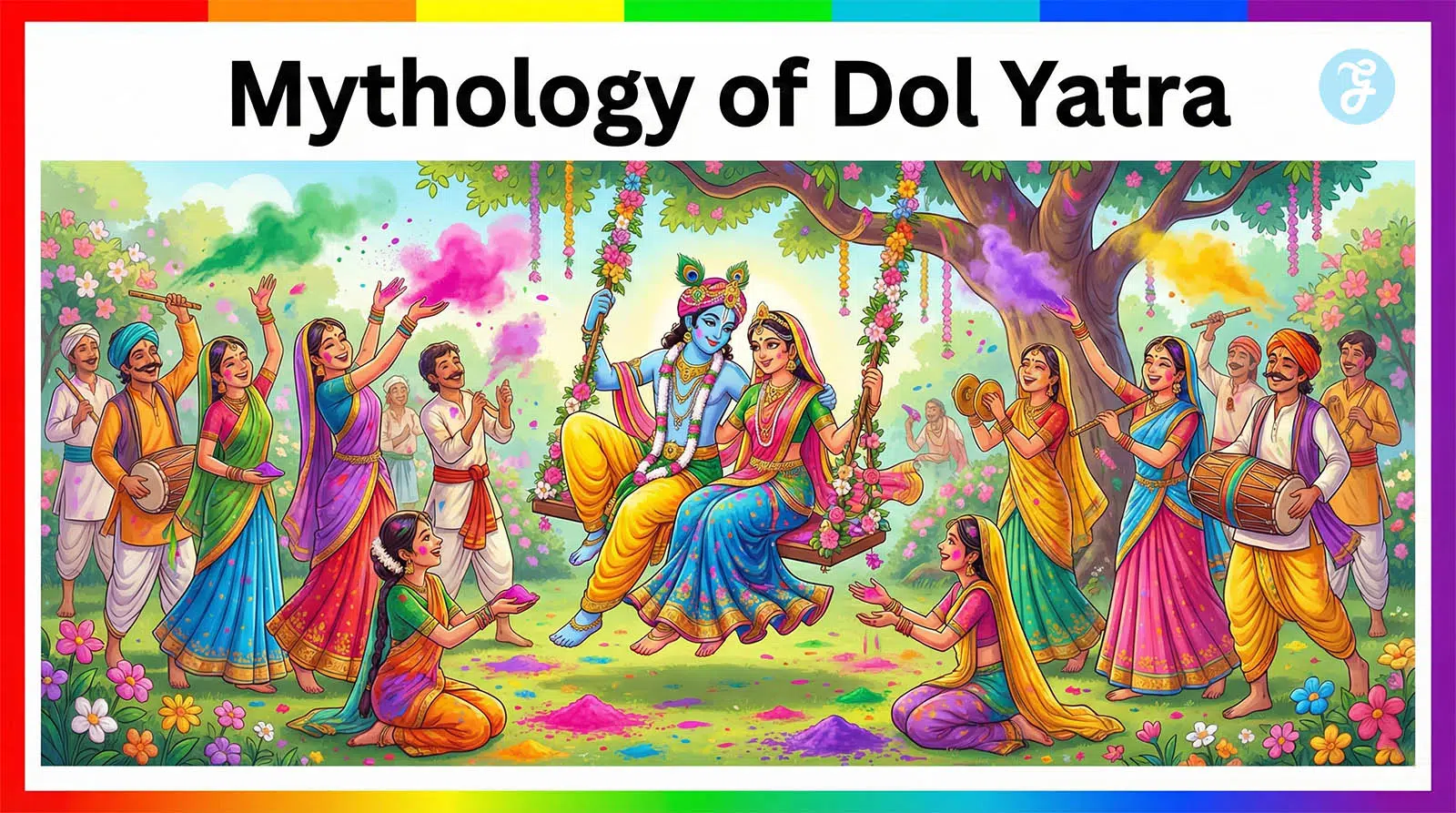
The most important ritual of the festival happens when priests place the idols of Radha and Krishna on a beautifully decorated swing. People call this swing a dola or jhulan. The physical act of swinging carries deep philosophical meaning in Hindu culture. It represents the cyclical nature of the universe. It shows the endless rhythm of birth, life, and rebirth.
The swing also acts as a physical bridge that connects the human world with the divine world. When devotees gently push the swing, they actively participate in the lila (divine play). They use this action to show their deep desire to connect with the ultimate source of happiness. The gopis surrounding the swing represent individual human souls searching for a union with the supreme divine entity.
The Symbolism of Phag (Coloured Powder)
The festival replaces water balloons and harsh synthetic colours with dry coloured powder. People in Bengal call this dry powder phag or abir. Legend says that Krishna started the tradition on this exact day. He openly expressed his love for Radha for the first time by playfully throwing phag at her face while she played on a swing with her friends.
The application of this powder symbolises the blooming of nature and the blossoming of divine love. Historically, families made their own phag using natural ingredients. They extracted beautiful shades of red, yellow, and green from turmeric, beetroot, spinach, henna, and marigold flowers. They also used the bright red plumes of the palash and shimul trees, which bloom heavily during the Bengali month of Phalguna.
| Mythological Element | Symbolic Meaning | Scriptural Source |
| The Swing (Dola) | Represents the cyclical nature of life, cosmic balance, and the divine play (lila). | Garga Samhita |
| Phag (Coloured Powder) | Shows the expression of divine love, passion, and the fertility of the spring season. | Padma Purana |
| The Gopis | Represents individual human souls longing for a deep connection with the supreme divine. | Brahma Vaivarta Purana |
| Vrindavan Forest | Acts as the spiritual landscape where pure devotion (bhakti) is fully realised. | Garga Samhita |
The arrival of Sri Chaitanya Mahaprabhu in the late 15th century completely changed the spiritual landscape of eastern India. He was born in 1486 CE in Nabadwip, a famous university town in West Bengal. He grew up to become a powerful mystic, a social reformer, and the leading figure of the Gaudiya Vaishnavism movement. He was born on the exact day of the spring full moon. This coincidence gives the festival dual meaning for his followers. They celebrate the history and mythology of Dol Yatra legends behind the festival while also celebrating his birth.
Gaura Purnima and the Nabadwip Parikrama
Followers call Chaitanya Mahaprabhu “Gauranga” because he had a golden complexion. Therefore, they refer to his birthday celebration as Gaura Purnima (Golden Full Moon). This event turns the towns of Nabadwip and Mayapur into massive global pilgrimage centres. Devotees perform the Navadvip Mandal Parikrama, which is a strict seven-day walking journey.
They walk barefoot across the nine islands of Nabadwip to retrace the steps of Chaitanya Mahaprabhu. The organisers divide the thousands of international pilgrims into different groups based on their language. They have specific groups for Bengali, Hindi, Tamil, English, and Russian speakers. Each group travels with senior speakers, singers, and drama teams. They believe that taking the dust of this holy land can liberate the entire universe.
Global Gathering at ISKCON Mayapur
The International Society for Krishna Consciousness (ISKCON) has its global headquarters in Mayapur, West Bengal. This temple complex hosts one of the largest Gaura Purnima festivals in the world. The temple organises a massive Kirtan Mela. Devotees gather to chant the holy names non-stop for a minimum of eight hours a day. People who cannot travel to India watch the event live on Mayapur.TV, creating a global spiritual connection.
On the evening of the festival, the temple priests perform a grand Maha Abhishek. They bathe the deities in holy water drawn from 108 sacred pots (kalashas). After the bathing ceremony, they shower the deities with fragrant flowers and offer a special feast containing 56 different dishes (chappan bhog). The devotees fast throughout the day and break their fast only after the moon rises.
Prasadam Distribution and Community Service
The festival places a massive emphasis on feeding the community. Srila Prabhupada, the founder of ISKCON, gave a strict instruction that no one within a ten-mile radius of the temple should ever go hungry. The temple strictly follows this rule during the spring festival. The kitchen staff prepares free meals for all registered participants.
They use massive facilities like the Anna Daan Kitchen, Gada Bhavan, and Gita Bhavan to handle the crowds. During the peak festival days, they feed more than 8,000 devotees, pilgrims, and guests daily. People can sponsor these meals. Sponsoring a full lunch costs Rs. 200,000, while sponsoring breakfast for 500 pilgrims costs Rs. 20,000. This massive food distribution ensures that everyone receives the blessings of the festival without worrying about basic needs.
| Gaura Purnima Event | Description of Activity | Location / Significance |
| Navadvip Parikrama | A 7-day walking pilgrimage across the nine sacred islands. | Nabadwip, West Bengal |
| Maha Abhishek | Bathing the deities with holy water from 108 kalashas (pots). | ISKCON Mayapur |
| Kirtan Mela | Continuous, non-stop chanting of the Hare Krishna mantra. | Global participation via Mayapur.TV |
| Prasadam Distribution | Free meals provided to over 8,000 daily pilgrims and visitors. | Anna Daan Kitchen, Mayapur |
Cultural Metamorphosis: Shantiniketan and Basanta Utsav
In the 1920s, the great poet and Nobel Laureate Rabindranath Tagore changed the way Bengal celebrated the spring season. He created a new event called Basanta Utsav (Spring Festival) at Visva-Bharati University in Shantiniketan. He wanted to remove the chaotic and loud elements of traditional colour throwing. He replaced them with an elegant, cultural celebration that focused on art, nature, and human unity. The history and mythology of Dol Yatra legends behind the festival clearly show how Tagore shifted the focus from orthodox religion to cultural aesthetics.
Tagore’s Vision for Spring
Tagore designed the festival to match the vibrant colours of the blooming local flora. Students and teachers dress strictly in basanti (yellow) coloured clothes. Women wear yellow and floral saris, while men wear yellow kurtas. They decorate their hair and bodies with fresh flowers instead of heavy jewellery. They completely avoid using wet colours or water guns. Instead, they gently share dry abir by hand. They apply it softly to each other’s faces as a sign of affection, rather than throwing it in anger or excitement.
The Role of Rabindra Sangeet
Music forms the absolute core of Basanta Utsav. The town wakes up before sunrise to the sound of students singing Tagore’s seasonal compositions, known as Rabindra Sangeet. The students form large groups and perform choreographed dances on the open university grounds. They dance gracefully under the large mango and sal trees.
They perform specific songs that capture the physical beauty of spring and the emotional awakening of the soul. Popular tracks include “Ore Grihabasi“, “Phagun Haoway Haoway“, “Aji Dakhino Duwar Khola“, and “Akash Amay Bhorlo Aloy“. These songs are now universally sung during morning processions across the entire state of Bengal. Tagore successfully democratised the festival’s music, making it accessible to everyone regardless of their religious background.
Modern Tourism and Visitor Trends
Today, Basanta Utsav draws thousands of visitors from across India and the globe. People travel from the USA, UK, Canada, and neighbouring countries to witness this cultural masterpiece. However, the massive crowds present a new challenge for the small town. The streets become congested, and peaceful moments become rare during the festival days.
Many visitors now seek accommodations slightly outside the main town centre. Resorts like Mohor Kutir offer a quiet retreat where guests can escape the bustling crowds. The university recently made the main campus event internal to protect the students and preserve the heritage. However, the surrounding town areas, especially the Sonajhuri Haat, stay alive with local Baul musicians and vibrant colour play.
| Rabindra Sangeet Track | Theme of the Song | Relevance to Basanta Utsav |
| Phagun Haoway Haoway | The wild and playful winds of the spring season. | Captures the physical energy of the changing weather. |
| Ore Grihabasi | A call for people to leave their homes and step outside. | Acts as the opening anthem to gather the community. |
| Akash Amay Bhorlo Aloy | The beauty of the sky fills the poet’s mind. | Reflects the deep connection between human emotion and nature. |
| Amar Mukti Aloy Aloy | Finding freedom in the light and open air. | Represents Tagore’s philosophy of open-air education. |
Aristocratic Heritage and Regional Variations
The festival takes on very different forms depending on where you travel in eastern India. Former landlord families preserve centuries-old rituals in their large rural estates. Meanwhile, states like Assam and Odisha have integrated their own unique monastic and temple traditions. These regional variations show the incredible adaptability of the festival. When you study the history and mythology of Dol Yatra legends behind the festival, you realise that local communities actively shaped the event to match their specific social structures.
Zamindar Traditions in Amadpur and Taki
In the rural villages of Bengal, the former Zamindar (landlord) families continue to observe the festival exactly as their ancestors did. The Chaudhuri family in the village of Amadpur, located deep in the Burdwan district, maintains a 400-year-old family home. Their property features a large lake surrounded by four terracotta temples dedicated to Lord Shiva. They built a special stage called a Dol Mancha just for this festival.
On the day before the main festival, they carry a sacred shaligram shila (a stone representation of Vishnu) to the stage. On the main day, they bring the idols of Radha Madhav out in a grand procession. They perform a special ritual called Deb Dol. The priests symbolically make the deities play with the coloured powder before any humans touch it. Once the deities finish playing, family members must strictly apply colour to the feet of their elders first. Only after receiving blessings can the younger generation start playing with colour.
Cross-Border Unity on the Ichamati River
The festival also acts as a powerful tool for social and geographical unity. The town of Taki sits on the banks of the Ichamati River, which serves as the official international border between West Bengal (India) and Satkhira (Bangladesh). The river becomes a central gathering place during religious immersions.
Boats from both countries sail to the middle of the river. Despite the presence of border security forces, people from both nations interact freely. They exchange sweets, greetings, and cultural camaraderie. The fluid nature of the river perfectly mirrors the shared cultural heritage of the Bengali people. This unique gathering caught the attention of modern filmmakers. Director Kaushik Ganguly featured the beautiful Ichamati river immersion rituals in his famous 2017 Bengali movie Bishorjon.
Barpeta Satra Doul Utsav in Assam
If you travel northeast into the state of Assam, the festival changes into the Doul Utsav (or Deul). The Barpeta Satra serves as the main centre for this celebration. Srimanta Sankardev and his disciple Madhavdev established this Vaishnavite monastery in the 16th century. A devoted follower named Sri Mathuradas Burah Aata formally structured the festival. He built the first Doul Griha, an earthen raised platform encircled by steps. The platform reaches a height of 15.0 metres, and its seven steps symbolise Sapta Baikuntha (the seven heavens of Lord Vishnu).
During the festival, priests bring the idols of Kalia Gosain (Lord Krishna) and Ghunusa out of the main temple and place them on the high platform. Devotees sing special devotional songs called Holi geets, which were composed by Sankardev and Madhavdev. They play traditional instruments like the taal (cymbal) and dhulki. At the end of the festival, the devotees split into two groups and break bamboo barriers. This action symbolises Goddess Lakshmi’s anger because Krishna spent time away from her. To enter the main temple again, Lord Krishna must pay a fine of Rs. 300 to Lakshmi.
Dola Purnima in Coastal Odisha
In the coastal state of Odisha, the festival focuses heavily on Lord Jagannath. Since Jagannath is another form of Lord Krishna, the traditions blend seamlessly. Women clean the area around their homes and create beautiful floor art using a mixture of raw rice powder and turmeric.
The priests replace the traditional idols of Radha and Krishna with Lord Jagannath. They place him in a heavy wooden palanquin. In the evening, men from the traditional milkman caste carry the palanquin on their shoulders and parade it through the streets. They do this to honour the fact that Krishna grew up as a cowherd and belonged to their specific clan.
| Regional Celebration | Key Location | Unique Rituals & Characteristics |
| Rajbari Dol | Amadpur / Taki, West Bengal | Features the Deb Dol ritual, terracotta Dol Mancha, and strict age-hierarchy. |
| Doul Utsav | Barpeta Satra, Assam | Focuses on singing Holi geets, breaking bamboo barriers, and paying a fine to Lakshmi. |
| Dola Purnima | Coastal Odisha | Highlights Lord Jagannath replacing Krishna, carried by traditional milkmen. |
| Ichamati Gathering | India-Bangladesh Border | Blurs international borders through shared river traditions and cultural exchange. |
Literary and Folk Echoes: Jhumur Songs and Mangal Kavya
The oral and written traditions of eastern India have recorded the joy of the spring festival for centuries. Indigenous communities expressed their raw emotions through energetic folk songs long before classical literature took over. These artistic expressions gave a powerful voice to the common people working in the fields. They also helped spread complex religious ideas through highly engaging multimedia formats. You can track the history and mythology of Dol Yatra legends behind the festival by analysing these ancient songs and scrolls.
The Tradition of Jhumur Songs
The musical heritage of the festival relies heavily on Jhumur folk songs. These songs started among the indigenous communities of the Rarh region, specifically the Santal tribes. Originally, Jhumur was an earthy, amorous song and dance form performed during harvest festivals. The word comes from the body movements used in the dance or from the practice of jhum cultivation.
As the Bhakti movement swept through the region, Jhumur absorbed Vaishnava themes. It transformed into a musical dialogue between Radha and Krishna. Two distinct characteristics define the singing style. First, the music builds up to a loud crescendo and then slowly drops down to a quiet diminuendo. Second, the balance between the high notes and the bass notes always remains unchanged. This unique structure heavily influenced classical Bengali literature, including Baru Chandidas’s Shri Krishna Kirtan and the works of the 14th-century poet Vidyapati.
Storytelling through Mangal Kavya and Patachitra
During the Middle Ages, Bengali poets composed long narrative verses called Mangal-Kavya (auspicious poems). These poems told the stories of local rural deities like Manasa (the snake goddess) and Chandi. People believed that listening to these poems during spring gatherings brought material and spiritual benefits.
Wandering artists called Patua or Chitrakar created a unique way to present these stories. They painted long visual scrolls called Patachitra. They would unroll the scroll frame by frame while singing the Mangal Kavya verses to the village audience. This combination of painting and singing served as an early form of multimedia storytelling. Eventually, this performative folklore evolved into the open-air theatre format known as Jatra, which remains popular in rural Bengal today.
| Folk and Literary Form | Key Elements | Cultural Significance |
| Jhumur Songs | Indigenous origins, crescendo-diminuendo structure. | Formed the basis for classical Vaishnava poetry and dialogic storytelling. |
| Mangal Kavya | Auspicious narrative poems from the 13th-18th centuries. | Humanised local gods and merged indigenous myths with Hindu deities. |
| Patachitra | Painted visual scrolls unrolled during live singing. | Created an accessible, multimedia method for teaching mythology to the masses. |
| Jatra Theatre | Open-air dramatic performances with loud dialogue. | Provided community entertainment and spread religious narratives. |
Spring Themes in Bengali Cinema and Literature
The vivid imagery of the spring festival naturally found its way into modern storytelling platforms. Legendary writers and filmmakers used the colourful backdrop of the festival to explore complex human emotions. This visual medium helped push regional traditions onto the global stage. It highlights exactly how cultural practices influence modern entertainment and keep ancient traditions alive in the digital era.
Rabindranath Tagore’s Cinematic Adaptations
Rabindranath Tagore did not just reshape the physical festival at Shantiniketan; his stories provided the foundation for some of the greatest films in Indian cinema. Directors repeatedly turn to his work to explore themes of love, loneliness, and social constraints. Satyajit Ray famously adapted Tagore’s novel Nastanirh into the 1964 masterpiece Charulata. The film explores the life of a lonely wife and her complicated relationship with her husband’s cousin.
Rituparno Ghosh directed the 2003 film Chokher Bali, starring Aishwarya Rai, which brought Tagore’s exploration of exoticism and forbidden love to a massive commercial audience. Other notable adaptations include Kumar Shahani’s Char Adhyay, Suman Mukhopadhyay’s Chaturanga, and the Hindi film Dak Ghar. These films capture the aesthetic beauty and intellectual depth that define the Bengali cultural landscape.
Depictions of the Festival in Modern Media
Modern directors continue to use the festival’s unique locations and rituals to drive their plots. The border town of Taki and the Ichamati River serve as the perfect backdrop for stories about separation and unity. Kaushik Ganguly’s 2017 film Bishorjon opens with a stunning documentary-style sequence showing the river immersions where the borders between India and Bangladesh temporarily disappear. The visual contrast between the heavily guarded border and the joyful cultural exchange provides a powerful cinematic experience.
| Film Adaptation | Original Author / Source | Core Theme Explored |
| Charulata (1964) | Nastanirh by Rabindranath Tagore | Explores loneliness and complex family dynamics in an aristocratic setting. |
| Chokher Bali (2003) | Chokher Bali by Rabindranath Tagore | Examines eternal love, exoticism, and social boundaries. |
| Lekin… (1991) | Kshudhit Pashaan by Rabindranath Tagore | Adapts a haunting story into an award-winning Hindi cinematic piece. |
| Bisarjan (2017) | Directed by Kaushik Ganguly | Highlights cross-border unity and cultural blurring during the Durga Puja immersions on the Ichamati River. |
Culinary Heritage and Festive Feasts
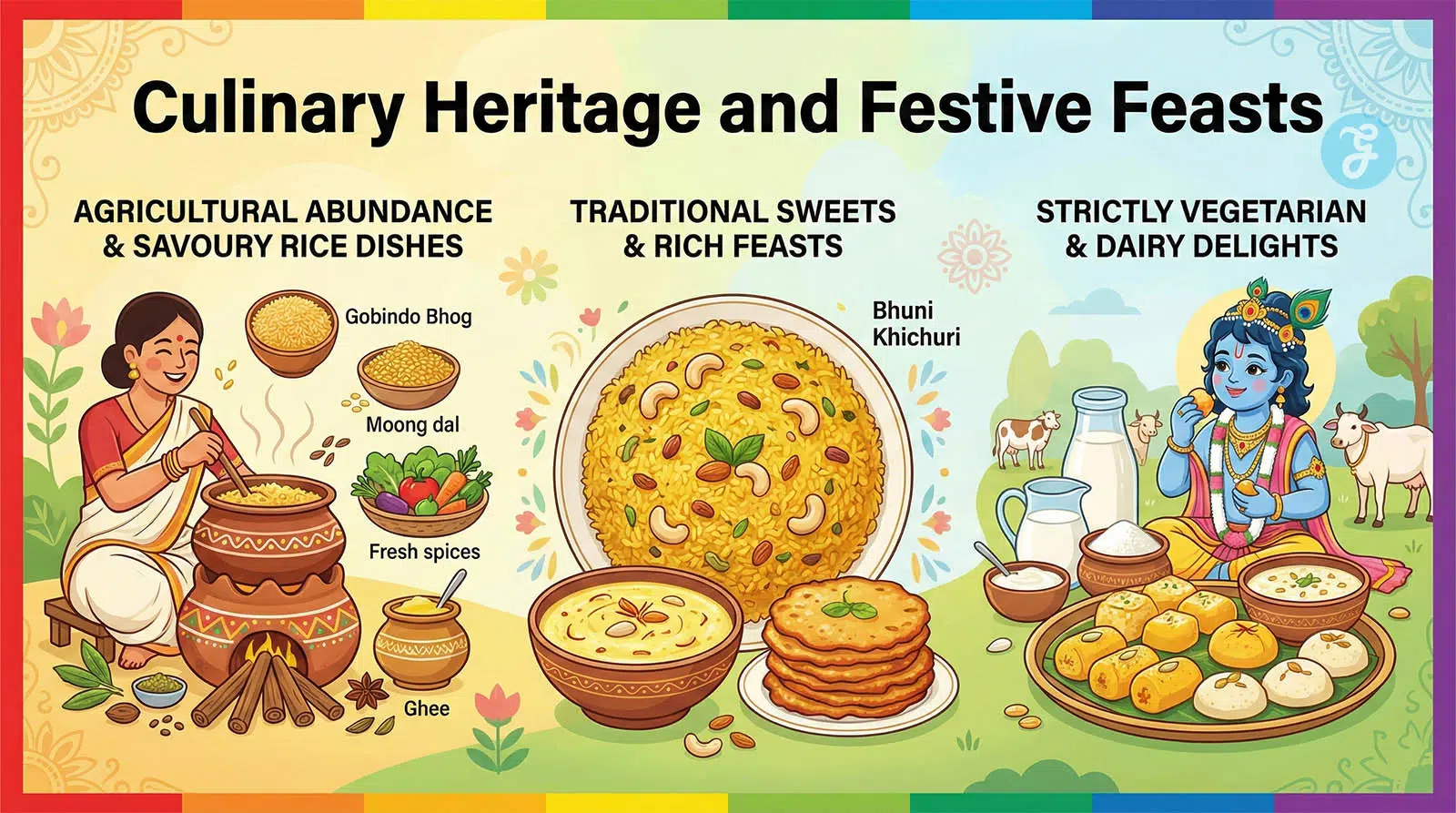
No major Indian festival feels complete without an array of specialised culinary delights. The food prepared during the spring festival perfectly reflects the agricultural abundance of the season. Because the core theme revolves around Lord Krishna, all the dishes prepared for the festival are strictly vegetarian. Traditional sweets and rich, savoury rice dishes dominate the festive menu. Cooking these specific recipes is an important part of preserving the region’s heritage.
The Savoury Special: Bhuni Khichuri
While everyday khichuri acts as a simple comfort food, the festive Bhuni Khichuri takes on a highly refined, almost pulao-like texture. Cooks prepare this dish using premium Gobindo Bhog rice and Sona moong dal. They start by dry roasting the moong dal until it turns light brown.
Because this food serves as an offering to the gods (bhog), cooks strictly avoid using onions or garlic. Unlike everyday recipes, cooks use generous amounts of turmeric to give the dish a vibrant, golden-yellow hue that celebrates the colours of spring. They heat a heavy wok and add generous amounts of pure cow ghee. They temper the ghee with coarsely broken cinnamon sticks, cloves, and green cardamom. They add grated ginger, green peas, and occasionally fried cauliflower florets. Finally, they add cashews and raisins to give the dish a festive, sweet finish.
Traditional Sweets and Desserts
Sugar and dairy play a massive role in the festival’s menu, reflecting Lord Krishna’s background as a cowherd. Families spend days preparing traditional Bengali sweets. They offer these sweets to the deities first, and then exchange them with friends and relatives who visit their homes in the evening.
The most common sweets prepared for the festival include malpua (deep-fried pancakes soaked in syrup), kheer sandesh, and basanti sandesh. The basanti sandesh is specially infused with saffron to match the yellow theme of the spring season. Many families also prepare payash (a rich rice pudding) and gujiya (sweet dumplings) to serve to their guests.
| Traditional Food Item | Key Ingredients | Culinary Significance |
| Bhuni Khichuri | Gobindo Bhog rice, Sona moong dal, cow ghee, whole spices, turmeric. | Serves as the primary savoury offering (bhog) prepared without onion or garlic. |
| Basanti Sandesh | Milk curds (chhena), sugar, saffron. | Provides a rich dessert that matches the yellow visual theme of the festival. |
| Malpua | Flour, milk, sugar syrup, fennel seeds. | A traditional deep-fried sweet shared heavily among visiting neighbours. |
| Payash | Rice, milk, sugar, nuts, raisins. | A staple pudding essential for any major Bengali religious celebration. |
Final Thoughts
The arrival of spring brings a much-needed sense of renewal and hope to communities across eastern India. The festival beautifully captures that optimism through a complex mixture of art, religion, music, and social bonding. It reminds people to embrace love, forgive past grievances, and look forward to the future. The traditions continue to thrive today because they constantly adapt to changing times while holding onto their core values. By understanding the history and mythology of Dol Yatra legends behind the festival, you can fully appreciate the depth of this cultural phenomenon.
From its earliest mentions in ancient stone inscriptions to the massive global broadcasts from ISKCON Mayapur, the festival has grown exponentially. Rabindranath Tagore successfully modernised it at Shantiniketan, turning it into a celebration of music and nature. Meanwhile, rural estates and ancient monasteries keep the strict, historical rituals alive. The digital age continues to preserve these stories, mapping them as important cultural entities on the global internet. This incredible legacy of joy, devotion, and universal love will undoubtedly continue to inspire and unite generations to come.