
Have you ever watched your team drift through the workday, going through the motions but not really present? People scroll past emails without reading them. Meetings feel like a waste of time. Productivity drops, morale sinks, and you can tell something is off, but you can’t quite pinpoint what needs to change. Here’s the good news: you can fix this.
Recent research shows that companies with strong employee engagement strategies see 21 percent higher profitability than their competitors. That’s a massive difference. Engaged workers stay longer, produce better work, and genuinely care about where the company is headed.
They become your best advocates, telling friends and colleagues how great your workplace is. This post walks you through the most effective employee engagement strategies for 2026. You’ll find practical steps to boost morale, sharpen communication, and build a place where people actually want to show up.
What Is Employee Engagement?
Employee engagement means your team members care about their work and your company’s success. Engaged employees show up with energy, put in real effort, and stick around longer. They feel connected to their jobs, their coworkers, and the organization’s mission. This connection goes beyond collecting a paycheck. It’s about finding meaning in what they do each day.
According to February 2026 polling data from Gallup, just 31% of U.S. full-time employees are actively engaged at work. That’s an 11-year low, down from 36% in 2020. It means that nearly 70% of your workforce may be disengaged or quietly quitting right now.
That’s a serious problem, but it also shows just how much room there is to improve. Here’s what an engaged employee actually looks like in practice:
- They bring energy and focus to their work each day
- They care about team goals, not just personal tasks
- They stay longer and contribute more to organizational culture
- They speak positively about your company to people outside it
Think of engagement as the spark that ignites workforce motivation and job satisfaction. Your staff retention rates climb when people feel valued and heard. Engaged employees collaborate better, communicate more openly, and deliver stronger results across the board.
Why Is Employee Engagement Important?
Engaged workers drive real results. They show up ready to contribute, they care about quality, and they stick around longer than disengaged staff. When your team feels connected to their work and valued by leadership, productivity soars. Staff retention improves because people don’t leave jobs they actually enjoy.

Morale lifts across departments, and collaboration happens naturally. Motivation flows from genuine investment in the work itself, not just from paychecks. Companies that prioritize employee engagement see their bottom line improve because focused workers accomplish more in less time.
Disengagement costs money, plain and simple. A March 2026 analysis by Paycor reveals that low employee engagement costs U.S. companies approximately $2 trillion in lost productivity every year. That’s not a soft HR metric. It’s a massive financial hit that touches every level of the business.
When talented people walk out the door, turnover expenses pile up fast. Lost productivity hits hard when workers go through the motions without real commitment. Poor communication and lack of recognition create frustration that spreads quickly through teams. Career development stalls, and your best performers start looking elsewhere for growth. Performance management becomes reactive instead of proactive. Job satisfaction drops, absenteeism rises, and quality dips.
- Recruiting and training new staff drains time and money
- Disengaged workers drag down team morale
- Poor recognition leads to high turnover
- Lack of feedback blocks career growth
- Leadership gaps multiply performance problems
Organizations that ignore employee engagement spend all their energy recruiting, training, and rebuilding their workforce. The cost of replacing a single employee often reaches thousands of dollars. Engagement strategies are simply smart business.
Key Benefits of Employee Engagement
When you invest in employee engagement, your organization gains stronger productivity, holds onto talented staff longer, watches employee mental health improve, and sees profits climb.
Increased productivity
Engaged employees work harder, faster, and smarter. They bring real energy to their jobs, which lifts workplace productivity to new heights. Staff retention improves when workers feel valued. This stability creates momentum. Your team gets more done in less time because people genuinely care about their work.
Workplace productivity soars when leaders foster team collaboration and open communication strategies. Employees who receive regular feedback know exactly what success looks like, so they hit targets with confidence.
“Engaged employees produce better results because they care about what they do.”
Career development opportunities keep people sharp. Job satisfaction rises when workers have autonomy over how they complete tasks. Performance management systems that feel fair encourage people to bring their best selves to work every day. Your bottom line benefits when you prioritize employee satisfaction and empowerment across the organization.
Higher employee retention
Productivity gains mean nothing if your best people walk out the door. Staff retention directly ties to your bottom line, since replacing workers costs money and time. Companies that invest in employee satisfaction see their teams stick around longer. Strong job satisfaction keeps talented staff from jumping ship to competitors. Your workforce motivation skyrockets when people feel valued and heard at work.
Career development opportunities lock in your top performers for years to come. Employees who see clear paths forward stay put, build greater skills, and contribute more to organizational culture.
- Recognition practices show staff that leadership values their growth
- Mentorship programs build deeper connections and skills
- High retention cuts hiring costs significantly
- Long-tenured employees carry institutional knowledge that money can’t replace
Improved mental wellness
Keeping your team happy at work directly impacts their mental health and job satisfaction. Employees who feel valued and supported show up with better morale and less stress. Strong retention rates mean workers stay longer, build deeper relationships with colleagues, and develop a real sense of belonging. This stability creates a foundation where mental wellness can actually flourish.
Your staff experience lower anxiety when they know their jobs are secure and their contributions matter. Mental health struggles drop when people feel heard through open communication and honest feedback. Career development opportunities give workers a sense of purpose and control over their futures. By supporting mental wellness, you build a workplace culture where people genuinely want to show up and perform at their best.
Enhanced organizational profitability
Engaged employees drive your bottom line straight up. When staff members feel valued, they produce more in less time. They make fewer mistakes. They stay longer. All of this cuts costs and boosts profits. Staff retention alone saves money on hiring and training. Productivity gains mean you get more output from your current workforce.
Here’s what that looks like in practice:
- Fewer costly hiring cycles each year
- Higher output without adding headcount
- Stronger financial results from motivated teams
- Less rework and fewer quality errors
Companies with high employee satisfaction report stronger financial results year after year. Profitability grows when you invest in your people’s career development and wellbeing.
Recognition and appreciation programs cost little but deliver big returns. Workforce motivation directly impacts your ability to compete in tough markets. Your organizational culture becomes a real asset when people want to show up and do their best work every single day.
Common Challenges in Employee Engagement Strategies
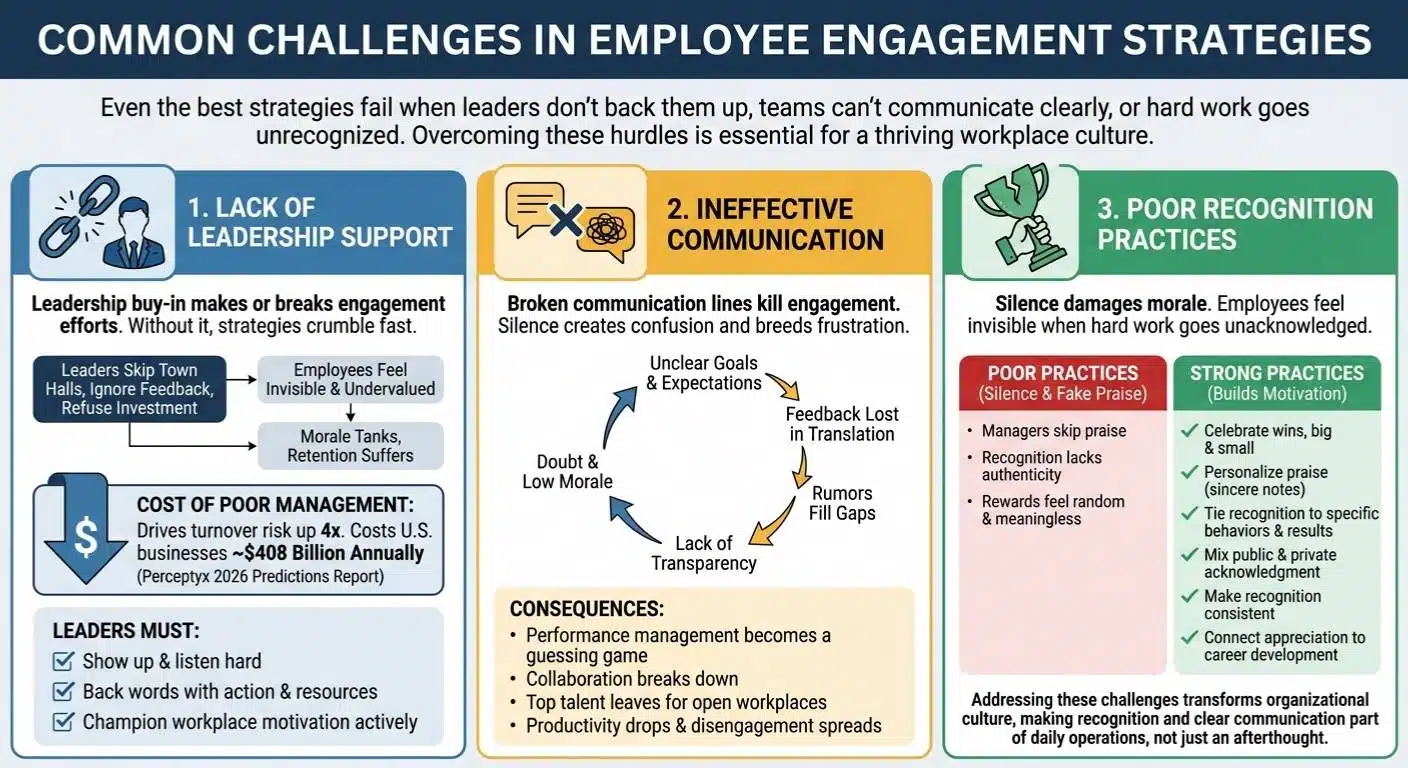
Even the best employee engagement strategies fail when leaders don’t back them up or when teams can’t communicate clearly. Companies often stumble because they don’t recognize hard work, or they design jobs that leave people feeling stuck and powerless.
Lack of leadership support
Leadership support makes or breaks employee engagement efforts. Without buy-in from top management, engagement strategies crumble fast. Leaders who fail to champion workplace motivation send a clear message to staff: this doesn’t matter. Employees pick up on that signal fast. They notice when executives skip town halls, ignore feedback, or refuse to invest in career development programs.
Weak leadership creates a culture where morale tanks, retention suffers, and organizational health deteriorates. According to the 2026 Predictions Report by Perceptyx, poor management drives turnover risk up by four times and costs U.S. businesses approximately $408 billion annually. That number is impossible to ignore.
Managers hold the keys to workforce motivation and job satisfaction. They shape daily interactions, model company values, and decide whether to support team collaboration or shut it down.
When leaders don’t actively promote employee recognition or champion work design improvements, engagement scores plummet. Staff feel invisible and undervalued. The ripple effect spreads across departments.
- Performance management becomes inconsistent across teams
- Talent development stalls across the organization
- Workers stop believing their voices count
- Teams lose confidence in their direction
Leaders must show up, listen hard, and back their words with action and real resources.
Ineffective communication
Broken communication lines kill employee engagement faster than almost anything else. Managers fail to share company goals clearly, so workers feel lost and disconnected from the bigger picture.
Teams don’t understand what leadership expects, feedback gets lost in translation, and rumors fill the gaps left by silence. This lack of transparency creates confusion, breeds frustration, and tanks morale across the entire workforce. Employees start to doubt whether their work matters, and motivation takes a nosedive.
Poor communication strategies also block career development and job satisfaction. Staff members don’t know about internal mobility opportunities because announcements never reach them. Recognition gets buried in email chains nobody reads.
- Performance management becomes a guessing game without clear expectations
- Collaboration breaks down when roles feel disconnected
- Disengagement spreads when silence replaces transparency
- Top talent leaves for workplaces that communicate openly
The result: employees disengage, productivity drops, and your best talent walks out the door looking for a workplace that actually talks to them.
Poor recognition practices
Poor recognition practices create a massive gap between what employees do and what leaders acknowledge. When staff members work hard but hear nothing back, their motivation takes a nosedive. Managers often skip praise because they assume good work speaks for itself, or they simply forget to say thank you. This silence damages morale fast. Employees start feeling invisible, undervalued, and disconnected from their jobs.
Your best talent walks out the door looking for appreciation elsewhere. Recognition programs that lack authenticity or consistency fail even harder. Staff members see through fake praise or rewards that feel random and meaningless.
Strong recognition practices flip this script entirely. Leaders who celebrate wins, big and small, build workforce motivation that sticks. Personalization matters here. A sincere note about someone’s specific contribution hits very differently than a generic email to the whole team.
- Tie recognition to specific behaviors and results
- Mix public praise with private acknowledgment based on individual preferences
- Make recognition consistent, not just a once-a-year event
- Connect appreciation to career development opportunities where possible
Your organizational culture transforms when recognition becomes part of how your team operates, not an afterthought tacked on at the annual review.
The Most Effective Employee Engagement Strategies for 2026
Companies that want their teams to thrive in 2026 need smart, practical strategies that actually deliver results. Here’s what works.
Start with well-designed surveys
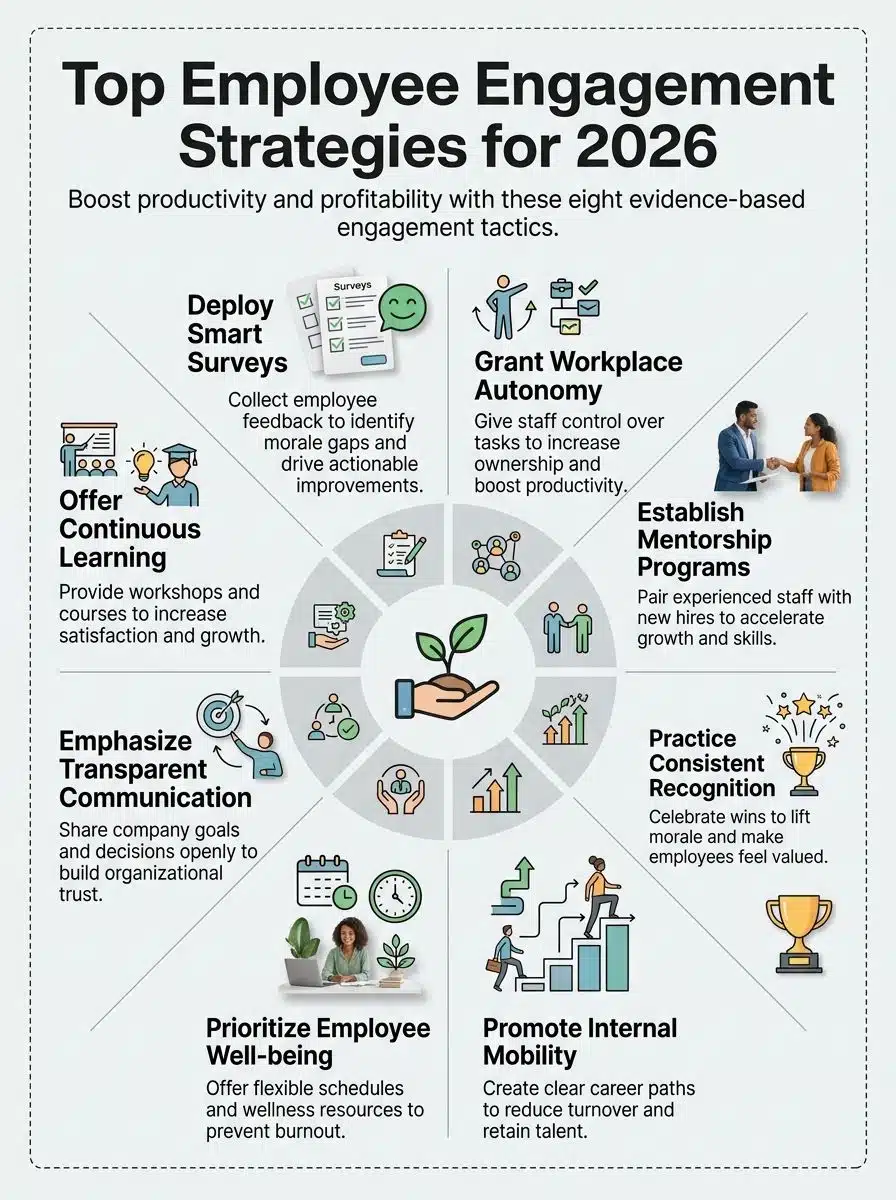
Well-designed surveys form the foundation of any strong employee engagement strategy. Your team members hold the answers you need, and surveys give them a voice to share their thoughts, concerns, and ideas. Ask specific questions about job satisfaction, workplace productivity, team collaboration, and organizational culture. Keep surveys short and straightforward so employees actually complete them without frustration.
The data you collect becomes your roadmap for improvement, showing you exactly where morale stands and what changes matter most to your workforce motivation. Act on what your surveys reveal. Employees notice when leaders ignore feedback, and that kills engagement fast. Share the results with your team, explain what you learned, and outline concrete steps you’ll take based on their input.
This transparency builds trust and shows your staff that their voices shape real decisions. Different departments may need different support, so dig into the data by team.
Performance management improves when you ground it in actual employee perspectives rather than assumptions. Surveys become powerful tools for career development conversations and recognition practices when you use them thoughtfully.
Foster workplace autonomy
Giving your team members control over their work creates powerful motivation. Autonomy means employees make decisions about how they complete tasks, which projects they tackle, and when they work best.
This approach builds job satisfaction because people feel trusted and valued. Your staff takes ownership of their results when you step back from micromanaging. Productivity rises naturally when workers shape their own workflow.
Managers who grant workplace autonomy see real shifts in workforce motivation and performance. Your team members develop stronger skills because they solve problems independently. They feel more connected to their work when they have real control.
This freedom reduces stress and supports a better work-life balance. Staff retention improves because people stay longer at companies where they feel genuinely empowered.
Establish mentorship programs
Mentorship programs light a fire under workforce motivation by pairing experienced employees with newer team members. Senior staff share knowledge, offer guidance, and help junior employees navigate career paths. This type of talent development builds stronger connections across your organization. Employees feel valued when someone invests time in their growth. Mentors gain leadership experience and fresh perspectives from their mentees.
Both parties develop skills that boost workplace productivity and job satisfaction. Your team members see clear pathways for advancement, which keeps morale high and reduces turnover.
- Match mentors and mentees based on career goals and skills
- Schedule regular check-ins to track progress and address challenges early
- Let mentees gain hands-on experience through real projects
- Recognize mentors publicly for investing in others’ growth
Employees who participate in mentorship programs report higher engagement levels and greater job satisfaction. Your organization builds a pipeline of prepared leaders ready to take on bigger roles. These relationships transform how people view their future with your company.
Encourage employee recognition and appreciation
Mentorship programs plant seeds for growth, yet recognition waters those seeds and helps them flourish. Employees thrive when their hard work gets noticed and celebrated. Recognition doesn’t have to be fancy or expensive. A simple thank you, a shout-out in a team meeting, or a small bonus can lift morale sky-high. Staff retention improves when workers feel valued, and job satisfaction climbs when people know their efforts matter.
Appreciation comes in many forms, and personalization makes it stick. Based on Snappy’s 2026 Workforce Study of U.S. employees, while 70% of companies have recently increased their recognition efforts, 73% of employees say recognition only feels genuine when it is highly personalized. Generic praise misses the mark. Specific, thoughtful acknowledgment is what actually moves people.
Some team members love public praise, while others prefer private acknowledgment. AI tools now help managers track accomplishments and suggest timely recognition moments, which takes the guesswork out of performance management.
When you tie recognition to specific behaviors and results, employees understand exactly what drives success in your organization. This approach builds stronger team collaboration, boosts workplace productivity, and creates a culture where people genuinely want to show up and do their best work.
Recognition programs that connect to career development opportunities make the impact even stronger, turning appreciation into real pathways for growth.
Promote internal mobility opportunities
Your staff members want to grow, and internal mobility gives them that chance. When employees see career paths within your organization, they stay longer and work harder.
According to 2026 workplace retention data from LinkedIn, employees at organizations with strong internal mobility stay an average of 5.4 years, compared to just 2.9 years at companies without it. That’s an extra 2.5 years of experience, institutional knowledge, and productivity you keep in-house.
Companies that support staff retention through internal promotions cut turnover costs significantly. Let workers move between departments, take on new roles, and build fresh skills. This approach strengthens your organizational culture while filling positions with people who already know your company.
- Map out which roles connect to each other across departments
- Share internal opportunities openly through your communication channels
- Highlight the success stories of staff who advanced internally
- Give employees time to explore new skills before committing to a role change
When people see their colleagues climb the ladder, they believe advancement is possible for them too. That belief is powerful for workforce motivation and long-term job satisfaction.
Prioritize employee well-being and work-life balance
Your workforce thrives when they have time to recharge outside the office. Employees who maintain a healthy work-life balance show stronger job satisfaction and deliver better workplace productivity.
Companies that support wellbeing initiatives see staff retention rates climb significantly. Offering flexible schedules, remote work options, and reasonable workload expectations sends a clear message: your team members matter as people, not just workers.
Here are some well-being initiatives that make a real difference:
- Mental health resources and access to counseling support
- Wellness days and fitness program stipends
- Flexible start and finish times, where the role allows
- Regular workload check-ins to prevent burnout
Leadership development starts with leaders who model a good balance themselves. Showing that stepping away from work is not laziness, but a necessity, sends a powerful signal to your team.
Burnout kills motivation faster than almost anything else. Addressing workload and stress becomes critical for performance management. Collaboration improves when people feel rested and valued. Praise rings hollow if workers are exhausted. Organizations that invest in workforce motivation through wellness programs see teams communicate more openly and work together more effectively. This approach creates loyalty that lasts.
Emphasize transparent communication
Transparent communication forms the backbone of strong organizational health. Leaders who share information openly build trust with their teams. Employees feel valued when they know what’s happening, why decisions get made, and how their work matters. This openness cuts through workplace confusion and reduces the rumor mill that spreads fast in offices.
Teams collaborate better when everyone has the same facts. Managers should communicate strategy, changes, and goals in plain language. Avoid corporate jargon that leaves people scratching their heads. When staff understand the big picture, they stay motivated and engaged.
- Town halls keep everyone aligned on the company’s direction
- One-on-one meetings build trust and surface concerns early
- Anonymous suggestion tools give quieter voices a channel
- Regular team updates prevent rumors and fill information gaps
Feedback flows both ways in transparent cultures. Your team members need to hear from you, but you also need to hear from them. Create channels where employees can speak up without fear. Staff retention improves when people feel heard and respected. Your workforce motivation soars when transparency replaces secrecy. People perform better when they trust their leadership and know exactly where they stand.
Offer continuous learning and growth opportunities
Your team grows when you invest in their skills. Companies that offer continuous learning programs see higher job satisfaction and stronger staff retention rates.
Employees want career development paths, not dead-end jobs. Provide access to online courses, workshops, and certification programs that match your workers’ goals. Let your people take time during work hours to learn new skills. This shows them you value their growth, and they repay that investment with better performance and loyalty.
Growth opportunities come in many forms, so mix them up:
- Pair junior staff with experienced mentors for talent development
- Rotate employees into different roles for broader experience
- Host lunch-and-learn sessions where team members share knowledge
- Offer tuition reimbursement for degrees or professional certifications
When employees see a clear path forward, their motivation climbs, and workplace productivity soars. These strategies build a culture where people feel empowered to reach higher. That energy spreads across your entire workforce.
How to Measure the Success of Employee Engagement Strategies
You’ll want to track how your employee engagement strategies perform so you can spot what works and what needs fixing.
Use employee feedback surveys
Employee feedback surveys act as your organization’s listening device. They give workers a real voice in how things run, and they show staff that leadership actually cares about their thoughts. Surveys reveal what drives your team, what frustrates them, and where they see growth opportunities. Companies that deploy regular feedback surveys see higher job satisfaction scores and stronger organizational health.
Make your surveys short and simple so employees actually complete them. Ask clear questions about work design, team collaboration, and career development opportunities. Track the feedback over time to measure real shifts in morale and motivation.
Act on what you learn, then tell your team what changes you made based on their input. This cycle of listening, acting, and reporting back builds trust. It shows workers that their voice shapes the workplace.
Track retention and turnover rates
Tracking retention and turnover rates gives you a clear picture of your staff retention strategy’s real impact. Your turnover rate tells you what percentage of workers leave your company each year, while retention metrics show you who stays.
Pull these numbers every quarter to spot trends early. If your retention drops, you know something needs to change fast. High turnover costs money through recruitment, training, and lost productivity. Low turnover means your workplace productivity stays strong and your organizational culture remains stable.
| Metric | What It Tells You | How Often to Track |
|---|---|---|
| Turnover rate | Percentage of staff leaving each year | Quarterly |
| Retention rate | Percentage of staff staying long-term | Quarterly |
| Time-to-fill | How fast you replace departures | Monthly |
| Tenure by department | Where people stay versus leave | Bi-annually |
Your data reveals which departments struggle most with keeping talent. Compare your turnover rates against industry standards to see if you’re ahead or behind. Track which employees leave after six months versus those who stick around for years.
This performance management insight helps you fix problems in your onboarding or work design. When retention improves, your job satisfaction scores typically climb, too. Your team collaboration strengthens as people build longer relationships with coworkers.
Assess productivity metrics
Productivity metrics tell you what your workforce actually accomplishes. You can measure output per employee, project completion rates, sales figures, or customer service response times.
These numbers reveal whether your engagement strategies move the needle on real business results. Pull data from your project management tools, sales systems, and performance tracking software. Compare these metrics before and after you launch new engagement initiatives.
Your team’s performance management system should track individual and team contributions. Look at the quality of work, not just the quantity. An employee might complete ten tasks, but did they complete them well?
Higher productivity often signals that your workforce motivation is climbing and your staff retention efforts are working. These metrics connect directly to organizational health and your bottom line, making them essential for measuring whether your employee engagement strategies deliver real value.
Final Thoughts
You now have a clear picture of the core strategies that drive employee engagement in 2026, from well-designed surveys to transparent communication that builds real trust across your organization. These approaches work because they center on what employees actually want: recognition, growth opportunities, and genuine work-life balance that respects their personal lives.
Start small. Pick one or two strategies that fit your company culture, then measure results through retention rates and feedback surveys to see what sticks. Your team members perform better when they feel valued, heard, and supported in their career development.
Ask yourself right now: which strategy could you launch this month to show your workforce you care about their wellbeing and job satisfaction? Your people are your greatest asset. When you fuel their motivation through collaboration and empowerment, your entire business transforms.
Frequently Asked Questions (FAQs) on Employee Engagement Strategies
1. What are the most effective employee engagement strategies for 2026?
Focus on open communication, flexible work options, and regular feedback. A 2025 Gallup study found that companies with flexible work arrangements report 21% higher engagement scores.
2. How can managers boost employee motivation in 2026?
Set clear goals and recognize good work often. When you celebrate small wins, motivation stays high.
3. Why does employee engagement matter for business success?
Engaged workers are more productive, stay longer, and contribute better ideas. According to a 2024 Gallup report, highly engaged teams show 23% higher profitability.
4. How can companies measure employee engagement levels?
Run short surveys, track turnover rates, and hold regular one-on-one check-ins. Tools like Culture Amp help you measure engagement quickly. When you act on what you learn, trust grows fast.