Finding a job in Germany before moving can feel like climbing a mountain with no map. Many skilled workers and graduates get stuck at the start. You might wonder if you need an offer letter just to set foot in the country. It used to be that way. Here is some good news. Germany’s “Chancenkarte,” or New Opportunity Card, lets non-EU professionals move there without having a job lined up.
I want to show you exactly how this works. We will look at who qualifies and how you can use this card to settle down legally.
Are you curious about your next steps? Let’s walk through it together.
What is the German Opportunity Card (Chancenkarte)?
The Chancenkarte is Germany’s open door for skilled people who want to work there. It gives you a way in. You can arrive even if your suitcase holds hope instead of a signed contract.
Definition and purpose
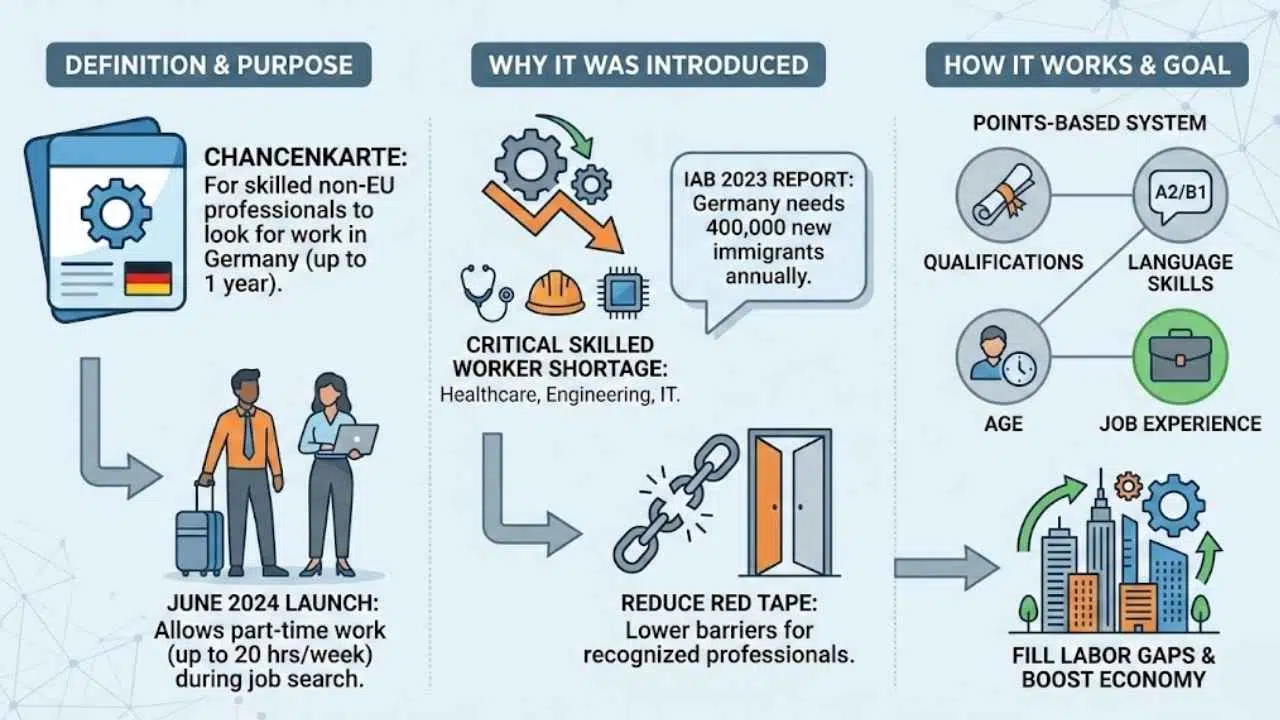
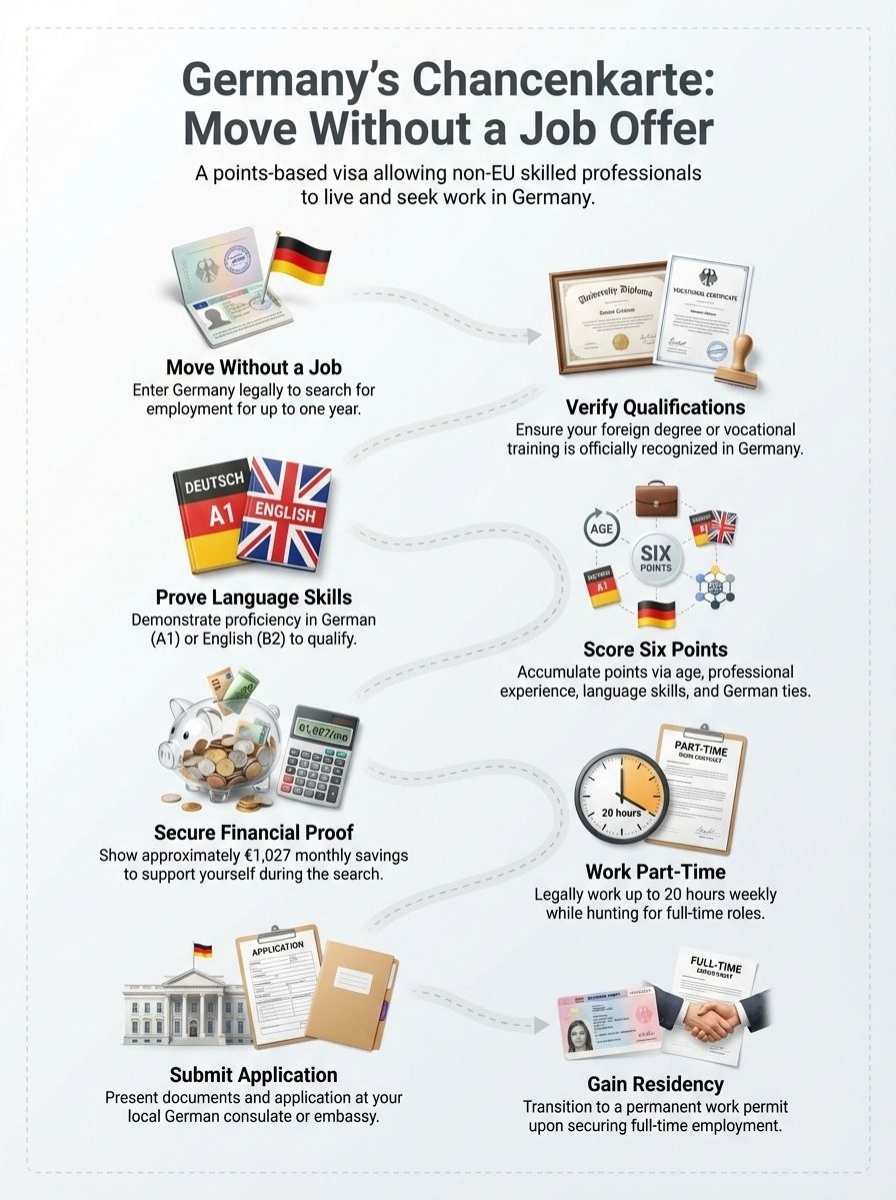
This card allows skilled professionals from outside the EU to move to Germany for up to one year to look for work. It officially launched in June 2024 to modernize how the country attracts talent.
Unlike previous visas, this permit allows you to work part-time (up to 20 hours a week) while you search for a permanent role. This is a massive shift. It means you can cover your rent and buy groceries without burning through your savings immediately.
German lawmakers created this system because businesses could not find enough skilled workers within current borders. A 2023 report by the Institute for Employment Research (IAB) noted that Germany needs 400,000 new immigrants annually to maintain its workforce.
This visa uses a points-based immigration method. It focuses on your qualifications, language skills, age, and job experience.
Why it was introduced
Germany faced a critical shortage of skilled professionals. The gap is widest in healthcare, engineering, and IT.
Many talented people wanted to move but hit a wall because they could not apply without a job offer first. The government launched the Opportunity Card (Chancenkarte) as a specific solution to this bottleneck.
“The goal is simple: reduce the red tape. The Chancenkarte lowers the barriers for recognized degree holders and skilled non-EU professionals.”
By making entry easier, the new visa system helps fill gaps in the labor market. It also boosts the German economy by bringing in people ready to work.
Eligibility Criteria for the Opportunity Card
You need to meet specific standards before you can get the Opportunity Card. It is not a free pass for everyone. Let’s look at the exact requirements you need to hit.
Recognized educational or vocational qualifications
Foreign professionals with academic credentials recognized in Germany can apply for the Chancenkarte immediately. Your diploma or vocational training must be fully recognized in the country where you obtained it.
The government uses a database called anabin to track this. You must check if your university and degree are listed as “H+” (fully recognized) in this system.
If you finished university in the US or India, for example, you need to prove your diploma is equal to a German one. You can also get a “Statement of Comparability” from the ZAB (Central Office for Foreign Education) if your degree isn’t clearly listed.
For skilled workers in regulated professions like nursing or teaching, you also need a “Berufsausübungserlaubnis” (license to practice). This recognition is step one on the road to legal employment.
Language proficiency: German or English
Speaking German helps a lot. However, the Chancenkarte is unique because it officially recognizes English proficiency too.
You generally need one of the following to qualify:
- German skills at level A1 (beginner) or higher.
- English skills at level B2 (upper intermediate) or higher.
Applicants prove these skills by showing certificates. For German, look for Goethe-Institut or Telc certificates. For English, TOEFL or IELTS scores are standard. Higher proficiency scores you more points. For instance, speaking German at a B2 level is worth more in the points calculator than just knowing basic English.
Points-based system requirements
Points determine your eligibility if you are not already considered a “skilled worker” with a fully recognized German degree. You need to score a minimum of six points to qualify.
Here is a quick breakdown of how you can stack up points:
| Criteria | Potential Points |
|---|---|
| Foreign Qualification Equivalence | 4 points |
| Relevant Work Experience (5+ years) | 3 points |
| German Language Skills (B2 level) | 3 points |
| Age (Under 35 years old) | 2 points |
| English Language Skills (C1 level) | 1 point |
| Previous Stay in Germany (6+ months) | 1 point |
Age matters significantly. If you are under 35, that is two easy points in your pocket. Work experience helps too. Two years of experience gets you two points, while five years gets you three.
Connections to Germany count as well. If you have lived there legally for at least six months in the last five years, you earn an extra point. Note that tourist visits do not count for this.
Proof of financial means and health insurance
You must show that you can support yourself. The German government does not want you relying on social benefits.
As of 2025, you generally need to prove you have about €1,027 per month. This usually means putting over €12,000 into a Blocked Account (Sperrkonto). Providers like Fintiba or Expatrio are commonly used for this service.
Health insurance is also mandatory. You cannot enter the country without it.
Most applicants start with private “incoming” or expat insurance from providers like Feather or Mawista. Once you get a full-time job, you will switch to the public statutory health insurance system.
Two Pathways to Qualify for the Chancenkarte
Germany lets you pick between two routes for the Chancenkarte. Grab a cup of coffee and see which one fits your story best.
Skilled worker pathway
Foreign professionals with academic degrees or vocational training that is fully recognized in Germany can use the skilled worker pathway. If your degree is already deemed equivalent to a German one, you qualify automatically.
You do not need to count points for this route. You simply need to prove your recognition, financial stability, and basic language skills.
This option is fast. Many healthcare workers, IT experts, and engineers take this route. It lets you sidestep the point counting and get straight to the application.
Points-based system pathway
This second route is for people whose degrees are recognized in their home country but not yet fully recognized in Germany. This is where the Opportunity Card truly shines.
You need a relevant vocational or academic degree that took at least two years to complete. Once you have that basic requirement, you start counting points.
You need to reach that magic number of six points. For example, if you are 30 years old (2 points), speak C1 English (1 point), and have 5 years of experience (3 points), you hit the target.
This system helps match talented people with jobs even if their paperwork isn’t perfectly aligned with German bureaucracy yet.
How to Apply for the German Opportunity Card
Applying feels like piecing together a puzzle. You need to get your documents ready and follow each step with care.
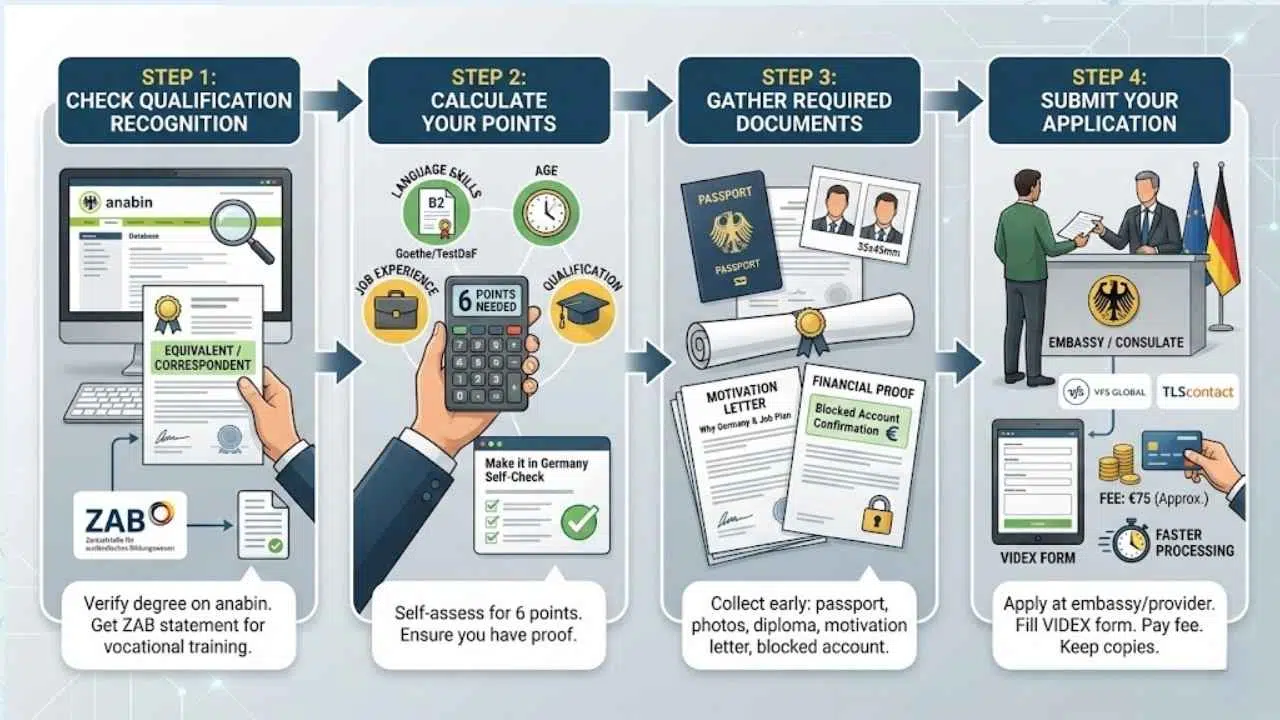
Step 1: Check qualification recognition
Start by checking if your qualification is recognized. Go to the official anabin database. Look for your university and your specific degree.
If your degree is listed as “equivalent” or “correspondent,” print that page. You will need it.
If your vocational training is not academic, you might need a statement from the ZAB. This first step can save weeks of confusion. German authorities are strict about paperwork matching their standards.
Step 2: Calculate your points
Grab a calculator. If you are not using the “Skilled Worker” route, you must ensure you have six points.
Be realistic with your self-assessment. For language points, you need the actual certificate, not just the ability to speak. If you claim B2 German, have your Goethe or TestDaF certificate ready.
Use the “Self-Check” tool available on the government’s Make it in Germany website. It is a great way to verify you meet the criteria before you pay any fees.
Step 3: Gather required documents
Start collecting your papers early. You will need a valid passport, biometric photos (35x45mm), and your diploma.
You also need a motivation letter. This should explain why you want to work in Germany and what kind of job you are looking for.
Don’t forget the financial proof. Opening a Blocked Account can take a few days, so do this well in advance. You need the confirmation document that shows the funds are locked and ready.
Step 4: Submit your application
Take your gathered documents to the correct authority. This is usually the German embassy or consulate in your home country. In some regions, you may need to apply through a service provider like VFS Global or TLScontact.
You will likely need to fill out the national visa application form, often called the VIDEX form, online before your appointment.
The fee is typically €75. Processing times vary, but it is generally faster than the old Job Seeker Visa. Keep copies of everything you submit. You might need them when you land in Germany.
Benefits of the Chancenkarte
You can pack your bags and head to Germany without clinching a job first. But the benefits go beyond just entry.
Flexibility to move without a job offer
The Chancenkarte lets you move to Germany and settle in before you start working. Picture an engineer from India or a teacher from Brazil. They can pack their bags and move using just this one-year visa.
You can attend interviews in person. This is a huge advantage. German employers trust candidates they can meet face-to-face.
With over 1.7 million open job vacancies reported in late 2023, the market is hungry for talent. Being on the ground lets you network and find the right fit.
Legal part-time work opportunities
This is the biggest upgrade from the old visa. You can work part-time for up to 20 hours per week.
This includes “Minijobs,” which are tax-free roles paying up to €538 per month (as of 2024). You could work at a café or do freelance consulting while you hunt for your main career role.
Earning euros while you search relieves massive financial pressure. It also helps you practice your German in a real-world setting.
Pathway to permanent residency
Once you find a qualified full-time job, you can switch your residency permit. You do not need to leave the country to do this.
You can transition to a standard Work Visa or an EU Blue Card if your salary is high enough. Time spent working in Germany counts toward your permanent residency (Niederlassungserlaubnis).
The new laws officially allow for faster naturalization too. In some cases, you can apply for citizenship after just five years, or even three years if you have exceptional integration achievements.
Job Seeker Visa vs. Opportunity Card: Key Differences
Non-EU professionals now have better options. The old Job Seeker Visa was rigid. The new Opportunity Card is flexible. Check out how they stack up below:
| Feature | Old Job Seeker Visa | Opportunity Card (Chancenkarte) |
|---|---|---|
| Eligibility | Strict. Only for those with fully recognized degrees. | Flexible. Uses a points system for those with partial recognition. |
| Language | Usually required German proficiency. | Accepts English (B2) or German (A1). |
| Work Rights | No work allowed (except trial work). | Up to 20 hours/week part-time work allowed. |
| Duration | 6 months. | 12 months (renewable in some cases). |
| Trial Work | Limited. | Allowed for up to two weeks per employer. |
Tips for Success with the Chancenkarte
Start your journey by planning each step with purpose. Stay curious and keep an open mind.
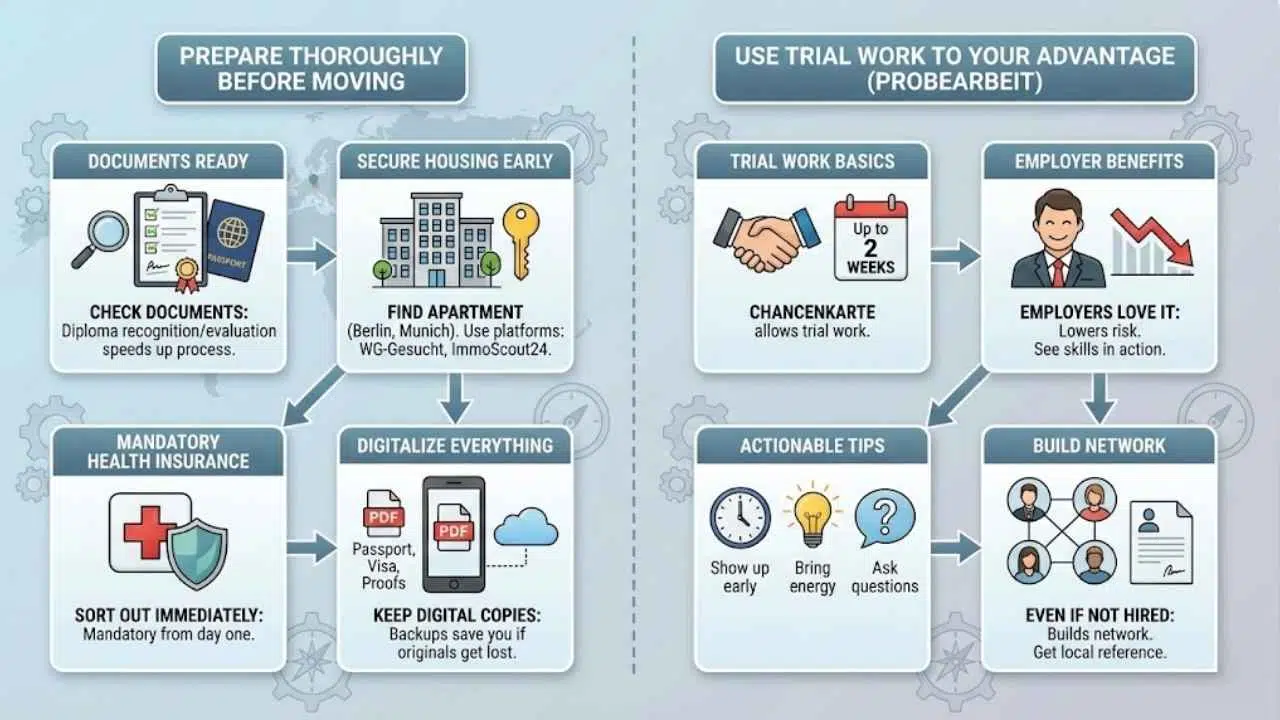
Prepare thoroughly before moving
Check your documents before you pack. Make sure your diploma is recognized or evaluated. This speeds up the process significantly.
Secure your housing early. Finding an apartment in cities like Berlin or Munich is tough. Use platforms like WG-Gesucht or ImmoScout24 to look for shared flats (WGs) before you arrive.
Sort out your health insurance immediately. It is mandatory from day one.
Also, digitalize everything. Keep PDF copies of your passport, visa, and financial proofs on your phone. German bureaucracy loves paper, but having digital backups saves you if originals get lost.
Use trial work to your advantage
Trial work (Probearbeit) is a great tool. The Chancenkarte lets you work on a trial basis for up to two weeks.
Employers love this. It lowers their risk. They can see your skills in action before signing a long-term contract.
Show up early. Bring energy. Ask questions.
Even if they don’t hire you, a good trial period builds your network. You get a local reference, which is gold in the German job market.
Final Thoughts
Germany’s Chancenkarte opens the door for skilled workers to start a new chapter. You do not have to wait for a job offer to begin your life there. We covered how the points work and what you need to prepare. The process rewards those who plan ahead. Are you ready to pack your bags? Learning a little German and organizing your paperwork can change your future. The German job market is waiting for you. Check the official government sites for the latest forms. If I could move with just paperwork and a suitcase, I’d join you myself! Your future in Germany is closer than it seems.