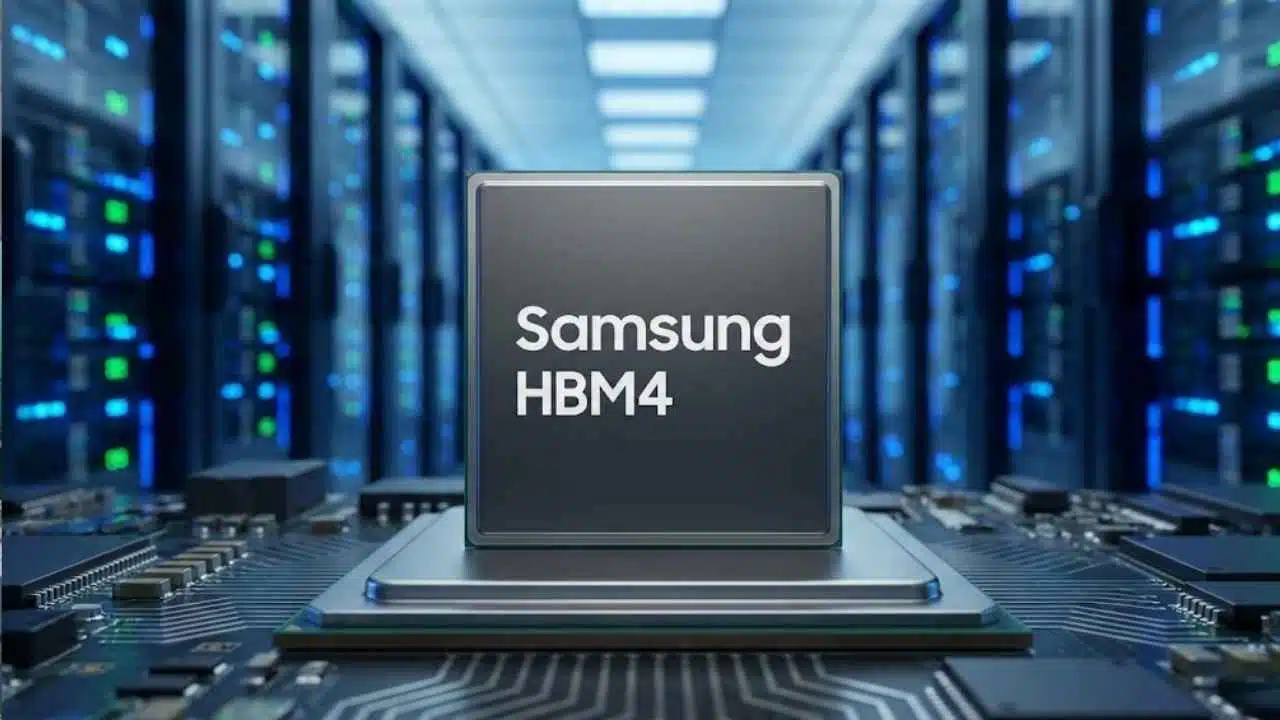
Samsung Electronics said on January 2, 2026, that customers are praising its next-generation Samsung HBM4 chips, a signal the company is regaining momentum in the high-bandwidth memory race that powers modern AI systems.
Why Samsung HBM4 Chips Matter In The AI Boom
High-bandwidth memory (HBM) is a stacked DRAM technology designed to feed GPUs and custom AI chips with extremely fast data transfer. In many AI servers, HBM is a performance bottleneck—and a supply bottleneck—because demand has surged faster than industry capacity.
Samsung has spent the past year trying to recover from delays in qualifying its HBM3E products for key AI platforms. With Samsung HBM4 chips, the company is aiming to reset the narrative: better performance, earlier readiness for next-gen AI systems, and more predictable supply for large customers.
What Samsung Said And What’s New
In a New Year message, Samsung’s semiconductor leadership highlighted customer feedback that its Samsung HBM4 chips look competitive, with some clients signaling renewed confidence in the company’s memory roadmap.
That messaging matters because HBM deals are often decided well before mass shipments begin. Customer praise, sample validation, and early performance results can shape multi-year supply allocations—especially for platforms expected to ship in huge volumes in 2026 and beyond.
Samsung HBM4 Chips: Production Timeline And Where They’ll Be Used
Multiple industry reports say Samsung intends to begin mass production of Samsung HBM4 chips in February 2026 at its Pyeongtaek campus in South Korea. The sixth-generation HBM is widely expected to be designed into next-wave AI accelerators planned for the second half of 2026, including systems built around Nvidia’s “Rubin” platform.
While exact customer line-ups and volumes are typically not confirmed in detail, industry watchers expect HBM4 demand to rise sharply once next-gen AI accelerators move from early deployments into broader cloud expansion.
Key Milestones For Samsung HBM4 Chips (2025–2026)
| Milestone | What It Means | Expected Timing |
| Customer sampling and performance validation | Early proof points that influence supply awards | 2025 (ongoing) |
| Mass production ramp | Volume manufacturing begins | Feb 2026 (reported) |
| Next-gen AI platform launches | Major demand wave for HBM4-based systems | 2H 2026 (expected) |
| Larger-scale data center rollouts | HBM4 demand expands with cloud capex cycles | Late 2026 onward |
Racing To Reclaim Market Share From SK Hynix
Samsung is trying to close the gap with SK Hynix, which has been the most visible winner of the HBM surge tied to AI infrastructure. Several market trackers have put SK Hynix in the leading position through 2024–2025, supported by early traction with top AI accelerator platforms.
One challenge for Samsung is that HBM share can shift quickly when a supplier misses a qualification window for a major GPU or AI accelerator generation. Even if a product becomes competitive later, customers may already be locked into capacity plans and multi-quarter supply schedules.
HBM Market Share Snapshot (Recent Estimates)
(Estimates vary by firm and by quarter, but the overall picture shows SK Hynix leading, with Samsung and Micron competing for the remaining share.)
| Period (Estimate) | SK Hynix | Samsung | Micron | Source Type |
| 2024 (global HBM) | ~52.5% | ~42.4% | ~5.1% | Market tracker estimate |
| Q2 2025 (HBM shipments) | ~62% | ~17% | ~21% | Market research estimate |
| Q3 2025 (HBM share) | ~53% | ~35% | (remainder) | Industry estimate reported publicly |
Samsung’s Broadcom And Custom AI Chip Push
A major part of Samsung’s strategy is diversifying beyond the biggest GPU buyer base. AI compute is expanding into custom accelerators (ASICs) designed by hyperscalers and chip designers, often for lower cost per inference and tighter integration with software stacks.
Industry reporting indicates Samsung has strengthened relationships in this segment, including supplying HBM via partners tied to hyperscaler AI chip programs. Analysts following Samsung’s memory business have also projected that a sizable portion of Samsung’s 2026 HBM output could be allocated to custom ASIC customers—an important hedge if GPU platform awards remain highly competitive.
What Samsung’s “One-Roof” Advantage Looks Like
Samsung’s pitch to customers often centers on vertical integration:
- Memory (HBM and conventional DRAM)
- Foundry (logic manufacturing for some customers)
- Advanced packaging (critical for stacking, interconnect, and thermal constraints in AI modules)
For large AI buyers, supply assurance is now part of performance. A customer that can secure memory, packaging capacity, and predictable delivery schedules is less exposed to project delays in data center buildouts.
HBM4 Versus HBM3E: What Changes
HBM generations typically improve bandwidth, power efficiency, stack density, and platform integration features. HBM4 is expected to extend bandwidth and deliver better scalability for next-gen accelerators. Some reporting has also highlighted strong internal test results and customer evaluations for Samsung HBM4 chips, which Samsung is using to reinforce its “back in the game” message.
At the same time, competition is tightening: rivals are also pushing HBM4 timelines forward, and customers are increasingly demanding customized configurations, tighter power envelopes, and advanced packaging compatibility.
Risks And What Could Still Slow A Comeback
Even with positive early feedback, several factors can still disrupt Samsung’s HBM rebound:
- Qualification timing: AI platforms often have strict validation gates; missing one can delay major revenue by quarters.
- Packaging constraints: Advanced packaging capacity can bottleneck HBM shipments even when wafers are available.
- Geopolitics and trade: Export controls, tariffs, and supply chain restrictions can change purchasing plans and manufacturing flows.
- Pricing and shortages: Industry reporting has pointed to tight memory supply and price pressure spilling into broader electronics markets, raising the stakes for stable HBM delivery.
What Comes Next For Samsung HBM4 Chips
Samsung’s message is clear: customers are responding positively to Samsung HBM4 chips, and the company wants the market to see this as the start of a broader AI-memory turnaround. The next real proof points will come from production stability in early 2026, confirmed supply wins for late-2026 AI platforms, and whether Samsung can convert early praise into sustained market share gains against an entrenched leader.