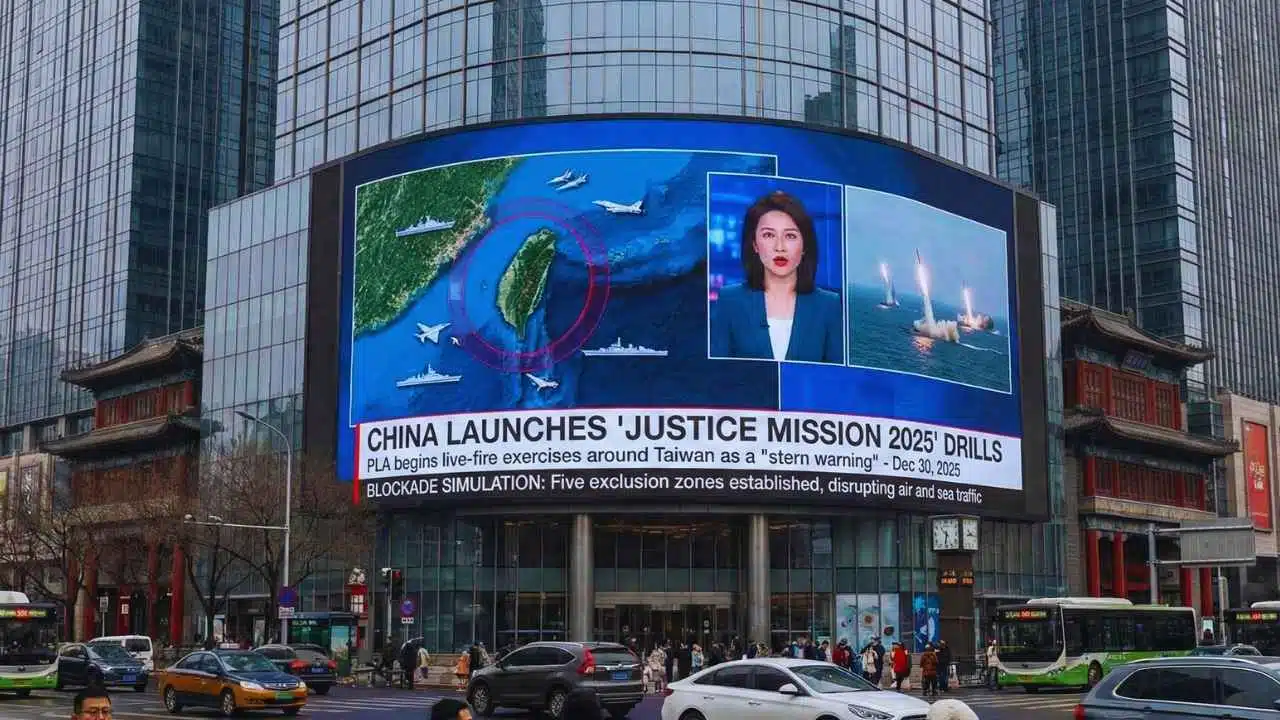
China encircles Taiwan in “Justice Mission 2025” drills with live-fire activity, heavy air-and-sea deployments, and rockets fired into nearby waters on December 30, 2025, escalating pressure days after a record U.S. arms package for Taipei.
China Encircles Taiwan In A Sweeping Live-Fire Show Of Force
China encircles Taiwan in a drill pattern designed to look and feel like an island “ring,” using aircraft, warships, and coast guard vessels to compress the air and sea space around Taiwan.
Taiwan’s defense authorities said the Chinese military operated at unusually high tempo through the day. The reported activity included 71 Chinese military aircraft and 24 naval and coast guard vessels around the island, plus 27 rockets launched into nearby waters during an exercise window described as roughly 10 hours.
China’s military messaging cast the operation as a warning. Beijing’s Eastern Theater Command described the drills as targeting “external interference” and what it calls “Taiwan independence” forces, language that has become a consistent feature of China’s pressure campaigns around the island.
The drill label—“Justice Mission 2025”—and the “encirclement” framing are not accidental. The idea is to show capability and intent at the same time: capability to mass forces quickly and coordinate across branches, and intent to keep Taiwan under constant strategic stress.
Drill Snapshot: What Was Detected Around Taiwan?
| Indicator | What Was Reported | Why It Matters |
| Aircraft activity near Taiwan | 71 aircraft (Dec 30 tally) | Demonstrates sustained air pressure and rapid sortie generation |
| Naval + coast guard presence | 24 vessels | Supports blockade-style posture and persistent tracking |
| Rockets launched into waters nearby | 27 rockets | Signals escalation and adds risk to surrounding sea/air lanes |
| Live-fire window | About 10 hours | Suggests deliberate pacing, not a short “burst” event |
| Median-line crossings (reported in wider counts) | Large share crossed the median line | Raises intercept risk and normalizes closer approaches |
This kind of operation blends several goals. It challenges Taiwan’s surveillance and response capacity, stresses civilian confidence through visible disruption, and signals to outside powers that intervention would face a layered maritime-air-missile environment.
Taiwan’s Response And The Civilian Impact
Taiwan’s government condemned the drills and said it monitored Chinese activity closely while keeping its own forces ready. Taiwan routinely scrambles aircraft, deploys naval assets, and activates land-based missile tracking when it detects high volumes of Chinese flights and ships near its air defense identification zone.
But one of the clearest effects of a large drill is often non-military: pressure on civilian movement.
Taiwan’s aviation authorities said portions of domestic routing were affected, with reported impacts on 11 of 14 local flight routes. Routes to offshore islands close to China’s coast, including Kinmen and Matsu, faced disruptions that affected roughly 6,000 passengers. Even when international flights continue, the declaration of large exercise zones can squeeze civilian air corridors, forcing reroutes and causing delays.
Taiwan’s offshore islands are especially sensitive in these moments. They sit closer to China’s coastline and are more exposed to changes in air and maritime control. Disruption there is also psychologically resonant because it touches daily life quickly—flights, ferries, cargo schedules, and tourism.
Taiwanese officials have described China’s repeated operations as a form of “psychological warfare,” a concept that refers to actions meant to weaken public morale, create a sense of inevitability, and pressure leaders into political concessions. Even without direct conflict, persistent “encirclement-like” activity can foster fatigue and raise the perceived cost of resisting Beijing’s demands.
At the same time, Taipei has strong incentives to avoid any move that Beijing could portray as a provocation. Taiwan’s standard approach in these episodes is to speak firmly, keep responses measured, and emphasize stability, while quietly testing readiness behind the scenes.
Why Now: The U.S. Arms Package And The Diplomatic Shockwaves?
The timing of “Justice Mission 2025” is closely tied to a major U.S. arms package for Taiwan announced in mid-December.
U.S. notifications described an overall package estimated at about $11.1 billion. The mix included long-range rocket artillery systems, self-propelled howitzers, anti-armor missiles, loitering munitions and unmanned systems, networking and mission software, and sustainment support. Taiwan’s Presidential Office publicly welcomed the package and framed it as strengthening Taiwan’s defensive posture.
From Beijing’s standpoint, these sales are not treated as ordinary commerce. China argues that U.S. military support violates its “one China” position and encourages Taiwan to resist Beijing’s political goals. That disagreement is foundational and structural, which means it tends to reappear whenever large defense transfers become public.
The package also fits Taiwan’s push toward asymmetric defense—capabilities meant to deny or delay an attack rather than match China platform-for-platform. Rockets, mobile artillery, loitering munitions, and anti-ship support are central to that approach because they are designed for survivability and dispersed operations under pressure.
Breakdown Of Major Items Highlighted In The U.S. Notifications
| System / Support Area | Estimated Value | Practical Use For Taiwan |
| HIMARS rocket artillery | ~$4.05B | Mobile precision fires; deterrence through range and survivability |
| M109A7 self-propelled howitzers | ~$4.03B | Modern artillery for ground defense and counter-landing operations |
| ALTIUS-700M/600 systems | ~$1.1B | Loitering munitions and ISR to find, track, and strike targets |
| Tactical mission networking | ~$1.01B | Secure coordination, targeting, and interoperability support |
| Javelin missiles | ~$375M | Short-range anti-armor defense against landing forces |
| TOW missiles | ~$353M | Anti-armor defense in layered ground engagements |
| Harpoon repair/support | ~$91.4M | Sustainment to keep anti-ship capability available |
| AH-1W spare/repair support | ~$96M | Sustainment to keep helicopter fleet mission-capable |
A key point is that these are not “instant” capabilities. Delivery schedules, training pipelines, and integration take time. That gap can increase pressure in the near term because Beijing may believe it has an opportunity to intimidate Taiwan before new systems are fully fielded.
China has also used sanctions and diplomatic warnings in previous episodes, signaling that it is willing to respond beyond the Taiwan Strait—targeting defense companies, restricting cooperation, and raising the political cost for governments that deepen ties with Taipei.
What “Encirclement” Means Militarily?
When people hear that China encircles Taiwan, the immediate fear is invasion. But many drills are structured to emphasize options short of an amphibious landing—especially a blockade, a quarantine-style operation, or a campaign of coercive pressure that restricts Taiwan’s access to trade routes and resupply.
A blockade-style posture can be practiced through several visible components:
- Air pressure: Large numbers of aircraft force Taiwan to track, identify, and respond while also signaling that China can surge and sustain operations.
- Maritime presence: Warships provide combat power, while coast guard and other state-linked vessels can apply pressure in a more “law enforcement” posture.
- Missile and rocket demonstrations: Launches into nearby waters communicate escalation capacity and create real hazards that reshape air and sea routing.
- Zone declarations: Temporary exercise zones can mirror the geometry of a quarantine, gradually expanding the idea that China can control access.
This blend is effective for coercion because it creates uncertainty. Even if shipping lanes remain technically open, insurance costs, commercial risk calculations, and schedule disruptions can rise quickly. For a global economy that relies on predictable East Asian logistics, even limited disruptions can ripple.
The median line issue matters here as well. The Taiwan Strait median line is not a treaty boundary, but it served for decades as a practical restraint. Frequent crossings can normalize closer contact, increase intercept risk, and make a crisis more likely to start from an incident rather than a planned decision.
These exercises also allow China to test real-world coordination: communications, timing, aircraft deconfliction, sensor coverage, and command decisions. The more complex the drill, the more it reveals about joint operational maturity.
Another often-overlooked element is information shaping. Labels like “Justice Mission” are designed to frame the operation as legitimate in Chinese domestic politics and to portray Taiwan as the provocateur. That narrative contests Taiwan’s diplomatic space and tries to weaken international sympathy for Taipei.
What Happens Next And What To Watch?
The immediate question after a large operation is whether the tempo drops back to baseline or whether the baseline itself has shifted again.
Several indicators will shape what happens next:
1) Frequency Of Live-Fire Elements
If China repeats rocket launches and live-fire windows more often, it raises the level of risk and makes civilian disruption more routine. It can also serve as rehearsal for maintaining exclusion zones during a crisis.
2) Expansion Of Coast Guard Roles
China’s coast guard presence can blur the line between military pressure and “law enforcement” activity. A higher proportion of coast guard operations can increase pressure while complicating response options and messaging.
3) Duration And Geographic Spread
Longer drills and wider zone geometry would matter more than a single-day surge. Watch for operations that cover multiple sectors around Taiwan at once or extend into choke points that shipping relies on.
4) International Responses
Statements and posture shifts by the United States, Japan, and other regional actors can influence Beijing’s calculations. Even without direct intervention, changes in alliance messaging or regional exercises can signal deterrence.
5) Taiwan’s Procurement And Readiness Timeline
The U.S. arms package is significant, but the deterrent value depends on delivery, training, and integration. Taiwan will likely emphasize dispersed basing, resilience, and the ability to keep operating under pressure.
A broader strategic backdrop also hangs over these events: U.S. defense assessments have highlighted China’s modernization goals and its stated ambitions to improve readiness for a Taiwan contingency by the end of 2027. Large joint drills near Taiwan are consistent with a military building toward credible options across multiple pathways, not just a single invasion scenario.
For now, “Justice Mission 2025” looks like an exercise designed to tighten coercive pressure while reminding Taiwan—and outside powers—that China can raise costs rapidly in the air and sea lanes that matter most.