Imagine you are three days into a backcountry hike. You reach for your phone to check the GPS or snap a photo of the sunset, but your cold, trembling fingers fumble. The device tumbles down a rocky scree slope and lands face down in a puddle. For a standard flagship phone, this is a death sentence—a cracked screen, water damage, and a dead battery within hours. But for the best rugged smartphones for outdoor adventures, this is just a Tuesday.
The era of rugged phones being slow, brick-like afterthoughts is over. The latest generation of outdoor-ready devices combines military-grade durability with flagship-level performance. We are seeing devices that don’t just survive drops; they offer tools that standard phones can’t match: thermal imaging to spot wildlife, built-in projectors for campsite movie nights, satellite messaging for off-grid safety, and batteries that last for weeks, not hours.
Whether you are a professional surveyor, an extreme sports enthusiast, or a weekend camper who wants peace of mind, there is a device built for your specific needs. In this guide, we have tested and ranked the top 8 rugged smartphones available today, breaking down their real-world performance, durability ratings, and unique features to help you choose the ultimate adventure companion.
Key Takeaways
-
Best Overall for Daily Use: Samsung Galaxy XCover 7 offers the perfect balance of ruggedness and usability with a user-replaceable battery.
-
Best for Battery Life: The Doogee V Max Plus and Unihertz Tank 3 Pro feature massive batteries (22,000mAh+) that can last over a week on a single charge.
-
Best for Safety: The CAT S75 is essential for true off-grid explorers, featuring integrated satellite messaging that works where cell towers don’t.
-
Best for Groups: The Ulefone Armor 26 Ultra includes a built-in walkie-talkie antenna, perfect for keeping hiking groups connected.
-
Most Durable: The Nokia XR21 carries an IP69K rating, meaning it can withstand high-pressure, high-temperature water jets, making it virtually waterproof.
Why Your Standard Flagship Isn’t Enough for the Wild
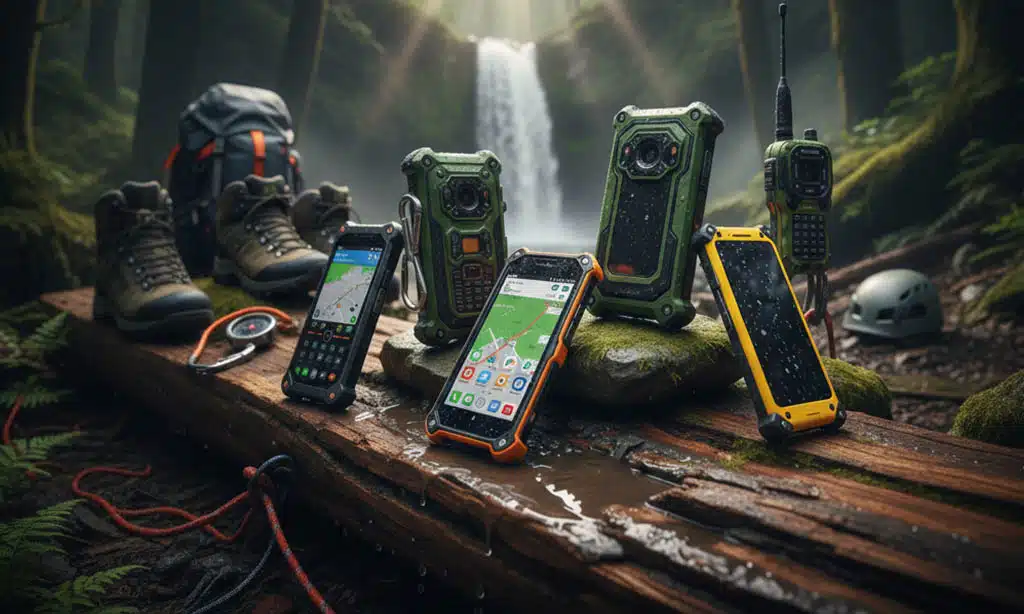
You might assume a waterproof case makes your standard phone adventure-ready, but the wilderness demands more. Consumer flagships have critical failure points that no case can fix: extreme temperatures, screen responsiveness, and raw utility.
In freezing alpine conditions, a standard battery can die instantly, whereas rugged phones are engineered with insulation to keep running. Furthermore, trying to use a sleek touchscreen with muddy gloves or during a downpour is often impossible. The devices on this list feature “Wet Touch” and “Glove Mode” technology, ensuring you can access maps even in a storm.
Beyond durability, these phones are purpose-built tools. They offer hardware advantages like thermal imaging, satellite connectivity, and high-powered lanterns. A case might save your screen from a drop, but a true rugged phone ensures you stay connected when nature fights back.
Quick Comparison: Top Picks at a Glance
| Model | Best Feature | Battery | IP Rating | Weight |
| Samsung XCover 7 | Removable Battery | 4,050 mAh | IP68 | ~240g |
| Nokia XR21 | Sleek & Eco-Friendly | 4,800 mAh | IP69K | 231g |
| Unihertz Tank 3 Pro | Projector & Lantern | 23,800 mAh | IP68 | 696g |
| CAT S75 | Satellite SOS | 5,000 mAh | IP68 | 268g |
| Ulefone Armor 26 | Walkie-Talkie | 15,600 mAh | IP69K | 600g |
| Doogee V Max Plus | Massive Battery | 22,000 mAh | IP68 | ~540g |
| Blackview BL9000 | Thermal Camera | 8,800 mAh | IP68 | 412g |
| Oukitel WP30 Pro | 120W Fast Charging | 11,000 mAh | IP69K | 413g |
The 8 Best Rugged Smartphones for Outdoor Adventures
We’ve rigorously analyzed the market to find the top performers that balance military-grade durability with modern utility. From satellite-enabled lifelines to battery behemoths, here are the elite devices ready to tackle your next expedition.
1. Samsung Galaxy XCover 7
Best For: The “Daily Driver” Adventurer
Most rugged phones feel like carrying a brick in your pocket. The Samsung Galaxy XCover 7 is the exception. It is designed for those who want a phone that fits in a pocket and runs familiar software but can still take a beating.
The Breakdown:
The standout feature here is the user-replaceable 4,050mAh battery. In the wilderness, charging ports can break or get wet. With the XCover 7, you can simply pop the back off and swap in a fresh battery in seconds—a feature long lost in modern smartphones. It runs on Samsung’s reliable One UI, ensuring you get regular security updates and a smooth interface that doesn’t feel “clunky.”
Pros:
-
Slim profile compared to competitors.
-
Instantly replaceable battery.
-
Guaranteed software updates and security patches.
-
“Wet Touch” screen sensitivity allows use in rain.
Cons:
-
Smaller battery capacity compared to the “tank” phones on this list.
-
The camera is decent (50MP) but lacks specialized night vision or thermal modes.
Verdict: If you are a hiker who wants a phone that works just as well in the office as it does on the trail, this is your best bet.
2. Nokia XR21
Best For: Eco-Conscious Hikers & Sleek Design
Nokia has returned to its roots of building indestructible phones. The XR21 is arguably the best-looking rugged phone on the market, built with a 100% recycled aluminum chassis and tough, impact-resistant polycarbonate.
The Breakdown:
The “XR” stands for Extreme Reality, and it lives up to the name with an IP69K rating. While IP68 protects against submersion, IP69K protects against high-pressure, high-temperature water jets. You could technically power-wash this phone, and it would survive. It also features a “Speed Warp” camera mode for capturing fast-moving action like mountain biking or trail running.
Pros:
-
IP69K rating (highest water resistance standard).
-
Made from sustainable, recycled materials.
-
Surprisingly good 64MP main camera with AI portrait features.
-
Stereo speakers are loud enough to hear over wind noise.
Cons:
-
Storage is not expandable via microSD.
Verdict: For the environmentally conscious adventurer who needs a phone that can survive a kayak flip or a sudden downpour, the XR21 is a stylish fortress.
3. Unihertz Tank 3 Pro
Best For: The Ultimate Camping Tool
The Unihertz Tank 3 Pro is barely a phone; it’s a survival multi-tool with a screen. It is massive, heavy, and unapologetically utilitarian.
The Breakdown:
Why carry a separate lantern and entertainment system when your phone can do both? The Tank 3 Pro features a built-in 100-lumen DLP projector, allowing you to project movies or maps onto your tent wall. It also boasts a massive camping light on the back that can illuminate an entire campsite. Powering all this is a gargantuan 23,800mAh battery, which provides standby time measured in weeks, not days.
Pros:
-
Built-in projector is a game-changer for camp entertainment.
-
Massive battery eliminates “range anxiety.”
-
Includes a dedicated camping lantern.
-
120Hz refresh rate keeps the display smooth.
Cons:
-
Extremely heavy (nearly 700g)—not for ultralight backpackers.
-
The bulky design is difficult to use with one hand.
Verdict: If you are car camping or overlanding and weight isn’t an issue, the Tank 3 Pro replaces three different gadgets in your pack.
4. CAT S75
Best For: Off-Grid Explorers (Satellite Connectivity)
For true explorers who venture far beyond the reach of cell towers, the CAT S75 offers something priceless: a lifeline.
The Breakdown:
The headline feature is the Bullitt Satellite Connect service. If you are injured or lost in a “dead zone,” the S75 allows you to send text messages and share your location via geostationary satellites. Unlike standard SOS beacons that only alert rescue services, this lets you message friends and family to say, “I’m okay, just running late.” It also features unique hygiene technology; all external components are blended with silver ion-based antimicrobial additives to keep the phone germ-free.
Pros:
-
Reliable two-way satellite messaging.
-
Waterproof to 5 meters for 35 minutes.
-
Drop-proof from 1.8 meters onto steel.
-
Antimicrobial coating is great for muddy/dirty environments.
Cons:
-
Satellite service requires a subscription plan.
-
Charging speed (15W) is slower than competitors.
Verdict: This is the best rugged smartphone for outdoor adventures where safety is the number one priority. It brings the peace of mind of a satellite messenger into your everyday device.
5. Ulefone Armor 26 Ultra
Best For: Group Communication (Walkie-Talkie)
Communication is key when moving in a convoy or hunting group. The Ulefone Armor 26 Ultra integrates classic radio tech with modern smarts.
The Breakdown:
This device comes with a detachable antenna that turns the phone into a UHF/VHF walkie-talkie. It supports both digital and analog modes, allowing you to communicate with other standard walkie-talkies without needing cellular service or Wi-Fi. It’s powered by a substantial 15,600mAh battery and features a monstrous 200MP main camera.
Pros:
-
A hardware walkie-talkie works completely off-grid.
-
Massive 200MP camera sensor for high-detail landscape shots.
-
120W fast charging tops up the huge battery quickly.
-
A loud 121dB speaker acts as a siren or music player.
Cons:
-
The antenna adds bulk when attached.
-
Heavy build due to the large battery.
Verdict: Ideal for search and rescue teams, hunting groups, or hiking convoys where keeping in constant voice contact is necessary.
6. Doogee V Max Plus
Best For: The “Battery King”
If you hate carrying power banks, the Doogee V Max Plus is your dream device. It holds the title for one of the largest batteries ever put in a smartphone.
The Breakdown:
With a 22,000mAh battery, this phone offers up to 2,300 hours of standby time. In practical terms, you could use it heavily for a week of hiking and still have power left. It also supports reverse charging, meaning it can act as a power bank to charge your GPS watch, earbuds, or a friend’s dying iPhone. It runs on the capable Dimensity 7050 chipset, making it snappy enough for gaming and heavy multitasking.
Pros:
-
Unbeatable battery life (effectively a power bank with a screen).
-
Solid performance with 12GB+ RAM.
-
Night vision camera included.
-
Stereo sound is surprisingly rich.
Cons:
-
Very thick (over 26mm) and heavy.
-
Charging takes a while despite 33W charging, simply due to capacity.
Verdict: The ultimate choice for long expeditions where electricity is unavailable for extended periods.
7. Blackview BL9000 Pro
Best For: Thermal Imaging & Technical Work
For some adventurers, seeing the landscape isn’t enough—you need to see the heat within it.
The Breakdown:
The BL9000 Pro integrates a high-resolution FLIR Lepton 3.5 thermal camera. This isn’t a gimmick; it allows you to spot wildlife in pitch darkness, check if your campfire is fully extinguished, or diagnose heat leaks in a cabin. The “MyFLIR Pro” app offers advanced analysis tools usually reserved for expensive standalone thermal cameras.
Pros:
-
Best-in-class thermal imaging (160×120 resolution).
-
Operable with gloves (Glove Mode).
-
Dual Harman Kardon speakers provide excellent audio.
-
120W charging fills the 8,800mAh battery incredibly fast.
Cons:
-
Smaller battery than the “Max” or “Tank” models.
-
The thermal camera module adds a camera bump.
Verdict: A specialized tool for hunters, engineers, and campers who need thermal vision for safety and observation.
8. Oukitel WP30 Pro
Best For: Performance & Fast Charging
Rugged phones often lag behind in speed, but the Oukitel WP30 Pro breaks that stereotype.
The Breakdown:
Powered by the MediaTek Dimensity 8050 5G processor, this phone scores flagship-level benchmarks. It’s fast, responsive, and handles 3D gaming with ease. Its “party trick” is the 120W fast charging, which can take the 11,000mAh battery from 0% to 50% in just 15 minutes. It also features a unique 1.8-inch AMOLED back display, allowing you to check the time, compass, or notifications without waking the main power-hungry screen.
Pros:
-
Fastest processor on this list (Antutu score ~800,000+).
-
Incredible charging speed (120W).
-
The rear display saves battery and adds convenience.
-
Premium carbon-fiber texture design.
Cons:
-
Rear screen functionality is somewhat limited to widgets.
-
No headphone jack.
Verdict: If you want a rugged phone that feels as fast as a premium gaming phone, the WP30 Pro is the clear winner.
Buying Guide: How to Choose a Rugged Phone
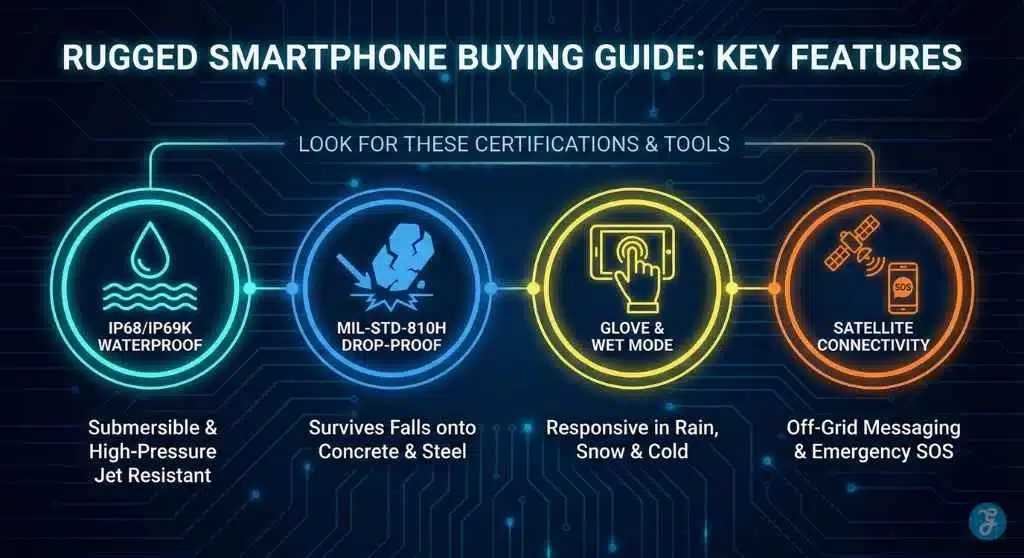
Choosing the right device goes beyond just looking at the battery size. Here are the critical factors to consider for outdoor use.
1. IP68 vs. IP69K: What’s the Difference?
Almost all modern phones are IP68 rated, meaning they can be submerged in 1.5 meters of water for 30 minutes.
IP69K is a step up. It certifies that the device can withstand high-pressure, high-temperature water jets (like a steam cleaner). If you are into motorsports, rafting, or industrial work, look for IP69K (found in the Nokia XR21 and Ulefone Armor 26).
2. MIL-STD-810H Explained
This is a US Military standard that tests equipment against environmental stress. A phone with this rating has survived tests for:
-
Thermal Shock: Rapid changes from freezing to scorching heat.
-
Vibration: Being mounted on an ATV or off-road vehicle.
-
Drop Tests: Usually from 1.5 to 1.8 meters onto concrete or steel.
Note: Always check if the manufacturer specifies “drop-to-concrete” vs. “drop-to-plywood.”
3. Screen Visibility & Glove Mode
A rugged phone is useless if you have to take off your gloves in a blizzard to use it. Look for “Glove Mode” or high touch sensitivity settings. Also, consider brightness; for direct sunlight, you want a display with at least 500 nits (though 1000+ nits, like standard flagships, is rare in this category).
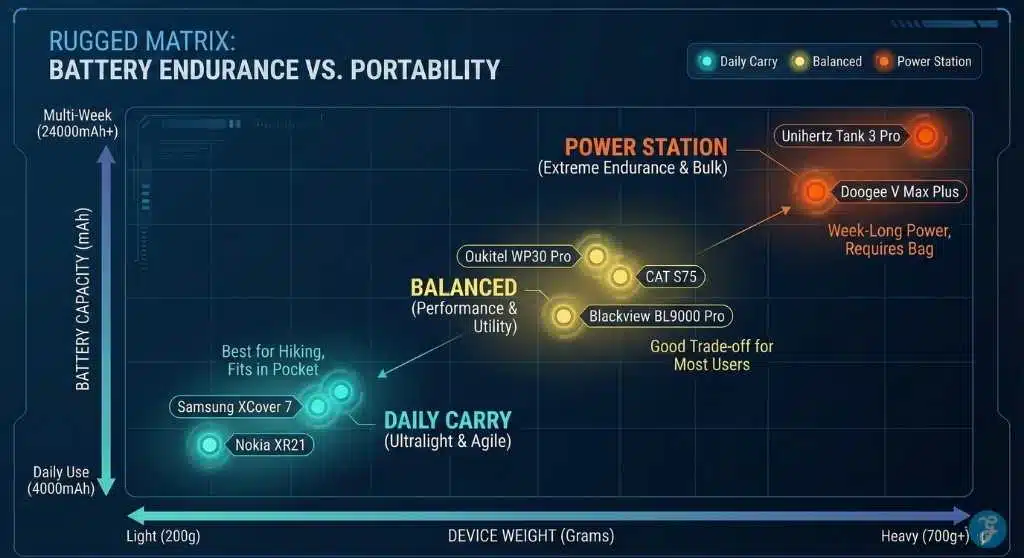
4. Weight vs. Battery Life
There is a direct trade-off here.
-
Under 300g: Comfortable for hiking and daily carry (Samsung XCover 7, Nokia XR21, CAT S75).
-
Over 500g: Too heavy for a pocket; requires a belt clip or backpack storage. These offer week-long battery life (Doogee V Max Plus, Unihertz Tank 3).
Frequently Asked Questions (FAQ)
Can rugged phones work on 5G networks?
Yes, most modern rugged phones (like the Oukitel WP30 Pro and Samsung XCover 7) are fully 5G compatible. However, always check the specific “bands” supported if you are importing a phone, as some Chinese rugged brands may have limited connectivity in North American rural areas compared to Europe or Asia.
Are rugged phones too heavy for everyday use?
It depends on the model. Phones like the Samsung Galaxy XCover 7 and Nokia XR21 weigh roughly the same as a standard iPhone Pro Max with a case. However, “battery beast” models like the Unihertz Tank 3 can weigh nearly three times as much (600g+) and are generally impractical for jeans pockets.
Which rugged phone has the best camera?
While none match the quality of a Pixel or iPhone, the Ulefone Armor 26 Ultra (200MP) and Nokia XR21 (64MP with AI processing) offer the best photography experience. The Blackview BL9000 Pro is the winner if you specifically need thermal imaging.
Do I really need satellite connectivity?
If you hike on popular trails or camp in established parks, standard cellular usually suffices. However, if you are an alpinist, deep-sea fisherman, or backcountry explorer where “zero bars” is guaranteed, the satellite SOS on the CAT S75 could literally save your life.
Why don’t mainstream brands like Apple make rugged phones?
Mainstream brands focus on aesthetics and thinness. They rely on users buying rugged cases (like OtterBox). Dedicated rugged phones are built from the inside out to handle shock, with reinforced solder joints and shock-mounted components that a standard phone in a case simply doesn’t have.
Final Thoughts
The gap between “rugged” and “smart” has finally closed. You no longer have to choose between a phone that survives a drop and a phone that can run your favorite apps smoothly. For the weekend warrior, the Samsung Galaxy XCover 7 offers a familiar, reliable experience without the bulk.
For the long-haul expedition leader, the Doogee V Max Plus ensures you are never left powerless. And for those who venture into the unknown, the CAT S75 provides the satellite link that keeps you connected to civilization.
The outdoors are unpredictable; your gear shouldn’t be. Choosing one of these best rugged smartphones for outdoor adventures ensures that when the trail gets tough, your technology keeps up.