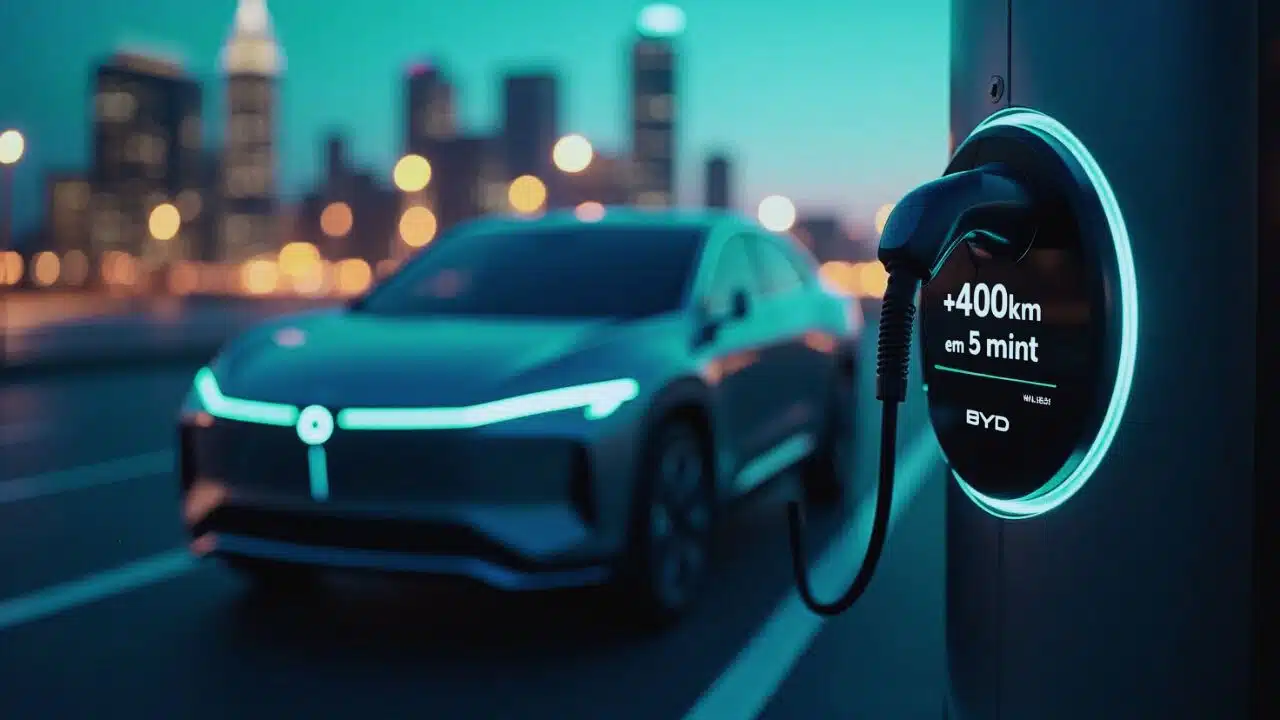
BYD’s megawatt-era charging is the closest EVs have come to “fuel-stop convenience,” but the catch is you need the right charger network—and that’s the hard (and expensive) part.
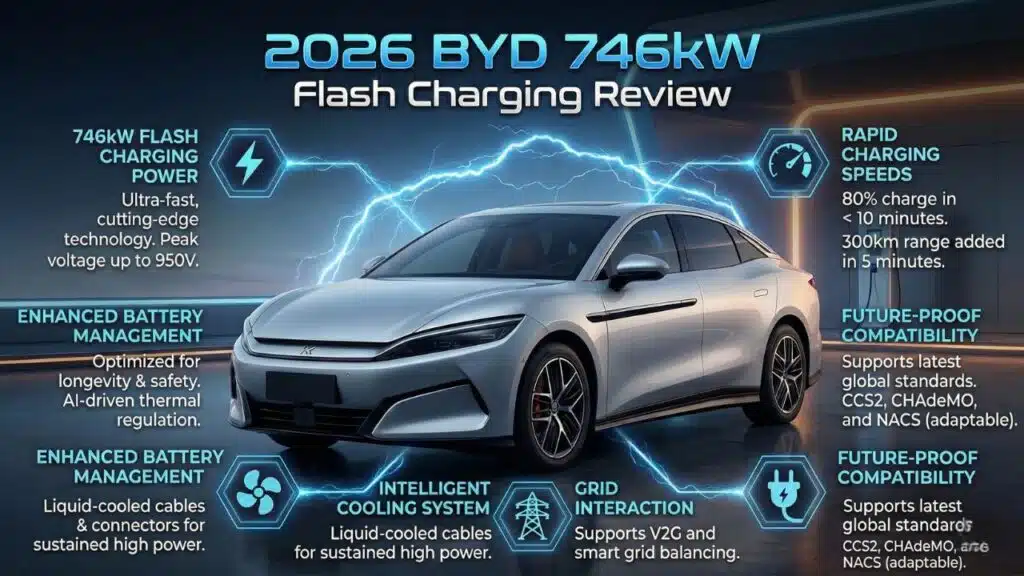
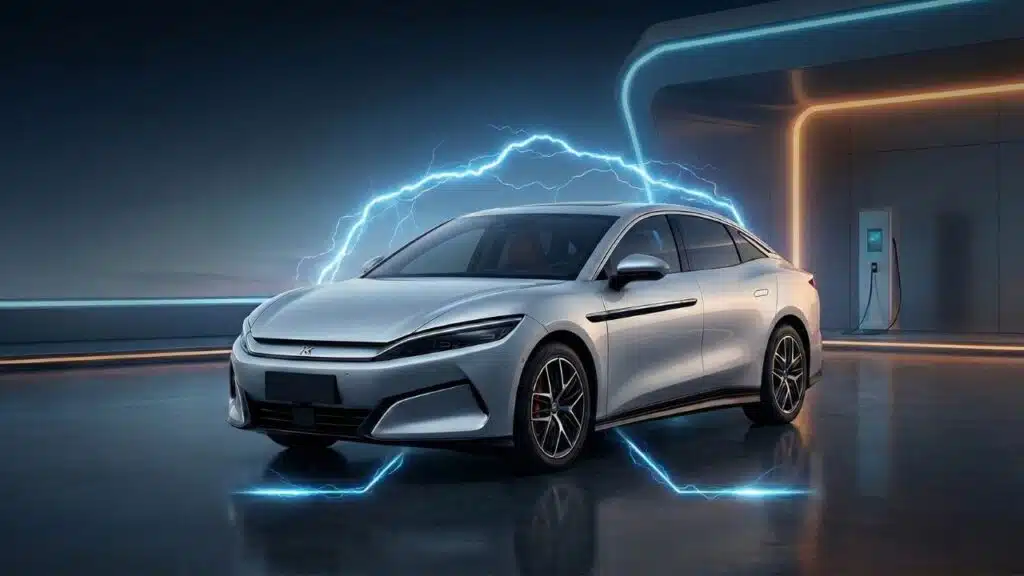
This 2026 BYD 746kW Flash Charging Review: 400 km Range in 5 Minutes? Review looks at BYD’s Super e-Platform as it appears in the BYD Han L EV—one of the first production cars built to exploit megawatt-class charging. BYD claims up to 1,000 kW peak charging and “400 km in 5 minutes,” and recent public demos have shown charging power spiking to around 746 kW in the wild.
Positioning: Think of the Han L EV as a full-size, China-market flagship performance sedan that’s trying to make two big statements at once—supercar thrust and gas-station-like charging stops. The target buyer isn’t just chasing speed; they’re chasing time saved on road trips and a “no compromises” EV routine.
Exterior Design and Practicality
| Spec | BYD Han L EV (AWD flagship) |
| Dimensions (L/W/H) | 5050 / 1960 / 1505 mm |
| Wheelbase | 2970 mm |
| Ground clearance | Not disclosed (varies by market/trim) |
| Cargo volume | Not disclosed (official); front trunk: 115 L (AWD) |
Design impression in daily use
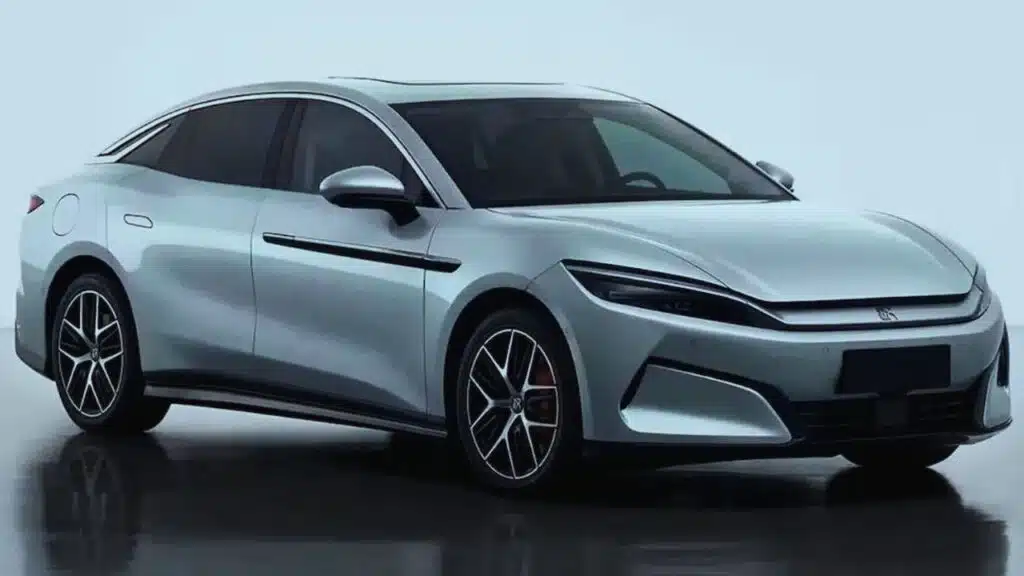
The Han L reads as clean and low-slung rather than shouty. It’s a big sedan (over five meters long), and in traffic it has that “long hood, planted stance” look that tends to age well.
Details matter here because this is a tech flagship, not a budget EV pretending to be premium. The exterior design leans toward aerodynamic cleanliness—flush handles, simplified surfacing, and a front-end that’s more “quiet confidence” than aggressive cosplay.
Build, paint, and visibility reality check
From the outside, the practical story is mixed in the way most low sedans are. The sleek roofline helps efficiency, but it also sets expectations: curb approaches and tight parking ramps demand more attention than in a crossover.
Visibility should be “fine, not panoramic.” The footprint is large, and you’ll lean on cameras and sensors in tight city spaces. This is the kind of car you learn quickly—where the corners are, how much the nose swings in a U-turn, and which driveways you avoid.
Utility: the part nobody puts on the brochure
Official trunk volume figures aren’t consistently published in the mainstream spec sources, so it’s safer to call it “large-sedan adequate” rather than promise a number. What is clearly documented is a usable frunk (115 L on the AWD trim listed), which is genuinely handy for cables, a small backpack, or the stuff you don’t want sliding around in the main trunk.
The big takeaway after living with a sedan-shaped EV: the Han L will do family errands and airport runs without drama, but it won’t replace the “throw anything in the back” ease of a tall hatch or SUV.
Interior Comfort and Technology
| Interior item | What you’re getting in Han L EV |
| Center screen | 15.6-inch floating touchscreen |
| Instrument display | 10.25-inch LCD cluster (reported) |
| Infotainment | BYD DiLink 150 (reported) |
| Seating material | Premium finishes; sustainable bamboo/wood elements noted in early reviews |
| Head/legroom | Not disclosed in the primary spec sheet sources used here |
Week-with-the-car comfort: what stands out
The cabin’s vibe is “modern flagship,” meaning it prioritizes screen-led control and lounge-like features over minimalist austerity. The dash design is clean, the materials aim for premium, and the overall impression is more mature than “gadget first, car second.”
The seat feature set is where the Han L tries to justify its flagship label in daily driving. Reports call out heating, ventilation, and massage up front, and attention to rear-seat comfort as well. That matters more than people admit, because megawatt charging only changes road trips if the car still feels fresh after hours on the move.
Infotainment and connectivity: big screen, big expectations
A 15.6-inch central display is a statement, but usability is what counts. BYD’s system approach here is “integrate everything”: navigation, media, car settings, and driver-assistance visualization all live in the same ecosystem.
One practical note: megawatt charging pushes you toward planning. The car and the network matter together, so the best version of this experience is the one where route planning, charger availability, and battery pre-conditioning feel seamless. If the software nails that, the charging headline becomes a daily-life benefit rather than a party trick.
Noise isolation and daily refinement
Big sedans tend to win on calmness, and early driving impressions emphasize stability and composure rather than harshness. The Han L’s platform story is basically “high power, but controlled delivery,” and that usually correlates with a quieter, less frantic cabin feel—especially at steady speeds.
If BYD gets the basics right—wind noise, tire roar management, and suspension tuning—this will feel like a proper long-distance tool, not just a fast commuter.
Performance and Powertrain
| Performance spec | BYD Han L EV (AWD flagship) |
| Powertrain type | Dual-motor BEV, AWD |
| Peak power | 810 kW (1,086 hp) |
| Peak torque | 860 Nm |
| Transmission | 1-speed fixed ratio |
| 0–100 km/h | 2.7 seconds |
| 0–60 mph | ~2.6 sec (approx., based on 0–100 km/h) |
How it feels in the real world
On paper, 810 kW is “supercar conversation.” In practice, what matters is how usable it is at normal speeds—merging, overtakes, and short highway gaps. The best descriptions emphasize power that arrives fast but doesn’t feel chaotic, with torque distribution that keeps the car stable when you’re not trying to launch like a drag racer.
The numbers suggest a car that won’t just feel “quick for an EV.” It’ll feel quick, full stop. And because it’s a big sedan, the real win is when it does that without feeling twitchy or constantly on edge.
Handling and ride: performance without being exhausting
A key detail in the road impressions is the chassis approach: mechanical suspension plus continuously variable damping. That typically means the car can be firm when you push and calmer when you cruise, which is exactly what a daily-driven flagship needs.
Steering feel is hard to judge without consistent instrumented testing across outlets, but the ideal here is predictable, confidence-building response—especially because this much straight-line power can expose weak chassis tuning fast.
The charging-performance link most people miss
The Super e-Platform isn’t just “a faster plug.” It’s a full-stack approach: 1000V architecture, battery design, thermal management, and power electronics meant to make extreme charging rates feasible without constant throttling. That matters because megawatt charging only feels normal if it’s repeatable and stable, not a one-time peak number followed by a fast taper.
In day-to-day use, you care less about the peak and more about the average power you can hold through the useful part of the charge window.
Fuel Economy and Real-World Running Costs
| Economy / costs | BYD Han L EV (AWD flagship) |
| Official consumption | 16.0 kWh/100 km |
| City (equiv.) | Not published in the core spec sources (cycle-dependent) |
| Highway (equiv.) | Not published in the core spec sources (cycle-dependent) |
| Real-world expectation | 18–22 kWh/100 km depending on speed, tires, climate (estimate) |
| Fuel tank capacity | N/A (EV) |
| Battery capacity | 83.2 kWh |
What the official number means (and doesn’t)
The published consumption figure is useful as a baseline, but it’s not the whole story. Your real cost depends on sustained speed, ambient temperature, tire choice, and how often you use the car’s biggest strengths.
Megawatt charging is about time, not efficiency. It’s absolutely plausible that a car optimized to accept extreme power will still be efficient at cruise, but fast charging sessions can add losses and heat management overhead. That’s not a deal-breaker; it’s simply part of the ownership math.
Running costs: the practical owner view
If you’re cross-shopping this against premium performance sedans, your big “EV savings” levers are still the usual ones: electricity pricing, home charging availability, and tire wear. High-power sedans tend to chew through rear tires faster than most owners expect, especially if the torque becomes a daily habit.
Maintenance on EV drivetrains is generally simpler than ICE, but advanced suspension and high-end sensors can shift costs back into the “premium car” bucket if something goes wrong out of warranty.
The megawatt station reality
The most important real-world cost question for this specific BYD isn’t energy. It’s infrastructure access. A 5-minute stop only exists if the station exists, is online, and can deliver the power without throttling.
Scaling that kind of charging requires serious station investment and, in many places, meaningful grid upgrades. Some approaches use local storage or power management to reduce grid strain, but it’s still a heavy lift compared to standard fast charging.
Safety and Driver Assistance
| Safety snapshot | BYD Han L EV |
| Crash-test rating | Not yet widely published for Han L in major western programs |
| ADAS suite | DiPilot 300 listed; NVIDIA DRIVE Orin X listed; LiDAR listed (by trim) |
| Airbag count | Not disclosed in the primary sources used here |
What’s actually on the car
The Han L’s spec listings include a modern compute platform for driver assistance, plus LiDAR hardware on certain trims. That’s a serious hardware stack, and it signals BYD’s intent to compete on more than just range and acceleration.
That hardware matters because big, heavy, very fast sedans need more than straight-line ability. They need confidence systems: predictable adaptive cruise behavior, solid lane keeping, and emergency assist that doesn’t constantly false-alarm or behave unpredictably.
Driver assistance in real use: the “trust” test
The lived experience always comes down to calibration: how smoothly it follows, how it handles cut-ins, and whether it nags or surprises you. A flagship should feel calm and consistent, not jumpy or overconfident.
If BYD tunes the system to be smooth first and “clever” second, it’ll be the type of assistance you keep on for long drives rather than turning off after 20 minutes.
Rating context (because buyers ask)
Depending on where you live, formal crash ratings for this exact model may not be widely available yet. That’s not unusual for newer, market-specific trims. If crash-test scores are a deal-breaker for your purchase decision, you’ll want to track local testing programs and confirmed results in your region once the model is evaluated.
BYD Han L EV vs. Tesla Model S Plaid
| Spec | BYD Han L EV (AWD) | Tesla Model S Plaid |
| Base price (reported) | 279,800 yuan (China launch MSRP listed) | $111,630 starting price (as tested/quoted) |
| Horsepower | 1,086 hp | 1006 hp |
| Efficiency / economy | 16.0 kWh/100 km (listed) | 110 MPGe combined (noted) |
| Battery / powertrain warranty | Battery pack warranty listed as first-owner lifetime | Battery & Drive Unit limited warranty (program varies by region) |
Value and positioning: these cars aim at different worlds
The wild part is the price spread. The Han L’s listed China pricing exists in a completely different ecosystem than the Model S Plaid’s U.S. pricing, yet the performance figures sit in the same neighborhood.
That doesn’t automatically mean the Han L is “better.” It means the markets, incentives, and supply chains are different. Tesla’s strengths tend to be software ecosystem maturity and charging network consistency in many regions, while BYD is aiming to win on charging speed—especially where it controls the infrastructure.
Charging: the headline battle
BYD’s story is “megawatt charging is here,” with claims of up to 1,000 kW peak and “400 km in five minutes.” Public demonstrations have shown very high observed charging power in real scenarios, and controlled demos suggest the car can touch extreme peaks before tapering as the battery fills.
Tesla’s counter is network scale and consistency in many countries, even if peak power is lower. For owners, “how often can I do it” tends to beat “what’s the max number once.”
The infrastructure catch (the part that decides everything)
This is the deciding factor. Megawatt charging can reduce the psychological friction of EV road trips, but it demands enormous power delivery and significant station investment. That’s easier when a single market is rolling out a coordinated plan, and harder when infrastructure is fragmented.
If your region won’t see megawatt-class stations soon, the charging advantage is mostly theoretical. If you do get those stations, the ownership experience can change overnight.
Final Verdict: Is the BYD Han L EV Worth Your Money?
Pros
- Megawatt-capable charging can change road-trip psychology when you have access to the right stations.
- Real-world demonstrations show headline-grabbing charging power when conditions align.
- Flagship-sedan size with serious performance credentials (810 kW / 1,086 hp; 0–100 km/h in 2.7s).
- Comfort and tech package reads properly premium on paper (big screen, high-feature seats reported).
- Strong driver-assistance hardware stack listed (modern compute + LiDAR by trim).
Cons
- The “5 minutes = 400 km” promise is infrastructure-dependent; without megawatt stations, it’s just a very fast EV on regular fast chargers.
- Extreme charging requires extreme power delivery, which is costly and complicated to scale.
- Some practical specs buyers care about (like trunk volume and ground clearance) aren’t consistently published across common sources.
- Global safety ratings for this exact model may not be widely available yet, depending on region and testing timelines.
Value assessment
In its home-market pricing context, the Han L EV looks like a disruptive “performance-per-dollar” play, especially with megawatt-ready hardware built in. Where it gets complicated is outside that context—pricing, availability, and charging networks differ massively by country.
Still, the direction is unmistakable: BYD is trying to win on time. And time is the one thing EV road trips have historically demanded too much of.
Definitive recommendation
Buy this car if you live where BYD’s megawatt chargers are (or will be) common, you do frequent long drives, and you want a flagship sedan that makes charging stops feel closer to fuel stops. The Han L EV makes a strong case that “charging anxiety” can be engineered away—at least where the infrastructure supports it.
Look elsewhere if your routine depends on public charging in regions without a clear megawatt rollout, or if you’d rather have a slower-but-denser charging experience today. In that world, reliability, station density, and route planning matter more than the peak number on a spec sheet.
FAQs on 2026 BYD 746kW Flash Charging Review
Is “400 km in 5 minutes” real in normal driving?
It can be real under ideal conditions, but it’s not a guarantee. Charging speed depends on charger capability, battery temperature, state of charge, and how aggressively the system tapers as the battery fills.
What matters more: peak kW or average charging speed?
Average speed across the useful window matters more. A brief peak looks great, but the best experience is sustained high power from roughly low-to-mid state of charge, because that’s where most road-trip top-ups happen.
Will ultra-fast charging hurt battery health?
Not automatically, but it increases thermal stress and demands smarter management. If the battery and cooling system are designed for it, the car can protect itself—yet frequent high-power charging is still harder use than mostly home charging.
Do I need a 1000V charger to benefit?
To get the headline experience, you need the right high-voltage, high-current infrastructure. On typical fast chargers, it’ll still charge quickly, but it won’t deliver the “gas-stop” style time savings.
Who should skip this BYD and buy something else?
If your region doesn’t have a clear path to megawatt-class stations, the core advantage won’t show up often. In that case, prioritize the best charging network coverage, service support, and the kind of cabin/ride you’ll enjoy every single day.