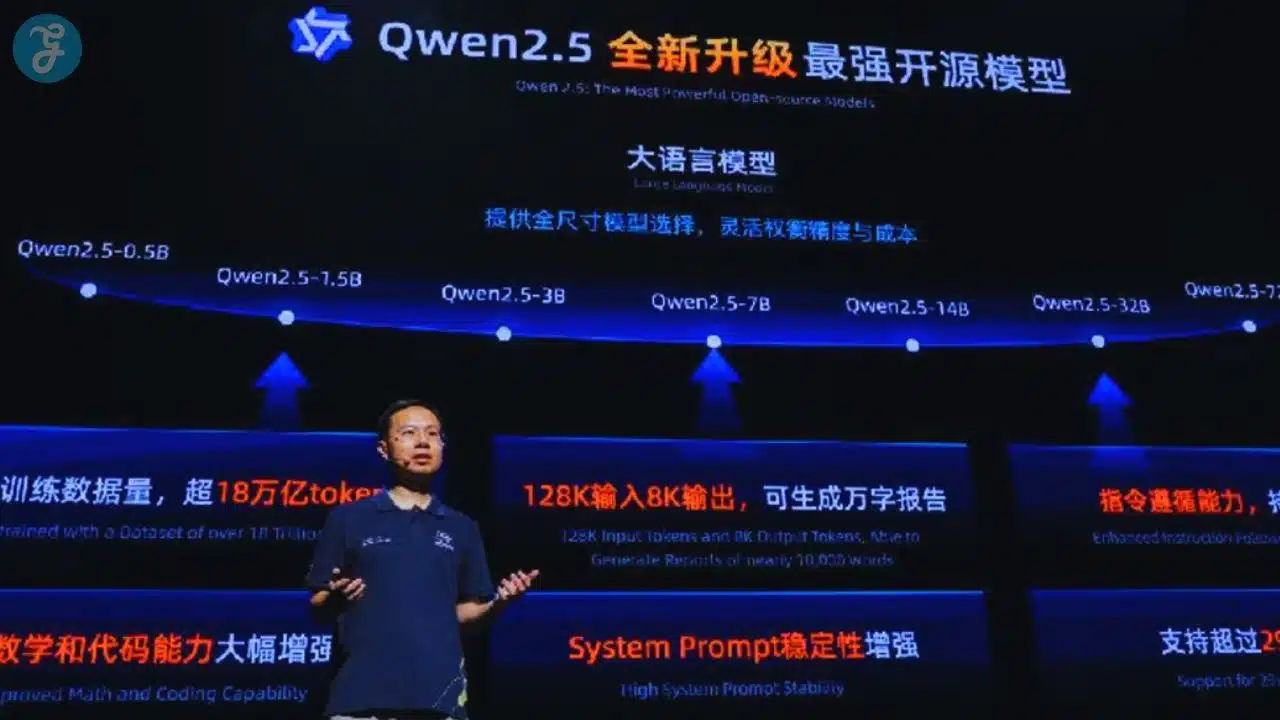
Alibaba’s Qwen has officially overtaken Meta’s Llama to claim the title of the most downloaded open-source AI model worldwide, signaling a dramatic power shift in the global AI race. This breakthrough, detailed in the comprehensive 2025 Open Models Year in Review from AI research firm Epoch AI—drawing on massive datasets from Hugging Face and other repositories—highlights Qwen’s explosive rise, with the entire Qwen 3 model family amassing over 600 million downloads throughout the year alone.
What started as a promising Chinese contender has evolved into the undisputed leader, especially for developers seeking versatile base models for fine-tuning across complex tasks. Experts point to Qwen’s superior multilingual capabilities as a key driver, allowing it to handle over 100 languages with high accuracy—from nuanced Mandarin dialects to intricate Arabic scripts and even low-resource African tongues—making it indispensable for global applications. In contrast to Llama’s strengths in English-centric benchmarks, Qwen’s architecture excels in cross-lingual reasoning, code generation, and long-context processing, which has propelled it ahead in total downloads and as the preferred starting point for custom AI builds.
By late 2025, Qwen-2.5 variants were logging 1.4 million monthly downloads on Hugging Face, outpacing Llama by a wide margin, while fine-tuning activity showed over 40% of new models on platforms like Replicate and Together AI basing their work on Qwen foundations. This isn’t just a numbers game; it’s reshaping how businesses worldwide build AI, from startups in Southeast Asia optimizing e-commerce chatbots to European firms tackling regulatory-compliant translation tools.
The milestone reflects broader trends in open-source AI democratization. Under its permissive Apache 2.0 license, Qwen lowers barriers for innovators who can’t afford proprietary giants like GPT-4 or Claude, offering comparable performance at a fraction of the inference cost—often under $0.10 per million tokens. Developers rave about its efficiency on consumer hardware, enabling rapid prototyping without massive GPU clusters. As one Epoch AI analyst noted, “Qwen has become the choice for a lot of problems,” particularly in resource-constrained environments where speed and affordability matter most.
Qwen App’s Meteoric Rise and Silicon Valley’s “Qwen Panic”
Fueling this dominance is the consumer-facing Qwen app, which launched its public beta on November 17, 2025, and skyrocketed to 10 million downloads in its debut week—a feat unmatched by contemporaries like Grok or Gemini apps. By early December, monthly active users hit 30 million across iOS, Android, and web platforms, delivering a staggering 149% month-over-month growth and cementing its status as the fastest-expanding AI application ever tracked by firms like Sensor Tower and App Annie. This surge stems from Qwen’s intuitive design, offering free, instant access to advanced features like real-time voice translation, image analysis, and personalized productivity tools, all powered by on-device inference for privacy and speed.
For everyday users, the app transforms mundane tasks: shoppers in Latin America use it to compare prices across borders in Spanish or Portuguese, while Indian professionals draft emails in Hindi or Tamil with cultural nuance. Businesses are integrating it too, with small e-commerce operators in Southeast Asia leveraging Qwen for dynamic product descriptions that boost conversion rates by up to 25%, based on early Alibaba ecosystem reports. The app’s viral spread underscores a key advantage: unlike gated Western models, Qwen prioritizes accessibility, running smoothly on mid-range smartphones and supporting offline modes in regions with spotty internet.
This momentum has ignited “Qwen Panic” in Silicon Valley, where U.S. tech titans grapple with the implications of Chinese models eroding their lead. Airbnb CEO Brian Chesky candidly revealed in a December 2025 podcast that his company “relies heavily” on Qwen, praising it as “very good, fast, and cheap” for production-scale deployments. Airbnb juggles 13 AI models, including OpenAI and Anthropic options, but found ChatGPT’s tools lacking readiness for high-stakes use cases like dynamic pricing or guest personalization—areas where Qwen delivered reliable results without the integration headaches. Chesky’s endorsement echoes a wider trend: OpenRouter’s analysis of 100 trillion tokens processed in 2025 shows Chinese open-source models, spearheaded by Qwen, capturing nearly 30% of global AI usage, a leap from just 1.2% in late 2024.
The numbers tell a stark story of market share erosion. Over 40% of fresh AI language models on developer hubs now derive from Qwen architectures, compared to Meta’s Llama slipping to 15%. This shift pressures Western incumbents, as cost-conscious enterprises—from fintech startups automating fraud detection to media companies generating subtitles—flock to Qwen for its balance of power and price. Venture capitalists in the Valley are buzzing about the “Qwen effect,” prompting frantic investments in catch-up open models, while regulators scrutinize the geopolitical ripple effects of such rapid adoption.
Alibaba’s Bold AI Strategy and Leadership Elevation
Alibaba is all-in on this AI ascendancy, elevating Zhou Jingren—CTO of Alibaba Cloud and head of Tongyi AI Labs, the powerhouse behind Qwen—to its prestigious 17-member Partnership on December 9, 2025. A Microsoft veteran with over a decade in big data and cloud engineering before joining Alibaba in 2015, Zhou has been the architect of Qwen’s transformation from an experimental project into a global juggernaut. Under his guidance, the labs iterated through six major releases in 2025 alone, incorporating breakthroughs like mixture-of-experts scaling, advanced retrieval-augmented generation, and vision-language fusion that rivals closed-source leaders.
This promotion arrives amid Alibaba’s massive $54 billion commitment over three years to AI infrastructure, including hyperscale data centers in Asia-Pacific hubs and custom silicon optimized for Qwen workloads. The bet is paying off handsomely: AI-related products have delivered triple-digit revenue growth for nine consecutive quarters, as outlined in Alibaba’s Q3 2025 earnings call, with cloud AI services alone surging 142% year-over-year. Beyond numbers, Qwen is embedding deeply into Alibaba’s vast ecosystem—powering hyper-personalized e-commerce recommendations that analyze user behavior in real time, enhancing mapping apps with AI-driven traffic predictions and local search, and revolutionizing services like restaurant discovery with multimodal queries (e.g., “Find vegan spots near me with great reviews and photos”).
This integration positions Qwen as more than a chatbot; it’s a comprehensive platform ecosystem, rivaling super apps like WeChat while expanding globally. In China, it’s already processing billions of daily interactions; internationally, partnerships with telecoms in Indonesia and Brazil are rolling out localized versions. For developers, Qwen’s open weights enable endless customization—fine-tuning for niche domains like legal document analysis in Europe or agricultural yield forecasting in Africa—driving a virtuous cycle of community contributions that further refines the models. As Alibaba eyes 2026, Zhou’s leadership signals sustained aggression, potentially challenging even proprietary frontiers in areas like autonomous agents and enterprise-grade reasoning.