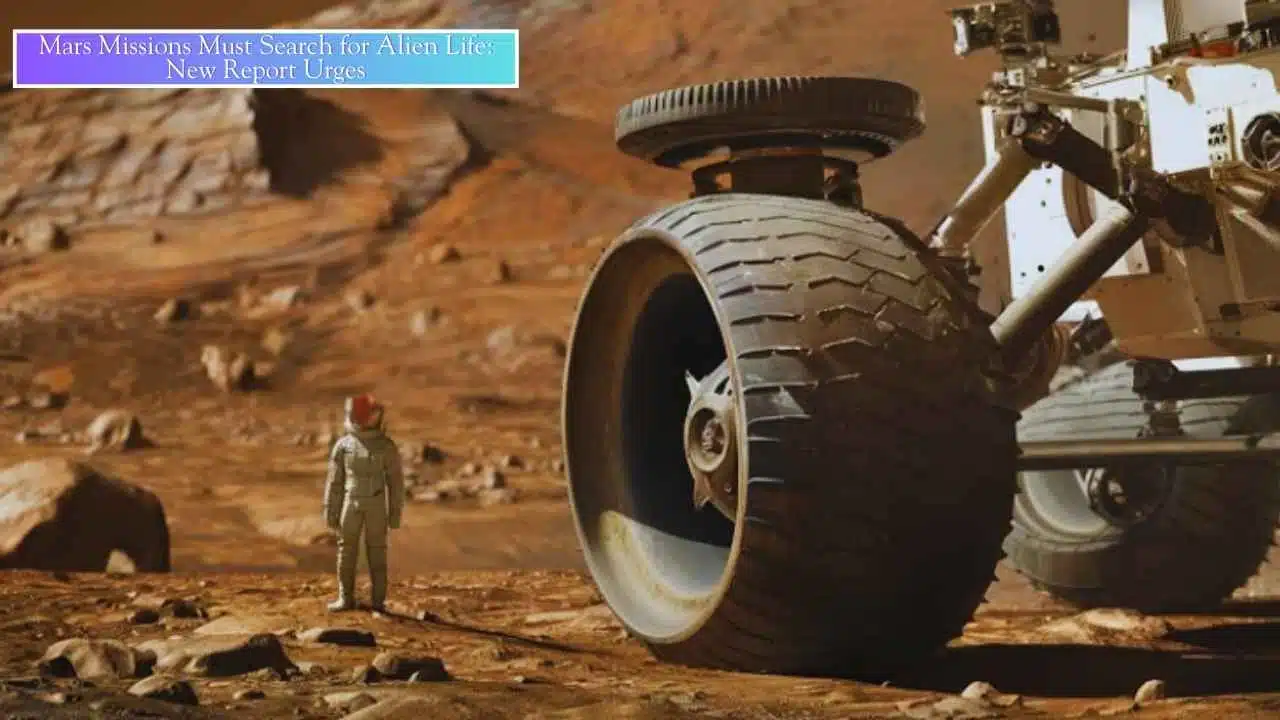
A comprehensive 240-page roadmap released on December 9, 2025, by the prestigious National Academies of Sciences, Engineering, and Medicine positions the search for signs of alien life as the absolute top priority for NASA’s upcoming crewed missions to Mars in the mid-2030s. Titled “A Science Strategy for the Human Exploration of Mars,” this influential document outlines 11 critical science objectives, explicitly stating that detecting past or present life on the Red Planet must lead the way for all explorers across disciplines. Organizers hail this as a pivotal shift, ushering in a new era where groundbreaking scientific discovery directly shapes and guides astronaut-led exploration efforts, rather than treating science as an afterthought.
This report emerges at a crucial juncture for NASA’s Artemis-to-Mars vision, building on lunar missions to refine technologies like habitats, suits, and propulsion systems before the longer, harsher Red Planet journey. It meticulously integrates insights from planetary scientists, astrobiologists, engineers, and human factors experts to ensure missions deliver maximum knowledge returns. By prioritizing life detection, the strategy addresses one of humanity’s oldest questions—whether we are alone in the universe—while laying groundwork for sustainable human presence beyond Earth.
Four Detailed Mission Campaigns Proposed
Co-chaired by renowned experts Dava Newman, former MIT Media Lab director and professor, and Lindy Elkins-Tanton, director of Arizona State University’s School of Earth and Space Exploration and lead of NASA’s Psyche asteroid mission, the report proposes four distinct, multi-phase campaigns. Each consists of three sequential missions designed to progressively build capabilities and scientific yields from humanity’s first boots on Martian soil. These campaigns emphasize site selection based on orbital data, in-situ resource utilization (ISRU) for water and fuel production, and advanced infrastructure to support extended stays.
The highest-priority campaign targets a geologically rich, 100-kilometer-wide exploration zone featuring diverse terrains and abundant near-surface glacial ice deposits, which could harbor preserved biosignatures from ancient microbial life. Phase one launches with a short 30-sol crewed surface mission—a sol being Mars’ day, roughly 24 hours and 40 minutes long—to scout and validate the site. This is followed by an uncrewed cargo mission delivering habitats, rovers, drills, and lab equipment. The campaign peaks with a 300-sol long-duration crewed mission, allowing deep fieldwork, sample collection, and real-time analysis in a fully equipped surface laboratory.
A second campaign shifts focus to subsurface exploration via deep drilling operations penetrating 2 to 5 kilometers into the Martian crust, targeting hypothesized aquifers or briny water pockets where liquid water might persist today despite surface extremes. Other campaigns explore lava tubes for radiation shielding and potential habitats, polar ice caps for water cycle studies, and equatorial regions for geologic history. Every campaign mandates “human-agent teaming,” blending astronaut expertise with autonomous robots and AI for safer, more efficient operations, such as robotic precursors scouting hazards or AI-assisted sample processing.
Core Science Objectives in Depth
At the forefront stands the quest for life: assessing Mars’ past and present habitability, hunting for extant or extinct organisms, and tracing prebiotic chemistry that could bridge non-life to life. Complementary priorities include characterizing the planet’s dynamic water and carbon dioxide cycles—from polar caps to seasonal flows—and reconstructing its geologic evolution through crater impacts, ancient volcanism, and tectonic clues. Crew health emerges as vital, evaluating full-spectrum risks like low gravity, radiation, dust toxicity, and psychological isolation over months-long stays.
Further objectives tackle dust storm dynamics and their impacts on operations, in-situ resource utilization for oxygen, water, and methane fuel production, multigenerational effects on plants and microbes in Martian greenhouses, long-term material stability under harsh conditions, and high-resolution radiation mapping for safe site selection. These goals draw from decades of rover data like Perseverance’s organic detections and Curiosity’s habitability findings, scaling them to human capabilities for transformative insights.
Bridging Science and Human Spaceflight Worlds
The report boldly fuses NASA’s science directorate with its human exploration arm, advocating a unified path under the Moon-to-Mars framework. When our astronauts set foot on Mars, it will be one of humanity’s greatest milestones. And finding extant or extinct life on Mars will be the discovery that defines the next century,” Newman declared, underscoring the profound stakes. Elkins-Tanton echoed this, noting Mars as a living laboratory for planetary habitability and human adaptation, where Earth shrinks to a pale blue dot in the sky.
Penn State University played a starring role, with researchers steering priorities in atmospheric modeling, astrobiology frontiers, and physiological countermeasures. James Pawelczyk, a Penn State kinesiology professor, former shuttle astronaut, and steering committee member, explained: “The report considers exploration in a very different way than we have conducted human spaceflight before,” integrating science as equal partner to engineering feats. This holistic view prepares for missions where astronauts aren’t just pioneers but chief scientists.
Navigating Planetary Protection Challenges
Stringent planetary protection protocols currently forbid crewed landings in zones with potential liquid water to prevent Earth microbes contaminating any native life, preserving pristine science. The report recommends NASA collaborate internationally to evolve these guidelines thoughtfully, enabling access to high-value life-bearing regions without compromising integrity—perhaps via sterile suits, clean zones, or phased approaches. It stresses immediate on-site labs for every landing to analyze samples before Earth return, minimizing forward contamination risks.
Looking ahead, the document calls for summits on optimizing human-robot-AI synergies, standardized surface lab designs, and a successor study on orbital and transit science phases. Full implementation could redefine NASA’s cadence, aligning with President Trump’s reelected administration’s push for accelerated deep-space goals post-2025 inauguration.