


How to Choose the Right Lab Equipment for Your Research

How to Choose Right Lab Equipment for Research

Selecting the right lab equipment is crucial for conducting accurate and efficient research. Whether you are setting up a new laboratory or upgrading existing equipment, making the right choices can significantly impact your research outcomes. Here’s a comprehensive guide to help you navigate the selection process.

Identify Your Research Needs

Before purchasing laboratory supplies, clearly define the specific requirements of your research. Consider the following questions:

  • What type of experiments will you be conducting?
  • What are the required precision and sensitivity levels?
  • How frequently will the equipment be used?
  • What safety measures should be in place?

Understanding these factors will help you narrow down your choices and select equipment that best fits your research needs.

Consider Quality and Reliability

The quality and reliability of lab equipment directly impact the accuracy of your results. Opt for equipment from reputable manufacturers known for their high standards. Look for the following:

  • ISO certifications and compliance with industry standards.
  • Positive user reviews and testimonials.
  • Warranty and after-sales support options.

Reliable equipment minimizes errors and reduces downtime due to malfunctions.

Budget and Cost Considerations

While cost is an important factor, it should not be the sole determinant in your decision-making process. Consider:

  • The long-term value of the equipment rather than just the upfront cost.
  • Maintenance and operational costs.
  • Potential funding or grants that could offset expenses.

Investing in high-quality equipment can save money in the long run by reducing the need for frequent repairs and replacements.

Space and Compatibility
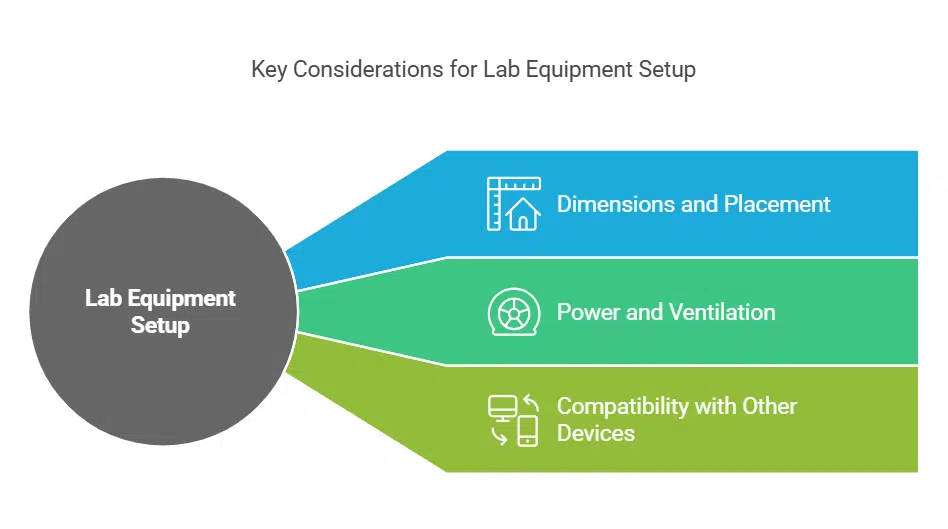
Space and Compatibility

Ensure that the equipment fits within your laboratory space and is compatible with existing systems. Take into account:

  • Dimensions and placement within the lab.
  • Power and ventilation requirements.
  • Compatibility with other devices and software.

Planning ahead will prevent operational inefficiencies and workflow disruptions.

Safety and Compliance

Lab equipment should adhere to safety regulations and comply with local and international standards. Key aspects to consider include:

  • Proper insulation and shielding to prevent hazards.
  • Compliance with OSHA, FDA, and other regulatory bodies.
  • Availability of safety manuals and training for users.

Choosing compliant equipment ensures a safer working environment and minimizes liability risks.

Vendor Reputation and Support

Partnering with a reputable vendor can make a significant difference in the quality and longevity of your equipment. Look for suppliers that offer:

  • Technical support and training.
  • Installation services and user manuals.
  • Spare parts and maintenance services.

A reliable vendor will help you resolve issues promptly and maximize equipment performance.

Future Expansion and Upgradability

As research evolves, your equipment needs may change. Consider selecting modular and upgradable equipment that allows for:

  • Software updates.
  • Additional accessories and attachments.
  • Integration with advanced technology.

Future-proofing your lab will ensure scalability and adaptability to new research developments.

Final Thoughts

Choosing the right lab equipment requires careful planning and consideration of multiple factors, including research needs, quality, cost, safety, and vendor support. By investing in the right equipment, you can enhance research efficiency, accuracy, and overall productivity. Take your time to research options, seek expert opinions, and make informed decisions to set up a successful laboratory environment.



Subscribe to Our Newsletter

Related Articles

Top Trending

Limitations of Large Language Models
10 Limitations of Large Language Models Nobody Should Ignore
What Are Digraphs
What Are Digraphs? A Parent’s Guide to Teaching th, sh, and ch
Product-Led vs Sales-Led Growth
Product-Led vs Sales-Led Growth: Can SaaS Companies Really Do Both?
On This Day August 16
On This Day August 16: History, Famous Birthdays, Deaths & Global Events
Infographic illustrating the Retrieval-Augmented Generation (RAG) process for AI, showing data retrieval, context augmentation, and generation for a grounded response.
RAG Explained: How AI Systems Ground Their Answers in Real Data

Technology & AI

Limitations of Large Language Models
10 Limitations of Large Language Models Nobody Should Ignore
Product-Led vs Sales-Led Growth
Product-Led vs Sales-Led Growth: Can SaaS Companies Really Do Both?
Infographic illustrating the Retrieval-Augmented Generation (RAG) process for AI, showing data retrieval, context augmentation, and generation for a grounded response.
RAG Explained: How AI Systems Ground Their Answers in Real Data
Digital security dashboard displaying key cybersecurity statistics for businesses alongside a glowing shield icon and network servers.
11 Cybersecurity Statistics That Should Worry Every Business
Mobile app for your business planning shown with app wireframes, performance analytics, budgeting notes, and multiple devices used to evaluate development decisions.
10 Questions to Ask Before Deciding on a Mobile App for Your Business

GAMING

Online Color Game Philippines
Online Color Game Philippines: What Every Beginner Should Know Before Playing
Ways to Reduce Game Development Costs
12 Ways Studios Cut Game Development Costs
NFT game development cost
How Much Does NFT Game Development Cost? A Realistic Budget Breakdown
Reasons Why You No Longer Need the Best Roblox AI Scripter
Forget Best Roblox AI Scripter: 10 Reasons Why You No Longer Need It
Blockchain Platforms for Game Development
The 9 Best Blockchain Platforms for Game Development

Business & Marketing

Mobile app for your business planning shown with app wireframes, performance analytics, budgeting notes, and multiple devices used to evaluate development decisions.
10 Questions to Ask Before Deciding on a Mobile App for Your Business
CAC Payback
Why CAC Payback Matters Far More Than Cheap Customer Acquisition
LTV to CAC ratio
The LTV to CAC Ratio: What It Is and Why Everyone Quotes It
effective meeting management
Top 10 Ways to Master Effective Meeting Management and Save Time
API cost management
The Business of APIs: Why Cost Management Decides a Tool’s Survival

EdTech & E-Learning

How Long Does It Take a Child to Learn the Alphabet
How Long Does It Take a Child to Learn the Alphabet? A Real Timeline
Games to Encourage Early Language Skills
I Tried 8 Games to Encourage Early Language Skills [One Flopped]
Active recall and spaced repetition
How to Study With Active Recall and Spaced Repetition: A Practical Guide
early math myths
8 Early Math Myths That Hold Kids Back
Bedtime Math
Bedtime Math: 7 Clever Ways to Boost Math Confidence

Software & Apps

Mobile app for your business planning shown with app wireframes, performance analytics, budgeting notes, and multiple devices used to evaluate development decisions.
10 Questions to Ask Before Deciding on a Mobile App for Your Business
Best Scheduling Tools
10 Best Scheduling Tools to Kill the Back-and-Forth
The Rebirth of ImagineLab Art
The Rebirth of ImagineLab Art: Inside the Unified AI Creative Platform in One Seamless Workspace
best minimalist apps
10 Best Minimalist Apps That Do One Thing Well
Best Voice-to-Text Apps
10 Best Voice-to-Text Apps for Capturing Ideas for Writers and Creators


















