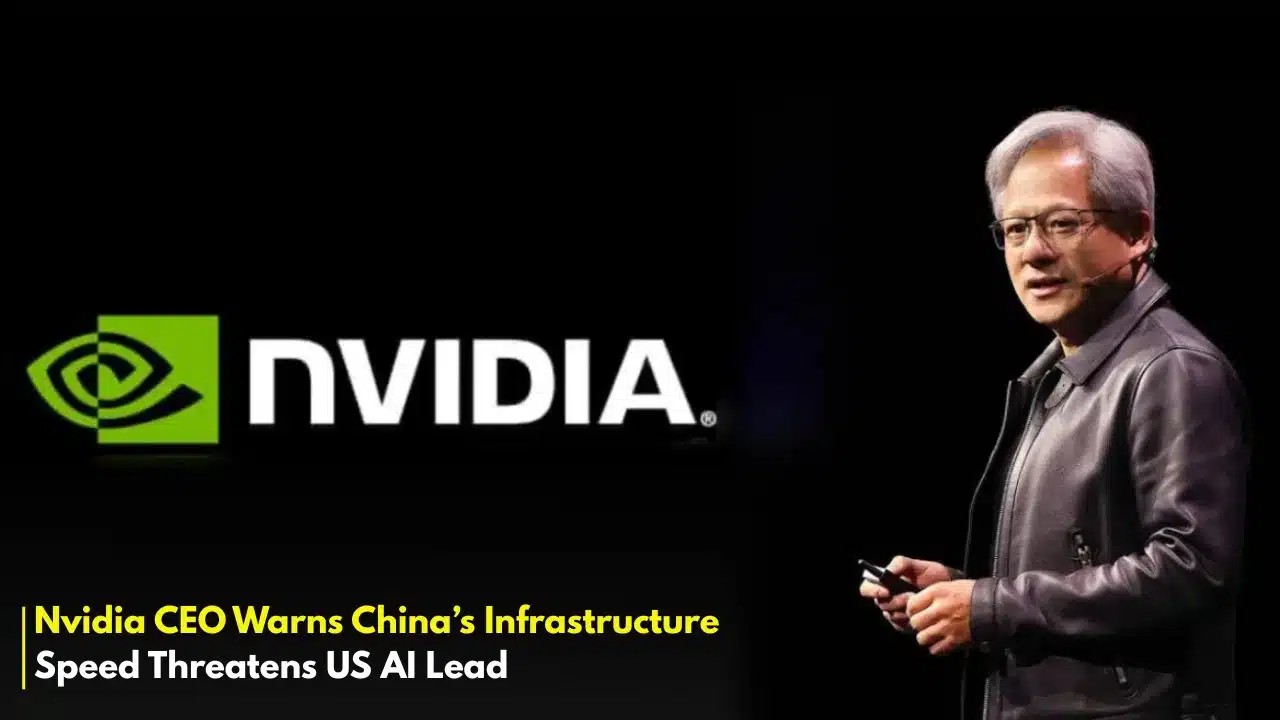
Nvidia CEO Jensen Huang has issued a stark warning to the United States: the nation’s leadership in artificial intelligence is under threat, not because of technological inferiority, but due to China’s unmatched speed in building infrastructure and its rapidly expanding energy capacity to power AI advancements. While the U.S. continues to dominate in the development of AI chips, Huang stressed that China’s ability to construct massive data centers and deploy AI infrastructure at breakneck speed could give it a decisive edge in the global race for AI supremacy.
The Speed of Infrastructure
One of the most striking points Huang made during his recent remarks was the contrast between the pace of infrastructure development in the U.S. and China. “If you want to build a data center here in the United States from breaking ground to standing up an AI supercomputer is probably about three years,” Huang told the Center for Strategic and International Studies. In contrast, he noted, “They can build a hospital in a weekend” in China. This dramatic difference in construction speed is not just anecdotal—China’s government-backed initiatives have enabled the rapid deployment of AI compute clusters, energy grids, and nationwide data center networks.
China’s AI Infrastructure Strategy, for example, has led to the creation of over 250 AI data centers by 2025, with plans to reach 300 exaFLOPS (EFLOP/s) of total compute capacity. This is a level of deployment that far outpaces the U.S., where data center projects face longer permitting, environmental, and regulatory hurdles. The U.S. is still investing heavily—estimates suggest $50 billion to $105 billion will be spent on new data centers in the coming year alone—but the speed of execution remains a critical bottleneck.
Energy Capacity and AI Growth
Beyond construction, Huang highlighted the crucial role of energy in supporting AI expansion. China, he noted, now generates twice the electricity of the United States, despite having a smaller economy. “Makes no sense to me,” Huang said, underscoring the disparity. China’s energy capacity continues to grow “straight up,” while the U.S. grid remains relatively flat. This energy advantage is pivotal for running the power-hungry data centers that drive AI innovation.
Chinese authorities have aggressively expanded power generation, adding 429 GW of net new capacity in 2024 alone—more than 15 times the amount added in the U.S. during the same period. Provincial partnerships between energy providers and AI firms are also powering data centers with renewables, further enhancing the sustainability and scale of China’s AI ecosystem. Meanwhile, the U.S. faces persistent energy constraints and regulatory delays that slow down the deployment of new data centers and limit the pace of AI growth.
U.S. AI Chip Lead: A Narrowing Edge
Despite these infrastructure challenges, Huang emphasized that the U.S. remains generations ahead in AI chip technology. Nvidia’s own GPUs continue to power the majority of global AI innovation, and the company’s semiconductor manufacturing processes are still unmatched. However, Huang warned against complacency: “Anybody who thinks China can’t manufacture is missing a big idea.” Chinese companies like Huawei, Baidu, and Alibaba are rapidly closing the gap with their own advanced AI chips and custom compute clusters.
The U.S. ban on Nvidia chips in China has only accelerated domestic Chinese efforts to develop indigenous alternatives. Huawei’s Ascend 910B and 910C processors, for example, are now powering new Atlas SuperPod clusters, and government-backed AI compute hubs are decentralizing capacity across eight provinces. These developments suggest that while the U.S. may retain a technological edge for now, China’s infrastructure and manufacturing momentum could erode that advantage in the coming years.
China’s AI “Belt and Road” Ambitions
Huang also raised concerns about China’s global ambitions in AI, drawing parallels to its Belt and Road Initiative. He warned that if U.S. firms allow Chinese rivals to dominate the domestic market, China could export its AI technologies and infrastructure to other countries, creating a global network of AI influence. This “AI Belt and Road” could extend China’s technological reach and reshape the global AI landscape.
China’s government has already designated ten data center clusters within eight national hub nodes, including locations in Guizhou, Inner Mongolia, Gansu, Ningxia, and Chengdu-Chongqing. These clusters are designed to support not only domestic AI applications but also international collaboration and export. State-led AI investment funds have poured billions into startups and research, further fueling China’s rise as a global AI powerhouse.
The U.S. Response: Policy, Investment, and Innovation
In response to these challenges, U.S. policymakers and industry leaders are ramping up efforts to bolster domestic AI infrastructure. President Donald Trump’s push to reshore manufacturing jobs and spur AI investments has led to increased federal funding and incentives for data center development. Tech giants like Nvidia, Google, and Amazon are pouring billions into new data center projects, with experts predicting a surge in U.S. AI compute capacity over the next year.
However, experts warn that regulatory reforms and energy policy changes are urgently needed to keep pace with China’s rapid deployment. The U.S. must streamline permitting, expand renewable energy sources, and foster public-private partnerships to accelerate infrastructure growth. Without these measures, the U.S. risks falling behind in the AI race, even with its technological lead.
The Broader Implications
The competition between the U.S. and China in AI is not just about technology—it’s about economic power, national security, and global influence. China’s ability to build infrastructure at scale and speed gives it a strategic advantage that could reshape the future of AI and its applications across industries. The U.S. must act decisively to maintain its leadership, investing in both innovation and infrastructure to stay competitive.
Huang’s warning is a call to action for American policymakers, businesses, and innovators. The AI race is not just about who has the best chips or algorithms—it’s about who can deploy them fastest and at the largest scale. As China continues to surge ahead in infrastructure and energy, the U.S. must respond with urgency and ambition to preserve its position as a global AI leader.
This detailed analysis of Nvidia CEO Jensen Huang’s warning highlights the critical role of infrastructure and energy in the global AI race. While the U.S. maintains a technological edge, China’s rapid construction capabilities and expanding energy capacity pose a significant threat to American leadership in AI. The coming years will test the resilience and adaptability of both nations as they vie for dominance in one of the most transformative technologies of the 21st century.