

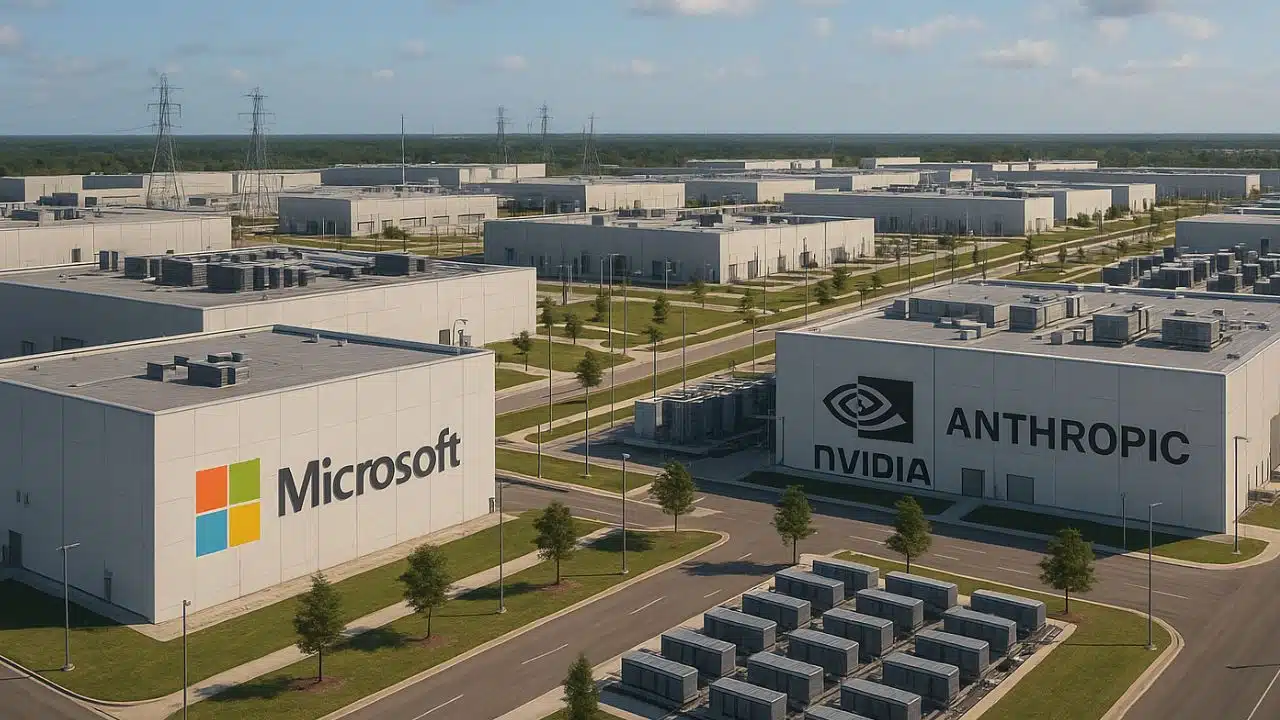
Microsoft, Nvidia, and Anthropic have unveiled one of the most consequential partnerships in today’s AI industry — a sprawling $45 billion, three-way agreement that reshapes how cloud computing, advanced chips, and foundation model development will scale over the coming years. The announcement marks a bold new escalation in the global AI infrastructure race, coming just weeks after another major industry shake-up: OpenAI’s massive cloud services deal with Amazon worth approximately $38 billion. These consecutive announcements show how aggressively the world’s largest tech companies are competing to secure sufficient computing capacity for next-generation AI models.
At the center of this new partnership is Anthropic, one of the fastest-growing AI companies and creator of the Claude family of large language models. Under the agreement, Anthropic commits to purchase $30 billion worth of computing power from Microsoft’s Azure cloud platform. This is not a symbolic amount — it represents a long-term, high-volume capacity purchase that effectively guarantees Anthropic access to the industrial-scale compute needed to build and run increasingly sophisticated AI systems.
To support this demand, Anthropic will gain access to as much as one gigawatt of AI compute power, a staggering level of capacity that underscores the direction in which AI development is moving: toward infrastructures that resemble large power-hungry data factories. Much of this compute will run on Nvidia’s most advanced chip systems, including hardware from the Grace Blackwell and Vera Rubin product lines, designed specifically for frontier-level model training.
Alongside the cloud deal, Microsoft and Nvidia will inject up to $15 billion in combined investment into Anthropic — $10 billion from Nvidia and $5 billion from Microsoft. For Nvidia, the investment strengthens its position not only as a supplier but also as a deeper engineering partner to one of the leading AI developers. For Microsoft, this represents further diversification of its AI model ecosystem beyond its long-standing relationship with OpenAI.
Interestingly, despite the monumental Azure commitment, Anthropic will continue using Amazon Web Services as a primary cloud partner. Amazon previously invested more than $8 billion in Anthropic between 2023 and 2024, and Anthropic has repeatedly emphasized that its strategy is to remain multi-cloud — a stance that reflects the intense competition among the major cloud providers for generative AI market share.
The newly announced partnership does not limit itself to financial and cloud infrastructure components. Nvidia and Anthropic also formalized a “deep technology partnership,” meaning they will collaborate on engineering, chip-model optimization, and possibly co-designed hardware that reflects model-specific performance needs. This kind of integration between chipmakers and model developers is becoming increasingly crucial as AI systems grow larger and more compute-intensive.
Microsoft, for its part, will be able to incorporate Claude models more deeply into its Azure AI ecosystem, broadening the portfolio of models available to customers and giving developers more choice in building applications for enterprise, research, and commercial environments. Even as Microsoft reaffirms its commitment to OpenAI, this deal positions the company with multiple frontier-model partners, creating strategic flexibility at a time when the AI landscape is evolving rapidly.
The enormous financial commitments involved reflect the unprecedented infrastructure demands of modern AI. Industry projections indicate that major technology companies may spend more than $400 billion on AI-related infrastructure in 2025 alone, a number that could climb to $3–4 trillion globally by 2030. These figures encompass everything from data center construction and chip manufacturing to power generation and cooling systems. In effect, AI companies are building the equivalent of new industrial sectors, powered by constant flows of electricity and data.
Some financial analysts warn that such extraordinary spending could signal an emerging bubble, particularly given that many AI companies, including Anthropic, are not yet profitable. Anthropic has openly acknowledged that it does not expect to break even until 2028, raising questions about how long investors and partners will tolerate high costs before seeing substantial returns. Nonetheless, companies like Microsoft and Nvidia maintain that these investments are foundational — necessary to secure market dominance and technological leadership in a field where compute availability increasingly determines innovation potential.
Nvidia’s CEO Jensen Huang has frequently described AI infrastructure as “factories for intelligence,” arguing that the massive data centers being built now will power real-time intelligent systems for decades. This vision continues to drive companies to expand compute capacity on an unprecedented scale.
With this three-way alliance, Microsoft strengthens its cloud leadership against Amazon and Google, Nvidia reinforces its dominance in AI chips, and Anthropic secures the compute it needs to pursue the frontier of generative AI development. Together, they position themselves to control a larger portion of the AI market as demand for models, tools, and infrastructure accelerates. The deal sends a clear signal: the future of AI will be defined not just by algorithms and models, but by the industrial-grade infrastructure that powers them.
AI Infrastructure Race Accelerates as Industry Spending Surges
The Microsoft-Nvidia-Anthropic partnership is the latest proof that the AI landscape is entering a new era driven by infrastructure scale rather than model-specific breakthroughs alone. Over the past two years, model performance has increasingly become tied to access to larger clusters of GPUs, more advanced chip architectures, and massive high-bandwidth cloud networks. As a result, tech giants have been racing to lock in long-term supply agreements with chipmakers, acquire strategic stakes in AI startups, and build new data centers designed specifically for heavy-duty AI training.
This competition intensified dramatically in recent months. Prior to this deal, the biggest headline was the multibillion-dollar agreement between OpenAI and Amazon, in which OpenAI committed to using AWS for a large portion of its training workload. That move was widely seen as Amazon’s attempt to slow Microsoft’s momentum in the AI cloud market. Now, the Microsoft-Nvidia-Anthropic alliance effectively counters that effort by securing one of the only other major frontier-model companies.
As these commitments expand, cloud providers, chip manufacturers, and AI developers are increasingly intertwined. The demand for compute has grown so quickly that companies must plan years in advance to ensure they have enough hardware and energy capacity to deploy new models. This environment has turned GPU allocation and compute access into strategic assets as valuable as the AI models themselves.
The partnership also intensifies competition among cloud providers. Microsoft Azure has seen rapid growth, reporting nearly 40% year-over-year expansion in its cloud business. This momentum contrasts with Amazon Web Services’ slower 17–18% growth, a gap that highlights how deeply AI workloads have influenced cloud adoption patterns. The Anthropic deal could accelerate Azure’s growth even further, as billions of dollars in compute usage flow into Microsoft’s infrastructure.
At the same time, these mega-deals raise questions about sustainability — financially, technologically, and environmentally. With AI data centers consuming increasing amounts of energy, there is growing debate about how the industry will meet power needs without straining electrical grids. Many companies are now exploring alternative power sources including advanced cooling, renewable energy contracts, and in some cases, nuclear microreactors.
Financially, the challenge lies in converting massive infrastructure investments into revenue. AI services are widely used, but the path to long-term profitability for model developers remains uncertain. Many models are expensive to train, costly to operate, and difficult to monetize at scale without enterprise adoption. Anthropic’s projection of financial break-even by 2028 reflects how long the runway may need to be for AI companies operating at the frontier.
Still, the prevailing sentiment among industry leaders is that these investments are essential to stay competitive. If AI truly becomes the backbone of future software, automation, research, and productivity tools, then the infrastructure supporting it must be built now. For Microsoft, Nvidia, and Anthropic, the new partnership is both a defensive and offensive strategy — aiming to secure critical AI resources while pushing the limits of what is technologically possible.
In essence, this deal signals where the AI world is headed: toward larger models, larger data centers, deeper collaborations between hardware and software companies, and a global competition shaped by compute power. The next generation of AI breakthroughs will rely less on conceptual innovations and more on who can access the most reliable, scalable, and efficient infrastructure. With this $45 billion agreement, Microsoft, Nvidia, and Anthropic have placed themselves squarely at the front of that race.





















