

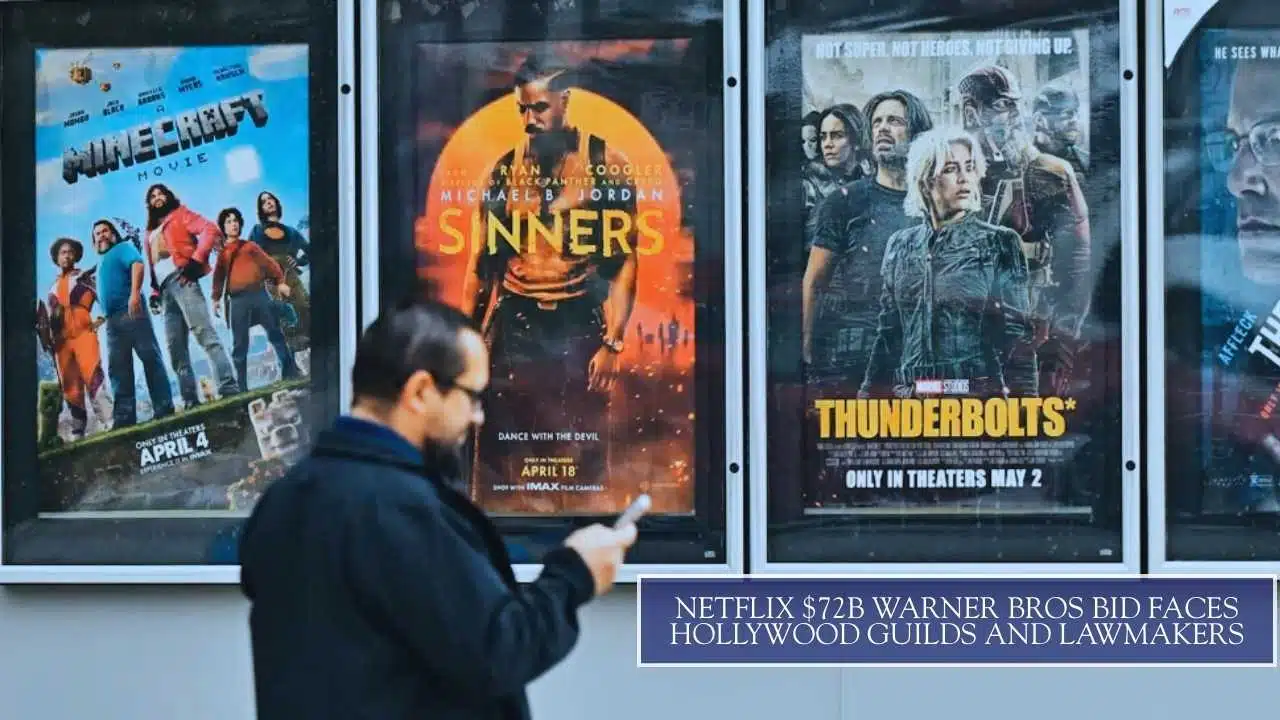
Hollywood is rallying in strong opposition against Netflix’s massive $72 billion acquisition bid for Warner Bros. Discovery’s film and streaming businesses, fearing it could reshape the entertainment landscape in ways that threaten competition, jobs, and the future of theatrical releases. This opposition comes from key Hollywood guilds, theater owners, and bipartisan lawmakers who warn that the proposed merger could fundamentally harm the industry.
Netflix officially announced the deal on Friday, December 5, 2025, after winning a high-stakes bidding war against competitors Paramount Skydance and Comcast. Netflix’s offer values Warner Bros.’ film and television studios, HBO, and HBO Max at $27.75 per share. The total enterprise valuation, including Warner Bros. Discovery’s debt, reaches an imposing $82.7 billion. This acquisition would unite Netflix’s vast streaming platform with one of Hollywood’s most legendary studios, paving the way for a new, unprecedented mega-conglomerate in the entertainment industry. However, the deal is subject to regulatory approval and is expected to close 12 to 18 months after Warner Bros. Discovery spins off its Discovery Global networks division, planned for the third quarter of 2026. Netflix has agreed to pay a $5.8 billion breakup fee if the deal is blocked by regulators or fails to close.
Hollywood Guilds Sound the Alarm
The Writers Guild of America (WGA) led the charge against the deal, issuing a sharply worded joint statement from both its East and West divisions calling for the merger to be blocked. WGA warned that the merger represents exactly the kind of anticompetitive consolidation that antitrust laws are designed to prevent. The guild predicted devastating consequences including job losses across creative ranks, wage suppression, worsening working conditions for writers, steep increases in consumer prices, and a decline in the quality and diversity of content produced. The fear is that one streaming giant controlling both Netflix and Warner Bros. content would reduce competition for talent and storytelling innovation, effectively hemming in creative freedom.
The Directors Guild of America (DGA) similarly expressed grave concerns about the deal, planning meetings with Netflix executives to make sure the company understands how vital a competitive market is to preserve directors’ creative rights and career opportunities. The Producers Guild of America (PGA) echoed the warnings, expressing that producers are “rightfully concerned” about the sale of such an iconic studio that has long been a supplier of diverse and influential film and television projects. These guilds represent thousands of industry professionals whose livelihoods and creative passions are intertwined with the health of a competitive Hollywood.
Netflix has tried to counter these fears by asserting that the merger would create new opportunities to produce and distribute content globally, but many in the industry remain skeptical of whether a single dominant player will foster the variety and independence that artists and audiences expect.
Theater Industry Facing an Existential Threat
Movie theater owners have been vocal about the risks this deal poses to theatrical exhibition, a core pillar of the entertainment business. Michael O’Leary, CEO of Cinema United, which represents more than 56,000 screens worldwide, called the acquisition an “unprecedented threat” to theaters, underscoring that Netflix’s core business model currently does not support theatrical releases but rather focuses on direct-to-consumer streaming. O’Leary warned that the merger could lead to widespread theater closures and significant job losses in the exhibition sector, estimating that up to 25% of the annual domestic box office revenues could be at risk if the ways films are released change dramatically. This would represent a severe financial blow to theaters, many of which are still recovering from the pandemic’s economic impact.
Adding to this, an anonymous group of A-list filmmakers sent a confidential letter to Congress, expressing deep concern about the consolidation’s implications for the theatrical marketplace. They worried that Netflix’s control over Warner Bros. content could “hold a noose around the theatrical marketplace,” making it increasingly difficult for independent theaters to thrive and for audiences to experience cinema on the big screen. European theater-owner groups have also publicly opposed the deal, emphasizing that the impact could be global and not just confined to the United States.
Although Netflix has pledged to maintain theatrical operations for Warner Bros.’ films for now, critics remain wary, noting that Netflix has avoided traditional theatrical windows in favor of streaming premieres in many past releases. This creates uncertainty around the future of theatrical distribution post-merger.
Bipartisan Political Opposition and the Trump Administration’s Skepticism
Political opposition to the deal emerged quickly from both sides of the aisle, reflecting growing concerns over monopolistic power in the entertainment industry. Senator Elizabeth Warren (D-MA), a fierce advocate against monopolies, condemned the deal as an “anti-monopoly nightmare.” She cautioned that the merger would create a media giant controlling nearly half of the streaming market, effectively stifling competition. Senator Mike Lee (R-UT), chairman of the Senate antitrust subcommittee, echoed the alarm, labeling the merger as raising significant antitrust concerns that should trigger thorough scrutiny by regulators worldwide.
The deal has also attracted skepticism from the Trump administration. A senior official privy to White House discussions revealed that the administration regards the acquisition with “heavy skepticism.” White House officials reportedly held meetings about the potential antitrust issues the transaction could create, anticipating a lengthy investigation akin to high-profile probes of technology giants like Google and Amazon. This signals strong government vigilance that could pose major hurdles for Netflix’s bid. Additionally, former WarnerMedia CEO Jason Kilar publicly criticized the sale on the social media platform X, calling it “one of the most effective ways to reduce competition in Hollywood.”
What Lies Ahead for the Industry and Consumers?
The path forward for Netflix’s acquisition of Warner Bros. Discovery remains uncertain. Key regulators are expected to conduct detailed reviews of the deal’s competitive impact, with antitrust authorities possibly demanding concessions or blocking the merger entirely if they find it would undermine consumer choice or industry competition. Lawmakers from both parties, such as Representative Darrell Issa (R), have already voiced concerns that the deal could harm consumers by limiting the diversity of available content and reducing competitive pressures that keep prices in check.
If approved, the combined entity would serve a massive global audience of roughly 450 million subscribers, combining Netflix’s streaming technology and subscriber base with Warner Bros.’ vast libraries of cherished franchises such as Harry Potter, DC Comics superheroes, and Game of Thrones. Netflix argues that this merger will accelerate its ability to create new stories and reach audiences worldwide by leveraging Warner Bros.’ legacy IP together with its own direct-to-consumer expertise. However, opponents fear it could instead concentrate too much power in one company, dampening creative risk-taking and driving up costs for viewers in the long run.
As the entertainment industry stands at this critical crossroads, the outcome of Netflix’s ambitious bid will shape how movies and television shows are produced, distributed, and experienced for years to come. This merger saga illustrates the clash between tech-driven streaming dominance and traditional Hollywood values, with far-reaching implications for creators, cinema workers, theater owners, and audiences globally.





















