

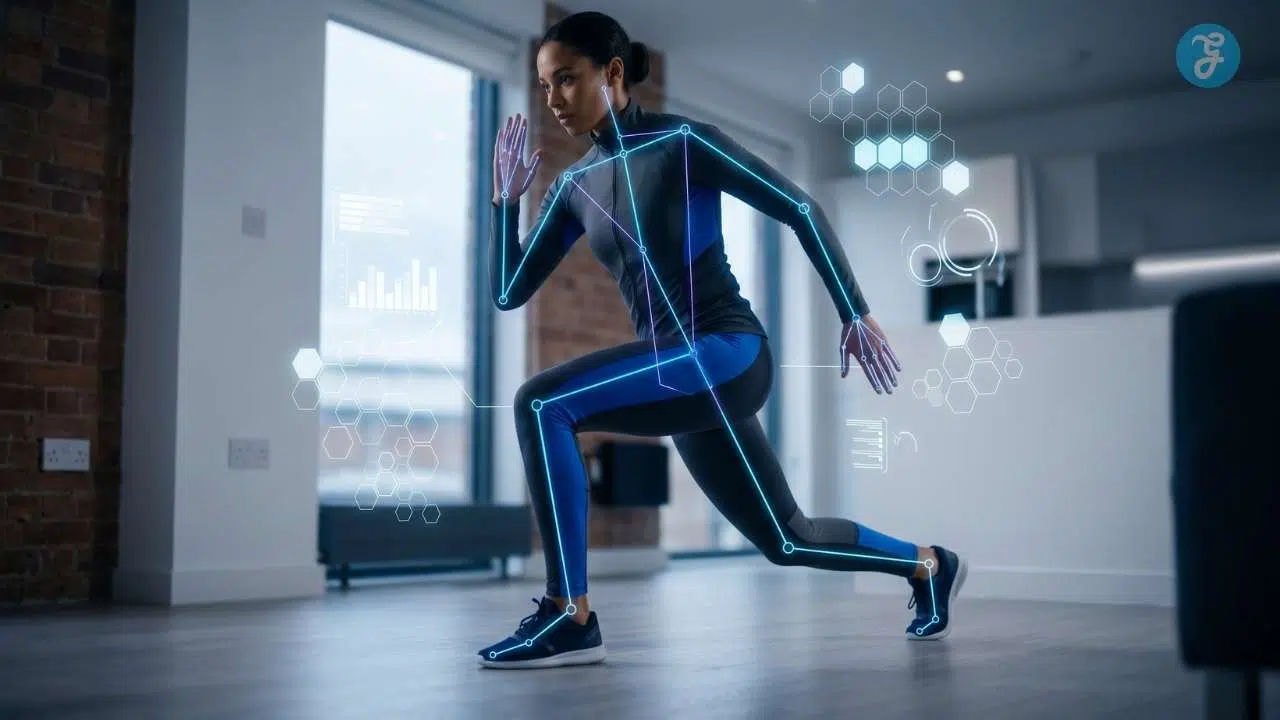
AI Personal Trainer Startups UK are fundamentally transforming the landscape of home workouts by bringing clinical-grade movement analysis directly into our living rooms. The era of generic fitness PDFs and static video tutorials is rapidly fading. In their place, a sophisticated wave of digital health technology is emerging.
These companies are leveraging complex machine learning algorithms, deep computer vision, and real-time biometric tracking to replicate the nuanced expertise of a human coach. This shift is not merely about convenience but rather about democratizing access to elite sports science.
Previously, hiring a dedicated coach to analyze your gait, correct your deadlift form, or periodize your strength training would cost hundreds of pounds per month. Now, that identical level of precision is available through the lens of a smartphone or a specialized wall mirror.
The Evolution of Digital Coaching in the United Kingdom
The United Kingdom has positioned itself as a global epicenter for this specific branch of health technology. British developers are uniquely blending advanced software engineering with behavioral psychology to ensure that users do not just download an app but actually stick to a progressive routine. The integration of intelligent systems means that the software actively learns from the user.
If you are fatigued, the algorithm adjusts the volume. If your form is compromised, the computer vision provides immediate auditory correction. This level of dynamic adaptation prevents injuries, maximizes muscular hypertrophy, and ensures cardiovascular endurance is built safely over time.
The technology has matured to a point where the digital coach in your pocket is often more mathematically precise than a human counterpart. As we explore the top companies driving this change, it becomes clear that the British fitness industry will never return to the days of generic, one-size-fits-all programming.
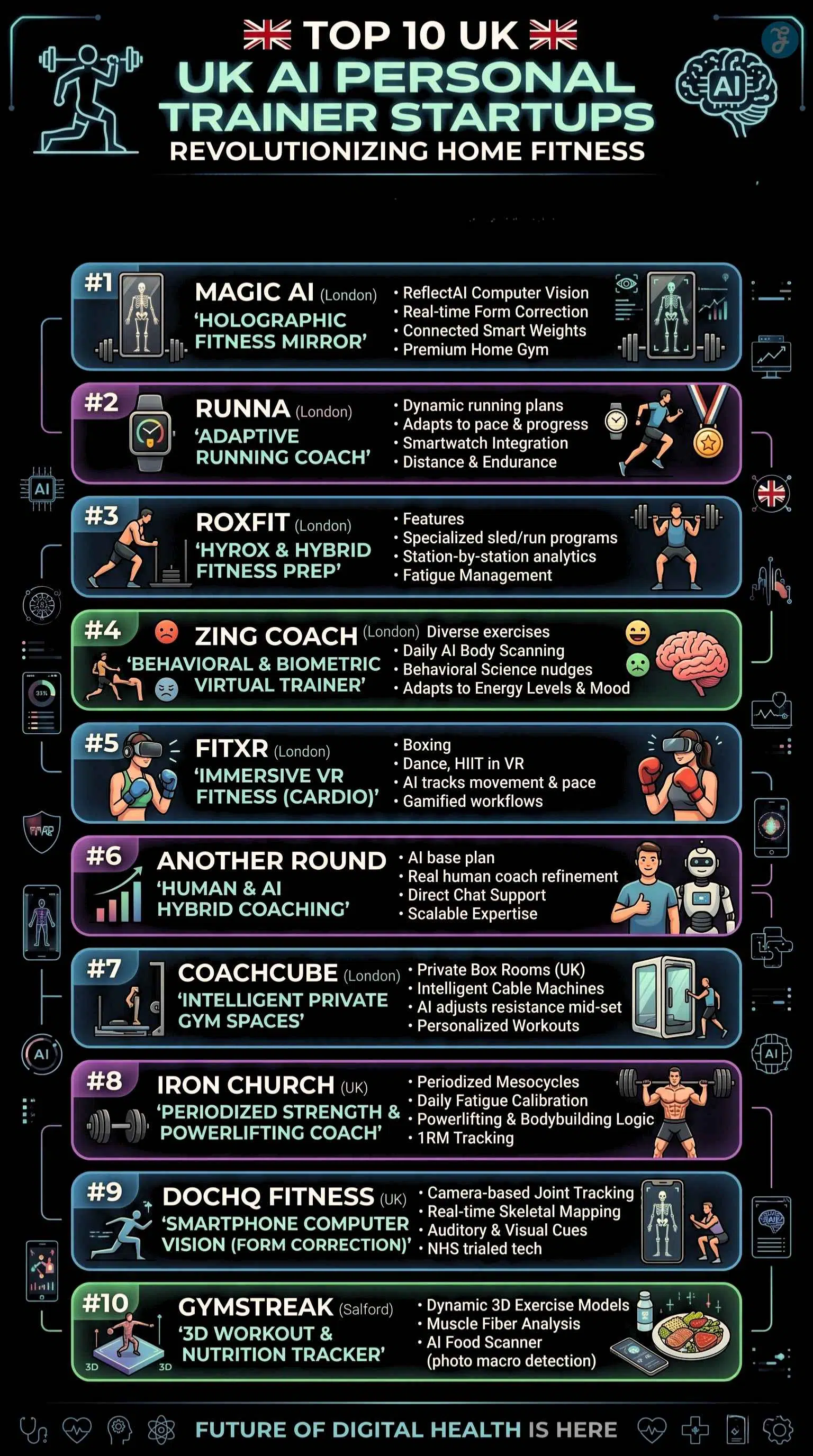
10 Leading AI Personal Trainer Startups in the UK
With the core evaluation criteria firmly established, we can now examine the specific companies driving this digital fitness revolution across the United Kingdom. From intelligent holographic mirrors to advanced behavioral algorithms, these ten startups represent the absolute cutting edge of the home wellness market.
They are completely redefining what it means to train effectively outside of a commercial gym environment. Let us dive into the top innovators reshaping the industry today.
1. MAGIC AI: The Holographic Future of Strength
MAGIC AI has successfully carved out a premium niche in the British fitness ecosystem by completely reimagining the physical hardware of a home gym. While most AI Personal Trainer Startups Uk focus strictly on mobile software, MAGIC AI integrates its proprietary machine learning directly into a sleek, wall-mounted mirror.
When deactivated, the hardware functions as a standard piece of home decor. Upon activation, it transforms into a full-scale interactive holographic display featuring elite athletes who guide the user through rigorous routines.
The underlying technology, dubbed ReflectAI, utilizes advanced computer vision to scan the user’s body across multiple anatomical points. This allows the system to count repetitions accurately and offer immediate verbal feedback if a movement is performed incorrectly.
If a user arches their back during a deadlift, the AI instantly recognizes the postural deviation and pauses the routine to provide corrective cues. Furthermore, the system syncs with intelligently designed physical weights, logging the exact load lifted and automatically adjusting the prescribed resistance for future sessions based on progressive overload principles.
- Core Technology: Proprietary computer vision housed within a smart mirror that syncs with connected intelligent weights.
- Target Audience: Premium consumers seeking a permanent and highly aesthetic home gym installation.
- Market Impact: It has successfully brought clinical-grade motion tracking into the luxury home market.
- Limitations: The required hardware demands a significant upfront financial investment and dedicated wall space within the home.
2. Runna: Revolutionizing Endurance Algorithms
Moving away from heavy lifting, Runna has dominated the cardiovascular conditioning space by building a profoundly intelligent running coach. Based in London, this startup recognized that most runners were relying on static, generic training templates that failed to account for individual progress or unexpected life events.
Runna replaces these rigid schedules with a dynamic algorithm that recalibrates constantly based on the user’s actual performance data. The software seamlessly integrates with major wearable devices to monitor pace, heart rate, and distance in real time.
If a runner misses a session due to illness or overperforms during a speed interval, the AI recalculates the rest of the mesocycle to ensure the athlete peaks exactly on their chosen race day. Beyond just logging miles, the platform incorporates structured strength and mobility work specifically designed to prevent common running injuries.
The rapid global adoption of Runna proves that runners are desperate for scalable, data-driven coaching that adapts to the chaotic nature of daily life.
- Core Technology: Dynamic algorithms that adjust weekly running volume and pace targets based on wearable data integration.
- Target Audience: Everyone from absolute beginners attempting their first five-kilometer race to elite marathon runners.
- Market Impact: It has rendered static running plans obsolete by providing scalable and data-driven endurance coaching.
- Limitations: The platform is strictly focused on running and lower body endurance, lacking comprehensive upper body hypertrophy programming.
3. ROXFIT: Data-Driven Hybrid Fitness
The explosive growth of hybrid fitness competitions like HYROX has created a massive demand for highly specialized training protocols. ROXFIT recognized this gap in the market and built an artificial intelligence platform entirely dedicated to the unique demands of functional fitness racing.
Training for a hybrid event requires a delicate balance between heavy strength movements (like sled pushes) and cardiovascular endurance (like running). Balancing these without overtraining requires meticulous planning.
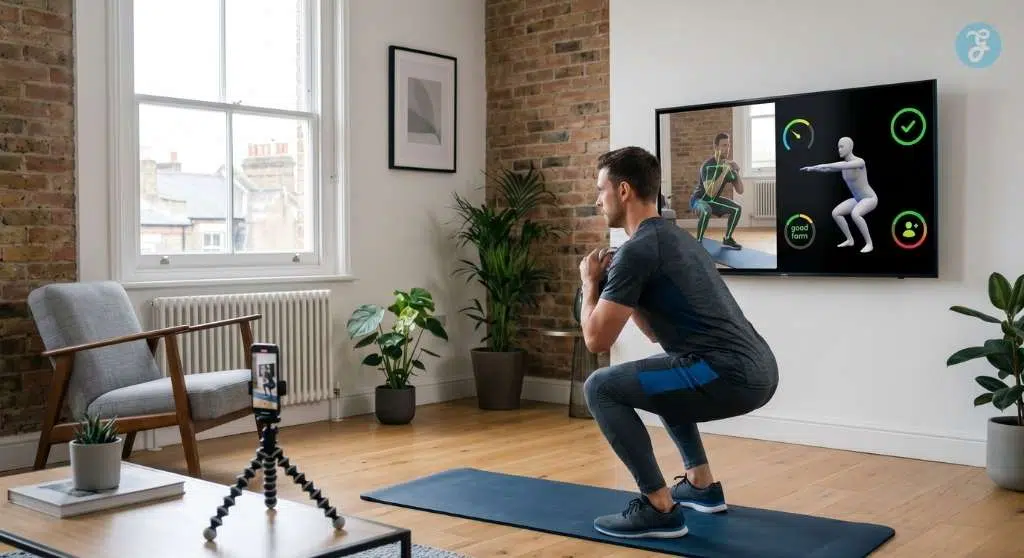
The ROXFIT algorithm acts as a digital head coach, generating bespoke programming that accounts for the athlete’s specific weaknesses. It analyzes past performance across various physical stations and adjusts daily volume to ensure central nervous system recovery.
The AI takes the guesswork out of hybrid training by calculating the exact ratios of threshold running to functional strength work required to shave minutes off a race time. This extreme specialization is a testament to how AI Personal Trainer Startups UK are moving beyond generic fitness and targeting highly specific athletic niches.
- Core Technology: Algorithmic balancing of cardiovascular endurance and functional strength training calibrated specifically for hybrid competition demands.
- Target Audience: Competitive athletes and dedicated fitness enthusiasts preparing for grueling functional fitness racing events.
- Market Impact: It provides a highly affordable alternative to specialized human hybrid coaches for competitive athletes.
- Limitations: The intense nature of the workouts makes the platform inaccessible for casual users or those recovering from injuries.
4. Zing Coach: Biometric and Behavioral Adaptation
Developed by the London-based health tech studio Palta, Zing Coach represents a fascinating intersection between deep biometric scanning and behavioral psychology. The developers understood that the primary reason fitness apps fail is a lack of user retention.
To combat this, Zing utilizes artificial intelligence not just to prescribe exercises, but to analyze the user’s mood, energy levels, and historical compliance. The platform begins with a comprehensive AI body scan and physical capability test to establish a baseline. From there, the algorithm generates daily routines that are specifically calibrated to the user’s current readiness state.
If a user logs high stress and low sleep, Zing automatically pivots the daily programming from high intensity intervals to restorative mobility work. This empathetic approach to algorithmic programming ensures that users remain consistent over the long term, building sustainable habits rather than burning out in the first month.
- Core Technology: Daily algorithmic adaptation based on user-inputted energy levels, available equipment, and ongoing biometric feedback.
- Target Audience: Daily fitness enthusiasts who want varied and intelligent workouts that fit around fluctuating work schedules.
- Market Impact: The integration of behavioral science makes this one of the most sustainable AI fitness applications available for long-term use.
- Limitations: The accuracy of the daily adaptation relies heavily on the user consistently and honestly logging their mood and energy data.
5. FitXR: Immersive Virtual Reality Tracking
FitXR completely removes the user from the physical limitations of their living room by merging artificial intelligence with advanced virtual reality. While most platforms require the user to stare at a phone screen, FitXR transports the athlete into a fully rendered digital environment.
The AI operates quietly in the background, tracking the spatial movement of the user’s hands and head to calculate velocity, reaction time, and caloric expenditure during high-energy boxing or dance routines. The genius of FitXR lies in its gamification. By disguising intense cardiovascular exercise as a highly competitive arcade game, the software tricks the brain into pushing harder and longer than it would on a traditional treadmill.
The artificial intelligence continuously scales the difficulty of the incoming digital targets based on the user’s successful hit rate, ensuring a state of continuous flow and progressive overload. This approach represents a massive leap forward in how we perceive and execute daily cardio.
- Core Technology: Gamified cardiovascular routines housed within immersive virtual reality environments with real-time spatial tracking.
- Target Audience: Gamers and tech enthusiasts looking for an interactive and high-adrenaline alternative to traditional cardio machines.
- Market Impact: It successfully eliminates the boredom traditionally associated with home cardio by turning exercise into an engaging visual experience.
- Limitations: Users are required to purchase and maintain a compatible virtual reality headset to access the platform.
6. Another Round: Scaling Human Expertise
Another Round takes a distinctly different approach by using artificial intelligence to scale, rather than replace, human expertise. The London-based startup operates on the philosophy that while algorithms are excellent at calculating volume and tracking metrics, they lack the emotional intelligence and empathetic accountability of a real trainer.
Another Round utilizes a proprietary AI backend to automate the administrative and mathematical heavy lifting of program design. The AI analyzes the client’s initial data and generates a highly optimized training block. A certified human coach then reviews, tweaks, and finalizes this block before delivering it to the client.
This hybrid model allows elite trainers to manage a larger roster of clients without sacrificing the quality of the programming. Users receive the mathematical precision of an algorithm alongside the direct messaging support and emotional encouragement of a dedicated professional, creating the ultimate accountability loop.
- Core Technology: A hybrid coaching model that uses machine learning to generate base programming, which is then refined by human professionals.
- Target Audience: Individuals who require the strict accountability and emotional support of a human coach but cannot afford traditional in-person rates.
- Market Impact: The platform beautifully balances the efficiency of modern technology with the irreplaceable value of human empathy.
- Limitations: Users must frequently record and upload videos of their sets so the human coaches can perform visual form corrections.
7. CoachCube: Intelligent Private Gym Spaces
CoachCube brings artificial intelligence out of the smartphone and builds it directly into a physical, architectural space. Operating physical locations in London, CoachCube addresses the anxiety many people feel in crowded commercial gyms by offering fully private, tech-enabled workout pods.
These Tron-style box rooms are equipped with massive digital screens and an incredibly advanced AI-driven cable machine. Upon entering the cube, the user logs into their profile, and the room instantly configures itself to their daily program. The smart cable machine utilizes algorithms to adjust resistance dynamically mid-set.
If the AI detects that the user is struggling during the eccentric phase of a bicep curl, it automatically lowers the weight by a fraction to allow for safe completion of the rep. This seamless integration of physical hardware and digital intelligence provides a hyper-personalized, frictionless workout experience for busy urbanites.
- Core Technology: Fully private training rooms featuring AI-driven resistance machines that adjust weight dynamically based on user fatigue.
- Target Audience: Time-poor professionals who desire premium and hyper-personalized coaching without navigating crowded fitness centers.
- Market Impact: It represents a brilliant physical manifestation of AI technology, offering a safe environment for serious training.
- Limitations: Access is strictly limited to individuals who live near and can book time slots at their physical London locations.
8. Iron Church: Deep Periodized Strength Logic
While many AI applications focus on weight loss or light mobility, Iron Church is engineered specifically for individuals looking to move serious iron. This web application functions like an elite powerlifting coach, utilizing complex mathematical logic to program deep, periodized strength cycles.
The AI ignores generic workout generation in favor of strict, science-backed progressive overload across nineteen different physical disciplines. The platform calibrates every single session against the user’s daily fatigue metrics and historical one rep max data.
It builds structured mesocycles that manage volume and intensity over a four-week block, ensuring the central nervous system recovers adequately before a heavy peaking phase. For bodybuilders and powerlifters, Iron Church provides a level of biomechanical and mathematical rigor that is rarely seen in consumer-facing fitness technology.
- Core Technology: Deep mathematical periodization that builds structured mesocycles based on daily fatigue and ongoing one rep max calculations.
- Target Audience: Serious lifters and bodybuilders focused intensely on progressive overload and structured strength gains.
- Market Impact: It strips away unnecessary gamification to deliver pure, scientifically sound programming for those dedicated to heavy lifting.
- Limitations: The dense data-heavy interface and highly specialized terminology may alienate casual gym goers looking for quick daily routines.
9. DocHQ Fitness: Camera-Based Clinical Form Correction
DocHQ Fitness brings the precision of a clinical physiotherapy clinic into the home by turning a standard smartphone camera into an advanced biomechanical scanner. Recognizing that improper form is the leading cause of home workout injuries, this startup developed a visual AI engine that maps specific skeletal points on the user’s body in real time.
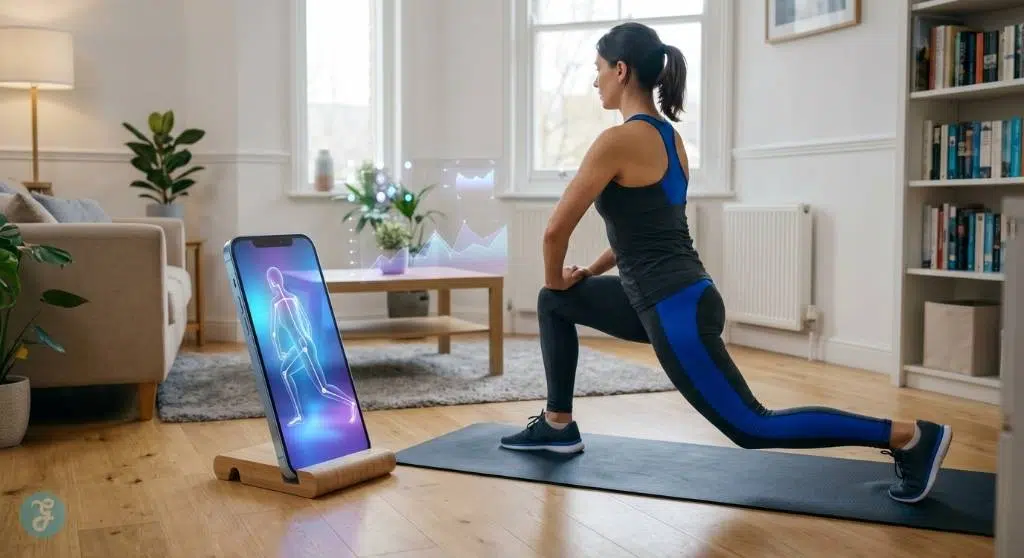
As the user performs a squat or a lunge, the AI continuously monitors joint angles and spinal alignment. If a dangerous deviation is detected, the system provides immediate audio and visual cues to correct the posture before an injury occurs.
This technology has been successfully trialed within the NHS, giving DocHQ a level of medical credibility that vastly outshines standard fitness applications. It is an invaluable tool for beginners learning complex movements or individuals actively rehabilitating from previous injuries.
- Core Technology: Advanced computer vision that maps skeletal movement points through a standard camera to deliver real-time clinical form correction.
- Target Audience: Absolute beginners learning foundational movements and patients requiring precise form guidance during physical rehabilitation.
- Market Impact: The technology provides a massive safety net for home athletes by successfully mimicking the watchful eye of an in-person coach.
- Limitations: The system requires a brightly lit and spacious room to track the body accurately without visual interference.
10. GymStreak: 3D Modeling and Macro Scanning
GymStreak is a comprehensive digital toolkit designed for the independent gym goer who wants to track every single aspect of their physical transformation. The application combines intelligent workout generation with deep, visual data tracking.
The software features fully rotatable 3D anatomical models that demonstrate exactly which muscle fibers are being engaged during a specific exercise, allowing users to perfect their mind-muscle connection. Beyond the physical training, GymStreak integrates a powerful artificial intelligence food scanner. Users simply take a photograph of their meal, and the AI utilizes image recognition to instantly estimate the macronutrient breakdown and total caloric value.
By combining dynamic workout generation with frictionless nutritional tracking, GymStreak allows users to manage both sides of the fitness equation simultaneously without needing to bounce between multiple different applications.
- Core Technology: Intelligent workout generation paired with dynamic 3D exercise models and a sophisticated AI-driven photo macro scanner.
- Target Audience: Independent gym goers who want a centralized solution for tracking both their lifting progress and daily caloric intake.
- Market Impact: It drastically simplifies the often overwhelming process of tracking progressive overload and complex nutritional data simultaneously.
- Limitations: The sheer volume of tracking features and available data can be overwhelming for casual users seeking a simple workout prompt.
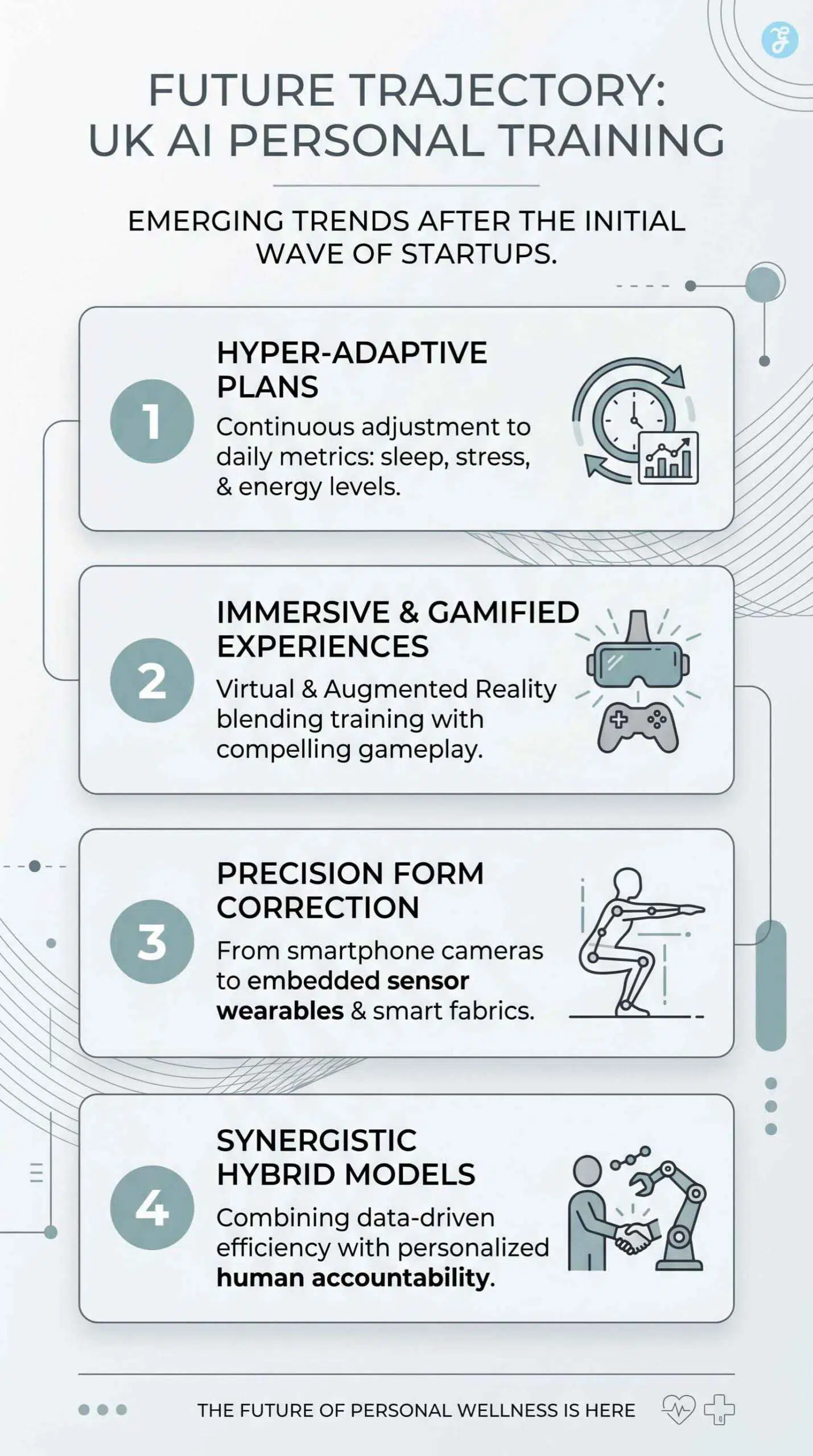
Integrating Machine Learning Tools into Daily Life
Adopting advanced health technology requires a deliberate approach to avoid digital fatigue. When incorporating these highly analytical platforms into your routine, the key is to allow the algorithm to do the heavy lifting regarding scheduling and mathematics.
Users should focus entirely on consistency and accurate data input. Artificial intelligence is only as effective as the data it is fed. If a user lies about their daily fatigue levels or skips logging a heavy meal, the resulting algorithmic adjustments will be fundamentally flawed.
By trusting the process and consistently engaging with the software, users allow the machine learning models to build an incredibly accurate physiological profile over time. The goal is not to become obsessed with the metrics, but rather to use the metrics to build a more sustainable, injury-free relationship with physical exertion.
At a Glance: The Market Leaders in AI Personal Trainer Startups
The following table provides a comprehensive overview at a glance of the top ten startups reshaping the British market. This data serves as a foundation for evaluating which platform aligns best with specific fitness aspirations.
| Startup Name | Headquarters | Core Technological Focus | Target Market |
| MAGIC AI | London | Holographic Mirror & Computer Vision | Premium Home Gym Owners |
| Runna | London | Adaptive Endurance Algorithms | Marathon & Distance Runners |
| ROXFIT | London | Hybrid Competition Programming | HYROX & Cross-Training Athletes |
| Zing Coach | London | Biometric & Behavioral Adaptation | Daily Fitness Enthusiasts |
| FitXR | London | Immersive Virtual Reality Tracking | Gamers & Interactive Cardio Seekers |
| Another Round | London | Human & AI Hybrid Coaching | Users Needing Human Accountability |
| CoachCube | London | Intelligent Private Gym Spaces | Time-Poor Urban Professionals |
| Iron Church | United Kingdom | Periodized Strength Logic | Bodybuilders & Powerlifters |
| DocHQ Fitness | United Kingdom | Camera-Based Form Correction | Beginners & Rehabilitation Patients |
| GymStreak | Salford | 3D Modeling & Macro Scanning | Independent Gym Goers |
Finally: The Next Horizon for British Health Tech
The rapid evolution of AI Personal Trainer Startups UK is setting a new global standard for digital wellness. As computer vision becomes more refined and machine learning models process larger datasets, the barrier to entry for elite athletic programming will completely disappear.
We are moving toward a future where our devices will not simply track our steps, but will actively prevent injuries, optimize our hormonal health, and extend our physical longevity. The startups highlighted in this breakdown are not just building applications; they are fundamentally rewriting the rulebook on how humans interact with their own physiology.
The integration of artificial intelligence into home fitness guarantees that personalized, scientifically sound coaching is now a universal right rather than a luxury privilege.
Frequently Asked Questions (FAQs) on AI Personal Trainer Startups UK
1. What is an AI personal trainer?
An AI personal trainer is a software application or connected hardware system that utilizes artificial intelligence, machine learning, and often computer vision to design, adapt, and monitor physical fitness routines. Unlike static workout plans, these digital coaches analyze user data in real time to adjust workout intensity, correct exercise form, and prevent overtraining.
2. Are AI fitness apps better than human coaches?
Algorithms excel at processing massive amounts of biometric data, calculating progressive overload, and adapting schedules instantly. However, human coaches provide emotional intelligence, empathy, and nuanced accountability that software cannot currently replicate. The best approach often involves using AI for programming and metrics while relying on human communities or hybrid coaches for motivation.
3. How much do AI personal trainer subscriptions cost in the UK?
The cost varies dramatically based on the technological integration. Purely software-based applications typically range from ten to thirty pounds per month. Hybrid services that include human oversight often sit between sixty and one hundred pounds. Hardware-integrated systems, like intelligent mirrors, require a significant upfront purchase of over one thousand pounds alongside a monthly software subscription.
4. Do I need expensive equipment for AI home fitness?
Not necessarily. While premium setups involve intelligent hardware, many of the most advanced AI platforms operate entirely through a standard smartphone. Applications utilizing computer vision for form correction only require a device camera and enough floor space for the software to map your skeletal movements accurately.
5. Is my data safe with computer vision fitness tracking?
Reputable British health tech companies adhere to strict GDPR regulations regarding biometric data. Most camera-based fitness applications process the visual data locally on the device to map skeletal coordinates and do not record or store raw video footage on external servers. However, it is always crucial to review a specific startup’s privacy policy regarding data retention before initiating a scan.
























