


For nearly three decades, Salesforce and HubSpot have owned the CRM market. They built their empires in an era when sales reps typed notes by hand, updated records after every call, and treated the CRM like a filing cabinet that needed constant feeding. That era is ending.
A new wave of American startups is rebuilding the CRM from the ground up, and this time with artificial intelligence baked into the core instead of bolted on as an afterthought. These companies share one big bet: your CRM should update itself. You should never have to manually log a call, copy a contact, or write a follow-up email. The AI does the work. The sales team closes the deals.
Billions of dollars are flowing into this space. Top investors like Sequoia, Google Ventures, Khosla Ventures, and Kleiner Perkins are pouring capital into names like Clay, Reevo, Lightfield, and Day AI. Y Combinator keeps graduating new AI CRM startups almost every batch. And for the first time in a long time, small teams are picking one of these newcomers over the two giants that have dominated for 25 years.
If you are a founder, sales leader, or investor, these are the 20 US-based AI-powered CRM startups and SMEs you need to know in 2026.
Why AI-Powered CRMs Are Exploding Right Now
Three things changed at once. First, large language models like GPT-4 and Claude made it possible for software to actually understand what is said in emails, meetings, and Slack messages. Second, buyers got tired of paying full price for CRMs their sales reps barely used. Third, early-stage startups began refusing to adopt legacy tools that slow them down.
The result is a brand new category many people now call the AI-native CRM. This is software that captures, structures, and acts on customer data automatically. Reps stop being data clerks. Managers get real answers to hard questions. And the pipeline moves faster because the tool is doing the grunt work instead of the human.
Here are the 20 AI-powered CRM startups in the USA leading that shift today.
The 20 AI-Powered CRM Startups Leading the USA in 2026
1. Clay — The AI Go-to-Market Platform
Best for: Outbound and revenue teams that want one tool to find, enrich, and reach prospects.
Key differentiator: AI-powered data enrichment and personalization that connects 100+ data sources directly into your CRM workflow.
New York-based Clay has become one of the most talked-about AI go-to-market platforms in the US, with a passionate community of revenue operators using it to replace fragmented sales stacks. The platform pulls data from over 100 sources, uses AI to research prospects in detail, and automatically writes personalized outreach that actually feels human. Backed by top investors including Sequoia, Clay is increasingly the default starting point for modern revenue teams that want to operate like the best AI-native sales orgs in the world.
2. Reevo — The AI Revenue Operating System
Best for: Growing sales teams tired of paying for a dozen separate tools.
Key differentiator: A true end-to-end platform covering prospecting, outreach, CRM, and forecasting in one system.
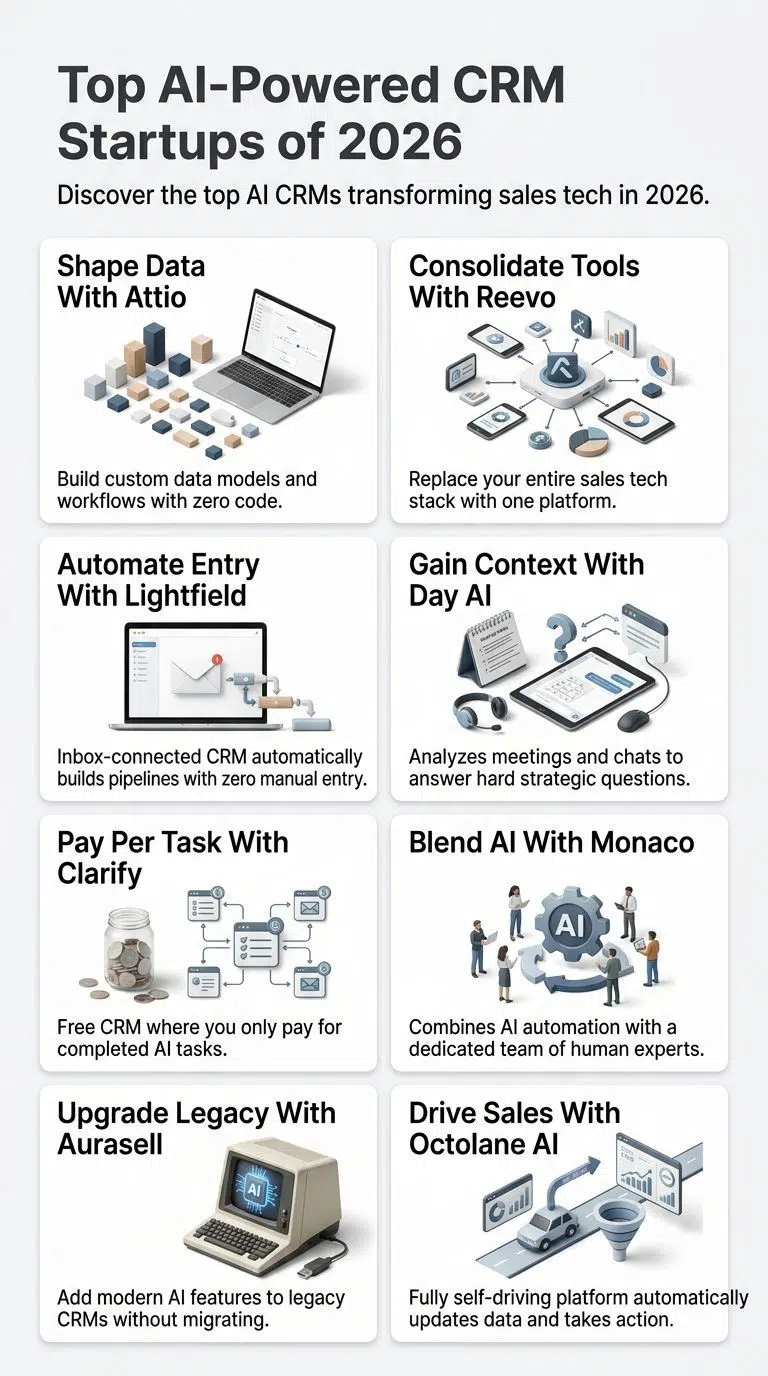
Founded by former DoorDash, Square, and Stripe operators and backed by Khosla Ventures and Kleiner Perkins, Reevo wants to replace the entire sales tech stack with a single platform. Instead of juggling a dialer, a sequencer, a data tool, and a CRM, teams get all of them in one place. The platform spans prospecting, outreach, pipeline management, and forecasting across sales, marketing, and customer success. With a heavy engineering focus, Reevo is one of the most ambitious end-to-end plays on the market.
3. Lightfield — The CRM That Updates Itself
Best for: Founder-led sales teams under 50 employees who hate manual data entry.
Key differentiator: A CRM that populates itself from your inbox in under five minutes, with zero manual setup.
Built by the founders of Tome, the presentation tool that reached 25 million users, Lightfield is designed around one core idea: complete customer memory. Connect your inbox, and five minutes later you have a populated pipeline with no manual entry required. The platform pulls context from unstructured conversations and turns it into structured CRM data on its own. Early traction has been remarkable, with thousands of companies (including more than 100 Y Combinator startups) signing up in just a few months. Many are migrating straight from HubSpot.
4. Day AI — The “Cursor of CRM”
Best for: Companies that want their CRM to answer hard strategic questions, not just store data.
Key differentiator: Listens across email, Slack, Zoom, and Google Meet to build complete business context in about 15 minutes.
Founded by former HubSpot product leader Christopher O’Donnell and backed by Sequoia Capital, Day AI is coming for the very company he helped build. The platform listens to your work across email, Slack, Zoom, and Google Meet, and it generates a conversational system of record that knows your business in just 15 minutes. O’Donnell calls the new category CRMx, where the “x” stands for context. Day AI aims to answer questions that traditional CRMs cannot, such as “What makes our best reps so good?”
5. Clarify — Ambient Intelligence for Sales
Best for: Venture-backed startups that want autonomous go-to-market motions from day one.
Key differentiator: Free CRM with usage-based AI pricing — you only pay when an agent successfully completes a task.
Co-founded by Patrick Thompson, and Ondrej Hrebicek, Clarify takes a different approach. The CRM should be an active teammate running in the background, not a database that needs to be served. Its pricing is also unusual. The CRM itself is free, and companies only pay when an AI agent successfully completes a task. This makes Clarify especially attractive to early-stage startups that want autonomous go-to-market motions without a heavy upfront commitment.
6. Monaco — AI CRM Plus Human Sales Pros
Best for: Seed and Series A startups that need both software and human sales expertise.
Key differentiator: AI CRM bundled with an actual supervised team of human sales professionals who attend your meetings.
Monaco is the brainchild of Sam Blond, former CRO at Brex and a former Founders Fund partner. What makes Monaco different is that customers get more than software. They also get a team of human sales experts who supervise the AI agents, train them to sell the product, and even attend customer meetings. The platform ships with a built-in prospect database, AI agents that run outbound campaigns, and a meeting note-taker. It is software sold as a service, and a service sold as software.
7. Aurasell — The Intelligence Layer for Legacy CRMs
Best for: Enterprise teams locked into long-term Salesforce or HubSpot contracts.
Key differentiator: Adds a modern AI execution layer on top of existing legacy CRMs — no migration required.
Aurasell takes a practical angle. Instead of asking companies to rip out their Salesforce or HubSpot setups, it sits on top of them. The platform adds AI-powered prospecting, forecasting, and analytics to legacy databases, which is a lifesaver for enterprise teams stuck in multi-year contracts. It is a smart middle ground between staying with the incumbent forever and migrating everything to a new tool.
8. Octolane AI — The Self-Driving CRM
Best for: Early-stage startups that cannot afford a dedicated RevOps hire.
Key differentiator: A fully self-driving CRM that updates itself, takes actions, and learns from every interaction.
Octolane calls itself “the world’s first self-driving AI CRM.” The idea is simple. The CRM updates itself, takes actions based on customer signals, and learns from every interaction. Sales teams never have to manually update data again. For early-stage startups that cannot afford a full-time RevOps person, this model is especially appealing.
9. Fixture — AI-Native CRM Built for Startups
Best for: Startups that want a modern, AI-first CRM from day one.
Key differentiator: Lean and AI-native by design, built specifically for founder-led sales motions.
Fixture is a newer Y Combinator-backed entry aimed squarely at startups that want a modern CRM from day one. The team has built something lean, AI-native, and designed for founder-led sales motions. Expect to hear much more from Fixture over the next twelve months as it scales its customer base.
10. Rings AI — Relationship Intelligence for Deal Teams
Best for: Venture capital firms, investment banks, and relationship-driven sales teams.
Key differentiator: Finds the fastest warm path to any prospect using your existing network.
Rings AI is built for relationship-driven organizations where introductions matter more than cold emails. Instead of focusing on deal pipelines, it focuses on people and warm paths. The platform combines real-time data with deep AI analysis to help users find the fastest route to any prospect through their existing network. For firms where relationships are the product, Rings AI is a purpose-built tool.
11. Vivun — AI for Pre-Sales and Solution Engineering
Best for: Solution engineering and pre-sales teams at B2B software companies.
Key differentiator: Focuses on the deal cycle before pipeline — technical wins, product gaps, and win/loss insights.
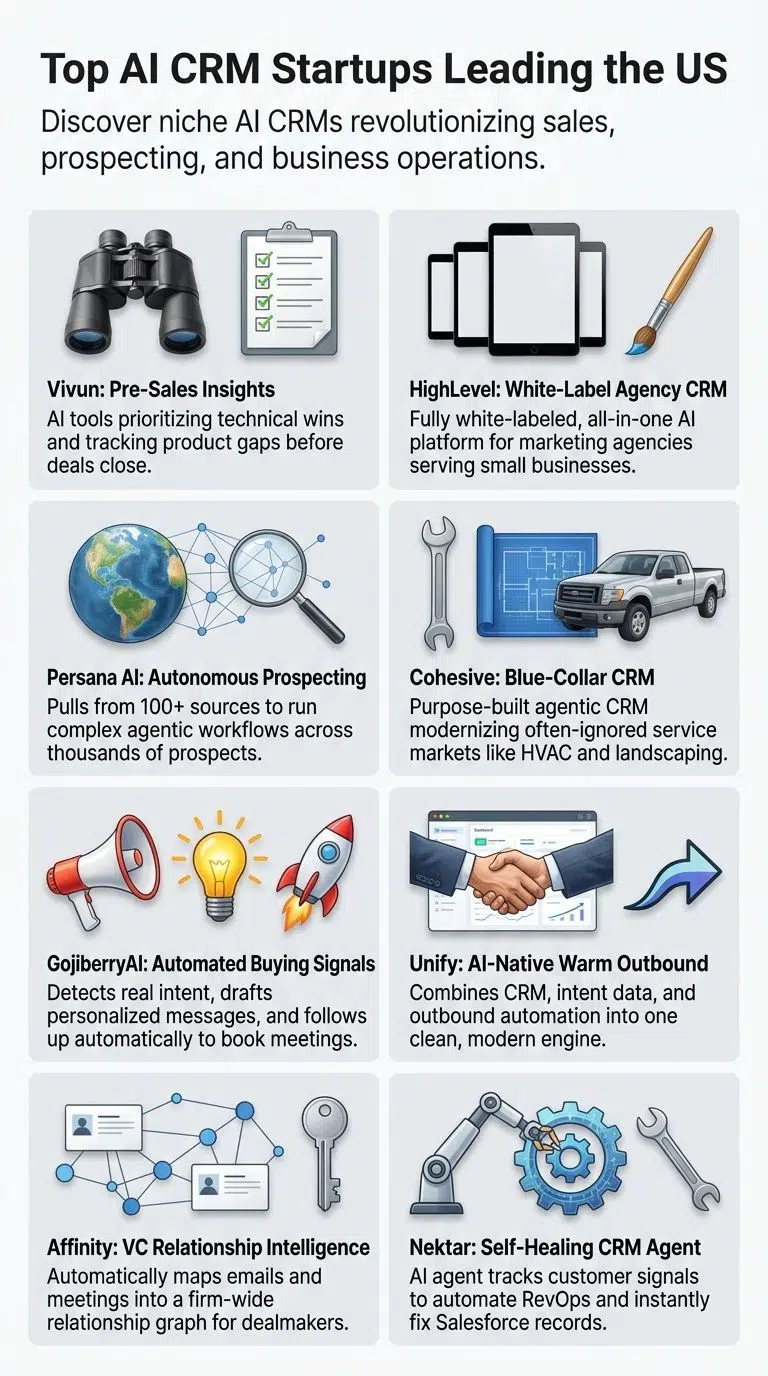
Founded by Matthew Darrow, Dominique Darrow, and Claire Bruce, Vivun solves a problem most CRMs ignore: what happens before a deal actually closes. Its AI tools help solution engineers and pre-sales teams prioritize technical wins, track product gaps, and give the rest of the sales organization better data about why deals are won or lost. It is a quiet but powerful niche.
12. HighLevel (GoHighLevel) — The White-Label AI CRM for Agencies
Best for: Marketing agencies that serve small and medium-sized businesses.
Key differentiator: A fully white-labeled, all-in-one AI CRM that agencies can resell as their own.
HighLevel is a different kind of success story. It is bootstrapped, privately held, and has grown massively by serving marketing agencies. The platform lets agencies white-label a full AI-powered CRM, funnel builder, and automation suite, then resell it to their small business clients. For SMBs that want an all-in-one sales and marketing platform without enterprise pricing, HighLevel is often the answer.
13. Persana AI — The Agentic GTM Platform
Best for: Outbound-heavy sales teams that want autonomous prospecting at scale.
Key differentiator: Pulls from 100+ data sources and runs agentic workflows across tens of thousands of prospects.
Persana is trying to replace the fragmented stack of prospecting, enrichment, and outreach tools that most sales teams patch together. Its agentic platform pulls from more than 100 data sources, runs complex workflows across tens of thousands of prospects, and syncs both ways with Salesforce and HubSpot. Customers report a 95% increase in qualified pipeline and 65% faster sales cycles.
14. Cohesive — The Agentic CRM for Blue-Collar Businesses
Best for: Service businesses like HVAC, landscaping, janitorial, and pest control.
Key differentiator: Purpose-built agentic CRM for a massive market that mainstream software has ignored.
Most AI CRM startups chase software companies and venture-backed SaaS teams. Cohesive goes the other way. It builds an agentic CRM for blue-collar service businesses like janitorial companies, HVAC contractors, pressure washers, landscapers, and pest control operators. This is a large, often overlooked market where the average CRM today is either a spreadsheet or a dated piece of industry software.
15. GojiberryAI — The GTM Brain
Best for: Sales teams that want a co-pilot to detect buying signals and act on them automatically.
Key differentiator: Combines intent detection, personalized messaging, and autonomous follow-up in a single brain.
GojiberryAI detects buying signals like funding events, job changes, hiring spikes, and competitor engagement, then prioritizes leads based on ideal customer profile fit and real intent. It drafts personalized messages, starts conversations, and follows up automatically until a meeting is booked, while constantly learning what works for each team. The pitch: two to five times more replies with no additional headcount.
16. Unify (UnifyGTM) — AI-Native Warm Outbound
Best for: Modern B2B teams running intent-based outbound motions.
Key differentiator: Combines CRM, intent data, and outbound automation without stitching together Clay, Apollo, and HubSpot.
Unify sits at the intersection of CRM, intent data, and outbound automation. It detects buyer intent signals, automatically enriches prospect data, and drafts personalized emails based on real-time research. For teams that want a modern outbound engine without patching together half a dozen separate tools, Unify is one of the cleanest options on the market.
17. Affinity — AI Relationship Intelligence for VCs and Dealmakers
Best for: Venture capital firms, private equity investors, and investment banks.
Key differentiator: Automatically maps every email, meeting, and introduction into a firm-wide relationship graph.
Affinity is the go-to CRM for venture capital firms, private equity investors, and investment banks. Its AI automatically maps every email, meeting, and introduction a firm has ever had, then uses that data to surface warm paths to any prospect. For deal teams whose entire business is built on relationships, Affinity is less a CRM and more a long-term memory system.
18. Tact.ai — The Conversational AI Assistant
Best for: Field sales reps in life sciences and pharma who need mobile-friendly CRM access.
Key differentiator: Voice-first and chat-first AI assistant that sits on top of Salesforce.
Tact.ai was early to the AI-in-CRM game. It built a natural-language assistant that sits on top of Salesforce and lets reps update records, log calls, and pull customer information using voice or chat. The company has carved out a strong niche in life sciences and pharma, where field reps need fast, mobile-friendly access to complex customer data.
19. Nektar — The Self-Healing CRM Agent
Best for: Enterprise RevOps teams that want cleaner Salesforce data without new headcount.
Key differentiator: The “Daisy” AI agent self-heals CRM records using real customer signals from emails, meetings, and calls.
Nektar built an AI agent called Daisy that sits on top of Salesforce and automates RevOps work. Daisy tracks every customer signal, including emails, meetings, and calls, and uses those signals to update records, fill data gaps, and flag missed opportunities. The result is a cleaner, more accurate CRM without having to hire a bigger operations team.
20. Siena AI — The Autonomous Customer Service CRM
Best for: E-commerce brands handling high volumes of inbound customer service.
Key differentiator: Autonomous AI agents that resolve customer conversations end-to-end, not just triage them.
Siena focuses on the customer service side of CRM. Its autonomous AI agents handle inbound customer conversations across email, chat, and social media for e-commerce brands. Instead of a human agent reading through a case history and typing a response, Siena’s AI handles the whole interaction from start to finish, escalating to a human only when it is truly needed.
What These Startups Tell Us About the Future of CRM
A few clear patterns stand out from this list.
Data entry is dying. Every single company here is built on the assumption that humans should not be updating CRM records by hand. The AI listens, captures, and structures the data on its own. This is the single biggest shift since CRMs moved to the cloud.
The stack is collapsing. Companies like Reevo, Unify, and Persana are betting that the 12-tool sales stack most teams use today will shrink to just two or three tools in the next few years. If that prediction plays out, the long-term winners will be platforms, not point solutions.
AI agents are the new battleground. The CRM is becoming the hub, and AI agents are the workers. Whichever platform hosts the most capable agents will likely win the long-term market. That is why founders are saying the CRM decision is no longer a CRM decision. It is an AI infrastructure decision.
Specialization is winning. From Cohesive serving blue-collar businesses to Tact.ai serving pharma reps to Affinity serving venture capital, the smartest bets in this list are the ones that pick a clear audience and go deep. Horizontal generalists will struggle to compete with vertical specialists.
Frequently Asked Questions (FAQs) on AI-Powered CRM Startups in the USA
What is an AI-powered CRM?
An AI-powered CRM is a customer relationship management system in which artificial intelligence is built into the core of the platform, not added as an afterthought. Instead of asking sales reps to manually log calls, update contacts, and write follow-ups, the AI captures, structures, and acts on customer data automatically. Modern AI CRMs also use language models to summarize meetings, draft emails, score leads, and answer plain-English questions about pipeline health.
How are AI-powered CRM startups in the USA different from Salesforce or HubSpot?
The 20 AI-powered CRM startups in the USA on this list were built from the ground up with AI as the foundation, while Salesforce and HubSpot were built in an earlier era and are now bolting AI on top of legacy systems. As a result, AI-native startups like Clay, Day AI, Lightfield, and Reevo can offer features such as zero data entry, conversational pipeline queries, and autonomous AI agents that simply do not work as well on top of older platforms.
Which AI-powered CRM is best for startups and small teams?
For early-stage startups and small teams, the strongest options on this list are Clay, Lightfield, Clarify, Day AI, and Fixture. They all offer modern interfaces, fast onboarding, and AI features that reduce admin work for small teams. Clarify in particular is worth considering because its CRM is free and you only pay when AI agents successfully complete tasks, which keeps costs predictable for cash-conscious startups.
Are AI-powered CRM startups replacing human sales reps?
No, and most of them are very explicit about this. Companies like Monaco even bundle in human sales experts who supervise the AI. The goal of these platforms is to remove the busywork (data entry, manual research, follow-up emails, pipeline updates) so that human reps can spend more time on the parts of the job that actually require human judgment, like building relationships and closing complex deals.
How much funding have AI-powered CRM startups in the USA raised?
Combined, the 20 AI-powered CRM startups in the USA on this list have raised more than $500 million in venture capital, with major rounds led by Sequoia, Khosla Ventures, Kleiner Perkins, Google Ventures, and Founders Fund. AI CRM is one of the hottest software categories of 2026, and the pace of funding is increasing every quarter as VCs look for the company that will become the “Cursor of CRM.”
Final Words
The CRM market is going through its biggest change in two decades. For 25 years, Salesforce and HubSpot defined what a CRM should look like. Today, a new generation of American startups is rewriting that definition, and they are doing it fast.
If you are running a small team and still manually updating records after every call, one of these 20 companies is likely a better fit than what you are using right now. If you are a larger business locked into a legacy contract, platforms like Aurasell, Nektar, or Persana can add an AI layer without forcing a painful migration. And if you are an investor or founder, this is one of the hottest software categories of 2026, with new breakout candidates appearing almost every month.
The AI-powered CRM revolution is no longer coming. It is here. The only question now is which of these twenty startups will define the next chapter of how businesses grow customer relationships.
























