Understanding the law is no longer something only lawyers and judges need. Every day, you click “I agree” on apps, sign digital contracts, post on social media, and buy products online. All of these actions sit inside a legal framework that affects your rights, your money, your privacy, and your future.
This guide explains basic law ideas for beginners in simple language. You don’t need a law degree. You only need curiosity and a little patience. We’ll walk through 10 practical law ideas, from contracts and consumer rights to digital privacy and employment rules. You’ll see where these ideas appear in daily life and how a little awareness can help you avoid costly mistakes.
How to Use This Beginner’s Law Guide

This article is designed as an introduction to law for everyday readers.
- Students who want a foundation in legal basics.
- Young professionals starting their careers or businesses.
- Freelancers and entrepreneurs are signing contracts and deals.
- Anyone who wants to understand their rights and responsibilities.
You can read it from start to finish or use the headings to jump to topics that matter most right now—like contract law basics, consumer rights, or criminal vs civil law. Think of this as a map of the legal landscape. Once you know the territory, it becomes easier to go deeper into any area that affects your life or work.
Law Idea #1: Understanding the Legal System and Types of Law
What Is “Law” in Simple Terms?
At its core, law is a set of rules created and enforced by governments and official institutions to guide behavior and resolve disputes.
These rules aim to:
- Maintain order in society.
- Protect people and property.
- Set standards for what is acceptable and what is not.
- Provide a system for resolving conflicts fairly.
Laws come from several sources, including:
- Constitutions – the highest rules that structure the state and protect fundamental rights.
- Statutes/Acts – laws passed by parliaments or legislatures.
- Regulations – detailed rules created by government agencies.
- Court decisions – judgments that interpret laws and create legal precedents.
Main Types of Law Beginners Should Know
As part of law basics for beginners, it helps to know the major branches of law you’ll often hear about:
- Criminal law – deals with offenses against society (theft, assault, fraud).
- Civil law – covers disputes between individuals or organizations (contracts, property, negligence).
- Constitutional law – defines the powers of government and protects fundamental rights.
- Administrative law controls how government agencies make and apply rules.
- Family law – marriage, divorce, child custody, adoption, inheritance.
- Business or commercial law – company formation, trade, banking, and commercial contracts.
- Cyber and digital law – online behavior, data protection, cybercrime.
You may never study these in detail, but knowing they exist helps you understand where an issue fits in the legal system.
Law Idea #2: Rights and Responsibilities Under the Rule of Law
Your Basic Legal Rights
Most modern legal systems recognize that people have certain basic rights.
Exactly which rights and how they are protected can differ by country, but common themes include:
- The right to life and personal security.
- The right to fair treatment and due process if accused of wrongdoing.
- The right to privacy within reasonable limits.
- The right to own property and use it within the law.
- The right to freedom of expression and association (again, with limits).
These are often called fundamental rights or human rights. They act as a shield between individuals and the state, and they strongly influence how courts interpret other laws.
Responsibilities That Come With Rights
Rights are never completely unlimited.
They are balanced against:
- The rights of other people.
- The safety and stability of society.
- The duty to obey lawful rules.
Some basic legal responsibilities include:
- Following the law (even when you disagree with it).
- Paying taxes and fees required by law.
- Respecting court judgments and orders.
- Not harming others, not damaging property, and not spreading serious misinformation that causes harm.
Understanding that rights and responsibilities go together is one of the key legal basics everyone should know.
Law Idea #3: Contract Law Basics — The Agreements You Make Every Day
What Makes a Contract Legally Binding?
Contract law is one of the most important basic law ideas for beginners because you enter into contracts all the time. When you:
- Click “I agree” on an app.
- Buy a subscription.
- Rent an apartment.
- Sign an employment agreement.
You are dealing with contracts.
A simple contract usually needs:
- Offer – one party proposes terms.
- Acceptance – the other party clearly agrees to those terms.
- Consideration – something of value is exchanged (money, service, product, promise).
- Capacity – both parties are legally able to contract (e.g., adults of sound mind, depending on local law).
- Legality – the contract is for a legal purpose (no contract can enforce an illegal act).
With digital life, many contracts are now electronic, but the basic rules remain the same.
Red Flags and Common Mistakes in Everyday Contracts
If you want to protect yourself, pay attention to:
- Price and payment terms – total cost, hidden fees, how and when you pay.
- Duration and renewal – how long the contract lasts, and auto-renewal clauses.
- Cancellation rules – notice period, penalties, and refund rules.
- Liability clauses – who is responsible if something goes wrong?
- Dispute resolution – arbitration, jurisdiction, and where claims must be filed.
For non-lawyers, contract law basics mean: never sign or click “I accept” without reading key terms, especially for long-term or expensive commitments.
Law Idea #4: Criminal vs Civil Law — Understanding the Difference
How Criminal Law Works
Criminal law deals with actions considered harmful to society as a whole.
Examples include:
- Theft, robbery, burglary.
- Assault and violent crime.
- Fraud and financial crime.
- Serious cybercrime, such as hacking.
Key ideas in criminal law:
- Presumption of innocence – a person is considered innocent until proven guilty.
- Burden of proof – the state (prosecutor) must prove the case.
- Standard of proof – usually “beyond a reasonable doubt,” which is a very high standard.
Punishments may include fines, community service, or imprisonment, depending on the seriousness of the crime and local law.
How Civil Law Works
Civil law deals with disputes between private parties, such as:
- A customer vs a company over a defective product.
- A landlord vs a tenant over rent or property damage.
- Businesses disputing a contract or unpaid invoices.
In civil cases:
- One party (the claimant/plaintiff) sues another (the defendant).
- The standard of proof is usually lower, often “balance of probabilities”.
- Outcomes typically involve compensation (damages) or orders to do or stop doing something, rather than prison.
Knowing the difference between criminal and civil law helps you understand what kind of case you might face and what results to expect.
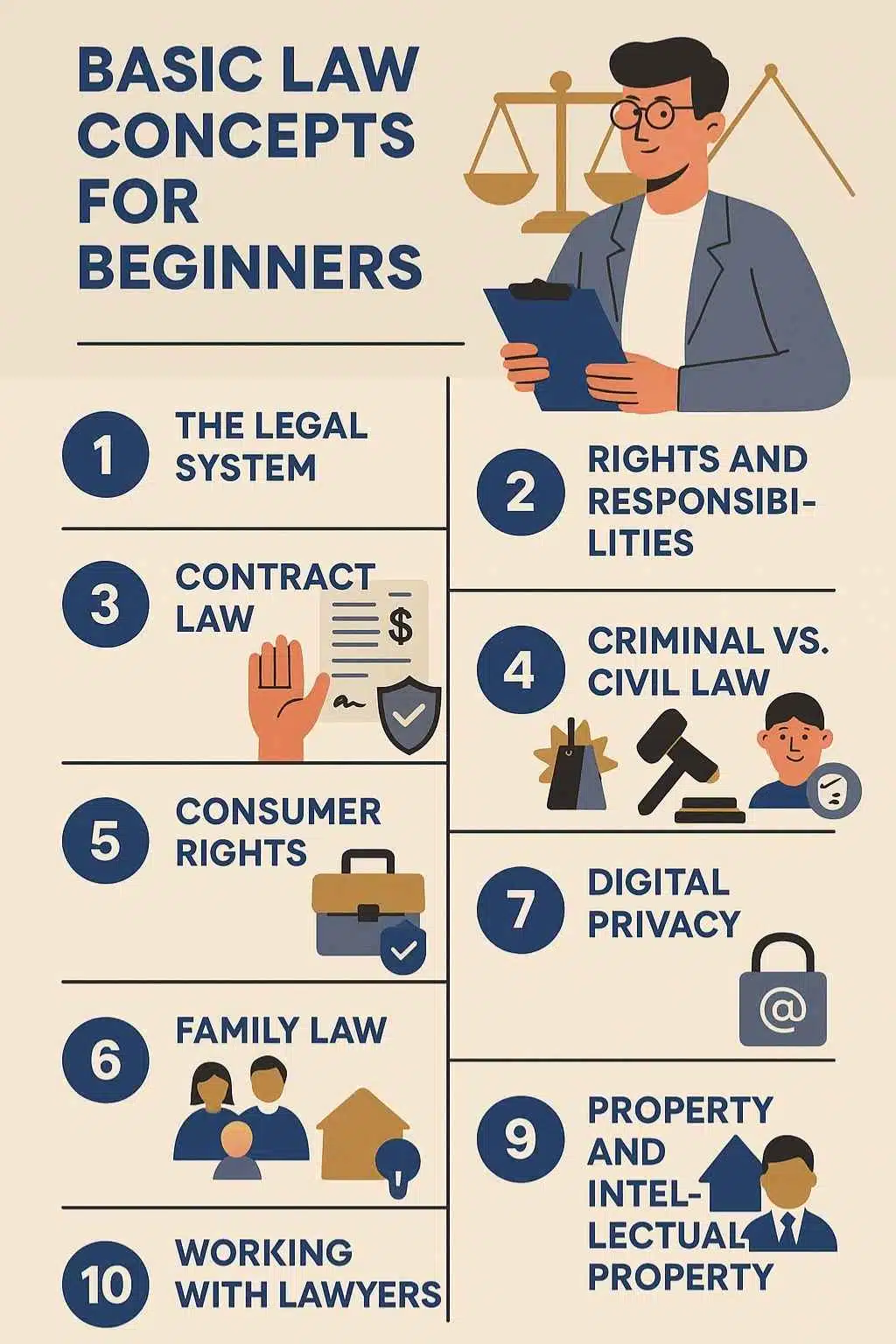
Law Idea #5: Consumer Rights and Everyday Purchases
What Are Consumer Rights?
Whenever you buy goods or services, you act as a consumer.
Most countries have laws to protect you from:
- Dangerous or defective products.
- Misleading advertising.
- Unfair contract terms or hidden conditions.
- Fraudulent schemes or scams.
Typical consumer rights may include:
- The right to clear and accurate information.
- The right to receive goods that are of satisfactory quality and fit for purpose.
- The right to a repair, replacement, or refund under certain conditions.
Using Consumer Law in Real Life
If something goes wrong:
- Gather evidence – receipts, emails, screenshots, photos.
- Contact the seller or service provider – explain the problem clearly.
- Follow their complaints process – many companies have formal procedures.
- Escalate if needed – to regulators, consumer protection agencies, or small-claims courts, depending on your country.
Understanding consumer rights and protections helps you stand up for yourself when a deal feels unfair or a product is not what was promised.
Law Idea #6: Employment Law Basics Every Worker Should Know
Your Rights at Work
When you start a job, you normally enter an employment contract. It may be written, digital, or sometimes partly implied by local law.
Usually it covers:
- Your role and responsibilities.
- Salary or wages and how you are paid.
- Working hours, holidays, and leave.
- Conditions for termination or resignation.
Key areas of employment law basics include:
- Minimum wage or fair pay rules.
- Limits on working hours and rest breaks.
- Anti-discrimination protections (for example, based on gender, race, or religion, depending on local law).
- Health and safety duties from employers.
Remote Work and Modern Workplace Issues
The modern workplace raises new questions:
- Remote work policies and monitoring of employees’ devices.
- Use of personal phones or laptops for work.
- Data protection and confidentiality obligations.
Before accepting a job, read your contract carefully. Ask questions about monitoring, overtime, side projects, and data privacy. Knowing your basic rights helps you spot unfair terms and negotiate better conditions.
Law Idea #7: Digital Privacy, Data Protection, and Cyber Law
How Your Data Is Collected and Used
Every time you use a smartphone, browse the web, or sign up for a service, you create a digital trail.
Companies collect data such as:
- Your name, contact details, and location.
- Your browsing behavior and search history.
- Your purchase patterns and interests.
Many legal systems now have data protection or privacy laws that regulate:
- How organizations can collect and store your data.
- What they must tell you about their practices.
- How long can they keep your information?
Your Digital Rights and Smart Practices
Depending on where you live, you may have rights to:
- Access your personal data held by companies.
- Correct or update inaccurate data.
- Ask for your data to be deleted in certain cases.
- Opt out of marketing communications.
As legal basics everyone should know in the digital age, try to:
- Read privacy notices for major apps and platforms.
- Limit permissions you give to apps (location, microphone, contacts).
- Use strong passwords and two-factor authentication.
- Be cautious before sharing sensitive personal information online.
Cyber law also covers offenses such as hacking, identity theft, cyberbullying, and online harassment—behaviors that can lead to serious legal consequences.
Law Idea #8: Family Law Essentials — Relationships, Marriage, and Children
Key Moments Where Family Law Applies
Family law governs legal relationships between family members.
Key areas include:
- Marriage and civil partnerships – legal recognition of relationships.
- Divorce and separation – how relationships legally end and what happens next.
- Child custody and support – who the children live with, visitation rights, and financial responsibilities.
- Adoption and guardianship – legal responsibility for children.
The details vary widely between countries and cultures, but the core goal is often to protect vulnerable family members, especially children.
Protecting Family Members and Yourself
Some basic principles that often appear in family law frameworks:
- The best interests of the child guide decisions on custody and support.
- Financial responsibilities for children usually last until a certain age or condition.
- Legal protections exist in many countries for victims of domestic violence or abuse.
Important documents in this area include marriage certificates, birth certificates, divorce decrees, custody orders, and, in some systems, prenuptial or postnuptial agreements.
Having at least an introduction to law in family matters helps you understand the emotional and financial impact of major life decisions.
Law Idea #9: Property and Intellectual Property (IP) Basics
Owning, Renting, and Sharing Property
Property law governs how you own, use, and transfer physical things like land, houses, and cars. It also shapes how you share or borrow those things.
Key concepts include:
- Ownership – you hold full legal title, subject to local rules.
- Lease or rental – you pay to use someone else’s property for a set time.
- Licensing – often used for software or digital content, where you buy a license to use, not to own.
If you rent a home or office, you are under a lease. Understanding the main terms—rent amount, notice period, responsibilities for repairs—can protect you from surprise disputes.
Intellectual Property in the Age of Content Creation
Intellectual property (IP) covers creations of the mind.
Such as:
- Written content, music, and art (copyright).
- Brand names and logos (trademarks).
- New inventions or technical solutions (patents).
For content creators, freelancers, and entrepreneurs, IP is critical:
- Using someone else’s work without permission—images, music, text—can infringe their rights.
- Building a brand often means protecting your name and logo with trademarks.
- Tech startups may rely on patents or trade secrets as core assets.
Knowing property and intellectual property rights helps you avoid accidental infringement and protect the value you create.
Law Idea #10: How to Read Legal Information and Work With Lawyers
Finding Reliable Legal Information
The internet is full of legal advice. Not all of it is correct or suited to your situation.
When you research law basics for beginners, pay attention to:
- Official government portals and court websites.
- Reputable legal organizations and bar associations.
- Recognized universities or educational institutions.
- Clear disclaimers that distinguish education from personal advice.
Use online articles to understand concepts, but be careful about relying on them for major decisions like signing a large contract, starting a business, or responding to criminal charges.
When You Really Need a Lawyer
Some situations are too serious or complex to handle alone.
You should strongly consider professional advice when:
- You are arrested or formally accused of a crime.
- You face a large financial claim or lawsuit.
- You are buying or selling significant property or a business.
- You are dealing with complex family matters (divorce, custody, inheritance disputes).
When choosing a lawyer, look at:
- Their specialization (criminal, family, corporate, etc.).
- Experience with cases similar to yours.
- Transparency about fees and billing.
- Willingness to explain things in language you understand.
And remember: this article provides general legal information, not a substitute for advice tailored to your case.
Quick Checklist: 10 Practical Law Habits for Beginners
To turn these basic law ideas for beginners into daily habits, use this simple checklist:
- Pause before you sign or click “I agree.” Read the key terms of any contract.
- Keep records of important transactions. Save receipts, contracts, emails, and messages.
- Know your main rights as a consumer and worker. Especially refunds, warranties, and workplace protections.
- Stay within the law online. Avoid harassment, hate speech, and copyright violations.
- Protect your data and privacy. Use strong passwords, check app permissions, and review privacy settings.
- Understand the difference between criminal and civil issues. Know when something could lead to criminal charges.
- Organize key documents. IDs, certificates, property papers, contracts, and any court orders.
- Ask questions when terms are unclear. With employers, landlords, service providers, or platforms.
- Use reputable sources for legal information. Don’t rely solely on rumors or social media.
- Get professional legal advice when the stakes are high. Especially for criminal matters, big money, or complex disputes.
Even small improvements in these habits can save you time, money, and stress later.
FAQ: Learning Law Without a Law Degree
Can I learn law as a non-lawyer?
Yes. You can learn the introduction to law topics on your own. Start with basic guides like this, then move to beginner-friendly textbooks, online courses, or lectures. You don’t need to become an expert; even a modest understanding makes you more confident and better protected.
Is this information valid in every country?
No. Laws differ across jurisdictions. This article explains general principles that appear in many legal systems, but specific rules and procedures may be very different where you live. Always check local laws or consult a local lawyer for accurate guidance.
Should I rely on online articles for legal decisions?
Online resources are helpful for learning legal basics everyone should know, but they are not enough for serious decisions. Use them to understand concepts and prepare questions. For major issues, talk to a qualified lawyer before acting.
What is the best way to go deeper into legal studies?
If you want to go further:
- Take introductory law courses online or at local institutions.
- Read beginner-level books on criminal law, contract law, or constitutional law.
- Follow reputable legal news sources to see how laws apply in real cases.
- Consider a formal study if you discover a strong interest in a legal career.
Bottom Line: Law as a Life Skill, Not Just a Career
Law touches almost every part of modern life. From the contracts you sign and the content you share to the jobs you take and the products you buy, legal rules shape your choices and protections.
By learning these 10 basic law ideas for beginners, you are not trying to replace lawyers or judges. You are building a life skill—a practical understanding of how rights, responsibilities, contracts, and protections work in the real world.
Use this guide as a starting point. Revisit the checklist when you face an important decision. Explore areas that affect your career, your business, or your family. With each step, the law becomes less intimidating and more like what it truly is: a tool you can use to protect your interests and make smarter choices.