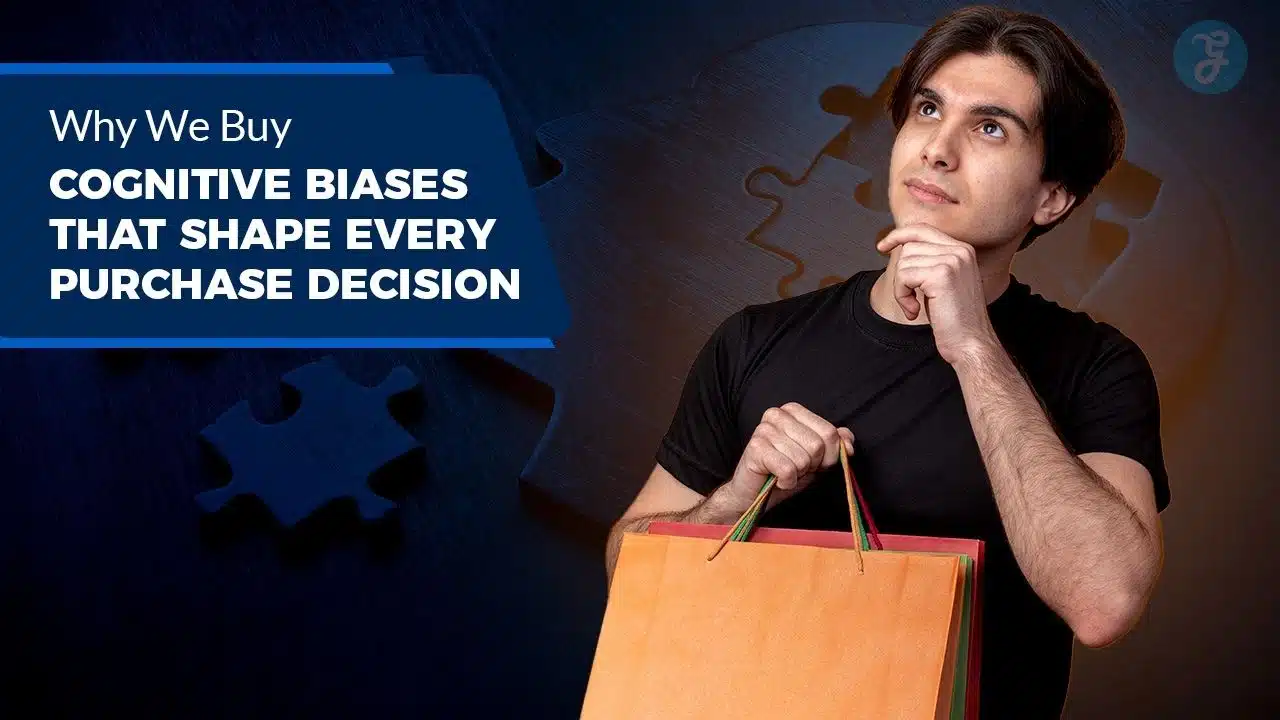
Understanding consumer behavior is at the heart of successful marketing. However, not all purchasing decisions are based on logic or need. Many of our choices are influenced by unconscious mental shortcuts—cognitive biases—that shape the way we perceive value, trust, and desirability in products.
These biases are deeply rooted in human psychology. And, when leveraged correctly, cognitive biases dramatically influence a consumer’s decision-making process. Let’s explore seven key biases that marketers use to their advantage, and how you, as a consumer, might be unknowingly influenced by them every time you make a purchase.
7 Cognitive Biases That Shape Every Purchase Decision
Understanding the 7 cognitive biases that influence consumer behavior is essential for both marketers and shoppers. These biases, including anchoring, scarcity, and social proof, impact purchasing decisions in ways we may not even realize. By recognizing these psychological triggers, businesses can better tailor their strategies, while consumers can make more informed choices.
1. Anchoring Bias: The First Price You See Shapes Everything
Anchoring bias is one of the most powerful cognitive biases when it comes to purchasing decisions. It occurs when individuals rely too heavily on the first piece of information they encounter, often referred to as the “anchor,” and use it as a reference point for making future judgments.
In the context of pricing, anchoring is commonly seen in sales and discount strategies. For example, if you see a jacket priced at $500, followed by a sale price of $250, the $500 becomes your anchor, and you perceive the $250 price as a great deal—even if the original price was inflated to begin with. This is because the brain tends to rely heavily on that initial number as a reference.
Marketers are aware of this bias and use it strategically. A luxury brand might set an exorbitantly high original price to create the illusion of a massive discount when the item is marked down, even if the sale price is still much higher than what consumers would pay for comparable items elsewhere. Similarly, online retailers often display the “regular price” next to the “discounted price” to emphasize the value of the offer.
2. Availability Heuristic: Decisions Based on Recent Information
The availability heuristic refers to the tendency to make judgments based on the information that is most readily available in our memory. This bias leads us to overestimate the importance of recent events or information that we’ve been exposed to, influencing how we make decisions.
In the world of consumer purchases, the availability heuristic is particularly evident when it comes to advertisements or media influence. If you recently saw a commercial for a new smartphone, you may be more inclined to purchase that phone simply because the information about the product is fresh in your mind. The same applies to experiences—if you recently attended a party where everyone raved about a particular brand of wine, you’re more likely to purchase that wine the next time you’re at the store, even if there are other options available.
This bias explains why brands that invest in advertising campaigns, especially those that feature repetition or emotional storytelling, tend to gain significant consumer traction. By keeping their products top of mind, they increase the likelihood of influencing purchasing decisions based on the availability heuristic.
3. Confirmation Bias: Seeking Out What You Believe
Confirmation bias occurs when we seek out information that supports our pre-existing beliefs or preferences, while dismissing or undervaluing information that contradicts them. This bias can be seen in action when consumers make product choices based on existing loyalties or brand preferences, often disregarding negative reviews or competing brands.
For instance, if you’re a long-time fan of a particular tech brand, you’re likely to seek out positive reviews about its latest product release while disregarding any critical reviews. Similarly, if you have a strong opinion about a brand, you may overlook the flaws in its products simply because you want to confirm your positive view of the brand.
Marketers know that consumers are influenced by confirmation bias, which is why they tailor their messaging to reinforce existing perceptions. By highlighting positive reviews, testimonials, or case studies, brands can encourage consumers to align their beliefs with the company’s narrative, leading to higher sales and customer loyalty.
4. Social Proof: The Influence of Others’ Actions
Humans are social creatures, and as such, we often look to others to guide our decisions, particularly when we are unsure. This bias is called social proof, and it plays a significant role in consumer decision-making. Social proof is the psychological phenomenon where people assume the actions of others reflect correct behavior for a given situation.
In marketing, social proof is often leveraged through testimonials, user reviews, and influencer endorsements. When consumers see that others are buying a product or praising a brand, they are more likely to follow suit. This is why platforms like Amazon heavily feature customer reviews and ratings—potential buyers feel more confident purchasing an item that others have already bought and endorsed.
The rise of influencer culture on platforms like Instagram and TikTok also illustrates the power of social proof. When a celebrity or influencer promotes a product, it sends a signal that the product is worthy of attention. This makes consumers more likely to purchase, as they want to be a part of the “in-crowd” or experience the same benefits as their favorite influencers.
5. Reciprocity: The Power of Give and Take
Reciprocity bias is the principle that when someone does something for us, we feel obligated to return the favor. This bias is frequently used in marketing to create a sense of indebtedness in consumers, compelling them to purchase after receiving something for free.
One of the most common examples of reciprocity in marketing is the free sample. Grocery stores and beauty brands often offer free samples of products, knowing that recipients of these samples feel compelled to buy the full-size product in return. Online businesses also use this bias through strategies like offering free trials or access to premium content for a limited time. The idea is that once the consumer experiences the value of the product or service, they are more likely to convert into a paying customer.
Additionally, brands often use promotional offers like “Buy One, Get One Free” or “limited-time discounts” to trigger a feeling of reciprocity. These offers suggest that the consumer is receiving something extra or special, which can push them to complete the purchase.
6. Scarcity: The Fear of Missing Out (FOMO)
Scarcity is a cognitive bias that occurs when people place higher value on things that are perceived as scarce or in limited supply. This bias is strongly linked to the fear of missing out (FOMO), which is a powerful motivator in driving purchasing behavior.
When consumers are told that a product is limited in quantity or available for a short time, they often feel a sense of urgency to act quickly to avoid losing the opportunity. This fear of missing out can be seen in action with phrases like “Only 5 left in stock!” or “Sale ends in 24 hours!” Online retailers like Amazon and fashion brands often use countdown timers and stock alerts to create a sense of urgency that leads to impulse purchases.
Scarcity works by triggering an emotional response—when something feels limited, it automatically feels more valuable. As a result, scarcity tactics can significantly increase sales and encourage consumers to make quicker, more impulsive buying decisions.
7. Loss Aversion: The Fear of Losing What You Have
Loss aversion is a cognitive bias that stems from the idea that losses are psychologically more impactful than gains. This bias explains why consumers are often more motivated by the fear of losing something than by the prospect of gaining something of equal value.
In purchasing decisions, loss aversion plays a role in how consumers respond to promotions or limited-time offers. When a deal or promotion is framed as a way to avoid losing out—whether it’s a sale, a limited-time offer, or a clearance event—consumers are more likely to make a purchase.
For example, a retailer might offer a “flash sale” with the tagline “Last Chance to Save 50%,” appealing to the consumer’s fear of missing out on the potential loss. Similarly, marketers use guarantees and return policies to reduce the perceived risk of losing money on a product, making consumers more comfortable with their decision to purchase.
How Marketers Leverage Cognitive Biases for Effective Strategies
Marketers are acutely aware of how cognitive biases shape consumer behavior, and they use these biases to craft more effective campaigns. By tapping into biases like anchoring, availability heuristic, and social proof, marketers can influence purchasing decisions and increase sales.
However, businesses need to use these strategies ethically. While cognitive biases can certainly drive sales, they should not be used to manipulate or deceive consumers into making poor choices. Consumers also need to be aware of these psychological triggers so they can make more informed, rational purchasing decisions.
Conclusion: Empowering Consumers and Marketers to Use Cognitive Biases Responsibly
Cognitive biases are an inherent part of human decision-making, and they play a significant role in shaping consumer behavior. By understanding how these biases work, both consumers and marketers can make better, more informed decisions. While marketers can use these insights to optimize their strategies, consumers can be more mindful of the psychological tactics at play and make conscious choices that are aligned with their true needs and values.
Whether you’re selling a product or simply making a purchase, being aware of these cognitive biases can empower you to take control of the decision-making process and ensure that your choices are based on informed, rational thought—rather than unconscious biases.