Have you ever read a poem so silly it made you laugh out loud, but then left you wondering if there was a hidden joke you missed?
It’s a common feeling. Many of us wish stories could be both hilarious and clever, but finding that perfect blend, especially in Bengali literature, can feel like a real treasure hunt.
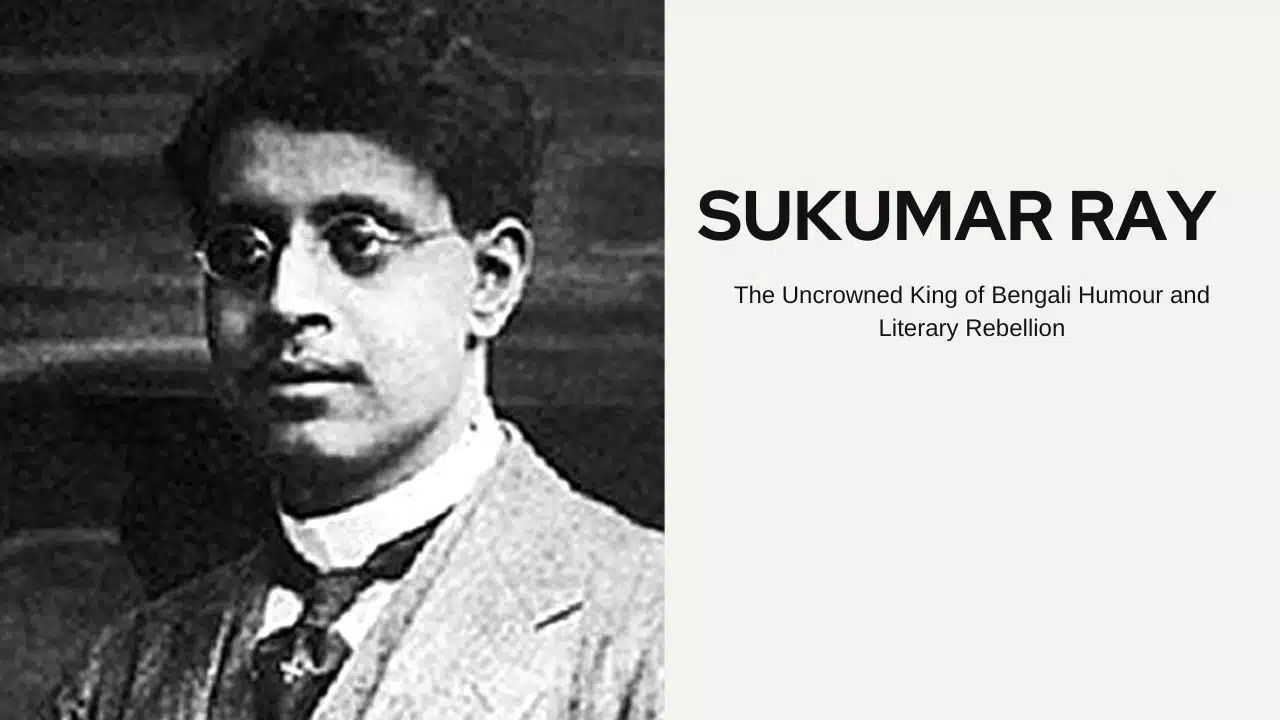
Well, here’s a little secret: Sukumar Ray mastered this trick over a century ago. He created a world of pure fun that also held a mirror up to society with books like Abol Tabol and Pagla Dashu. Today is his 138th birth anniversary. Happy birthday Sukumar Ray.
I’m going to walk you through how this incredible writer became the king of Bengali humor and a quiet rebel, using nothing but wild rhymes and brilliant jokes. Let’s explore his world together!
Key Takeaways
- Sukumar Ray wrote iconic humorous books like Abol Tabol (1923), Ha Ja Ba Ra La (1921), and Pagla Dashu, which delighted readers of all ages while offering sharp social commentary.
- He used a unique mix of jokes, rhymes, original drawings, and invented words to poke fun at the rigid social norms in colonial Bengal, creating a style inspired by Lewis Carroll but distinctly Bengali.
- Ray was a key figure at the Sandesh magazine, first with his father Upendrakishore Ray and later inspiring his son, the famed filmmaker Satyajit Ray, who used similar humor in films like Goopy Gyne Bagha Byne.
- He broke traditional poetry rules by blending scientific facts, casual language, and sharp wit into playful nonsense verse that resonated with both children and adults.
- His work remains a cornerstone of Bengali culture, celebrated widely on the 100th anniversary of Abol Tabol in 2023 and still used in schools across West Bengal.
Sukumar Ray’s Legacy in Bengali Literature
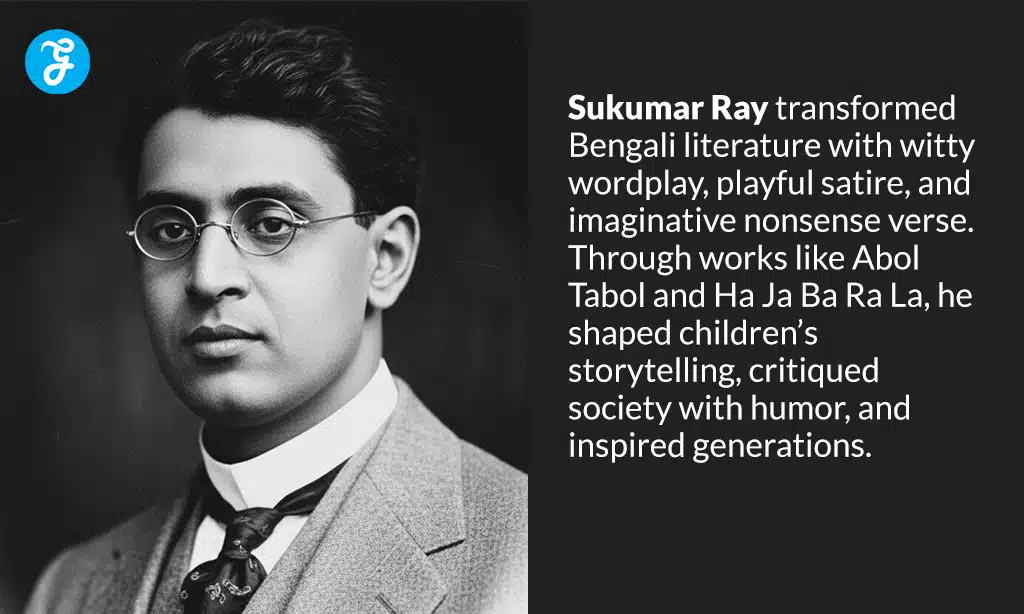
Sukumar Ray completely changed the game in Bengali literature with his clever wordplay and imaginative ideas. Children across Bengal still giggle at the talking creatures in Abol Tabol, while adults appreciate the smart jabs at the society of his time. His work was a product of the buzzing creative energy of Calcutta, centered around his family’s press, U. Ray & Sons.
How did Sukumar Ray influence children’s literature?
Books like Abol Tabol and Ha Ja Ba Ra La weren’t just simple stories for kids. Ray combined absurd characters, catchy rhymes, and his own quirky illustrations to make children laugh while also thinking about the world around them.
His nonsense verse was inspired by Western writers like Lewis Carroll, the author of Alice in Wonderland, but he gave it a uniquely Bengali flavor that felt right at home. He wasn’t just writing; he was creating a whole new way for children to experience stories.
As an editor for the family’s children’s magazine, Sandesh, which he took over after his father Upendrakishore Ray’s death in 1915, he shaped the imaginations of an entire generation. Even today, stories from Pagla Dashu are used by teachers in West Bengal to make learning fun and engaging for young students.
Sukumar Ray was a master of using humor to make a point. His nonsense rhymes in books like Abol Tabol were filled with subtle but sharp critiques of the social norms and colonial attitudes of the Bengal Renaissance.
Through bizarre creatures and nonsensical situations, he cleverly poked fun at everything from the rigid colonial bureaucracy to the “Babu culture” of locals who eagerly imitated the British. For example, his poem about a creature called “Kumro Potash” is often seen as a jab at an arbitrary, bossy authority figure.
A 2022 analysis pointed out that Ray used his fantastical creatures and wordplay to create “a counter-narrative” against the colonial environment, making readers laugh while also questioning the world around them.
He did all of this without ever sounding preachy. His jokes were aimed at stuffy scholars and self-important officials in Calcutta, but the humor was so light and playful that everyone could enjoy it. He made people think without them even realizing it.
What are Sukumar Ray’s Most Notable Works?
Ray’s most beloved books have truly stood the test of time, sparking laughter and imagination for over a century. His playful and brilliantly illustrated stories continue to be cherished on bookshelves everywhere, from Calcutta to Santiniketan.
Abol Tabol
Published posthumously in 1923, Abol Tabol (which translates to “Gibberish” or “Nonsensical”) became an instant classic in Bengali literature. The book is a collection of 46 poems filled with fantastical creatures, delightful wordplay, and pure, joyful chaos. Readers still laugh at the antics of memorable characters like Kumro Potash, the grumpy pumpkin-like figure, and the ever-hungry Huko Mukho Hangla.
But it’s not all just for fun. Ray used these silly rhymes to subtly poke fun at the absurdities of grown-up society. The poems work on two levels: kids love the sounds and strange characters, while adults catch the clever social satire hidden within. This masterpiece of nonsense verse firmly places Sukumar Ray alongside other greats of the genre, like Lewis Carroll and Edward Lear.
Ha Ja Ba Ra La
First published in 1921, Ha Ja Ba Ra La (or “Mumbo Jumbo”) is a wild, dream-like story that throws logic completely out the window. The story follows a narrator who ends up in a land of bizarre talking animals, including a goat named Byakaran Shing who is a grammar expert, and a raven named Kakeshwar Kuchkuche who spouts nonsensical calculations.
Clearly influenced by Alice in Wonderland, the story features a chaotic courtroom scene that feels like a direct, loving nod to Lewis Carroll’s work. However, the puns, wordplay, and humor are deeply rooted in the Bengali language and culture. His son, Satyajit Ray, considered it one of his father’s most brilliant creations in the world of literary nonsense.
Pagla Dashu (“Crazy Dashu”) introduces one of the most beloved characters in Bengali children’s literature. The book is a collection of stories about a wonderfully eccentric schoolboy at Calcutta’s City College School who has a knack for turning everyday situations upside down with his wild ideas and pranks.
Dashu isn’t just mischievous; he’s a clever rebel who uses his “craziness” to expose the foolishness of his classmates and even his teachers. In one famous story, he cleverly teaches the arrogant class topper a lesson by secretly swapping his textbook with a silly storybook right before the teacher calls on him. Dashu’s antics are a perfect example of Ray’s social commentary, using a child’s perspective to gently mock the rigid rules of the adult world.
The Art of Nonsense Verse
Sukumar Ray handled words with the skill of a magician, creating wild rhymes and strange creatures that could make anyone smile. But his nonsense verse was more than just silly poems; it was a clever tool for looking at the world in a completely new way.
Ray’s humor was his secret weapon. He created a universe of impossible animals and absurd situations to comment on the very real society of colonial Bengal. In Abol Tabol, his fantastic creatures often act out the foolish behaviors of people in power.
- The “Tash Goru” (The Blighty Cow) is a bizarre creature that tries to act very proper and British, seen as a satire of Bengalis who eagerly mimicked their colonizers.
- The “Kimbhut” (Super-beast) is a creature made of mismatched parts from other animals, reflecting the anxiety of a confused identity in a colonial world.
His jokes weren’t mean-spirited; they were playful observations that nudged readers to think. He could critique rigid social rules or the hypocrisy of officials without writing a single serious word. Even the great poet Rabindranath Tagore was an admirer of Ray’s unique ability to use simple humor to reveal complex truths.
What multimodal storytelling techniques did Sukumar Ray employ?
Sukumar Ray was far more than just a writer; he was a complete storyteller who blended words and images seamlessly. He was one of the first authors in India to make illustrations a vital part of his work.
Having studied advanced printing technology in London, he had a deep technical understanding of visual art. Between 1911 and 1913, he trained at the London School of Photo-Engraving and Lithography, mastering techniques like half-tone blockmaking. This allowed him to create incredibly detailed and expressive drawings for his characters.
In his books and in Sandesh magazine, he combined:
- Poems and Illustrations: His drawings weren’t just decorations; they were essential to the joke, showing you exactly how absurd a “Storkoise” (stork + tortoise) looked.
- Playful Typography: He would often play with the size and style of fonts to add another layer of fun to the page.
- Riddles and Puzzles: He loved to engage his readers’ minds, mixing in clever brain-teasers alongside his stories and poems.
How was Sukumar Ray a Literary Rebel?
With a sharp mind and a playful pen, Sukumar Ray broke the old rules of Bengali poetry. He blended science, everyday language, and social commentary into a form of nonsense verse that Calcutta had never experienced before.
In what ways did he challenge the literary conventions of his time?
At a time when Bengali poetry was often formal and serious, Ray filled his pages with playful, conversational language. He rejected the stiff rules and proved that children’s literature could be smart, funny, and meaningful all at once.
He wasn’t afraid to be different. He started the “Monday Club” in 1915, a weekly gathering where he and other young thinkers like scientist Prasanta Chandra Mahalanobis and singer Atul Prasad Sen could freely discuss ideas and challenge the status quo. This rebellious spirit carried over into his writing, where he mixed jokes with serious ideas, creating a style that was entirely his own.
How did he blend science and creativity in his works?
Sukumar Ray had a brilliant scientific mind. In 1906, he graduated from Presidency College with double honors in Physics and Chemistry. This love for science is sprinkled throughout his creative work. His father was close friends with the famed scientist Jagadish Chandra Bose, so Sukumar grew up surrounded by exciting scientific ideas.
He used this background to add a layer of clever logic to his nonsense. You might find a poem that playfully makes fun of a mathematical problem or a drawing that shows a deep understanding of anatomy, even if the creature is imaginary. He was also a pioneer in photography and printing, becoming a Fellow of the Royal Photographic Society in 1922. This unique mix of artistic talent and technical skill made his work truly one-of-a-kind.
How Has Sukumar Ray Influenced Future Generations?
Sukumar Ray’s playful genius continues to color Bengali culture, inspiring wild ideas in both children and adults. More than anyone else, he sparked the creative imagination of his own son, Satyajit Ray, shaping the future of Indian cinema.
What impact did he have on Bengali culture?
Ray’s work fundamentally changed how people viewed children’s literature in Bengal. He made it smart, funny, and respectable. Lines from Abol Tabol became common phrases, and his characters felt like old friends to generations of families.
The magazine he edited, Sandesh, became an institution, fostering a love for creative storytelling. His work has inspired everything from theatrical plays to modern festivals. For instance, in 2014, a gourmet-themed show in Kolkata called ‘Nale Jhole’ was organized to celebrate his “Monday Club,” bringing his whimsical world to life through food. His legacy is so strong that even a century after his death, his books are still bestsellers.
How did Sukumar Ray inspire Satyajit Ray’s works?
Sukumar Ray passed away when his son Satyajit was only two years old, but his influence was profound. Satyajit grew up surrounded by his father’s books, illustrations, and the creative spirit of Sandesh magazine.
This early exposure to humor, fantasy, and sharp social observation became a cornerstone of Satyajit’s own work as a filmmaker. You can see the direct influence of his father’s whimsical and satirical style in films like Goopy Gyne Bagha Byne. The famous “ghost dance” sequence in the film, for example, is pure Sukumar Ray-style fantasy brought to life on screen.
In 1987, Satyajit Ray paid a direct tribute to his father by creating a documentary titled Sukumar Ray. The film celebrates his life and work, showing just how deeply the father’s legacy shaped the son.
Takeaways
Thanks to one man’s wild wit, laughter rang out from the classrooms and homes of Calcutta. Sukumar Ray turned simple words into a festival of fun, making everyone smile.
Bengali literature simply wouldn’t be the same without the delightful chaos of Abol Tabol or the clever pranks of Pagla Dashu.
His wordplay inspired countless people, from his own son, Satyajit Ray, to the kids still reading Sandesh magazine today. Though he never wore a crown, Sukumar Ray’s humor continues to rule the hearts of generations.
FAQs on Sukumar Ray
1. Who was Sukumar Ray and why is he important in Bengali literature?
Sukumar Ray (1887-1923) was a pioneering Bengali writer and poet, celebrated for his mastery of literary nonsense. His iconic works like Abol Tabol and the character Pagla Dashu arrived during the Bengal Renaissance, shaping modern Bengali poetry and deeply influencing his son, the filmmaker Satyajit Ray. He remains a cultural icon for his unique blend of humor, satire, and imagination.
2. What are some of Sukumar Ray’s most famous works?
His most famous book is the poetry collection Abol Tabol, posthumously published in 1923, which is a cornerstone of Bengali children’s literature. Other beloved classics include the short story collection Pagla Dashu, about a clever and eccentric schoolboy, and Heshoram Hushiyarer Diary. His works are filled with whimsical characters and a playful command of language.
3. How did Sandesh magazine play a role in Sukumar Ray’s career?
After his father Upendrakishore Ray Chowdhury founded it in 1913, Sukumar took over as editor of the children’s magazine Sandesh. He used his education in printing technology from London’s School of Photo-Engraving and Lithography to elevate its quality. The magazine became his primary platform for publishing his stories, poems, and illustrations, mixing entertainment with popular science.
4. Which people influenced or worked with Sukumar Ray?
He was part of a vibrant intellectual circle that included Nobel laureate Rabindranath Tagore, who admired his writing, and the scientist Jagadish Chandra Bose. Sukumar Ray also founded the “Monday Club” (Monda Club), a weekly gathering for lively discussions among friends like statistician Prasanta Chandra Mahalanobis. His family, including his father Upendrakishore and sister Shukhalata Rao, were also major creative forces in his life.
5. Did Western writers inspire him?
Yes, he was heavily inspired by the English masters of literary nonsense, particularly Lewis Carroll of Alice in Wonderland fame and the poet Edward Lear.
He attended City College School and later graduated with double honors in Physics and Chemistry from Presidency College in Calcutta. In 1911, he received the Guruprasad Ghosh scholarship to study photo-engraving and lithography in England, where he became a Fellow of the Royal Photographic Society. This technical training proved invaluable for his work with Sandesh magazine.