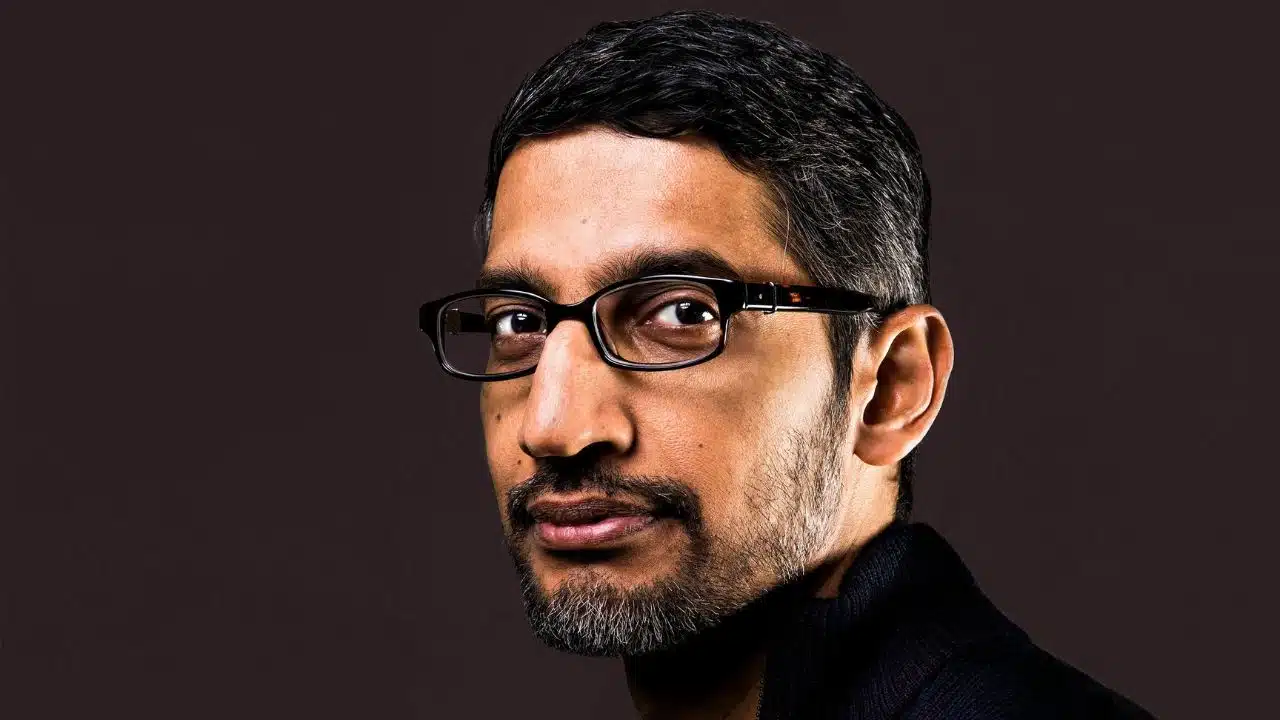
Alphabet CEO Sundar Pichai today celebrated the awarding of the 2025 Nobel Prize in Physics to a trio of scientists, two of whom have strong ties to Google, bringing the total number of Nobel laureates affiliated with the tech giant to five. The prize, awarded for foundational work in quantum mechanics, underscores the pivotal role corporate research labs now play in pushing the boundaries of fundamental science, a domain once largely confined to academia.
The Royal Swedish Academy of Sciences in Stockholm awarded the prestigious prize to John Clarke of the University of California, Berkeley, Michel H. Devoret of Yale University and Google, and John M. Martinis, a former long-time Google researcher now at the University of California, Santa Barbara. Their groundbreaking experiments in the 1980s demonstrated that the bizarre rules of quantum mechanics could be observed in macroscopic, human-made electrical circuits, a discovery that has become a cornerstone for the development of powerful quantum computers.
In a post on the social media platform X (formerly Twitter), Sundar Pichai expressed his pride: “Feeling lucky this morning to work at a company that has had 5 Nobel Laureates among our ranks — 3 prizes in 2 years!” He highlighted the laureates’ direct contributions to Google’s ambitious quantum computing efforts.
Key Facts
- Who: John Clarke, Michel H. Devoret, and John M. Martinis awarded the 2025 Nobel Prize in Physics.
- What: The prize recognizes their “discovery of macroscopic quantum mechanical tunnelling and energy quantisation in an electric circuit.”
- Google Connection: Michel Devoret is the Chief Scientist of Quantum Hardware at Google’s Quantum AI lab. John Martinis led Google’s quantum hardware team for many years, including during their 2019 “quantum supremacy” claim.
- Pichai’s Reaction: Alphabet CEO Sundar Pichai congratulated the winners, noting that Google now counts five Nobel laureates among current and former staff.
- Impact: The laureates’ foundational work is critical to the ongoing global race to build fault-tolerant quantum computers, with potential applications in medicine, materials science, and artificial intelligence.
- Prize Money: The laureates will share the prize of 11 million Swedish kronor (approximately $1 million).
From Microscopic Oddity to Macroscopic Reality
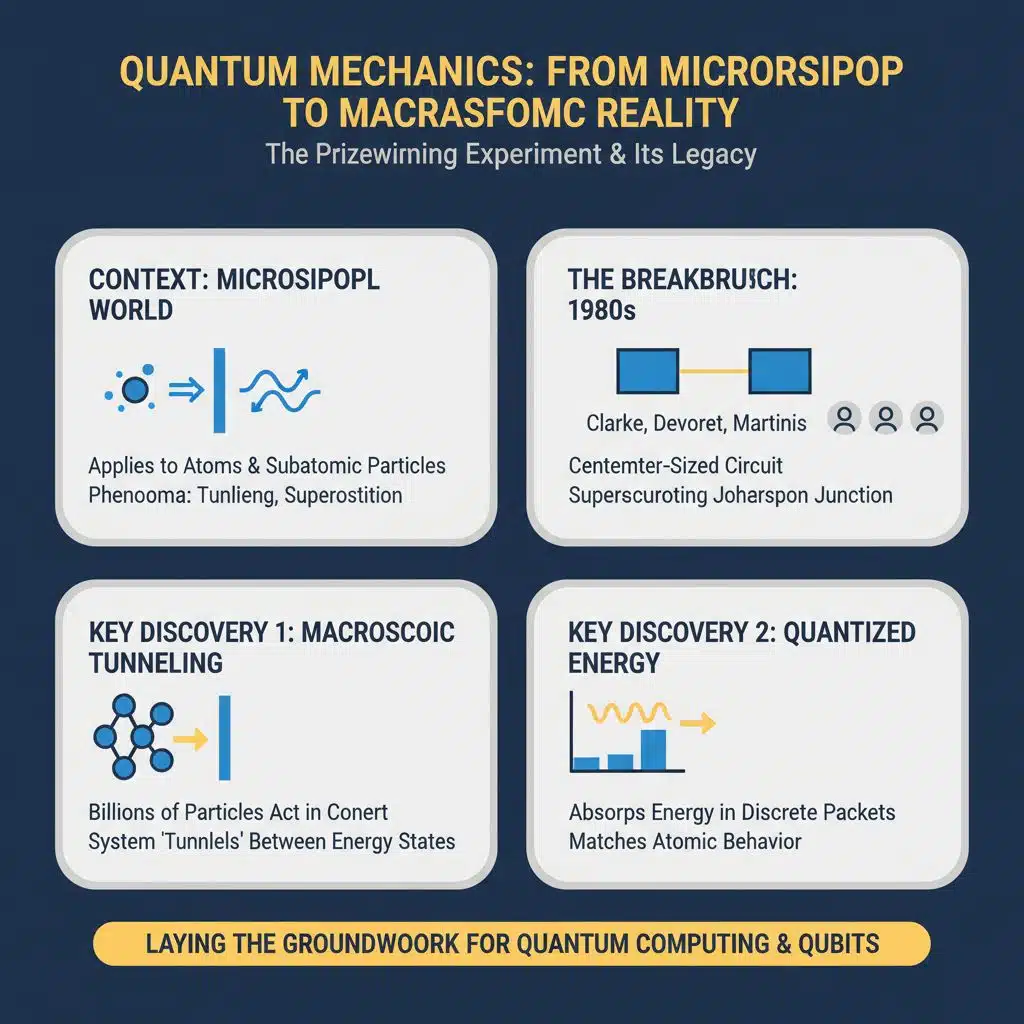
The world of quantum mechanics, which governs the behavior of atoms and subatomic particles, is famously counterintuitive. Phenomena like “tunneling”—where a particle can pass through a solid barrier—and “superposition”—where it can exist in multiple states at once—were long believed to be confined to the microscopic realm.
The work of Clarke, Devoret, and Martinis in the mid-1980s shattered this perception. As detailed by the Royal Swedish Academy of Sciences, their experiments involved creating a superconducting electrical circuit, about a centimeter in size, featuring a “Josephson junction” (a thin insulating layer between two superconductors). They demonstrated that this macroscopic system, containing billions of particles acting in concert, exhibited quantum effects. The circuit could “tunnel” between different energy states and could only absorb energy in discrete packets, or “quanta,” just as an atom does.
This was a monumental achievement. It proved that quantum mechanics wasn’t just a theory for the infinitesimally small; its principles could be engineered into tangible devices. This leap from the microscopic to the macroscopic laid the essential groundwork for building quantum bits, or “qubits,” the fundamental building blocks of quantum computers.
Latest Data & Statistics
- Nobel Recognition for Google: As of October 8, 2025, five scientists who are either current or former employees of Google have been awarded a Nobel Prize. Three of these prizes have been awarded in the last two years (2024-2025).
- Google’s Nobel Roster (as of Oct 2025):
- Michel Devoret (Physics, 2025): Current Chief Scientist, Quantum Hardware.
- John Martinis (Physics, 2025): Former head of Quantum Hardware.
- Geoffrey Hinton (Physics, 2024): Former Google VP and AI researcher.
- Demis Hassabis (Chemistry, 2024): CEO of Google DeepMind.
- John Jumper (Chemistry, 2024): Researcher at Google DeepMind.
- History of the Physics Prize: The 2025 prize is the 118th Nobel Prize in Physics awarded since 1901. It has been awarded to 229 laureates in total as of this year.
Official Responses and Expert Analysis
In his congratulatory message, Sundar Pichai emphasized the long-term impact of the laureates’ research. “Their pioneering work in quantum mechanics in the 1980s made recent breakthroughs possible, and paved the way for error-corrected quantum computers to come,” he wrote.). Pichai also mentioned a recent visit to Google’s Santa Barbara quantum lab, where Devoret works, noting the “incredible progress.”
Experts agree that this Nobel Prize is both a look back at a pivotal discovery and a nod to the future it is creating. Olle Eriksson, Chair of the Nobel Committee for Physics, stated, “It is wonderful to be able to celebrate the way that century-old quantum mechanics continually offers new surprises… It is also enormously useful, as quantum mechanics is the foundation of all digital technology.”
The award highlights a significant trend: the migration of top-tier scientific talent from purely academic settings to corporate research labs like those at Google, IBM, and Microsoft. These companies possess the immense computational resources and long-term funding necessary to tackle “hard tech” problems like quantum computing.
Impact on People: The Quantum Future
While the concept of macroscopic quantum tunneling may seem esoteric, its implications are profound. Quantum computers, which this research underpins, promise to revolutionize numerous fields. They could simulate complex molecules to design new life-saving drugs in a fraction of the time, create novel materials with unprecedented properties, break current encryption standards, and supercharge artificial intelligence.
For the average person, this technology, while still years from widespread use, could lead to more effective medicines, more efficient energy systems, and more secure digital communications. The work of Clarke, Devoret, and Martinis was the essential first step in building a bridge from theoretical quantum physics to this tangible, high-impact future.
One of the laureates, John Clarke, in an interview after the announcement, connected his work to everyday technology: “I’m speaking on my cellphone, and I suspect that you are too, and one of the underlying reasons that the cell phone works is because of all this work.”
What to Watch Next
The immediate focus for the field is the challenge of scaling and error correction. While Google, under Martinis’ leadership, famously claimed to have achieved “quantum supremacy” in 2019 by performing a calculation impossible for classical supercomputers, current quantum processors are still “noisy” and prone to errors. The next great hurdle is to build a “fault-tolerant” quantum computer that can perform useful, complex calculations reliably. Devoret’s ongoing work at Google is central to this mission. The 2025 Nobel Prize will undoubtedly inject fresh momentum and investment into this global race.
The 2025 Nobel Prize in Physics is a powerful affirmation of four decades of painstaking research that took quantum mechanics from the chalkboard into the lab and made it an engineering discipline. For Google, it is a moment of immense prestige, cementing its status as a powerhouse in fundamental research. As Sundar Pichai’s comments suggest, the company sees this deep scientific expertise not just as a source of pride, but as the engine that will drive its future technological dominance.