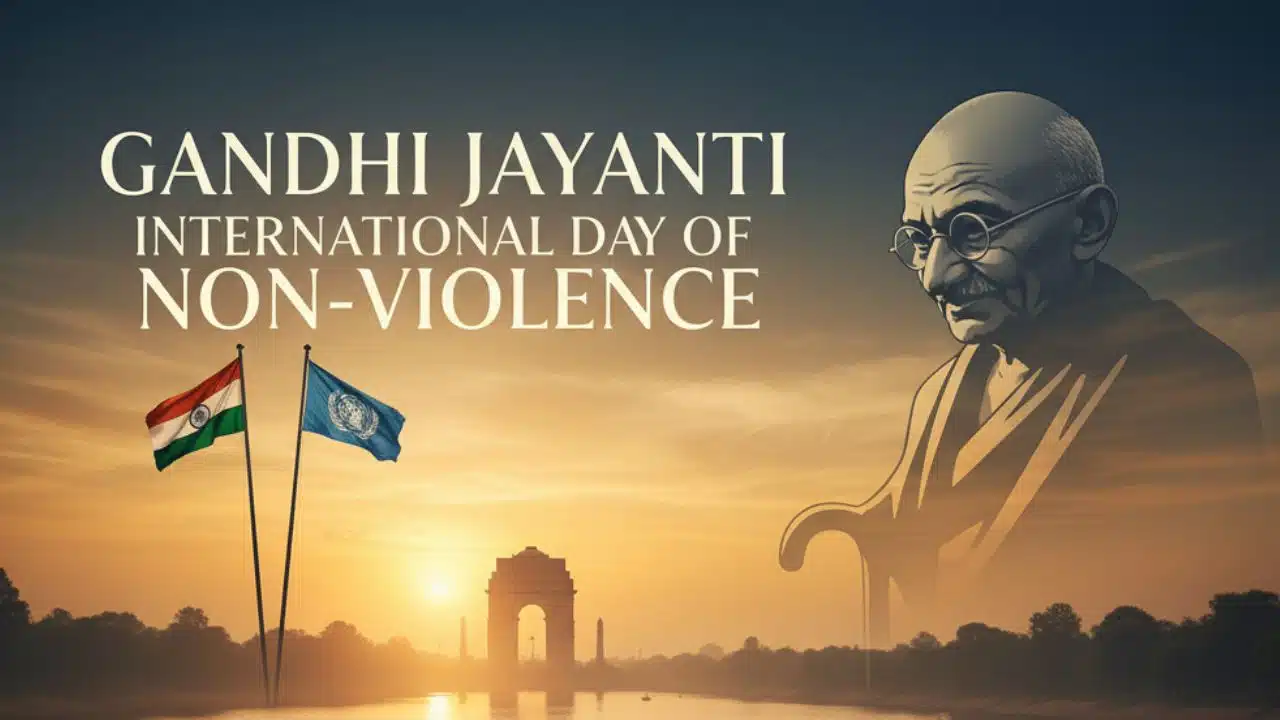
Every year on October 2, the world celebrates Gandhi Jayanti, the birth anniversary of Mahatma Gandhi, one of the greatest leaders and moral visionaries of the 20th century. In 2007, the United Nations officially declared this date as the International Day of Non-Violence to honor Gandhi’s enduring philosophy of peace, truth, and nonviolence.
This declaration was more than a symbolic gesture. It recognized Gandhi’s role in shaping global movements for justice and equality and emphasized the importance of nonviolence as a guiding principle in solving modern conflicts. But why did the UN specifically choose Gandhi Jayanti for this recognition? And how does Gandhi’s philosophy continue to inspire peace across the world even today?
The UN Resolution and Its Background
The idea of observing Gandhi’s birthday as the International Day of Non-Violence was first introduced by India at the United Nations. On June 15, 2007, the UN General Assembly passed the resolution by consensus, with 140 member states co-sponsoring it—a strong signal of global unity.
The resolution explicitly acknowledged Gandhi as “the leader of the Indian independence movement and pioneer of the philosophy and strategy of nonviolence.” It urged member states to spread the message of nonviolence through education, public awareness, and events that foster peace and tolerance.
This resolution reflected a growing recognition that peace cannot be achieved merely through political negotiations and military strength but through a cultural shift towards dialogue, understanding, and nonviolent resistance.
Why Gandhi Jayanti Was Chosen
The date was no coincidence. October 2 marks Gandhi Jayanti, the birth anniversary of Gandhi, who spent his entire life living by the principles of Ahimsa (nonviolence) and Satyagraha (truth-force).
By aligning Gandhi Jayanti with the International Day of Non-Violence, the UN not only honored Gandhi’s legacy but also gave the world a day to reflect on nonviolence as a global necessity. Gandhi’s commitment to peace was not limited to India’s independence struggle; it was a universal philosophy applicable to all humanity.
The Philosophy of Non-Violence
At the heart of Gandhi’s vision was Ahimsa, the idea that harming another being—whether physically, emotionally, or spiritually—weakens humanity as a whole. He believed nonviolence was not passive but an active force that required immense courage and discipline.
Through Satyagraha, Gandhi demonstrated that even the most powerful empires could be challenged without weapons. His campaigns, such as the Non-Cooperation Movement, the Salt March of 1930, and the Quit India Movement of 1942, became historic examples of nonviolent resistance.
For Gandhi, nonviolence was not just a political tactic but a way of life—rooted in truth, love, and respect for all.
Global Impact of Gandhi’s Nonviolence
Gandhi’s philosophy extended far beyond India. His teachings influenced some of the world’s most iconic leaders and movements:
-
Martin Luther King Jr. drew inspiration from Gandhi in leading the U.S. Civil Rights Movement. King’s strategy of peaceful protest against racial segregation was directly modeled on Gandhi’s nonviolent resistance.
-
Nelson Mandela acknowledged Gandhi’s impact on South Africa’s anti-apartheid struggle, emphasizing reconciliation instead of revenge.
-
Leaders and activists across Asia, Africa, and Latin America adopted nonviolence as a powerful tool to challenge oppression.
Today, Gandhi is remembered not just as the Father of the Indian Nation but as a global symbol of peace and resistance against injustice.
International Day of Non-Violence in Practice
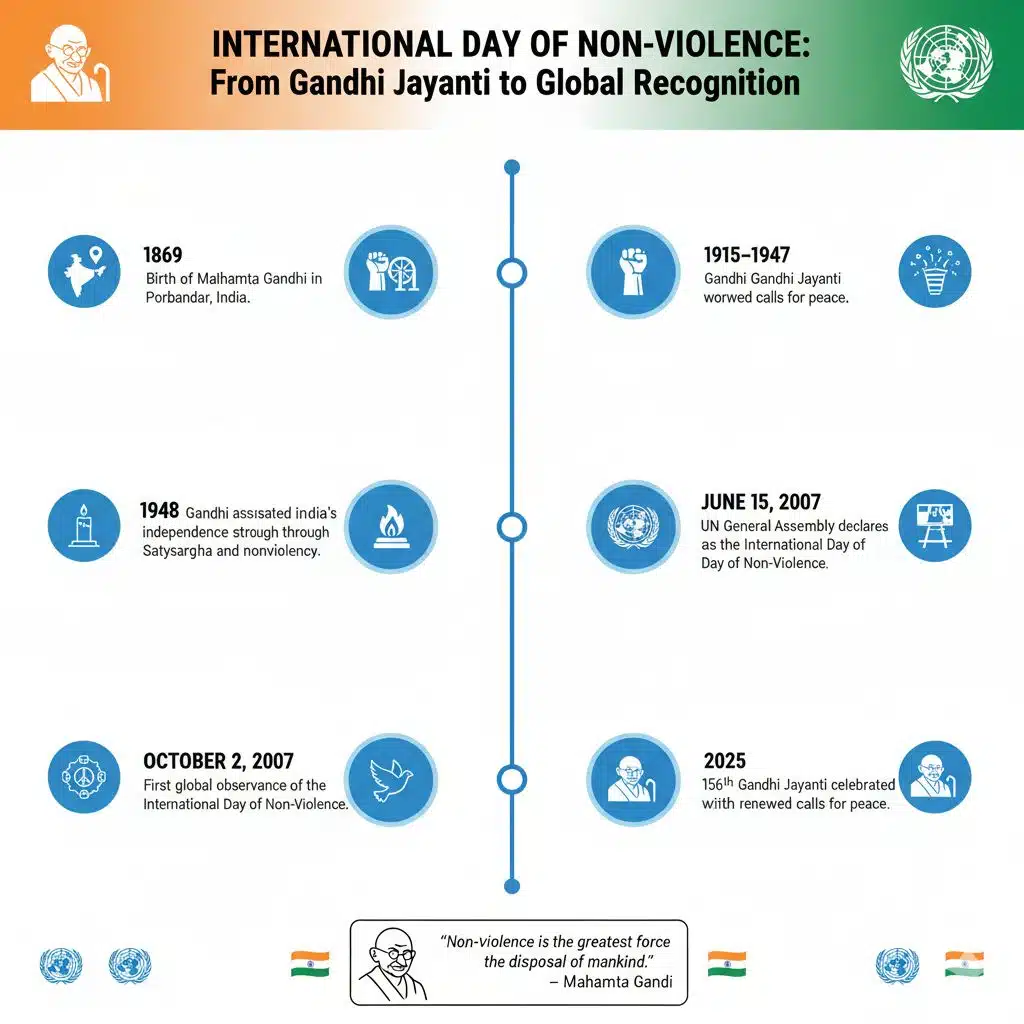
Since 2007, International Day of Non-Violence has been observed worldwide through educational activities, cultural events, peace marches, and community dialogues.
-
In India, schools and universities hold special programs highlighting Gandhi’s life and values. Khadi exhibitions, cleanliness drives, and interfaith prayers are also common.
-
Globally, countries organize peace seminars, art competitions, and public awareness campaigns promoting tolerance and nonviolent conflict resolution.
-
The United Nations uses the day to emphasize its mission of promoting peace, diplomacy, and sustainable development.
The observance is not just ceremonial; it encourages societies to rethink how conflicts can be addressed without violence.
Relevance in Today’s World
In 2025, Gandhi’s message of nonviolence feels more urgent than ever. Around the globe, wars, terrorism, political polarization, and hate crimes dominate headlines. The UN’s decision to mark October 2 as the International Day of Non-Violence serves as a reminder that peace is not just the absence of war—it is the presence of justice, equality, and dialogue.
-
Geopolitical conflicts in regions like Ukraine, the Middle East, and Africa show the dangers of violence-driven solutions.
-
Social unrest in many democracies highlights the need for dialogue over division.
-
Climate change activism has also adopted Gandhian principles of peaceful protest, with young activists organizing marches and campaigns without violence.
Gandhi’s philosophy offers a blueprint: real strength lies not in weapons or aggression but in moral courage and collective responsibility.
UN Observances Related to Peace & Human Rights
| Date | UN Observance | Focus/Purpose |
|---|---|---|
| January 27 | International Day of Commemoration in Memory of the Victims of the Holocaust | Remembering Holocaust victims and reaffirming commitment to human rights. |
| February 20 | World Day of Social Justice | Promotes equality, fairness, and eliminating barriers to human rights. |
| March 21 | International Day for the Elimination of Racial Discrimination | Focus on ending racism and promoting tolerance. |
| June 20 | World Refugee Day | Recognizes the rights and struggles of refugees worldwide. |
| August 30 | International Day of the Victims of Enforced Disappearances | Draws attention to human rights violations and justice for victims. |
| September 21 | International Day of Peace | Dedicated to strengthening peace ideals through non-violence and ceasefires. |
| October 2 | International Day of Non-Violence (Gandhi Jayanti) | Honoring Mahatma Gandhi’s philosophy of non-violence and global peace. |
| December 9 | International Day of Commemoration of Victims of Genocide | Raises awareness about preventing genocide and honoring victims. |
| December 10 | Human Rights Day | Marks the adoption of the Universal Declaration of Human Rights in 1948. |
Inspiring Gandhi Quotes on Non-Violence
Here are some of Gandhi’s most powerful quotes that still resonate today:
-
“Non-violence is the greatest force at the disposal of mankind.”
-
“An eye for an eye will only make the whole world blind.”
-
“You must be the change you wish to see in the world.”
-
“Nonviolence is not a garment to be put on and off at will. Its seat is in the heart.”
-
“In a gentle way, you can shake the world.”
Each of these quotes reflects Gandhi’s deep conviction that nonviolence is not weakness but the highest form of strength.
Takeaways
The United Nations’ declaration of Gandhi Jayanti as the International Day of Non-Violence is a recognition of Gandhi’s enduring legacy as a global apostle of peace. More than just honoring one man, it is a call to humanity to embrace dialogue over conflict, tolerance over hatred, and compassion over violence.
In a divided world, Gandhi’s voice reminds us that true freedom and progress are possible only when built on the foundation of nonviolence. As we mark his 156th birth anniversary, the message is clear: Gandhi’s teachings are not relics of the past—they are the guiding light for a more peaceful and just future.