The H-1B visa, long seen as a critical pathway for skilled foreign professionals to work in the United States, has now become significantly more expensive for employers. In September 2025, the Trump administration announced that companies seeking to sponsor foreign workers on H-1B visas will be required to pay an annual fee of $100,000 for each employee they wish to bring in under the program. The amount, equivalent to nearly ₹90 lakh in Indian currency, marks an unprecedented escalation in visa costs.
This new policy, announced at the White House, represents one of the most aggressive changes to U.S. immigration in recent years. It is being positioned as a measure to prioritize American workers, limit the reliance of U.S. companies on foreign labor, and ensure that only the most skilled professionals qualify for sponsorship.
Purpose and Administration’s Stance
The administration has framed the new fee as part of a broader effort to strengthen the American workforce. The official argument is that by substantially raising costs, companies will only pursue H-1B sponsorship when the foreign employee offers skills that are difficult to replace with local talent. The move also aligns with the broader political messaging of protecting domestic jobs, particularly in technology and professional services.
In addition to the steep fee, the administration has signaled that it intends to enforce stricter compliance, including audits of companies, more rigorous prevailing wage rules, and oversight of how these visas are used. The aim is to prevent large corporations from relying on foreign talent for roles that could otherwise be filled by U.S. graduates.
Additional Financial Burden
Importantly, the $100,000 charge is not a replacement for existing H-1B application costs. Employers already pay several fees, including a $215 registration fee for the visa lottery and a $780 filing fee for Form I-129, alongside legal expenses and additional costs for premium processing or anti-fraud measures. With this new requirement, the overall cost per visa applicant could easily cross $105,000 annually for companies.
For employers who depend on a significant number of H-1B visa holders, the financial implications are enormous. While multinational corporations with deep resources may be able to absorb the increase, small and mid-sized firms, startups, and consulting companies that rely heavily on H-1B talent may struggle to afford sponsorship under the revised rules.
Broader Legislative Context
The announcement comes amid a broader wave of proposals aimed at reshaping U.S. immigration. Just weeks before, lawmakers introduced the American Tech Workforce Act, which called for raising the H-1B wage floor from $60,000 to $150,000, abolishing the Optional Practical Training (OPT) program for foreign students, and replacing the current lottery system with an auction-like mechanism that favors the highest bidders.
Together, these measures signal a clear direction: making it harder and more expensive for foreign nationals to enter the U.S. labor market, while pushing companies to hire locally.
Impact on Indian Professionals
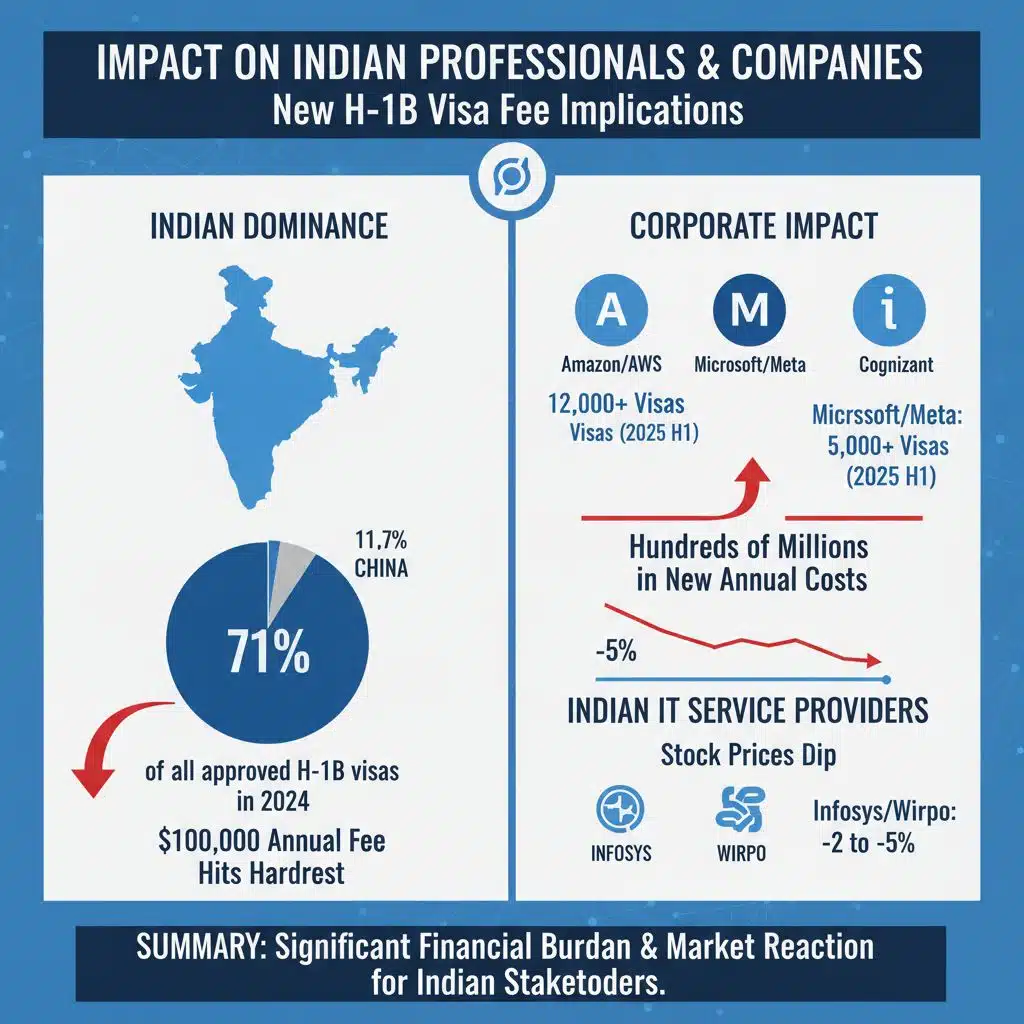
India remains the single largest source of H-1B beneficiaries. In 2024, Indians accounted for 71 percent of all approved H-1B visas, with China following at a distant 11.7 percent. The new $100,000 annual fee will hit Indian professionals and the companies that sponsor them especially hard.
Leading American technology firms such as Amazon, Microsoft, and Meta each sponsor thousands of Indian employees every year. In the first half of 2025 alone, Amazon and its cloud arm AWS secured approvals for more than 12,000 H-1B visas, while Microsoft and Meta each surpassed 5,000 approvals. With the new fee, the collective costs for these firms could amount to hundreds of millions of dollars annually.
Indian IT service providers, including Infosys, Wipro, and Cognizant, which rely heavily on H-1B employees for U.S. operations, saw their stock prices dip after the announcement. Shares of Cognizant fell by nearly five percent, while Infosys and Wipro lost between two and five percent on U.S. trading exchanges.
Corporate Reactions and Silence
While some government officials claimed that major corporations were aligned with the new requirement, most large U.S. tech, banking, and consulting companies declined to publicly comment. Many are believed to be evaluating the long-term impact of the measure on their hiring strategies, especially as competition for talent in artificial intelligence, cloud computing, and cybersecurity intensifies.
Industry analysts warn that forcing companies to spend such large amounts could lead to reduced hiring of foreign workers, delays in project delivery, or even outsourcing of jobs outside the United States. Smaller firms that cannot shoulder the cost may stop pursuing H-1B sponsorship altogether, limiting opportunities for early-career international talent.
Visa Landscape Tightens Further
The new $100,000 fee is not the only challenge facing foreign workers. The U.S. immigration system has already introduced additional hurdles:
-
Citizenship Test Changes: From October 2025, applicants for U.S. citizenship will face a more demanding civics test. The number of questions has been expanded to 128, with candidates required to answer at least 12 of 20 questions correctly.
-
Background Checks: The U.S. Citizenship and Immigration Services (USCIS) has expanded its review process, including checks on moral character and even neighborhood interviews for immigrants applying for naturalization.
-
New Visa Filing Rules: From September 2025, the U.S. State Department has directed that applicants for non-immigrant visas, including visitor visas (B1/B2), student visas (F1), and employment visas (H-1B and O-1), must file applications only from the country where they reside or hold citizenship. This removes flexibility for applicants who previously filed from third countries.
These changes collectively mark a sharp turn in U.S. immigration policy, creating new financial and administrative barriers for those hoping to live and work in the country.
Market and Economic Implications
The imposition of a $100,000 sponsorship fee is expected to reshape how businesses approach talent acquisition. Some companies may choose to prioritize only senior-level or highly specialized roles for H-1B sponsorship, while others may accelerate the hiring of local graduates to avoid the high cost.
For India, where tens of thousands of professionals migrate each year on H-1B visas, the policy could significantly reduce mobility and alter the aspirations of students and workers planning careers in the U.S. Universities in the United States, which attract large numbers of Indian and Chinese students who later transition to H-1B roles, may also see a decline in demand if pathways to employment become more restrictive.
Global outsourcing strategies may also shift. Companies that find it too expensive to bring workers to the U.S. could move projects offshore, setting up or expanding hubs in India, Eastern Europe, or Latin America, where talent pools are already established.
The Trump administration’s decision to impose a $100,000 annual fee on H-1B visas represents one of the most dramatic immigration policy shifts in decades. While intended to protect American workers and raise the bar for foreign employment, it also risks creating severe disruptions in the technology sector, straining U.S.-India economic ties, and reducing opportunities for skilled migrants.
As businesses, lawmakers, and immigrant communities absorb the impact, the new regulation is expected to face legal challenges and intense debate. For now, however, the immediate reality is clear: entering the United States on an H-1B visa has just become drastically more expensive, further tightening the gates for global talent.