The United Nations General Assembly has overwhelmingly endorsed a resolution known as the New York Declaration, a France- and Saudi-backed initiative designed to push forward a two-state solution to the decades-long Israel-Palestine conflict. The resolution received the backing of 142 member states, with 10 opposing and 12 abstaining, reflecting a broad global consensus on the urgency of restarting a political process that has been stalled for years.
The resolution condemns the actions of Hamas, calls for the immediate release of all hostages still held in Gaza, and demands that the group end its rule in the territory. It also outlines the requirement for Hamas to hand over weapons to the Palestinian Authority, paving the way for internationally supported governance in Gaza.
France and Saudi Arabia Lead Diplomatic Push
The roots of the New York Declaration lie in a July 2025 conference hosted by France and Saudi Arabia, where ministers and diplomats from across the globe convened to explore ways of breaking the deadlock. That meeting was boycotted by the United States and Israel, but it produced a seven-page declaration that gained traction among Arab states and European powers.
France, under President Emmanuel Macron, has signaled its intention to formally recognize the State of Palestine during a September 22 summit in New York, co-chaired with Saudi leaders. This move is expected to be mirrored by other countries, which would significantly shift the diplomatic balance and increase pressure on Israel to reconsider its strategy in Gaza and the West Bank.
What the Resolution Demands
The New York Declaration sets out a series of time-bound, tangible, and irreversible steps aimed at achieving peace. These steps include:
-
The release of all hostages still in Gaza.
-
The removal of Hamas from political and military control in the territory.
-
The transfer of authority in Gaza to the Palestinian Authority, supported by international actors.
-
A roadmap toward the establishment of a sovereign Palestinian state existing alongside Israel.
-
A call for collective action from the international community to end the war in Gaza.
Unlike earlier resolutions that avoided direct mention of Hamas, this declaration specifically calls for the group’s removal, which many diplomats consider a significant development in UN diplomacy.
Reaction From Member States
Support for the resolution came from a wide spectrum of nations, including all 26 other members of the European Union, the Arab League, and states across Africa, Asia, and Latin America. Countries that opposed it included Israel, the United States, and a small group of allies. Abstentions came mainly from states seeking to avoid deepening divisions with either Israel or Arab states.
For countries supporting the declaration, the resolution represents a unified rejection of Hamas while at the same time creating space for renewed recognition of Palestinian statehood. Some governments believe the document will serve as political cover against accusations of condoning Hamas while still advancing the rights of Palestinians.
Implications for Hamas and Gaza
If implemented, the declaration would fundamentally alter the political landscape in Gaza. Hamas would be required to disarm, surrender control of its security and governance structures, and allow the Palestinian Authority to re-establish itself in the territory. International observers and possibly a UN stabilization mission could be deployed to secure the transition and ensure humanitarian access.
This would address one of the most contentious issues since Hamas took over Gaza in 2007—how to reintegrate the enclave into a wider Palestinian political framework while ensuring stability and reconstruction.
Israel’s Response and Security Concerns
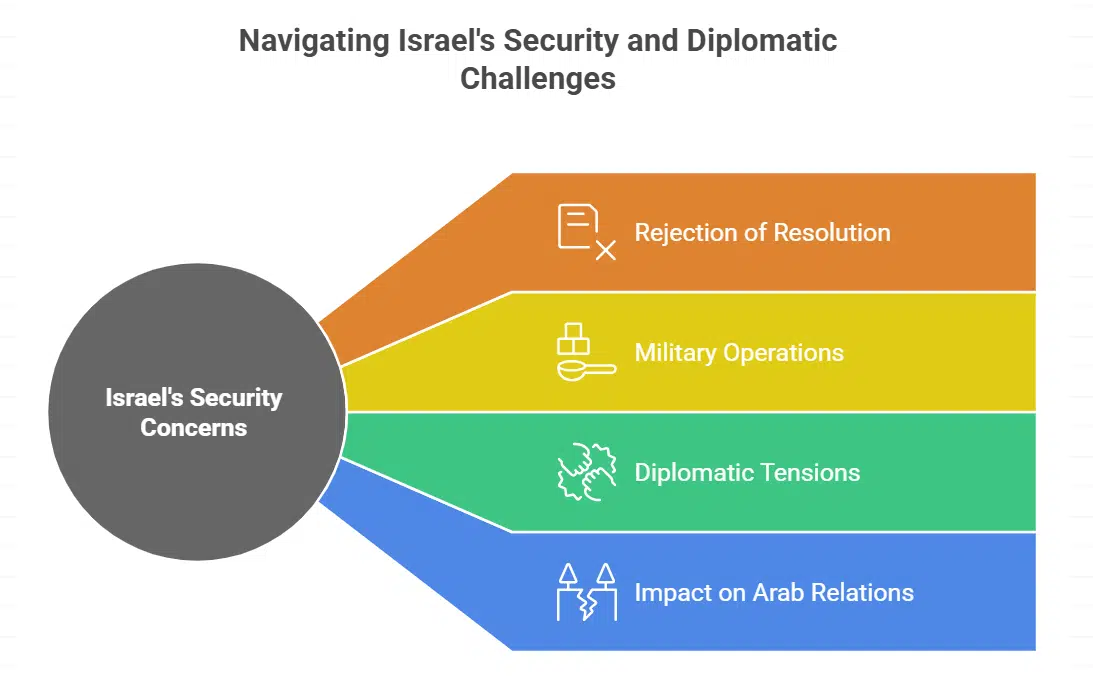
Israel rejected the resolution, arguing that it does not adequately address its security concerns. Israeli officials have long insisted that any arrangement that weakens its ability to defend against rocket fire or incursions from Gaza is unacceptable. Recent Israeli military operations targeting Hamas leaders abroad, including a controversial strike in Doha, Qatar, have already sparked tension with countries such as the United Arab Emirates, which summoned the Israeli envoy in protest.
The strain is notable, as the UAE was among the first Arab states to normalize relations with Israel under the Abraham Accords. Its sharp response to recent developments highlights how Israel’s aggressive approach toward Hamas leaders outside Gaza is complicating even relationships with Arab partners who have economic and defense ties with Tel Aviv.
Wider Middle East Fallout
The resolution also comes amid wider regional developments:
-
United States Sanctions on Houthis: Washington has announced its most sweeping sanctions yet against Yemen’s Houthi rebels, targeting 32 individuals, entities, and four vessels accused of financing and supplying the group’s operations. The measures focus on disrupting smuggling networks and supply chains that link the Houthis to Iranian support.
-
Netherlands and Eurovision Boycott: Cultural diplomacy also became entangled in the conflict, with the Netherlands announcing that it will boycott the 2026 Eurovision Song Contest if Israel is allowed to participate, citing humanitarian concerns in Gaza. Ireland and Spain have already indicated they may follow suit, placing further symbolic pressure on Israel.
-
UAE-Israel Tensions: The UAE’s decision to summon Israel’s ambassador over the Doha strike on Hamas leaders illustrates the fragility of the normalization agreements. Statements from Abu Dhabi emphasized that any attempt by Israel to expand settlements or conduct extraterritorial strikes risks crossing “red lines.”
The Path Toward Palestinian Statehood
The September 22 summit in New York is expected to serve as a key moment. France’s planned recognition of Palestine, backed by Saudi Arabia and other Arab states, may encourage additional European and Global South nations to follow. Several leaders are expected to use the summit to make formal announcements of recognition, creating new momentum for a sovereign Palestinian state within internationally recognized borders.
This would mark one of the most significant diplomatic shifts in the conflict in years, particularly if major EU states join France. The General Assembly resolution thus acts as a stepping stone to a broader international recognition process, designed to put pressure on Israel to accept negotiations and end the war in Gaza.
Why the Resolution Matters
The passage of the New York Declaration is symbolically powerful, even if it lacks enforcement mechanisms. It represents the first time the General Assembly has explicitly linked progress toward a two-state solution with the removal of Hamas from Gaza. By doing so, it unites many Arab and Western states around a common framework while leaving Israel and a handful of allies in a minority position.
Critics caution that without a credible plan to enforce Hamas’s removal or protect civilians in Gaza, the declaration may have limited impact. Yet supporters argue that it consolidates international consensus, strengthens the Palestinian Authority, and lays groundwork for recognition of Palestine as a sovereign state.
What Comes Next
-
September 22 Summit: France, Saudi Arabia, and other states are expected to announce recognition of Palestine.
-
International Stabilization in Gaza: Discussions may intensify on how to deploy international forces or observers to support governance transition.
-
Israel’s Military Strategy: Whether Israel continues to strike Hamas leaders abroad or responds militarily to pressure from Gaza will shape regional dynamics.
-
Regional Diplomatic Realignment: The positions of the UAE, Qatar, Egypt, and Turkey will be crucial in determining whether Arab consensus holds.
-
Humanitarian Situation in Gaza: Aid access, civilian protection, and reconstruction remain urgent, and the resolution is likely to be judged partly on whether it improves conditions on the ground.
The UN General Assembly’s adoption of the France–Saudi resolution marks a pivotal moment in international diplomacy on the Israeli-Palestinian conflict. By demanding Hamas’s disarmament, calling for hostages’ release, and advancing concrete steps toward a two-state solution, the world body has set a new benchmark for political engagement.
The upcoming summit in New York will test whether this momentum translates into tangible recognition of Palestine and whether Israel can be pressured into negotiations. While challenges remain immense, the resolution demonstrates a rare convergence of international opinion on a path forward, underscoring the urgency of ending one of the world’s most protracted and destabilizing conflicts.